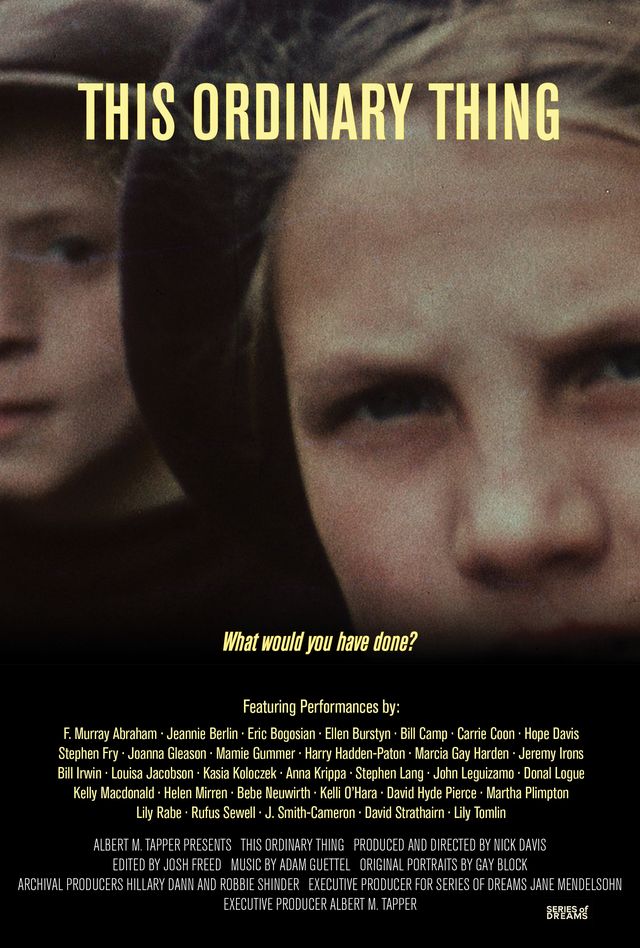
Remembering heroes who defied Hitler to save Jewish lives

By Richard Ades

When Schindler’s List was released in 1993, viewers probably saw its hero as one of a kind. German businessman Oskar Schindler may have stuck his neck out to help Jews survive the Holocaust during World War II, but it was assumed few others were willing to do the same.

That assumption was wrong, according to the new documentary This Ordinary Thing. Written and directed by Nick Davis, the film tells the stories of dozens of people who risked Nazi wrath to come to the aid of their Jewish friends and neighbors.

As we learn, those people were spread across multiple countries that fell under Hitler’s domination, including Germany itself, France, the Netherlands, Poland, Hungary, Ukraine, Belgium and Yugoslavia.

Davis tells these heroes’ stories in more or less their own words, based on accounts of their ordeals that were recorded in the late 1980s. Excerpts from those accounts are delivered off-camera by top-tier actors—F. Murray Abraham, Ellen Burstyn, Jeremy Iron and Helen Mirren, just to name a few—and illustrated by archival scenes of wartime life.

These are startling tales of courage and compassion, involving people who refused to say “no” when asked to hide or otherwise aid fellow countrymen who happened to be Jewish. Doing so was clearly the right thing to do, but it was also the dangerous thing to do. In a few cases, they were found out but managed to avoid imprisonment or worse with the help of bribes involving money, alcohol or even sex.

The fact that these good Samaritans have received so little attention over the years makes This Ordinary Thing even more of a can’t-miss film. However, some viewers might wish Davis had given us the chance to get better acquainted with his subjects.

With a running time of just over an hour and a format that continually skips from person to person and country to country, there is little opportunity for individuals’ personalities to emerge. And it doesn’t help that we don’t hear the actual individuals, but rather actors who are clearly playing roles.  

A woman and a trio of children display the stars of David that Nazis forced them to wear to reveal their Jewish identities. (Photo courtesy of Series of Dreams)

Some viewers might also be distracted by the film’s visuals, which combine actual wartime film footage with occasional re-enacted scenes, leading to the question: How much of what we’re seeing is real?

Possibly adding to the confusion, much of the archival footage is in color. Davis has said he went out of his way to find color footage, since we usually see World War II depicted in black-and-white images that make the era seem divorced from our everyday reality.

And, of course, what we’re seeing is not that divorced from our everyday reality. Though the doc doesn’t spell out the connection, it’s hard not to see parallels between Hitler’s occupied Europe and Trump’s America.

Substitute “immigrants” for “Jews,” and “ICE” for the “SS” and “Brownshirts,” and you end up with another society in which members of a minority group are being demonized and rounded up in ways that ignore their civil rights, let alone common decency.

Despite this unavoidable comparison, the film’s predominant message is a positive one: In the face of official threats and societal pressure, a surprising number of non-Jews were willing to risk everything to help save fellow citizens who were being persecuted.

Just how many of these heroes were there? It’s impossible to know, the film states, but as of 2023, the World Holocaust Remembrance Center had honored 28,217 people as “Righteous Among the Nations” for helping to save Jewish lives during World War II.

It’s a number that’s both inspiring—because of the courage and humanity it represents—and depressing—because it’s not higher.

Rating: 4 stars (out of 5)

This Ordinary Thing will be available through major VOD outlets beginning June 12.
Circus skills on full display in touring musical

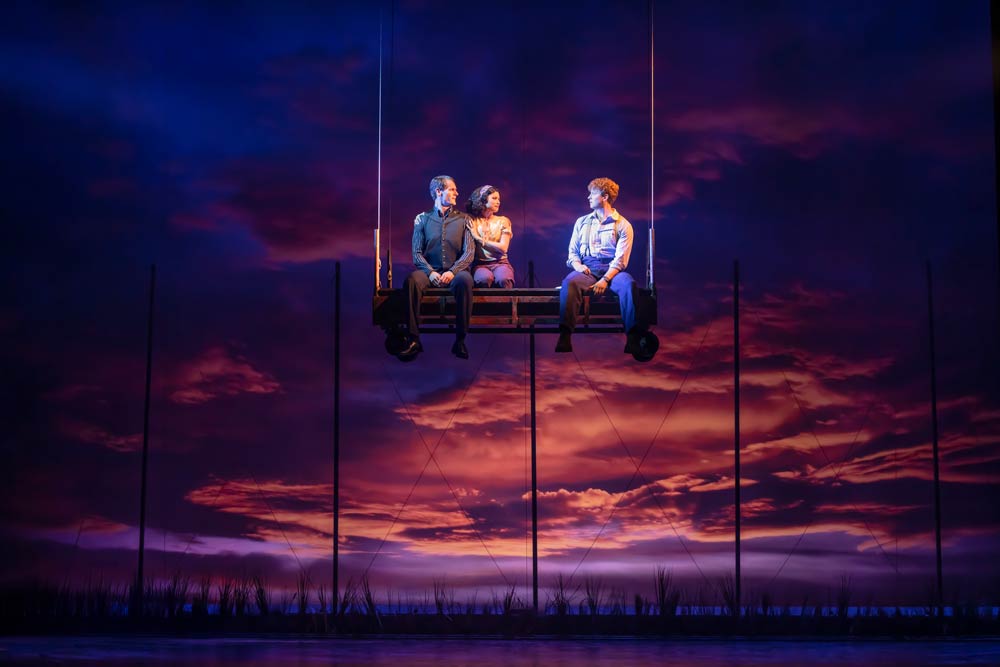
Jacob (Zachery Keller, right) meets with the circus’s owner, August (Connor Sullivan), and star performer, Marlena (Helen Krushinski), in the touring production of Water for Elephants. (Photo by Matt Murphy for MurphyMade)

By Richard Ades

Running away to join the circus generally isn’t the best way to deal with your problems. But sometimes it’s the only way available to you.

That’s the situation faced by Jacob Jankowski in Water for Elephants, a touring musical now playing at Columbus’s Ohio Theatre.

We first meet Jankowski as an old man (Robert Tully) reminiscing about his past, but the show then thrusts us into that past, when a young Jacob (Zachery Keller) hitches a ride on a circus train and is offered work after he reveals he was trained as a veterinarian.

Because the Great Depression is in full force, and because Jacob has no other prospects, he reluctantly accepts the job. He then tries to make the best of what turns out to be a bad situation, complicated by a dictatorial and sadistic boss, August (Connor Sullivan). The job’s only perk is that Jacob gets to meet the show’s beautiful star performer, Marlena (Helen Krushinski), who, unfortunately, turns out to be August’s wife.

In an odd way, one gets the feeling that the show’s cast and crew are in much the same boat as their protagonist: They’re in the difficult situation of putting on a flawed piece of work, but they’re trying to make the best of it.

Namely, they’re amping things up with Lion King-worthy puppetry, gorgeous scenery and lighting (designed by Takeshi Kata and Bradley King, respectively), and especially with gasp-inspiring acrobatics and other injury-defying acts that would be at home under any big top.

With a book by Rick Elice and music and lyrics by the Pigpen Theatre Co., Water for Elephants opened on Broadway in March 2024 under the direction of Jessica Stone. It garnered eight Tony nominations, winning none, and closed that December.

The current touring production, directed by Ryan Emmons, was launched last fall and is scheduled to close in August. It has a lot going for it, including two wonderful lead performances.

As Jacob, Keller reveals the best male voice I’ve heard in a long time, pulling a surprising amount of beauty and emotion out of his solos. As Marlena, Krushinski also sings beautifully, and at one point she even performs one of the acrobatic feats that play such a big part in the production.

When Jacob and Marlena’s budding romance begins to blossom (I’m not giving anything away here—it’s pictured right on the program cover!), Keller and Krushinski do what they can to sell it. But the script just doesn’t give them much to work with.

Perhaps the show’s most affecting moment involves Marlena’s ailing horse, Silver Star, imaginatively represented by a puppet head and a lithe man hanging from a sash. But other moments that should be moving or shocking or otherwise noteworthy seldom reach their full potential.

As for the music, it offers pleasant, Americana-flavored accompaniment to the dancers and acrobats’ leaping, swinging and twirling, and talented singers like Keller occasionally make it soar. But none of it is really memorable.

So don’t go to Water for Elephants expecting to have a sublime theatrical experience. Instead, go expecting to see hard-working performers doing their best to recreate the thrills of a circus, with a little drama and romance thrown in for good measure.

Head to the theater in that frame of mind, and you won’t be disappointed.

Water for Elephants runs through June 14 at the Ohio Theatre, 39 E. State St., Columbus. Showtimes are 7:30 p.m. through Friday, 2 and 7:30 p.m. Saturday, and 1 and 6:30 p.m. Sunday. Running time: 2 hours, 30 minutes (including intermission). For ticket information, visit columbus.broadway.com. For information on future tour stops, visit waterforelephantsmusical.com.