‘Avatar’ sequel is beautiful but plodding

Neytiri (Zoe Saldana, left) and Jake (Sam Washington) confer during a fiery moment in Avatar: The Way of Water. (Photos courtesy of 20th Century Studios)

By Richard Ades

If you plan to see Avatar: The Way of Water, make sure you’re prepared.

Most importantly, visit the restroom before it starts. That’s always a good idea for a movie that runs three hours and 12 minutes, but especially for one that has a whole lot of, you know, water in it.

Almost as important: Refresh your memory about the original Avatar, which opened in 2009. Director James Cameron obviously remembers it well, since he’s been working on this and future sequels for the past 13 years, so he assumes we all do. That’s why he jumps right into the action without explaining who all these people and avatars are, or even what an avatar is.

In brief: An avatar is a genetically engineered body that resembles the Na’vi, the 10-foot-tall inhabitants of the world Pandora, but is remotely controlled by a human whose own body is in stasis. The new film’s main protagonist is Jake Sully (Sam Worthington), who turned into an avatar in the first outing and later became chief of the local Na’vi clan while starting a family with Neytiri (Zoe Saldana), daughter of the previous clan chief.

As Jake’s narration explains in the film’s early moments, the Na’vi have led a peaceful existence since repelling human invaders years earlier. However, that peace abruptly ends with the appearance of a new invasion force led by another holdover from the original Avatar, Col. Miles Quaritch (Stephen Lang). Since Quaritch was killed during the first incursion, he and his soldiers return thanks to a new type of avatar called a “recombinant,” which is embedded with the memory of a specific human.

The immediate result of the attack is fire and destruction that are keenly seen, heard and even felt by us viewers thanks to 3-D images shot at 48 frames per second (twice the normal rate) and accompanied by sound technology that makes our very seats shake beneath us. If you were looking for a reason to return to the multiplex, this “you are there” experience is it.

A typically awe-inspiring scene from Avatar: The Way of Water

As an innovator and master of cutting-edge technology, Cameron is simply without equal. He uses motion-capture wizardry to not only create an exotic world that is beautiful and fully realized, but to place the viewer right in the middle of it.

Once there, unfortunately, the viewer soon realizes that Cameron is not without equal as a storyteller. He and his four co-scripters set up a bare-bones plot with a predictable progression: Jake becomes a Na’vi resistance leader, then is forced to flee with his family after Quaritch captures Spider (Jack Champion), a human teenager who knows all the rebellion’s secrets. The family seeks refuge among a remote ocean-going clan and hopes Quaritch won’t find them there.

But, of course, it’s only a matter of time before he will. Since there are more than three hours of that time to fill, the flick pads it out with a series of digressions that often come off as mere excuses to show off its impressive imagery while underlining its pro-environment and anti-war messages. Ironically, it all leads to a finale so destructive and drawn out that you eventually start wondering, “Isn’t everyone dead by now?”

Through it all, the movie is an odd combination of images that are gloriously unique and plot points that seem derivative of previous works of cinema, TV and even video gaming. Many have seen similarities to 1990’s Dances With Wolves, while I also saw reflections of Moby Dick, Platoon, Stranger Things and Lara Croft: Tomb Raider. By the end, Cameron is even borrowing from his own 1997 blockbuster, Titanic.

At the very end, the movie reveals that it’s only paving the way for more episodes—not surprisingly, since the second sequel was shot concurrently with the first. So go see Avatar: The Way of Water if you can’t resist the chance to bask in its revolutionary technology and imagery. Just be aware that Cameron is in this for the long haul, and he expects you to be as well.

Rating: 3 stars (out of 5)

Avatar: The Way of Water (PG-13) opens Dec. 16 in cinemas nationwide.

Spielberg directs his own origin story

A young Sammy Fabelman (Mateo Zoryan Francis-DeFord) is introduced to cinema by his parents, Bert and Mitzi (Paul Dano and Michelle Williams). (Photos by Merie Weismiller Wallace/Universal Pictures and Amblin Entertainment)

By Richard Ades

If you ever wondered how Steven Spielberg became a cinematic wizard, your curiosity should be partially satisfied by his new semiautobiographical film, The Fabelmans.

Assuming the tale is to be believed, Spielberg owes his fascination with movies to Cecil B. DeMille’s 1952 blockbuster, The Greatest Show on Earth. His fictitious stand-in, a boy named Sammy Fabelman (Mateo Zoryan Francis-DeFord), sees the flick only after being dragged to the theater by his parents. Even so, he finds himself transfixed by the experience.

Sammy seems especially awed by the movie’s giant train crash—so much so that he asks for a model train set for Hannukah just so he can engineer a miniature crash of his own. The resulting damage to his expensive toy angers his father, Burt (Paul Dano).

On the other hand, his mother, Mitzi (Michelle Williams), theorizes that Sammy had to recreate the chaos in order to feel it was under his control. Secretly, she urges him to borrow his father’s movie camera so that he can capture the crash on film and watch it over and over.

This sets up a pattern that continues throughout: Burt, a practical-minded computer scientist, doesn’t understand Sammy or his growing devotion to moviemaking, which he dismisses as a mere “hobby.” But Mitzi, a gifted pianist, has an innate appreciation for her artistically minded son.

Unfortunately, the incident also sets up the pattern of characters speaking in baldly descriptive and psychologically tinged terms. Even though Tony Kushner co-wrote the script with Spielberg, it lacks the finesse he brought to earlier Spielberg works such as Lincoln and last year’s West Side Story remake.

High school classmate Monica Sherwood (Chloe East) tries to convert Sammy (Gabriel LaBelle) to Christianity.

Partially making up for the script’s heavy-handedness are committed performances by all involved, including Dano and Williams as the parents, Francis-DeFord as young Sammy, Gabriel LaBelle as a teenage Sammy in later scenes, and Seth Rogen as Paul’s best friend and co-worker. And the literary clunkiness all but disappears when Judd Hirsch breezes in for a cameo as a film aficionado who fully understands Sammy’s compulsion to make movies. Hirsch’s brief appearance is so memorable that Oscar buzz is inevitable.  

Sammy’s devotion to moviemaking grows amid a series of challenges, such as the antisemitism he faces after his father moves the family to a new home in northern California. This has painful consequences, but also amusing ones when an amorous classmate (Chloe East) takes it on herself to convert him to Christianity.

More devastating is the growing tension between his parents, leading to a painful discovery Sammy makes with the help of his beloved “hobby.” The experience nearly causes him to put his movie gear away for good.

But, of course, we know he won’t, because his real-life alter ego grew up to be one of the world’s most successful directors. For those who have long admired Spielberg’s work, The Fabelmans offers an interesting, if imperfect, glimpse at the forces that helped to shape him.

Rating: 3½ stars (out of 5)

The Fabelmans (PG-13) is available in theaters nationwide.

Less fun than a Lambo sighting

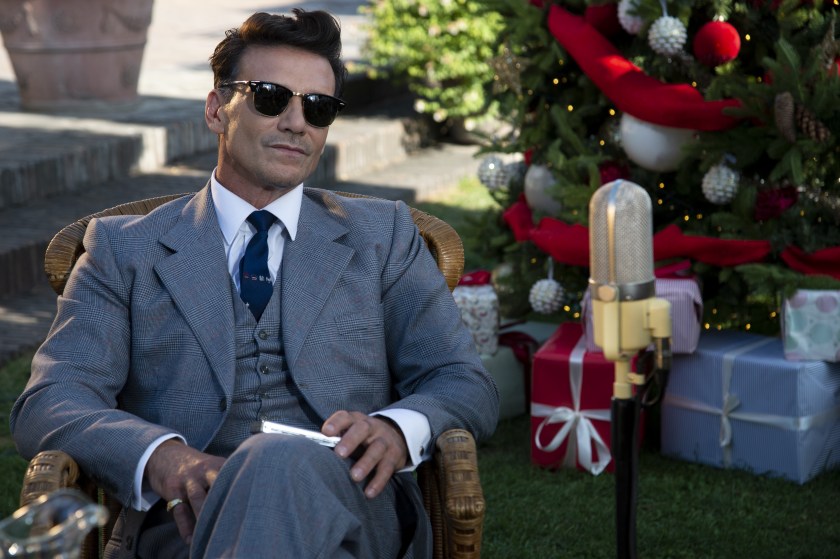
Frank Grillo as Ferruccio Lamborghini, tractor manufacturer-turned-automaker, in Lamborghini: The Man Behind the Legend (Photos courtesy of Lionsgate)

By Richard Ades

Ferruccio Lamborghini’s new biopic could have been called Lamborghini v. Ferrari, as the rivalry between the two Italian supercars is a central theme. It’s fortunate that it wasn’t, as that name would have made it even harder to avoid comparisons with 2019’s far superior Ford v. Ferrari.

Instead, the flick is called Lamborghini: The Man Behind the Legend, thus promising an in-depth study of the entrepreneur who created one of the world’s most exotic automobiles. Sadly, however, it also has trouble living up to that title, as it leaves us with little idea who Lamborghini really was. Written and directed by Bobby Moresco (co-scripter of Crash), it comes across as just another biopic about a man whose ego and ambition dominate his life.

Where did this ambition come from? It’s a mystery, as the young Lamborghini (Romano Reggiani) already has his eye fixed on success when he returns to the family farm after serving in World War II. Rather than settling back into his old life, he tells his father he plans to make his fortune by designing and marketing a superior breed of tractor.

“You’ll throw your life away,” his pragmatic father (Fortunado Cerlino) warns him.

“But what better way to do it than in search of greatness?” the son replies.

That begs the question: Do real-life people really talk about “greatness” in such an abstract way? Maybe not, but they do in this film, adding to the feeling that Moresco has crafted a generic and rather rushed (97-minute) biopic that doesn’t take time to flesh out its protagonist.  

Lamborghini (Frank Grill) introduces his namesake sports car to the world.

The presence of a devoted best friend and loving wife (Matteo Leoni and Hannah van der Westhuysen) do help to humanize Lamborghini, but they abruptly disappear from the film soon after it makes a jarring leap several years into the future. There we find that Lamborghini (now played with rigid determination by Frank Grillo) has become a successful tractor manufacturer with a new doting wife (Mira Sorvino).

Eventually, of course, Lamborghini branches out from farm machinery into high-class automobiles. According to the film, it’s all due to a brief encounter he has with the one and only Enzo Ferrari (Gabriel Byrne), during which he brashly offers to help improve the automaker’s celebrated product. Ferrari responds dismissively, which is depicted as the catalyst that propels Lamborghini on a quest to create his own luxury sports car—and to do it in time to debut it at a prominent auto show just months away.

The frantic scenes that follow, with their shop talk of aluminum engine blocks and wet sumps, might interest the kind of auto geek who’s likely to be drawn to a film called Lamborghini: The Man Behind the Legend. But they do little to fill in the blanks of a biopic that promises more than it delivers.

Rating: 2 stars (out of 5)

Lamborghini: The Man Behind the Legend (rated R) opens Nov. 18 at select theaters and VOD outlets.

Romantic partners on the run in Central America

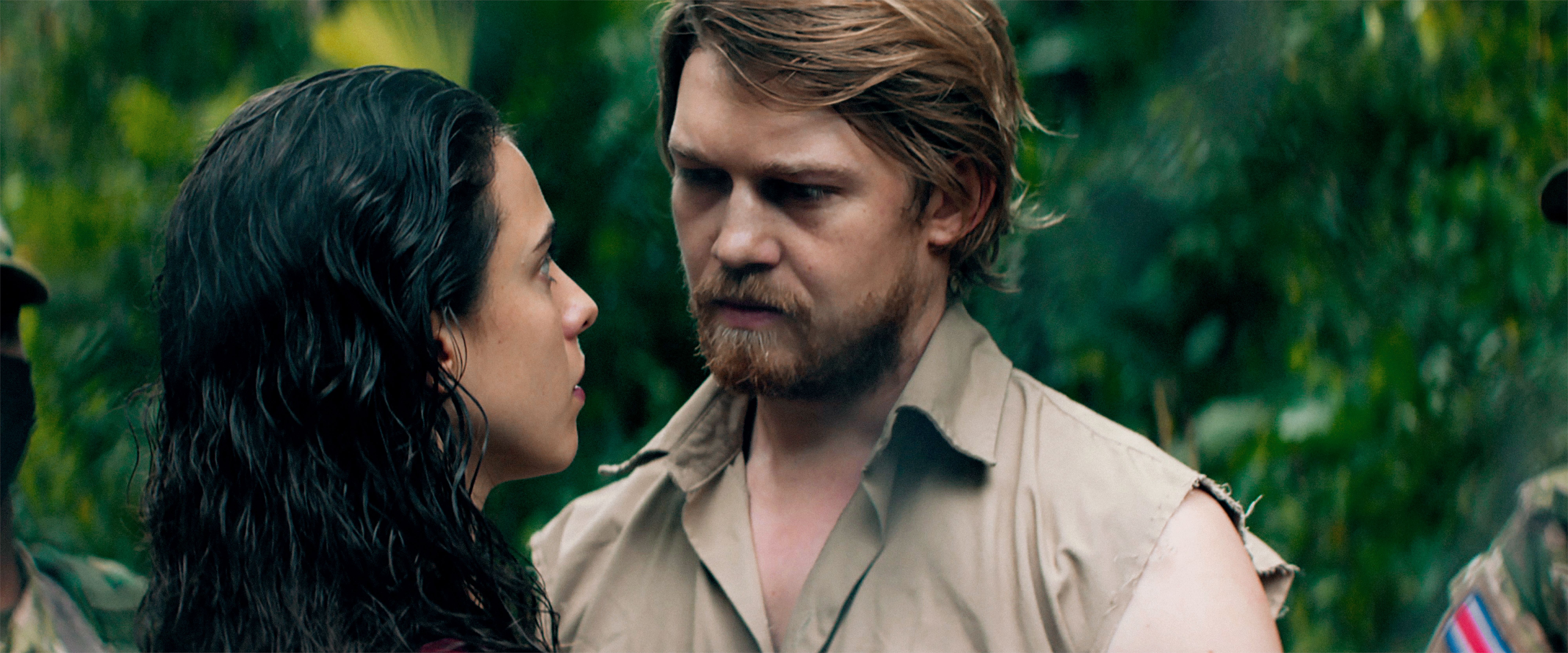
Trish (Margaret Qualley, right) and Daniel (Joe Alwyn) get acquainted in Stars at Noon. (Photos courtesy of A24)

By Richard Ades

When an American journalist has an affair with a British businessman in Stars at Noon, it begins as a financial transaction: She offers to sleep with him in exchange for American dollars.

Trish (Margaret Qualley) is in dire straits, being stuck in Nicaragua with no money, no passport and no support from her stateside editor. But she finds herself in even direr straits after hooking up with Daniel (Joe Alwyn), who claims to do humanitarian work for an oil company but attracts an unusual amount of attention from a scary Costa Rican cop (Danny Ramirez).

Why? Why, indeed. Director and co-scripter Claire Denis never explains why Daniel is in the cop’s (and eventually the CIA’s) crosshairs, nor does she fill in Trish’s back story. The acclaimed French filmmaker is more interested in establishing a tense atmosphere that justifies the new couple’s eventual run for their lives. In this, she succeeds, though she takes so much time doing so that even the frequent interludes of sex and nudity may fail to keep viewers intrigued.

Stars at Noon is based on Denis Johnson’s 1986 novel, which was set during a U.S.-led attempt to overthrow Daniel Ortega’s leftist government. The new movie takes place in COVID-era Nicaragua, as can be seen by the face masks characters don when entering public places.

Much has changed in Nicaragua between the 1980s and the present—in particular, Ortega has morphed from a revolutionary leader to a standard-issue dictator who jails opponents. However, the movie only hints at the current dynamic by showing ever-present armed troops in the streets and by allowing the two lovers to briefly address the political situation: Trish predicts the government will find an excuse to cancel the upcoming elections, while Daniel holds out hope that supporters of democracy will prevail.

What’s behind Trish’s cynicism and Daniel’s optimism? If only we knew, the characters, and thus their romance, would be more interesting.

It’s particularly frustrating that we know so little about Trish, the chief protagonist. At one point, she apologizes to an official for writing a story about kidnappings and other presumably government-sanctioned crimes, which suggests she was once an idealistic reporter rather than a desperate woman who tries to dilute her misery with alcohol. Qualley does what she can to add depth to her portrayal, as does Alwyn, but the script gives them little help.

Inevitably, Stars at Noon becomes a couple-on-the-run movie, harking back to any number of flicks made throughout the history of cinema. The difference is that in most of its predecessors, we knew who the characters were and why they were forced to flee. Filmmaker Denis is purposefully vague on both counts, leaving us with little reason to care—or to feel anything except a general sense of dread. That, the film does well.

Rating: 2½ stars (out of 5)

Stars at Noon (rated R) opens Oct. 14 in select theaters and on demand, and will begin screening Oct. 28 on Hulu.

Determined mom goes to war with bureaucracy

Bunny King (Essie Davis) holds aloft the tool of her trade.

By Richard Ades

The title of the New Zealand film The Justice of Bunny King may be its most optimistic element.

Its homeless heroine is waging an uphill battle to regain custody of the two children who were taken from her due to her criminal record. And though she’s sly and resourceful, she’s pitted against an entrenched bureaucracy that refuses to see the reality of her situation.

“Justice” appears to be an impossible goal. Yet the more unreachable it seems, the harder Bunny works to attain it, because that’s who she is.

Essie Davis (The Babadook) plays Bunny as someone who throws herself wholeheartedly into whatever she tries. In the beginning, we see her walking up and down lines of traffic with a squeegee and a broad smile as she cleans windshields in exchange for whatever coins drivers toss her. Later, she retires to the home where she cooks and babysits for her sister (Toni Potter) in return for a place to sleep.

All this she does cheerfully, but there’s a hole in her psyche the size of her physically challenged daughter (Amelie Barnes) and teenage son (Angus Stevens). She’s determined to regain custody but knows that will happen only if she can find a suitable home, something that’s likely beyond her income level.

Then, just as a solution appears to be at hand, she stumbles into the terrifying realization that her teenage niece Tonyah (Jojo Rabbit’s Thomasin McKenzie) is being abused by her sister’s partner (Errol Shand). She tries to fix the situation but only succeeds in making her own life harder. And, thanks to combination of bad luck and bad choices, things just keep getting worse.

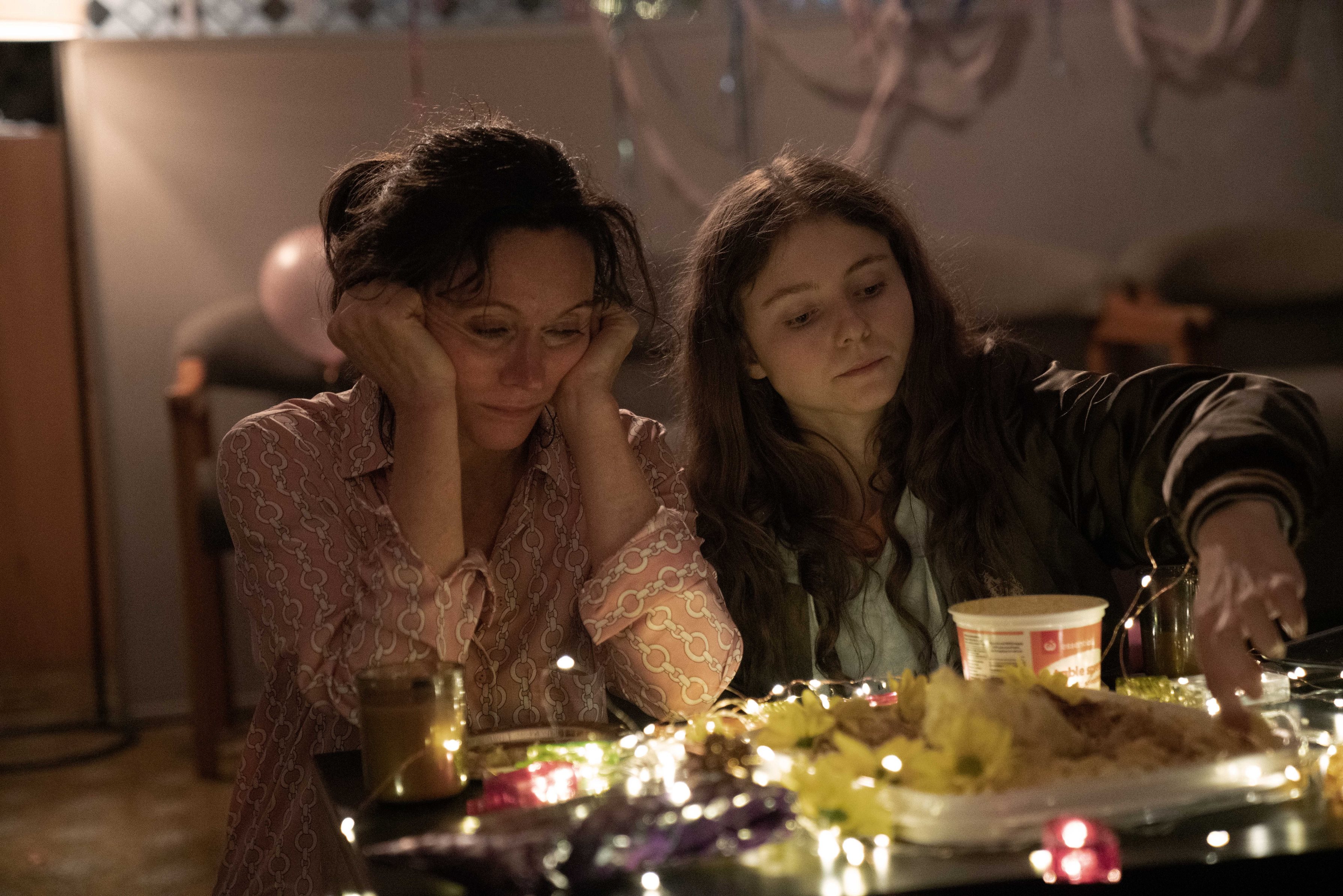
Bunny and Tonyah (Essie Davis and Thomasin McKenzie)

Directed by Gaysorn Thavat from a story she co-conceived with Gregory David King and screenwriter Sophie Henderson, this could be seen as a cautionary tale of the steep odds faced by those on the lower rungs of society’s ladder. First of all, though, it’s a character study of a woman whose instincts sometimes get her in trouble but whose courage and determination are beyond reproach.

Davis’s all-in portrayal keeps us engaged whether Bunny’s antics are amusing us or tying our stomachs in knots. McKenzie and the rest of the cast offer strong support, as does Ginny Loane’s naturalistic cinematography.

The Justice of Bunny King doesn’t go where you expect—or want—it to go, but Davis makes the trip memorable.

Rating: 4 stars (out of 5)

The Justice of Bunny King opened Sept. 23 in select theaters and will be available on demand beginning Sept. 30.

Anime pals take an eventful walk in the woods

Trying to scare off an angry beast they meet in the forest are (from left): Drop (Ayumu Murase), Roma (Natsuki Hanae) and Toto (Yuki Kaji). (Photos courtesy of Studio Madhouse).

By Richard Ades

The opening of Goodbye, Don Glees! finds teens Roma and Toto (Natsuki Hanae and Yuki Kaji) racing their bikes down a dark, twisty road. A near-collision with an oncoming motorist sends Roma flying into the nearby woods, with Toto following behind. After getting their bearings, the two find themselves looking out over the magical place they see as their gateway to the world beyond their tiny village: an airport.

We have to wait to learn what happens next, as the Japanese anime film then flashes back to the events that led up to this moment. They include a fireworks display, a forest fire and a difficult journey the boys undertake along with their new friend, Drop (Ayumu Murase). The ostensible purpose of the trip is to prove the trio didn’t start the fire, but that’s really just the “MacGuffin” that launches a trek filled with danger, beauty, self-discovery and a touch of supernatural mystery.

Goodbye, Don Glees! was directed by Atsuko Ishizuka, who’s previously worked only in television and on 2017’s No Game, No Life: Zero, a big-screen prequel to a TV series. So this is her first completely original work, made more so by the fact that she also wrote the script. It’s an impressive debut, filled with awe-inspiring images and indelible characters, each experiencing a private version of teenage angst that isn’t always clear to the others.

Roma, embarrassed by the odor he picks up shoveling manure on his uncle’s farm, suffers from low self-esteem and is too shy to admit his feelings for Tivoli, a classmate he idolizes. Toto struggles to keep up his grades in order to fulfill his parents’ lofty plans for him. And Drop, the newcomer, carries a burden that will be obvious to viewers long before it is to his companions.

The teens’ inner struggles often cause them to lash out at each other. It’s probably predictable that they eventually learn to appreciate each other more thanks to the shared travails the journey puts them through, but the plot also leaves viewers with some unexpected developments—including one that defies rational explanation.

Filled with impassioned speeches about finding one’s “treasure” and tinged with a sense of mortality, Goodbye, Don Glees! may be too difficult for young children. In fact, the original Japanese version may challenge some English-speaking adults, especially when it divides the screen between subtitles and the characters’ social-media posts. Fortunately for slow readers, a dubbed English version is available, though seeing it would deprive you of hearing the masterful work of original voice artists Hanae, Kaji and Murase.

In case you’re wondering, “Don Glees” is the name of a club Roma and Toto founded. As we learn late in the film, the moniker was inspired by their pessimistic attitude toward life.

Rest assured that if you enter the theater feeling the same way, you’ll leave on a more buoyant note.

Rating: 4 stars (out of 5)

Goodbye, Don Glees! (PG) will be screened Sept. 14 and 20 (original Japanese version), and Sept. 18 (English version) in theaters nationwide, including Central Ohio’s Marcus Crosswoods Cinema 17 (all three dates) and AMC Dine-in Easton Town Center (Sept. 18 and 20 only).  

Kaepernick’s career-ending act of conscience

Colin Kaepernick (center) takes a knee during a pre-game rendition of the national anthem in 2016. Flanking him are teammates Eli Harold (58) and Eric Reid (35). (Photo: Nhat V. Meyer/Bay Area News Group/TNS/Alamy Live News)

By Richard Ades

Kaepernick & America, a new documentary on blackballed quarterback Colin Kaepernick, points up an ironic fact: When the then-San Francisco 49er began taking a knee during the national anthem in 2016, he saw it as a way of protesting America’s racial injustice without disrespecting its flag.

Earlier, Kaepernick had simply remained seated during the anthem to speak out against incidents of police violence against Black men. But then Nate Boyer—a 49ers fan who’d served as a Green Beret—sent Kaepernick an open letter saying he considered this a hurtful act. The two met, and Boyer suggested taking a knee as a more respectful way of getting his point across.

So Kaepernick began dropping to one knee, only to be booed by fans—and by a presidential candidate who never missed a chance to foment anger, particularly against people of color. The quarterback’s career soon came to an end.

Directors Tommy Walker and Ross Hockrow interview several people who speak about Kaepernick on several levels: as a star quarterback who felt called upon to risk censure for the sake of his beliefs; as a person of mixed race and cultures, with all the additional pressures that entailed; and as the perfect foil for Donald Trump, who riled up supporters by saying team owners should fire any player who refused to stand for the flag.

Among the interviewees are CNN news anchor Don Lemon; Hue Jackson, one of the few Black men who’ve coached NFL teams; and DeRay Mckesson, a Black Lives Matter activist. Others include April Dinwoodie, an authority on transracial adoption, who theorizes about how Kaepernick might have been shaped by his personal history as a mixed-race child who was adopted and raised by White parents.

One person who isn’t interviewed is Kaepernick himself, who no longer seems interested in commenting on the controversy he inspired. It’s therefore understandable that he appears only in archival footage, but it’s also disappointing. His absence may leave viewers feeling they don’t really know the man who was willing to pay such a high price simply for exercising his right to free speech.

On the other hand, viewers will be all too familiar with the picture of America the film presents: one in which angry White men with guns use Kaepernick’s No. 7 jersey for target practice. We recognize this picture because it bears such a close resemblance to the America we still live in.

One commentator predicts that Kaepernick eventually will be seen as someone who—like the late Muhammad Ali—took an unpopular stance that ultimately was seen to be the right one. That note of optimism seems particularly justified following the 2020 police murder of George Floyd, with its new and lethal twist on “taking a knee.”

If that reconciliation ever happens, it may be of some consolation to Kaepernick, but it still won’t bring back his career.

Rating: 4 stars (out of 5)

Kaepernick & America will be available through streaming outlets beginning Sept. 2.

New baseball series atones for classic flick’s omissions

Carson (Abbi Jacobson, left) gets acquainted with Max (Chante Adams) in a scene from A League of Their Own. (Photos courtesy of Amazon Prime Video)

By Richard Ades

There’s a moment in the 1992 film A League of Their Own when a ball gets away from a member of the All-American Girls Professional Baseball League. A Black passerby palms the ball and throws it back with power and skill, after which both women smile at each other in recognition of their mutual love of the game.

The scene, lasting mere seconds, is the flick’s sole acknowledgement of the fact that some Black women played baseball back in 1943 and would have tried out for the then-new league if they’d been allowed to. But they weren’t, as the women’s league was just as segregated as its male counterpart was until Jackie Robinson joined the Brooklyn Dodgers some four years later.

Prime Video’s new A League of Their Own series, like its big-screen predecessor, revolves around the real-life women’s baseball teams that were formed to give fans something to watch while male players went off to fight World War II. But it’s hardly the same story. The series institutes changes designed to make up for elements of the film that now seem dated at best, insensitive at worst—starting with the short shrift it gives to 1940s racial discrimination.

The character at the center of much of the plot is still a married White woman who tries out for the league while her soldier-husband is serving overseas. Here, she’s named Carson Shaw and is played by Abbi Jacobson, who co-created the series with Will Graham. But playing just as big a role is Max (Chante Adams), a Black hair stylist who lives for baseball and is determined to join the league despite its color bar.

There are other differences, too. While the movie shows men such as an alcoholic coach (Tom Hanks) playing leadership roles in the women’s league, the series is a study in female empowerment. Even when Carson’s Illinois-based team is given a former pro player (Nick Offerman) as a coach, he shows little interest in fulfilling his duties. In this version of reality, there’s no male savior in sight.

The new series also delves into the possibility that some of the league’s players are more than just friends off the field. In fact, the challenges of being queer in the 1940s becomes a major theme.

Members of Carson’s team, the Rockford Peaches, gather in the locker room.

The eight-episode first season surrounds both Carson and Max with a host of colorful friends and colleagues. Carson, of course, has her teammates, starting with the free-thinking Greta (D’Arcy Carden), who surprises her early on with a kiss that forces her to re-examine everything she thought she knew about herself. For her part, Max has a fearsome mother and a supportive father, but primarily she has best friend Clance (Gbemisola Ikumelo), a would-be artist who’s as devoted to the world of comic books as Max is to baseball.

Everyone, from the leads to supporting players and guest stars, is portrayed with as much style as a curve ball and as much gusto as a triple play. Even so, the series takes a while to hit its stride.

In the first episode, the dialogue is filled with enough raunchy language to undermine its sense of time and place. (It doesn’t help that a 1960s Janis Joplin anthem is heard over the closing credits.) Later, some of Max’s scenes take her so far from baseball that they seem part of another series altogether. Especially superfluous is an episode in which she and Clance search for crabs to serve at an important party.

Eventually, though, things begin to coalesce. We learn that Carson and Max are on similar life paths, in more ways than one, and we come to care about them and about those around them.

By the end of its first-season arc, A League of Their Own still seems like two related stories rather than a cohesive whole, but at least they’re interesting stories. Besides, maybe that’s the price the series pays for correcting one of its popular predecessor’s chief shortcomings.

Rating: 4 stars (out of 5)

A League of Their Own premieres Aug. 12 on Amazon Prime Video.

Polish prostitutes find danger in exotic surroundings

Prospective prostitutes recruited by Emi (Paulina Galazka) board a plane to entertain wealthy clients.

By Richard Ades

Women who seek success in a way that’s both sexy and shady are courting disaster, and they inevitably find it. That’s the usual message of movies about such exploits.

One of the latest is the Polish film Girls to Buy, based on the true story of a young woman who was seduced into the world of high-class prostitution. Directed in a flashy style by Maria Sadowska, the flick delivers its cautionary tale with lots of eye candy and ear candy, even if its dramatic appeal is diluted by its lack of relatable characters.

The protagonist is Emi (Paulina Galazka), who lives in a small town with her hard-working single mom. Frustrated by their poverty, Emi has adapted by using sex appeal to get what she wants. Then she meets Dorota and Marianna (Katarzyna Figura and Katazyna Sawczuk), a mother and daughter who introduce her to the seemingly glamourous life of a call girl.

It’s not really selling yourself, the two assure her. It’s just getting paid for something you’d be doing anyway.

Emi (Paulina Galazka, right) plays a poker game with high stakes. At her side is Marianna (Katazyna Sawczuk).

Emi catches on and soon surpasses her tutors in ambition and smarts. Things really take off after she forms a strategic alliance with Sam (Giulio Berruti), who procures women to entertain wealthy Arab businessmen and royalty. Soon it’s Emi who’s recruiting women who are willing to use sex appeal to get ahead, though she isn’t always forthcoming about what they’ll be expected to do for the money.

Eventually, even Emi finds herself in over her head when Sam introduces her and her band of prostitutes to increasingly powerful men and increasingly dangerous situations.

As portrayed by Galazka and screenwriters Mitja Okorn, Lucas Coleman, Peter Pasyk, Emi earns admiration for her intelligence and determination but none for her scruples, which are nearly nonexistent. It’s easier to feel pity for her recruits, especially the naïve Kamila (Olga Kalicka). On the other hand, it’s hard to relate to most of these women, who often come off as starry-eyed children in the midst of opulence that they hope will rub off on them.

Emi (Paulina Galazka) forms a precarious alliance with Sam (Giulio Berruti).

As Dorota, Figura exudes classlessness and excessive confidence in her charm and guile. As Sam, Berruti is a puzzle. He seems to genuinely like Emi, but he’s willing to complicate her life when she unwittingly disappoints his employers.

Though Girls to Buy has an exuberant style all its own, it’s hard not to compare it to previous flicks with similar themes. It’s better than Molly’s Game (2017), Aaron Sorkin’s drab tale of a woman who hosts high-stakes card games, but not as interesting as Hustlers (2019), starring Jennifer Lawrence as a stripper who drugs and fleeces well-to-do customers. Best of all is 2020’s Zola, the scary and bracingly original account of a dancer who stumbles into a prostitution ring.

Girls to Buy could use a little more heart and a little less predictability, but it gets its message across, and it does so with glitz and energy.

Rating: 3½ stars (out of 5)

Girls to Buy (not yet rated; contains nudity and sexual content) opens July 15 in select theaters and through VOD outlets.

Determination trumps inexperience in fun fairway tale

Maurice Flitcroft (Mark Rylance) is a golf novice when he lands a chance to play in the 1976 British Open.

By Richard Ades

Maurice (Mark Rylance) seems unphased when he learns he’s finished dead last in the qualifying round at the British Open. After all, he explains cheerfully, it’s the first round of golf he’s ever played.

The Phantom of the Open, which tells the story of a rank amateur’s participation in the prestigious golf tournament, would seem far-fetched if it weren’t based on fact. In 1976, a working-class Brit named Maurice Flitcroft really did stumble into the tournament, where he played so abominably that officials realized he never should have been allowed on the fairway.  

How did he get there in the first place? And why?

Actor Rylance, working under Craig Roberts’s direction, depicts Maurice as a naive shipyard worker who fails to recognize his own limitations. After learning his job might not last forever, he happens upon a news story about the Open’s 1975 winner and the hefty purse he took home. Thinking this is a sign that golf will be his new career, Maurice decides to enter the 1976 tournament despite the fact that he’s never even picked up a club.

Simon Farnaby’s script, based on a book by Scott Murray, tells the seemingly tall tale in a homey, funny and good-natured way. Flashbacks explain that Maurice married single mom Jean (Sally Hawkins) and provided the fatherly support that helped her son Michael (Jake Davies) grow up to be a successful professional. He also supported the couple’s twin sons James and Gene (Jonah and Christian Lees) in their decidedly less-practical quest to become world-class disco dancers.

Indeed, “support” could be the family’s watchword, which is why no one questions Maurice’s decision to enter a major golf tournament despite his lack of experience. Eventually, though, the more worldly Michael pushes back against his stepdad’s pie-in-the-sky ideas, leading to a father-son argument that threatens their happy home.

Committed performances by Rylance, Hawkins and others help to sell characters defined not only by their decency but by absurd levels of optimism and naivete. Along with Roberts’s savvy direction, they also help to sell a script that sometime slices into predictable territory in service of its upbeat sentimentality.  

Once the hazards are crossed and the scorecards are added up, the flick emerges as an irresistible tribute to a real-life Brit who became a hero simply by refusing to take “no” for an answer.

Rating: 4 stars (out of 5)

The Phantom of the Open (PG-13) opens June 24 in select theaters.