Mystical Mexican tale pits kids against drug gang

Tigers Are Not Afraid Estrella Shine
Estrella (Paola Lara) comforts Shine (Juan Ramon Lopez) in a scene from Tigers Are Not Afraid.

By Richard Ades

In most horror films, ghosts or other supernatural entities endanger the lives of ordinary people. In Tigers Are Not Afraid, there are supernatural entities galore, but the real danger comes from human beings.

The tale takes place in a Mexican city where the ongoing drug war has left many children to fend for themselves after their parents have been killed or have simply disappeared. Imaginatively written and directed by Issa Lopez, it’s scary and sad, but also mystical and inspirational.

We meet our adolescent heroine, Estrella (Paola Lara), in a classroom where her teacher assigns the students to write stories incorporating magical figures such as princes and, at one child’s suggestion, tigers. We then are engulfed in Estrella’s story, in which a boy steals a gang thug’s phone and pistol and contemplates shooting him but can’t—because, the narrator decides, he’s forgotten how to be a prince.

Suddenly, we’re dragged back into the classroom, where the sound of gunfire has forced the students to hit the floor. In the aftermath, the school is closed, and Estrella returns home to learn her mother has joined the ranks of missing parents. Hungry and destitute, she throws herself on the mercy of a ragtag group of orphaned boys led by the gruffly macho Shine (Juan Ramon Lopez).

Tigers Are Not Afraid Boys
Shine’s gang of homeless orphans

Shine, it turns out, has recently stolen a gang thug’s phone and pistol. From this point on, Estrella’s life seems to merge with her unfinished tale. She also has entered a state of reality in which ghostly figures and portentous streams of blood intrude on the already-terrifying everyday world.

One of film’s most compelling storylines is the evolving relationship between Estrella and Shine’s followers. She quickly takes a maternal interest in the youngest boy, Morrito (Nery Arredondo), who clings for comfort to his little stuffed tiger. But others see girls as bad luck, and Estrella is ordered to prove her worth by killing the owner of the stolen phone, a gang member named Caco (Ianis Guerrero). When she uses a magical wish in an attempt to avoid the task, it backfires, putting all of them in the crosshairs of ruthless drug kingpin Chino (Tenoch Huerta Mejia).

As the plucky heroine, Lara sometimes underplays Estrella, perhaps suggesting that the girl is in shock or sleepwalking through the nightmarish predicament in which she’s been thrust. Leading the wonderful supporting cast, Lopez makes Shine a boyishly insecure leader who’s tormented by his fears, failures and losses.

Juan Jose Saravia’s cinematography unobtrusively melds the supernatural with the natural, turning the film into a prime example of Latin American “magical realism.” Vince Pope’s musical score provides the final complement to Lopez’s drama of children forced to live in a dangerous world not of their own making.

Seeing this fantasy-laden take on the real-life suffering of children is a devastating experience. But, as a morality tale and an innovative work of cinema, it’s also uplifting and unforgettable.

Rating: 4½ stars (out of 5)

Tigers Are Not Afraid (originally titled Vuelven) opens Sept. 13 at the Gateway Film Center in Columbus. The film is unrated but contains rough language and violence.

Thrown-together fugitives become huckleberry friends

Peanut Butter Falcon
Tyler, Eleanor and Zak (Shia LaBeouf, Dakota Johnson and Zack Gottsagen, from left) wander through the waves in The Peanut Butter Falcon.

By Richard Ades

The name “Mark Twain” comes up in an early scene of The Peanut Butter Falcon. It happens when a nursing-home attendant runs into an unemployed fisherman named Tyler and asks if he’s seen the runaway she’s seeking. Rather than give her a straight answer, Tyler coyly suggests the escapee may be off on the kind of adventure Twain might have thought up.

That pretty much describes this warmhearted tale, which in many ways resembles an updated version of Huckleberry Finn.

To be sure, there are key differences. Rather than being a motherless boy and a runaway slave, the heroes are Tyler (Shia LaBeouf), who’s lost both his job and his brother, and Zak (Zach Gottsagen), a 22-year-old man with Down syndrome. Like their literary counterparts, though, they’re on a trek in search of freedom and happiness. At one point, they even commandeer a raft.

We first meet Zak when he’s living in a North Carolina facility for senior citizens—the only place the state could find for him after he was abandoned by his family. Sharing a room with the sympathetic Carl (Bruce Dern), he spends his evenings watching old wrestling videotapes and dreaming of becoming a wrestler himself. If only he can escape, he plans to learn grappling moves by enrolling in the school run by his hero, the Salt Water Redneck (Thomas Haden Church).

Despite the efforts of friendly attendant Eleanor (Dakota Johnson), Zak does escape and soon runs into Tyler, who is on the lam himself. Frustrated at his inability to obtain a crab-fishing license following his brother’s untimely death, Tyler has resorted to stealing from other fishermen’s traps. Beaten up for his efforts, he then retaliates by starting a fire that turns out to be more destructive than planned. He takes off in his boat, with two revenge-seeking fishermen in fierce pursuit.

It’s at this point that Tyler realizes Zak—a short, chubby man clad only in underwear—has been hiding on his boat. Thus begins a reluctant collaboration that eventually grows into a close friendship.

Co-writers and directors Tyler Nilson and Mike Schwartz tell the tale with warmth and wit. With help from a down-home musical score, they also do a good job of capturing the time (roughly the 1990s, judging from one character’s flip phone) and place (the coastal Carolinas and Georgia). The perfectly cast actors do the rest.

Despite playing a shotgun-toting character who’s down and out, LaBeouf projects grit and an undercurrent of decency. Whether he’s gruffly laying down the rules to his traveling companion or flirting with a woman who seems out of his league, you know he’s essentially a good guy.

As Eleanor, whose job requires her to track down Zak and bring him back to the nursing home whether he wants to go or not, Johnson combines a sense of duty with genuine caring.

But it’s Gottsagen’s portrayal of Zak that gives the film its soul. In fact, according to a producer who spoke at a preview screening, the whole film was built around the actor’s talents. As a mentally challenged man who’s determined to live the life he wants, not the one others have proscribed for him, Gottsagen paints an indelible portrait of naïve faith and brave determination.

Surprisingly, he’s also funny, with help from a script that knows how to laugh at someone’s foibles without ridiculing their challenges. In its respectful but non-pandering treatment of a person with disabilities, The Peanut Butter Falcon is a model of sensitivity.

Most of all, though, it’s a delightful and entertaining adventure—one that I’m already looking forward to seeing again.

Rating: 4½ stars (out of 5)

The Peanut Butter Falcon (PG-13) opens Aug. 23 at theaters nationwide.

Looking back on China’s ‘one child’ rule

One_Child_Nation
Amazon Studios

By Richard Ades

From 1979 to 2015, China enforced a rigid policy that forbade most couples from having more than one child. The rule was intended to reverse the country’s exploding population growth, which was seen as a threat to plans for economic development.

One Child Nation, a documentary directed by the Chinese-born Nanfu Wang and Jialing Zhang, shows that the policy’s effects were long-lasting and horrifying.

With the help of archival footage, the film depicts the propaganda campaign China used to urge its people to abandon their tradition of large families. Billboards, theatrical performances and even playing cards helped to spread the message that population control was the key to prosperity.

As a result, many supported the policy, though some did so only out of fear or a sense of duty. Others tried to evade it and suffered disastrous consequences. Wang, who moved to the U.S. six years before giving birth to her own son, returns to her native village with camera in hand in an attempt to learn just what those consequences were.

Perhaps because she is seen as a local rather than an outsider, Wang is able to uncover some startlingly raw emotions.

A former village chief says he enforced the policy only because he had to, adding that he refused to take part in forced sterilizations of women after their first child. A former midwife feels guilt for performing such sterilizations—and for performing mandatory abortions so late in the pregnancy that, in her mind, they amounted to murder.

But not everyone feels such guilt. A woman who was lauded by the government for her role in “family planning” says the policy was justified despite its cost in misery and lives. “It was like fighting a war,” she says, according to the translated subtitles. “Death was inevitable.”

It quickly becomes apparent that the policy was complicated by many couples’ patriarchal wish for a son who could carry on the family name. Parents of girls often tried to evade the law, sometimes going so far as to abandon their daughters. The documentary traces the cost in terms of dead babies and a lucrative market for the adoption of Chinese “orphans”—a market in which government representatives were likely complicit.

One Child Nation is full of such shocking revelations. If it doesn’t attain the emotional arc of an effective work of fiction, it’s partly because some of the most painful details arrive early or midway through.

By the end, the film’s focus has shifted to a Utah couple’s attempt to connect Chinese children with previously unknown siblings who were basically sold on the foreign adoption market. It’s a worthy effort, but it’s one giant step removed from the nightmarish ordeal their parents went through in the name of progress.

Rating: 3½ stars (out of 5)

One Child Nation (rated R) opens Aug. 23 at the Gateway Film Center in Columbus.

The key to happiness: Listen to Springsteen

BLINDED BY THE LIGHT
Javed (Viveik Kalra) becomes a devotee of Bruce Springsteen in Blinded by the Light. (Photo by Nick Wall/Warner Bros. Pictures)

By Richard Ades

Blinded by the Light introduces us to Javed, a Pakistani-British teen who feels imprisoned by forces beyond his control. Those forces include immigrant-hating bullies and the weak economy of Margaret Thatcher’s UK in the late 1980s.

Worst of all, though, is Javed’s rigid father, who insists on dictating what his son does with his life. Dad’s pragmatic plans leave little room for Javed’s real love, writing, which he surreptitiously practices by writing poems that he shows to no one.

Then a fellow student turns Javed on to the music of Bruce Springsteen, and suddenly his outlook improves. After listening to the American rocker’s lyrical explosions of pain, anger and indomitability, he realizes he’s found a kindred spirit. With the Boss as his inspiration, he begins fighting for the kind of future he wants.

Admittedly, all this would come off as Pollyannaish and unbelievable if it were fiction. However, the fact that the film is inspired by the life of an actual person helps to transform it into an uplifting, if flawed, tale of the power of art and music.

Directed and co-written by Gurinder Chadha (Bend It Like Beckham), the flick relies heavily on Viveik Kalra’s engaging portrayal of its struggling protagonist. Other young actors also are convincing, including Dean-Charles Chapman as Matt, Javed’s best friend; and Aaron Phagura as Roops, the Sikh who introduces him to Springsteen.

On the home front, Kulvinder Ghir adds a humorous edge that prevents Malik, the father, from turning into a total villain. Especially funny is Malik’s insistence that the key to Javed’s success is to copy the behavior of his Jewish classmates—advice that Javed quickly labels “racist.”

Blinded by the Light running
Joyously reacting to the music of the Boss are (from left) Eliza (Nell Williams), Roops (Aaron Phagura) and Javed (Viveik Kalra). (Photo courtesy of Warner Bros. Pictures)

Also strong are the female members of the cast, though they mostly play one-note supporting roles (in more ways than one). Meera Ganatra is Javed’s hard-working mother, Nikita Mehta is his sympathetic sister, and Hayley Atwell is the teacher who pushes him to develop his writing talent. As the activism-minded student Eliza, Nell Williams has a similarly limited role, chiefly serving as Javed’s love interest.

Blinded by the Light’s best moments occur early on—when it introduces us to Javed’s soul-draining environment—and late, when it wraps up its crises in a satisfying way. In between, things are a little more problematic.

When Javed first hears Springsteen songs via a Walkman cassette deck, the film superimposes the words on walls and other parts of his environment. It’s a bit gimmicky, but it gets across the impact the words have on the teen.

Quite a bit sillier are various music video-like scenes in which people run or dance around joyfully in reaction to Springsteen songs. There are also moments that are too predictable or contrived to elicit the emotional response they seek.

Fortunately, the cast turns things around at the end by sticking the landing. The result is that we’re sent out of the theater with renewed faith in life, love, the future and the genius of a certain troubadour from New Jersey.

Rating: 3½ stars (out of 5)

Blinded by the Light (PG-13) opens Aug. 16 at theaters nationwide.

Women test sailing skills in globe-circling competition

Maiden
Tracy Edwards (center) leads an all-woman crew around the world in the documentary Maiden. (Sony Pictures Classics)

By Richard Ades

For much of its existence, women had never competed in the Whitbread Round the World Race. In 1989, Tracy Edwards set out to change that by proving that female sailors were equally capable of circling the globe on wind power alone.

As the account of that groundbreaking venture, Maiden hits all the right notes and avoids all the wrong ones. Alex Holmes’s documentary is exciting and uplifting, yet relatable. Rather than placing its heroine on a feminist pedestal, it depicts her as a brave but flawed pioneer who battles sexism and her own demons while struggling to overcome her biggest foe: the ocean.

“The ocean is trying to kill you,” Edwards announces frankly at the doc’s beginning. Thanks to actual footage taken during her 33,000-mile journey—a journey that sends her all-woman crew through violent storms and iceberg-infested waters—we readily believe it.

But Holmes doesn’t jump right into the race. Instead, he prepares us for the ordeal by recounting the Edwards’s difficult but character-building early years.

Born in Southampton, England, she suffers her first trauma when she loses her doting father at the age of 10. When her mother’s remarriage leaves her at the mercy of an abusive stepfather, she ultimately runs away and immerses herself in the male-dominated world of sailing. By taking on menial jobs such as stewardess or cook, she earns access to men who can teach her the skills she will later put to good use.

Maiden cold
The crew suits up for a trip through frigid southern waters. (Sony Pictures Classics)

By the time Edwards and her crew have acquired a boat—a refurbished yacht they dub “Maiden”—and joined their male competitors at the race’s starting line, she has the know-how but not necessarily the self-confidence she needs for the task ahead. Nonetheless, she sets out to disprove the many chauvinist predictions that they will drop out early. She’s determined not only to finish the race but to come in first in their class.

As filmed by Jo Gooding, a childhood friend of Edwards who also serves as the boat’s cook, the nine-month race is shown to be a combination of frustration and terror, triumph and setback. It all culminates in a surprising realization that what they’ve been doing has meaning far beyond trophies or bragging rights. While they’ve been engaged in a lonely, isolated battle with the sea, it turns out, the world has been watching.

It’s a heartwarming ending to a stirring saga of courage and grit.

Rating: 4½ stars (out of 5)

Maiden (PG) opens Aug. 9 at the Gateway Film Center and AMC Lennox Town Center 24.

Milquetoast turns manly in dark spoof of machismo

Art of Self Defense
Karate instructor Sensei (Alessandro Nivola, right) is determined to turn Casey (Jesse Eisenberg) into a real man. (Photos courtesy of Bleecker Street)

By Richard Ades

Minutes into The Art of Self-Defense, a vicious mugging sends 35-year-old Casey (Jesse Eisenberg) to a gun shop in search of protection. Ultimately, though, he ends up in a karate studio, where he becomes a devotee of a secretive instructor known only as Sensei (Alessandro Nivola).

It’s a decision that at first transforms and later endangers his life.

Though Casey’s goal is to learn how to defend himself, it turns out that Sensei teaches more than kicks and punches. He’s determined to turn Casey into a man—his definition of a man, that is, which includes the most extreme attributes of machismo.

And maybe that’s what Casey wants, too. “Other men intimidate me,” he tells Sensei, admitting what we’ve already witnessed in his interactions with assorted obnoxious males. So when Sensei eventually invites him to join the dojo’s exclusive “night class,” promising that it will help him become what he fears, Casey jumps at the chance.

Sure enough, he soon becomes someone who instills terror in others, but in the process he starts down a dangerous path that has no easy exit.

Written and directed by Riley Stearns (2014’s Faults), The Art of Self-Defense could just as easily be called The Pitfalls of Toxic Masculinity. Its true subject is that much-derided syndrome, which has been blamed for offenses ranging from sexual harassment to mass shootings and has been attributed to male entitlement, among other causes.

Here, Stearns doesn’t delve deeply into the disorder’s whys, other than having one of Casey’s fellow students suggest that men’s aggression is caused by testosterone. Instead, the flick concentrates on depicting machismo in its most absurd and destructive form.

In his quest to help Casey man up, Sensei tells him to start listening to heavy metal music and to give up his plans to visit France, a country best known for raising the white flag. In its place, he recommends idolizing more “masculine” lands such as Russia or Germany and is pleased to learn that Casey’s dog is German, even though it’s only a lowly dachshund.

Art of Self Defense Anna
Anna (Imogen Poots) is consigned to second-class citizenhood in Sensei’s male-centered dojo.

As for women, Sensei’s male-centric worldview reduces them to second-class citizens since, after all, they’re not men. Accordingly, he continually downgrades the only woman in the dojo, Anna (Imogen Poots), despite the fact that she’s one of his fiercest and most skilled followers. And Anna herself seems to accept his judgment to some extent, even while she chafes at being denied the black belt she clearly deserves.

The Art of Self-Defense is being promoted as both a dark comedy and a drama. Of the two, it’s probably closer to the former, as long as you realize it’s more “dark” than “comedy.”

Nivola’s deadpan portrayal of the militantly manly Sensei may garner a chuckle or two, but the film’s spiral into danger and violence stops it from turning into a laugh fest. As for the dramatic elements, they’re undercut by Casey’s unrealistic transformation from a fearful milquetoast to an unprovoked throat-puncher, as well as by certain developments that are more predictable than they should be.

It’s probably most interesting to see Stearns’s flick as a comment on toxic masculinity, though Anna’s presence complicates the subject. After all, for the most part she is just as aggressive and dangerous as the men around her. It’s not until the final act that we learn there is one step on Sensei’s perverse journey that she refuses to take.

In the film’s dire view of humanity, that represents a slim hope for salvation.

Rating: 3 stars (out of 5)

The Art of Self-Defense (rated R) opened July 18 at Columbus’s Gateway Film Center, AMC Lennox Town Center 24 and AMC Dine-In Easton Town Center 30.

Privilege is gently punctured in warm and witty ‘Late Night’

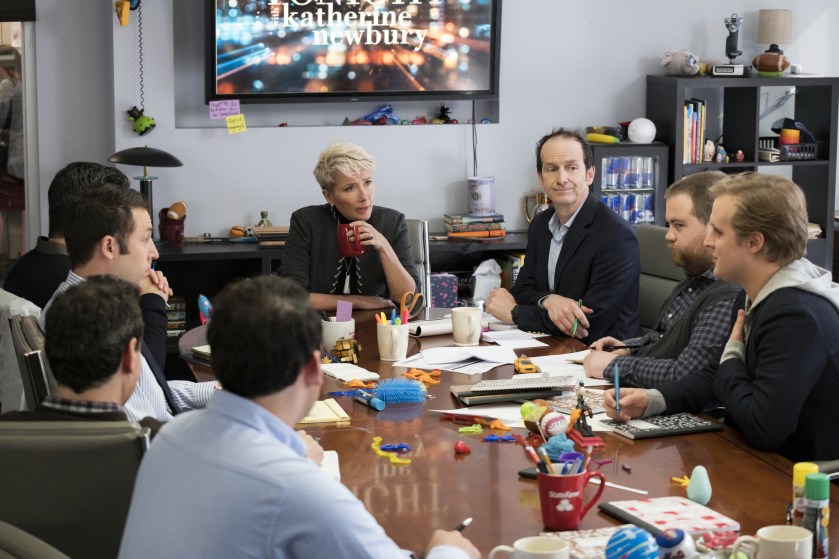
Late Night Writers
Talk-show host Katherine Newberry (Emma Thompson) has a rare meeting with her writing staff in Late Night. (Photos courtesy of Amazon Studios)

By Richard Ades

While appearing on The Late Show With Stephen Colbert recently to talk up her new flick, Emma Thompson described her character as a woman who serves as a late-night TV host. “So it’s basically science fiction,” she joked.

Yes, Late Night does exist in a kind of alternative universe where a woman has crashed the white boys’ club of hosts such as Colbert, Fallon and Kimmel. Even so, the script by co-star Mindy Kaling doesn’t ignore the special hurdles faced by women—as well as racial and ethnic minorities—in the entertainment industry. In fact, it makes salient points on that very issue. The only reason it doesn’t come off as a political diatribe is that Kaling is such a nimble and witty writer.

It also doesn’t hurt that Kaling is a funny and appealing actor. As aspiring joke writer Molly Patel, she functions as the warm, brown-skinned counterpoint to Thompson’s frosty, white-privileged Katherine Newberry.

The story opens as Katherine is forced to face a painful surprise. New network boss Caroline Morton (Amy Ryan) tells Katherine that because she’s been letting her show languish, she will soon be replaced by a new host. Adding salt to the proud feminist’s wounds, the replacement will be a male comedian who trades in sexist, frat-boy humor.

An even more shocking critique comes from Katherine’s invalid husband, Walter (John Lithgow), who tells her the show hasn’t been good in years. When Katherine asks why he didn’t tell her sooner, Walter says he didn’t think she cared. But since she obviously does, he advises her to fight back.

Late Night Mindy
Molly Patel (Mindy Kaling) eagerly heads to her new job as a writer on her favorite TV show.

In no time, Katherine begins taking what for her are drastic measures. She actually begins to spend time with her all-white, all-male writing staff, and she counters the charge that she’s out of touch by ordering a “diversity hire.” Thanks to luck and good timing, Molly ends up being that hire despite the fact that she has no experience writing comedy.

What the former chemical-plant worker does bring to the job are (1) experience in “quality control” and (2) her longtime love of Katherine’s show. She puts both to work by pointing out the reasons for the show’s decline, including Katherine’s reliance on stale humor and her refusal to liven things up by venturing outside the studio. Since Molly’s critiques stomp on her boss’s and co-workers’ egos, she only succeeds in increasing their resistance to this eager newcomer.

Fans of David Letterman’s final years on The Late Show might recall that he fell into some of the same lazy patterns as Katherine, recycling old jokes and staying chained to his desk. Unfortunately, Letterman didn’t have someone like Molly, who eventually convinces Katherine to take a chance on edgier material. But it all seems for naught when the comic, like Letterman before her, is embroiled in a scandal that poses a new threat to her career.

Director Nisha Ganatra, whose previous work has mostly been on TV, gives her two stars ample opportunity to flaunt their talents. Thompson wins laughs as a flinty celeb who fires anyone who rubs her the wrong way, while her scenes with Lithgow’s ailing Walter pay emotional dividends. And Kaling is lovably relatable as Molly, whether she’s a fangirl who swoons in her boss’s presence or a self-doubter who still manages to respond to rejection with plucky determination.

The result is not quite a slam dunk, as things do get a bit contrived and message-y at times. Mostly, though, Late Night succeeds in delivering its societal critiques discretely amid torrents of laughter.

Rating: 4 stars (out of 5)

Late Night (rated R) opens June 14 at theaters nationwide.

Sequel continues revealing pets’ quirks, fears and adventures

Secret Life
New York pooches Duke (Eric Stonestreet, left) and Max (Patton Oswalt) visit a farm in The Secret Life of Pets 2.

By Richard Ades

Max and the rest of his furry friends are back in The Secret Life of Pets 2. Like its 2016 predecessor, the animated flick is an affectionate and occasionally funny look at the dogs, cats and assorted other animals who share our homes.

The sequel finds a few things have changed for Max, the good-natured mutt who shares a New York apartment with his beloved human, Katie (Ellie Kemper), and a giant-sized canine named Duke (Eric Stonestreet). For one, Max is now voiced by Patton Oswalt, replacing Louis C.K. (for obvious reasons).

A more substantial change happens after Katie meets and marries the amiable Chuck (Pete Holmes) and subsequently gives birth to a mischievous imp named Liam (Henry Lynch). Max has heard tales of how children ruin pets’ lives, and the stories seem to come true when Liam starts using him as a toy-slash-punching bag. But as the toddler grows, Max learns to love him—a little too much, in fact. He spends so much time worrying about the child’s welfare that he develops a nervous scratching habit and has to be fitted with the dreaded “cone.”

Again directed by Chris Renaud, the sequel continues the original’s lush visuals, depicting NYC with a series of warm-toned cityscapes and later turning the countryside into a verdant wonderland. Written by Brian Lynch, who co-wrote the original, it again builds to an action-packed finale. The main difference is that the original told basically one story, while the new film separates itself into a trio of concurrent tales before bringing the characters back together at the end.

In the main thread, we follow along as Max’s family pays a visit to Chuck’s uncle out in the country, where a tough farm dog (Harrison Ford) pushes the visitor to conquer his fears. Back in the city, Max’s Pomeranian friend, Gidget (Jenny Slate), has been left in charge of his favorite squeeze toy and is horrified when she accidentally lets it bounce into an apartment full of hostile cats. Determined to get it back, she asks neighbor cat Chloe (Lake Bell) for advice on how to pass as a feline. (First lesson: Cats don’t chase balls.)

In the most outlandish tale, a newly arrived dog named Daisy (Tiffany Haddish) is determined to rescue a tiger from a traveling circus and its abusive trainer (Nick Kroll). She enlists the help of the once-villainous Snowball (Kevin Hart), who is now living with a doting owner and fancies himself a bunny superhero.

As a result of its trio of stories, Pets 2 seems more scattered than its predecessor, but the characters are as lovable as always. Among the voice actors, Haddish mainly does an impression of herself, but most give their characters distinctive personalities.

What is the film’s prime audience? The later mayhem, complete with homages to kung fu and Three Stooges flicks, will mainly appeal to younger viewers. However, the gentle jokes about the quirks and neuroses of our animal pals should appeal to adults as well—especially those with pets of their own.

Rating: 3 stars (out of 5)

The Secret Life of Pets 2 (PG) opens June 6 or 7 at theaters nationwide.

‘Godzilla’ over-plotted and under-lit

Godzilla and Ghidorah
Godzilla (right) faces off against the alien “titan” Ghidorah in Godzilla: King of the Monsters. (Photos courtesy of Warner Bros. Entertainment and Legendary Pictures Productions)

By Richard Ades

It was back in 1954 that Japan gave us Godzilla, the story of an ancient monster reawakened by tests of the hydrogen bomb. The original movie (though toned down for its U.S. release) was a grimly compelling morality tale. Like Frankenstein, it warned of the horrors that can be unleashed by scientists bent on advancement at all costs.

Over the years, the classic has spawned numerous sequels and reboots. Many of the earliest were campy affairs in which an actor in a Godzilla costume trampled miniature facsimiles of Tokyo while fighting new monsters such as Mothra and Rodan. More impressive was the 2014 U.S. remake, which used the latest cinematic technology to recapture the awe and wonder—if not the moral authority—of the original.

Now we have Godzilla: King of the Monsters, which could be the Godzilla movie to end all Godzilla movies. Not because it’s so great, unfortunately, but because it’s so boring.

Thanks to the haphazard direction of Michael Dougherty and the light-challenged cinematography of Lawrence Sher, the movie’s frequent battle scenes are dark, frenetic spectacles in which we struggle to discern who is being attacked by whom. And thanks to the drab, needlessly convoluted script by Dougherty and his co-writers, we struggle to care one way or the other.

Building on the mythology of 2014’s Godzilla, the flick centers on Monarch, an international organization devoted to controlling Godzilla and other monstrous “titans” by keeping them in a state of hibernation. That puts the group at odds with members of the U.S. government and military who believe the only good titan is a dead titan.

Sharing this belief is scientist Mark Russell (Kyle Chandler), who lost a son to a previous Godzilla attack and went into an alcohol-fueled tailspin that alienated him from his wife, Emma (Vera Farmiga), and daughter, Madison (Millie Bobby Brown). Further dividing the family is Emma’s devotion to studying, rather than destroying, the monsters. In fact, we first meet her in a Monarch “outpost” where none other than Mothra is about to emerge from a gigantic cocoon.

GODZILLA: KING OF MONSTERS
Dr. Emma Russell (Vera Farmiga) and daughter Madison (Millie Bobby Brown) face one of many tense situations in Godzilla: King of the Monsters.

Now here’s where the plot gets really strange. After Emma brings the monster under control with a nifty device called the Orca, the outpost is attacked by eco-terrorist Alan Jonah (Charles Dance). Jonah and his troops proceed to kill everyone present except for Emma and Madison, who are taken hostage.

Or are they? It turns out that Emma is actually in cahoots with Jonah—sort of. While he’s out to collect titan DNA for presumably commercial gain, Emma is determined to release Godzilla and the other monsters in order to save the world from its greatest adversary: mankind. She theorizes that we’ll eventually learn to live in harmony with these ancient beasts, who will help us return Earth to its preindustrial purity.

Let’s pause at this point to consider how far this morality tale has strayed from its 1954 roots. Rather than being our punishment for introducing deadly new weapons to the planet, Godzilla and friends are now seen as allies in the fight against global warming. Of course, millions of innocent people would be trampled and otherwise destroyed once these “allies” are unleashed, but we have no time to consider that ethical complication because the script introduces yet another twist.

Unlike Godzilla and the other titans, it turns out that the mightiest of the monsters, the three-headed Ghidorah, is actually a space alien and will only push Earth further from its original ecological balance. Curses! Not only that, but Godzilla has been weakened or killed in battle and is unable to save us from this invasive species. Double curses!

Given all the busy plotting about monsters and ways to deal with them, it’s hard to care about Mark, Emma and Madison, let alone the many peripheral characters around them. In fact, I found myself worrying more about the actors themselves, including established talents such as Sally Hawkins and Bradley Whitford, who are stuck in unrewarding, one-note roles. Fairing not much better is the Japanese-born Ken Watanabe, whose character, the Godzilla-loving Dr. Serizawa, spouts so much Eastern-style philosophy that he jokes about getting it from a fortune cookie.

The dialogue hits its lowest mark whenever the monsters show up and the humans respond with profound statements such as “Jesus,” “God,” or “Oh, shit!” As for us viewers, we’re likely to be aiming a few choice words of our own at the technicians who lit the monsters so dimly that we can barely make them out.

Rating: 2 stars (out of 5)

Godzilla: King of the Monsters (PG-13) opens May 31 at theaters nationwide.

Presidential rom-com mixes satire with sex and drug jokes

Long Shot
Fred Flarsky (Seth Rogen) helps Secretary of State Charlotte Field (Charlize Theron) loosen up in a scene from Long Shot.

By Richard Ades

The two main criteria for judging a romantic comedy are, naturally: (1) Is it romantic? And (2) is it funny?

In the case of Long Shot, the answer to both questions is “sometimes.”

Directed by Jonathan Levine (Snatched), the rom-com concocts a potentially intriguing matchup. On the one side is Secretary of State Charlotte Field (Charlize Theron), who begins planning a presidential run after learning the current commander-in-chief (Bob Odenkirk) won’t seek a second term. On the other side is Fred Flarsky (Seth Rogen), a liberal journalist who leaves his job when his publication is sold to a conservative media conglomerate. When the two meet at a party and Charlotte realizes they were childhood neighbors, she impulsively hires Fred as a speechwriter.

On the surface, the glamorous, powerful Charlotte and the scruffy, laid-back Fred are a typical rom-com odd couple. Beneath the surface, however, there’s an actual connection. Years ago, 13-year-old Fred secretly had a crush on 16-year-old Charlotte, who served as his babysitter when she wasn’t running to be their school’s student-body president.

Now that they’ve been thrown together as adults, it’s obvious that Fred still has a crush on Charlotte, but he’s too aware of the difference in their positions to let on. Instead, he starts plying her for information about herself, explaining that a speechwriter needs to know his subject. Apparently charmed by his interest, Charlotte is happy to oblige. Even if you’re not a rom-com fan, you’ll have no trouble figuring out where this is headed.

Is Charlotte and Fred’s roundabout courtship romantic? Well, it may be for some, but not for me. It just seems too contrived and predictable, especially with sappy music telegraphing every development.

Well, is the film at least funny? Parts of it are, especially the early slapstick scenes featured in the commercials. Whether later scenes tickle your funny bone depends on your affinity for R-rated gags involving sex and drugs. They may produce a few reflexive chuckles, but they’re not nearly as satisfying as humor that grows organically out of characters and situations.

Appropriately for a film coming out in 2019, Long Shot also takes a stab at political satire, though its efforts are pretty tame compared to what’s aired on late-night TV. Like Donald Trump, Odenkirk’s President Chambers earned his fame on television (as an actor rather than a reality star). But unlike Trump, he has no political ambition and is simply using the presidency as a steppingstone to his actual career goal of breaking into the movies.

Screenwriters Dan Sterling and Liz Hannah likewise take aim at Trump’s favorite show, Fox & Friends, with a clone that lambastes liberals and feminists and is part of a network run by the Stephen Bannon-like Parker Wembley (Andy Serkis). To make sure the flick doesn’t alienate conservative viewers too much, though, their script aims other barbs at the liberal Fred, who is shamed for not knowing that his black best friend (O’Shea Jackson Jr.) is a Republican—a Republican whose political philosophy is along the lines of “Believe in yourself.” Edgy!

Perhaps the movie makes the strongest political statements about the special challenges faced by a woman like Charlotte who’s trying to break through the ultimate glass ceiling. But it may go too far when it has Fred apologize for not realizing that such challenges sometimes force her to sacrifice her ideals. That’s probably not a message that real-life women candidates would appreciate.

Long Shot does benefit from two likable star turns. Theron adds enough humanity to the regal Charlotte to prevent her from becoming an ice queen, while Rogen plays the chemically adventurous Fred as an extension of his usual persona. It’s just too bad the script didn’t find more interesting ways for these two likable people to interact.

Rating: 3 stars (out of 5)

Long Shot (rated R) opened May 3 at theaters nationwide.