In a recent “Dilbert” cartoon, the hapless title employee talks about his hope of hooking up with a woman he’d met through virtual contract negotiations—even though, as it turns out, he’s seen only the part of her face that wasn’t hidden by a mask, a shower cap and an eye patch.
For those who lack a regular partner, a pandemic-induced quarantine is hardly the ideal environment for romance. And yet, people can’t turn off their libido simply because it’s not convenient. Recently, the New York City health department acknowledged this fact by releasing guidelines for how to deal with intimacy while minimizing the risk of contracting COVID-19.
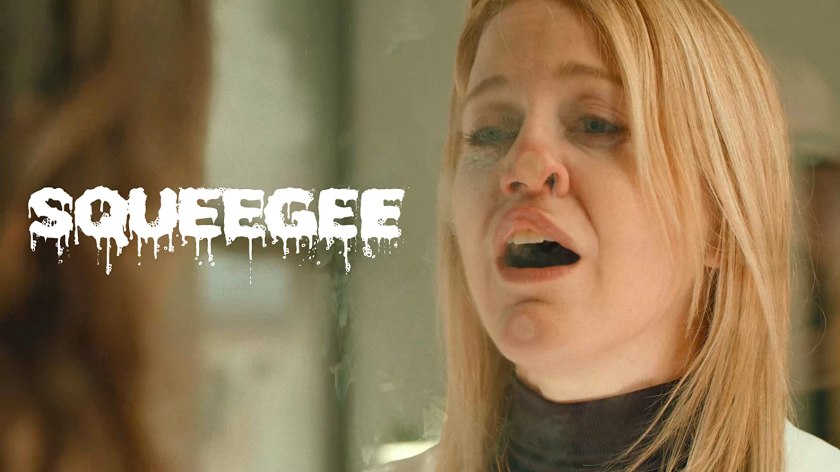
One suggestion it missed: Have a romantic encounter while separated by a thick window several stories above the street. That’s the situation described in Squeegee, an 11-minute film written and directed by Morgan Krantz.
It begins as Lori (Amy Rutherford), a well-dressed executive, is rushing to her downtown office building. Once she’s inside, an assistant (Emily Jane King) tries to corral her for a meeting with waiting guests, but Lori tells her to stall them. She then locks herself in her office and, oddly, uses a spray bottle and tissues to wipe off the window.
In a moment, we see why. A young window washer (played by Blair McKenzie, who actually cleans windows in real life) lowers himself into view outside her office. After efficiently doing his job with water and a squeegee, he waits expectantly. Soon the two are carrying on what apparently is an ongoing relationship involving playful flirting and even a bit more.
Though clearly made in pre-quarantine times, Squeegee could not be timelier. Its depiction of romance under the constraints of social distancing—“social” possibly having more than one meaning here—results in a film that’s funny, sexy, sad and even a bit profound.
Rating: 4½ stars (out of 5)
Squeegee (recommended for mature audiences) is available on Vimeo.
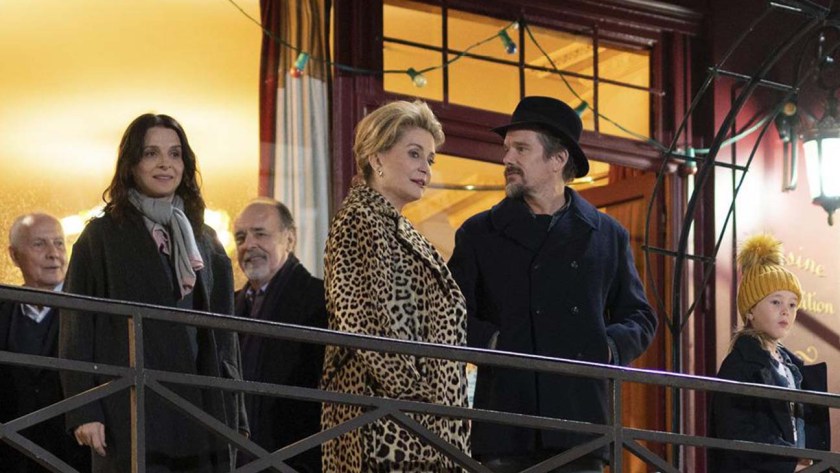
Movie star Fabienne (Catherine Deneuve, center) is visited by daughter Lumir (Juliette Binoche) and son-in-law Hank (Ethan Hawke) in The Truth.
By Richard Ades
The Truth is a startling change of pace for Japanese writer/director Hirokazu Koreeda (2018’s Shoplifters), being a French film with two very French leading ladies. In a different sense, though, it’s not startling at all.
Though the plot hinges on the prickly relationship between aging movie star Fabienne Dangeville (Catherine Deneuve) and her screenwriter/daughter, Lumir (Juliette Binoche), the implicit subject is the world of movies. And moviemakers love to make movies about moviemaking, as Quentin Tarantino did just last year with Once Upon a Time…in Hollywood.
The Truth takes its title from Fabienne’s new memoir, whose upcoming debut has prompted a visit from New York-based Lumir and her actor/husband, Hank (Ethan Hawke), and young daughter, Charlotte (Clementine Grenier). But the book hardly lives up to its name, Lumir finds, as it describes a warm mother-daughter relationship that never actually existed. Asked about this, Fabienne huffily replies that, being an actor, she feels no obligation to be shackled by reality.
We soon learn that Fabienne actually feels little obligation to anything but her craft. She routinely ignores or insults those around her, including her past and current lovers (played by Christian Crahay, Alain Libolt and Roger Van Hool). Frankly, she’s a monster, as she proved long ago during an incident that still haunts Lumir and may even haunt Fabienne herself.
Even so, most people let Fabienne get away with such behavior because she’s a living legend. And so do we, the viewers, if only because she’s played by a beloved living legend.
Fabienne (Catherine Deneuve) and Lumir (Juliette Binoche) share a rare moment of mother-daughter ease.
As Fabienne, Deneuve is as cool and self-possessed as ever, though not quite as enigmatic as she was in some of her classic roles. The script isn’t subtle about the fact that she behaves the way she does because nothing matters to her except acting.
That makes it hard to get involved in the mother-daughter relationship that’s at the center of the film. It’s clear that Lumir wishes Fabienne had been as warm a mother to her as she is to her own daughter. But it’s also clear that, for Fabienne, duty to her daughter and others will always be outranked by her duty to cinema.
One gets the feeling that, for writer/director Koreeda, that’s as it should be. Maybe that’s why, despite being a handsome work with a great cast, The Truth is likely to appeal more to hardcore cinephiles than to the general public.
Rating: 3 stars (out of 5)
The Truth (PG) is available from VOD outlets beginning July 3.
Most Americans don’t know that “9 to 5” was a labor movement years before it was the name of a hit movie starring Jane Fonda, Lily Tomlin and Dolly Parton. In their first documentary since the Oscar-winning American Factory, Julia Reichert and Steven Bognar try to remedy that situation.
9to5: The Story of a Movement talks to the movement’s co-founders, Karen Nusbaum and Ellen Cassedy, along with dozens of others who joined forces to fight for the rights of America’s secretaries.
The flick’s fast-paced beginning uses an amusingly dated promotional film to illustrate the conditions the women worked under. Interviews with former office workers further clarify their predicament: Since there were no formal job descriptions, they were expected to make coffee, run personal errands and generally do whatever their bosses ordered them to do—all the while putting up with sexist comments and frequent sexual harassment.
It was in the early ’70s that Nusbaum and Cassedy took the skills they’d learned from antiwar and civil rights protests and began addressing the problems faced by secretaries. Working out of an office at Harvard, they and others published and distributed a newsletter on the topic. This generated so much interest that they soon became involved in nationwide organizing efforts.
These eventually came to the attention of Fonda, who had time to tackle a new issue after the end of the Vietnam War. As the doc shows, she set up focus groups to gauge just how angry secretaries were at their bosses. The results helped to shape the 1980 revenge comedy 9 to 5.
The documentary makes it clear that the “9 to 5” movement found early success by helping office workers across the country publicize and combat the frustrations they faced in their dead-end jobs. However, things were not so easy when its leaders tried to take the next step by forming a union.
Coincidentally, Reichert and Bognar’s film also loses steam when it begins recounting this difficult period. As they often do, the filmmakers concentrate mainly on activists in their home state of Ohio—specifically, Cleveland and Cincinnati—but they do it in a way that forces viewers to fill in multiple blanks.
What is the “west campus” Cleveland organizers are talking about? Was the Cincinnati walkout strictly a local affair or part of a nationwide strike? A few explanatory comments or title cards would make this section more understandable.
During an interview earlier this year for a profile in Columbus Monthly magazine, Reichert told me they were working to finish the film in time to debut at South by Southwest and the Cleveland International Film Festival (both of which ended up being canceled due to Covid-19). It’s possible the rushed schedule left a few loose ends untied—which is a shame.
Though 9to5 can’t match the “you are there” immediacy of American Factory, the first half or even two-thirds of the running time is both entertaining and informative. Let’s hope the rest of the film can be tweaked before it’s released to the general public, as it offers an important history lesson about a brave battle for the rights of women and workers.
Rating: 3½ stars (out of 5)
9to5: The Story of a Movement had a virtual debut at the AFI Docs 2020 film festival. It is not currently available for viewing.
Guor Mading Maker, a refugee who became an Olympic athlete, in Runner
By Richard Ades
Two very different kinds of heroism are on display in documentaries coming out this weekend. One centers on a refugee-turned-Olympic athlete, the other on a celebrity wife and mother-turned-forgotten woman.
First up is Runner, the story of Guor Mading Maker, who was born in Sudan during a decades-long struggle between the Arabic/Muslim northern region and his own African/Christian south.
Director Bill Gallagher uses somber animation to depict Guor’s early years, when his parents reluctantly sent him away for his own safety. But “safety” is a relative term in the midst of a civil war, as he was captured by the enemy and, after escaping, spent four years of his boyhood totally on his own.
Guor’s fortunes finally changed due to a chance encounter with an aunt and uncle, who took him to the U.S. and settled in New Hampshire. There—as the documentary relates via interviews with former high school classmates and coaches—he discovered that running was not merely a survival tool but a sport and even the possible key to a college education and a promising future.
The bulk of the documentary deals with Guor’s Olympic aspirations, which were spread out over several years and were inextricably linked to the political situation in his homeland. He first opted to compete under an international banner, having no desire to run on behalf of the country that destroyed much of his family and nearly killed him. However, when a peace deal opened the possibility that southern Sudan would gain its independence, he had hopes of joining the new country’s first Olympic team.
Most sports fiction eventually leads to a rousing scene of hard-won triumph. Confined by reality, Gallagher’s film can’t do that, but it does deliver stark glimpses of the pain and frustration of competition, mixed with moving depictions of cultural pride and long-delayed reunions. Most of all, it introduces us to a man who has maintained his determination and integrity despite obstacles most of us can’t even imagine.
Vivian Liberto and Johnny Cash during the early, happy years of their marriage
This weekend’s other new documentary, My Darling Vivian, pays homage to the Catholic schoolgirl who became Johnny Cash’s first wife and bore most of his children. Directed by Matt Riddlehoover, it serves as a counterpoint to the 2005 Cash biopic Walk the Line, which some feel was a misrepresentation of who Vivian Liberto really was.
Riddlehoover’s main witnesses are Vivian’s four daughters: singer Rosanne Cash and younger sisters Kathy, Cindy and Tara. Interviewed separately and only occasionally disagreeing on minor details, they present a comprehensive picture of the difficult life their mother led as Cash’s wife, and of the nearly invisible existence she led as his ex-wife. Family photos and archival footage help bring the story to life.
Obviously, the film will appeal most to Cash fans, particularly early scenes that detail how the couple met, fell in love and engaged in a long-distance courtship while Johnny finished his military service. But the account of their difficult marriage, during which Vivian was left to watch over the girls and assorted animals while her husband was away on tour for months at a time, should awaken even non-fans’ empathy. And few will fail to see the injustice of what happened to Vivian after their divorce, when the public forgot her as Johnny and new wife June Carter Cash became the music scene’s new darlings.
The doc makes two things clear: (1) Johnny Cash was an impossible man to live with; and (2) Vivian loved him anyway and always would. It’s also clear that Vivian’s daughters loved her and were eager to undo the damage they felt Walk the Line and time itself had done to her reputation. My Darling Vivian gives them the chance to do just that.
Ratings: Runner: 4½ stars (out of 5) My Darling Vivian: 4 stars
My Darling Vivian is available from VOD outlets beginning June 19. For information on how to watch Runner, visit runnerdoc.com.
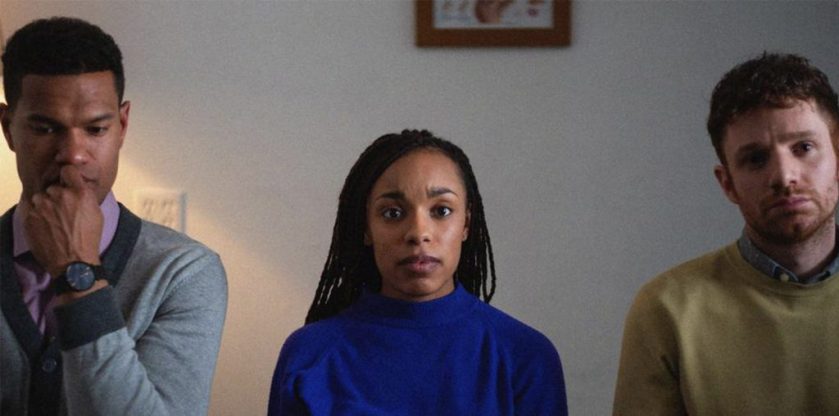
Jess (Jasmine Batchelor) agrees to give married friends Aaron (Sullivan Jones, left) and Josh (Chris Perfetti) a baby in The Surrogate.
By Richard Ades
The Surrogate is about a woman who is merely, as she puts it, a “vessel” for her best friend’s baby. When her pregnancy develops a complication, however, she finds herself becoming much more.
Writer/director Jeremy Hersh’s drama stars Jasmine Batchelor (The Good Fight) as the complicated New Yorker named Jess. Just why Jess does the things she does is not always easy to understand, but it helps if you pay close attention to the flick’s early moments.
In the first scene, Jess tries to sell would-be fiancé Nate (Brandon Micheal Hall) on a just-friends relationship, telling him she can’t commit because she has no idea what she’ll be doing in a year. She might even join the Peace Corps, she says.
Later, she’s seen trying to find donors to help expand the services of the nonprofit where she works as a web designer. She reluctantly stops only when her boss instructs her to stick to the agency’s core mission.
Jess, it seems, is a relentless do-gooder. Maybe that’s why we don’t see her being truly happy until she finds herself pregnant with the baby she’s agreed to have on behalf of best friend Josh (Chris Perfetti) and his husband, Aaron (Sullivan Jones). This leaves her so delirious that she’s puzzled when another pregnant woman says she can’t imagine giving up her own baby. To Jess, it seems the most natural thing in the world.
Then things take a startling turn when a prenatal test reveals the baby likely will have Down syndrome. For a while, Jess remains upbeat, cheerfully inviting Josh and Aaron to read up on the condition and to meet the parents of Down children. What she almost willfully fails to notice is that her two friends are going along with her only out of awkward politeness. Only later does she realize that the baby’s prognosis has changed everything.
Hersh’s movie is partly a character study of everyone involved in this gut-wrenching situation, but especially of Jess, who behaves in ways that are both admirable and unadmirable, predictable and unpredictable. Batchelor’s all-in portrayal helps us sympathize with her, whether or not we agree with her actions.
As it goes on, though, the film begins morphing into a debate on a question with no easy answers, in the process bringing up issues of race, class and sexuality. Before it’s over, various characters play the black card, the gay card, even the Jewish card. The effect is that they sometimes seem more like symbols than actual personalities.
This—plus an ending that is abrupt and almost capricious—make this a film that fails to move us quite as much as it enlightens us.
Rating: 3½ stars (out of 5)
The Surrogate (no MPAA rating) is available from VOD outlets beginning June 12.
Dolly Wilde, aka Joanna Morrigan (Beanie Feldstein), shares a musical moment with rock star John Kite (Alfie Allen) in How to Build a Girl. (Photo by Sven Arnstein/IFC Films)
By Richard Ades
Reading is usually an entertaining pastime, but for English teen Johanna Morrigan it’s a road map to dissatisfaction. That’s because she suspects her life will never live up to those of her literary heroines. For one thing, no Prince Charming ever shows up to save her from her humdrum existence.
“I do not think my adventure starts with a boy,” Johanna (Booksmart’s Beanie Feldstein) concludes early on. “I think it starts with me.”
This establishes the theme for How to Build a Girl, a comedy based on Caitlin Moran’s semiautobiographical novel about a girl bent on reinventing herself. Set in the early ’90s, it follows 16-year-old Johanna as she seeks to turn her writing talent into a fulfilling career. The quest eventually leads her to a dark corner of journalism in which she savages struggling bands as a poison-pen rock critic.
(Personal note: This portion of her saga struck a few autobiographical chords for me, as I long ago turned my love of writing into a career in journalism. And though I never became a rock critic, I worked with one who became famous for his devilishly nasty putdowns. Back to the movie.)
Directed by Coky Giedroyc from a script by Moran and John Niven, How to Build a Girl mixes witty invention with infectious exuberance. It quickly introduces us to Johanna’s large family, which includes her musically frustrated dad (Paddy Considine), her worn-out mom (Sarah Solemani) and her supportive gay brother (Laurie Kynaston)—as well as a dozen or so portraits of historic and fictional figures that regularly come to life to serve as her confidants and cheerleaders.
Johanna’s big break comes when she interviews for work with a London-based pop-culture magazine and lands a freelance gig thanks to sheer pluck and determination. Remaking herself with the help of a new name (Dolly Wilde), an eccentric wardrobe and red hair dye, she’s soon having the time of her life raving about the rock scene she’s never known before. She even has her first crush after meeting soulful singer John Kite (Alfie Allen). But then she makes a fangirl misstep and is able to salvage her career only by skewering the music scene she once praised.
Heading up the strong cast, Feldstein gives Johanna an indomitable spirit and a generally convincing Midlands accent. Behind the scenes, Oli Julian plays an indispensable role as composer of the flick’s original music.
Despite its inventiveness, the script eventually leads its heroine into a clichéd predicament, while the finale leaves us with a saccharine aftertaste. For the most part, though, Johanna’s makeover journey is a delightful and inspiring ride.
Rating: 4 starts (out of 5)
How to Build a Girl (rated R) opens May 8 at VOD outlets.
Amber Havard plays Kris, a troubled Texas teen with hopes of becoming a bull rider. (Photos courtesy of Samuel Goldwin Films)
By Richard Ades
Tough but touching, Bull is the story of a girl’s coming of age amid the direst of conditions. It’s also the story of her unlikely relationship with an aging rodeo performer, as well as a window into a subculture most of us know nothing about.
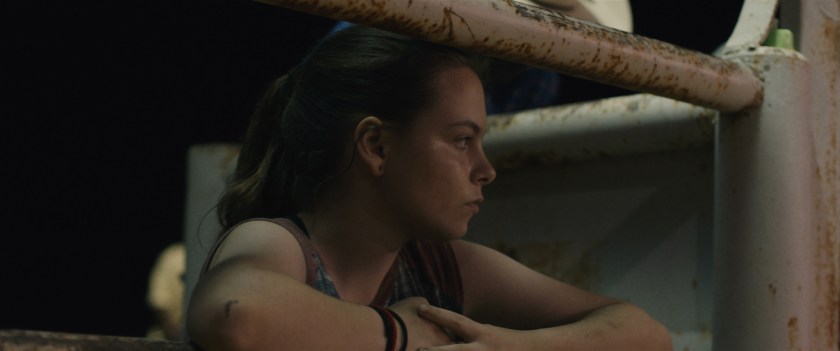
Kris (Amber Havard) is a 14-year-old living on the outskirts of Houston with her grandmother and younger sister while she waits for her mother to serve out a prison term. Mostly left on her own, she has a tendency to get into the kind of trouble that suggests she’ll eventually follow in her mom’s self-destructive footsteps.
One such incident lands Kris on the bad side of neighbor Abe (Rob Morgan), a former rodeo bull rider who lives next door. Hobbled by years’ worth of injuries, Abe can no longer ride, but he stubbornly clings to his old life by serving as one of the daredevils who race into the ring to divert bulls’ attention away from fallen contestants.
Despite being mad at Abe for forcing her to make amends by doing chores, Kris quickly becomes fascinated by his former occupation. When she sees him training teenage boys how to ride bulls, she begs him to let her try and soon seizes on bull riding as her ticket to a better life.
That sounds like the making of a happy, not to mention sappy, ending, but director/co-writer Annie Silverstein has no intention of giving her characters easy solutions. Abe and Kris are too complicated for that, as are their problems.
Despite his injuries, Abe (Rob Morgan) still clings to the rodeo, where he was once a successful competitor.
Abe is too bitter over life’s setbacks to willingly serve as Kris’s surrogate father, and she’s not looking for one anyway. She clearly craves male companionship, but—perhaps taking after her mother—she appears to be drawn to “bad boys.”
She first gloms onto a mischief-making teen named Daryl (Reece McClure), but she soon transfers her attention to Billy (Steven Boyd), an adult who turns out to be just as unscrupulous as he seems. Savvy performances by leads Morgan and Havard, sensitively captured by director Silverstein, make the consequences both harrowing and moving.
Though they’re very different films, it’s hard not to compare Bull with Chloe Zhao’s The Rider (2017). Each exposes us to a part of Western culture that’s often overlooked—Native American cowboys in the earlier film, black cowboys in this one. And each deals with a man whose health challenges keep him from plying his chosen career.
Both films are great, but Bull gets the edge due to its absorbing tale of two lonely people who need each other far more than they’re willing to admit.
Rating: 4 stars (out of 5)
Bull opens May 1 through VOD outlets. The film is not rated but contains rough language and brief instances of sexual content, nudity and drug use.
Jesse Eisenberg as Marcel Marceau in Resistance (Pantaleon Films)
By Richard Ades
There may be no performing artist who’s despised and ridiculed more than the mime. But maybe after seeing Resistance, people will start to give these silent storytellers the benefit of the doubt.
The World War II thriller focuses on that most famous mime of all time, Marcel Marceau, and reveals that he definitely had a story to tell, though he mostly kept to himself. It turns out that back when he was coming of age in occupied France, Marceau joined the Resistance and was instrumental in helping hundreds of Jewish children escape the Holocaust.
It’s a fascinating and unique story, despite the fact that writer/director Jonathan Jacubowicz fails to tell it in a manner that’s fascinating or unique—or even very believable.
True, we’re used to reality-based tales taking liberties with the facts in order to ramp up the drama (the bullet-riddled escape from Iran in Argo comes to mind). But Resistance is filled with so many clichés and cliffhangers that we start to doubt virtually everything we see. Just to take one: Did Marceau’s father, a butcher, really oppose his son’s desire to be an actor, or is that simply Jacubowicz’s attempt to add the kind of parent-child tension that invariably leads to a moving reconciliation?
Further feeding our doubts, the movie casts 36-year-old Jesse Eisenberg as Marceau, even though he was actually a teenager at the time. You may or may not feel Eisenberg is able to shed his usual persona and do a convincing job here (I’m not impressed), but it doesn’t help that the movie depicts Marceau as years older than he really was. You have to wonder what else is made up.
Another weakness: Despite focusing on someone who came to personify mime—a craft that calls on viewers to use their imagination—Resistance seems determined to spoon-feed us information.
Just in case we don’t know what the Holocaust was, the first scene shows a soon-to-be-orphaned Jewish girl (Bella Ramsey) asking her parents, “Why do they hate us?” And just in case we don’t know that the Nazis were evil, the film periodically cuts away from Marceau to show vicious Gestapo agent Klaus Barbie (Matthias Schweighofer) methodically shooting, beating or torturing people. For the record, Barbie was a real-life monster, but Schweighofer’s version comes off as the kind of psychopathic sadist who could just as easily double as the villain in a run-of-the-mill melodrama.
Despite all these problems, the film does succeed on some levels. The cast—including Clemence Poesy as Marceau’s love interest and fellow Resistance fighter, Emma—is good enough to make us care about the people trying to survive and oppose the Nazis’ reign of terror. As a result, viewers who are able to overlook the film’s excesses will watch many scenes in a heightened state of tension.
But the film’s real value lies in its revelation of the heroism displayed by a well-known figure and many others in response to the 20th century’s greatest evil. It provides the kind of inspiration that’s welcome now that we need all the heroes we can find.
Rating: 3 stars (out of 5)
Resistance (rated R for bloodless but troubling violence) opens March 27 at VOD outlets.
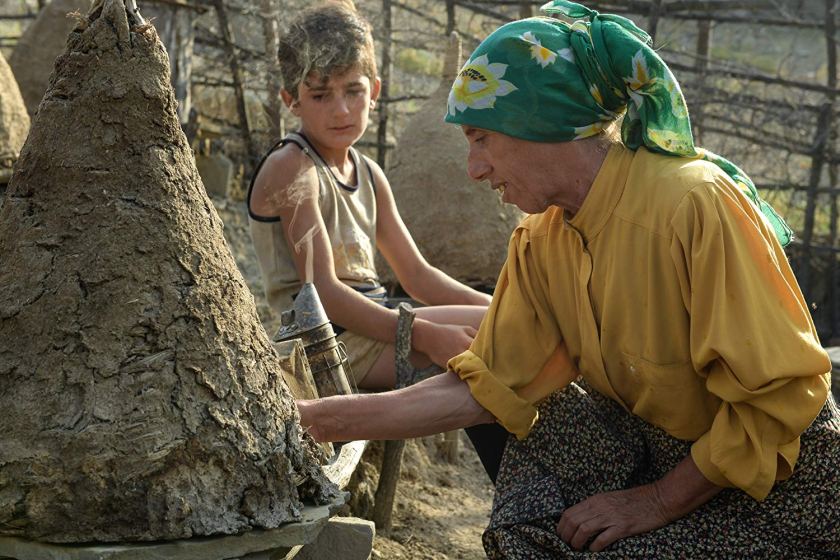
Beekeeper Hatidze Muratova tends to one of her hives while a young neighbor watches in a scene from Honeyland.
By Marilyn Fais and Richard Ades
Note: Guest critic Marilyn Fais helps review Honeyland, a film from North Macedonia that has been nominated for Academy Awards in two categories: Documentary and International Feature. Directed by Tamara Kotevska and Ljubomir Stefanov, the film originally was meant to be a short documentary about the land surrounding a river in the country’s central region. Then the filmmakers met Hatidze Muratova, a 50-something woman eking out a living as a beekeeper, and they ultimately decided to focus their lens on her unusual life.
If you decide to see Honeyland, don’t expect any big moments, but expect to be captivated by many small moments. Taking place in a remote area of North Macedonia, the film follows one woman, Hatidze Muratova, as she goes about her subsistence life as a beekeeper.
She’s in her mid-50s and lives with her ailing mother. They have no neighbors, and it appears they’re the only people around for miles.
Then they get neighbors—a large nomadic family led by Hussein and Ljutve Sam—and the interactions that follow add new complications to Hatidze’s difficult existence. Between her reactions to these newcomers and her brief but poignant talks with her mother, viewers gain new insights into Hatidze’s life and philosophy.
In the process, they also gain insights into the challenges faced by anyone attempting to live in harmony with the natural world. These make this unusual film both intensely personal and sadly universal.
Rating: 4 stars (out of 5)
Honeyland opens Feb. 7 at the Gateway Film Center in Columbus.
Mikhail Khodorkovsky (right) faces the consequences of being on the wrong side of Vladimir Putin in Citizen K. (Zachary Martin/Greenwich)
By Richard Ades
Early in the documentary Citizen K, Mikhail Khodorkovsky recalls Russia’s own “Wild West” era. It occurred during a roughly seven-year period following the 1991 fall of the Soviet Union and the subsequent decline of communist authoritarianism.
The resulting legal vacuum allowed Khodorkovsky and other enterprising individuals to make their fortunes through often-shady means. It also allowed many of these so-called “gangster capitalists” to be killed for their money while Moscow turned into the “murder capital” of Europe.
Fortunately for Khodorkovsky, he managed to avoid the assassins, though he soon made an enemy who was equally ruthless: Vladimir Putin.
Written and directed by Alex Gibney, Citizen K is a history of modern Russia as seen through the eyes of Khodorkovsky, who amassed billions through his ownership of a major oil company. It describes the ways he and other self-created capitalists attempted to remake Russia for their own benefit. It also describes how Putin, once an out-of-work KGB agent, rose to power by appealing to people’s nostalgia for Soviet power and influence.
Finally, it explains how Khodorkovsky and others found themselves working at cross-purposes with Putin, putting a target on their backs. Some are alleged to have paid for this with their lives. In Khodorkovsky’s case, he was put on trial for financial crimes and ended up spending 10 years in a remote prison.
Majestically photographed by cinematographers Mark Garrett and Denis Sinyakov, with an equally grand score by Robert Logan and Ivor Guest, Citizen K is an impressive piece of filmmaking. It’s also an invaluable history lesson for any who want to understand how Russia became the dangerous adversary it is today—and why President Trump’s apparent failure to recognize that fact is so concerning.
If there’s one thing the documentary lacks, it’s someone to root for.
The thousands of stories based on America’s lawless Wild West generally gave us a hero who showed up to save the day. In this tale of Russia’s “Wild West” and its aftermath, it’s hard to decide whether our protagonist deserves that label.
In an archival interview, a young Khodorkovsky proudly admits that greed is his chief motivator. Other historic footage makes it clear that he was willing to lay off thousands to achieve his financial goals. It’s even suggested that he may have resorted to tactics such as bombings or murder.
Only later, after being released from prison, does Khodorkovsky take on a task that doesn’t seem entirely self-serving: From his new home in the UK, he funds efforts to promote democracy in his homeland. That does seem heroic.
By this point in the film, however, we’ve learned enough about the way “politics” work in Putin’s Russia to suspect that it’s also a quixotic exercise in futility.
Rating: 3½ stars (out of 5)
Citizen K opens Feb. 7 at the Gateway Film Center in Columbus.