Saying goodbye to educational freedom

By Richard Ades

Jan. 6, 2021, will forever be remembered as the day rioters stormed the U.S. Capitol and tried to overthrow the lawful results of a presidential election.

That’s enough to relegate any date to permanent disgrace, but Jan. 6 re-earned its infamy just two years later. That’s when Florida governor and presidential hopeful Ron DeSantis began what amounted to a hostile takeover of one of his state’s most prestigious schools: New College of Florida.

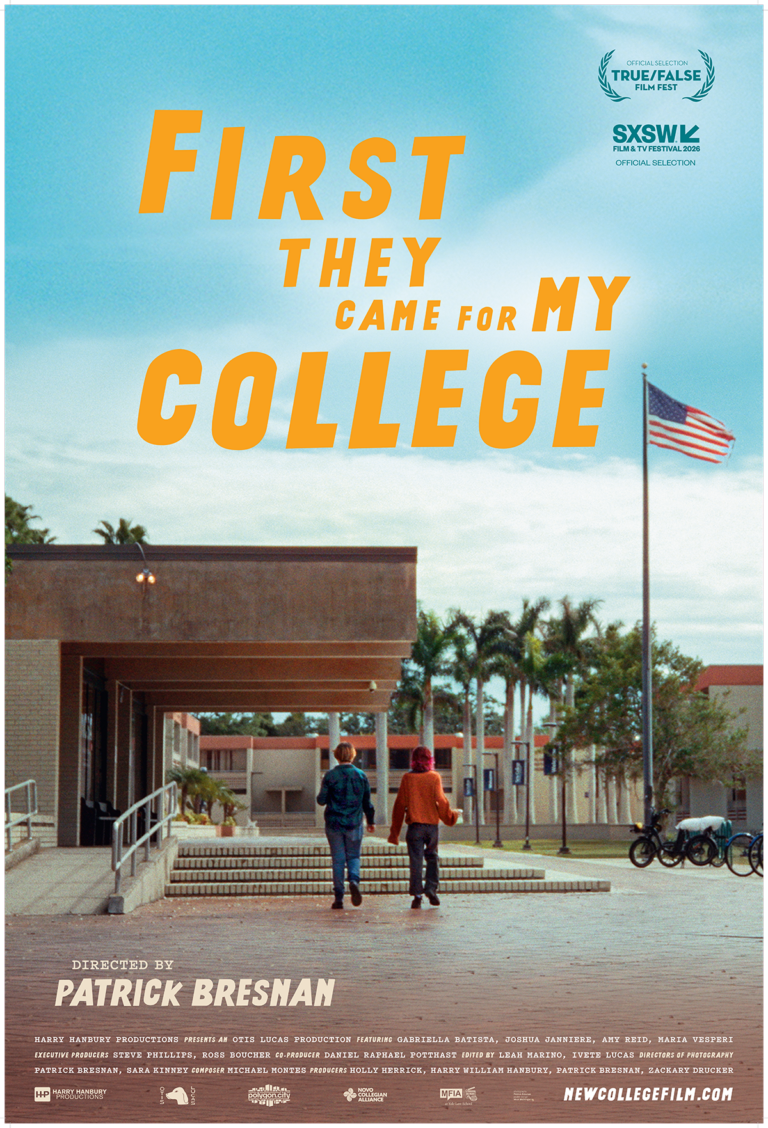
As recounted in the documentary First They Came for My College, the story is both sad and—as suggested by the title—cautionary. Directed by Patrick Bresnan (Rabbit Hunt) with help from students both in front of and behind the camera, the film lays bare a strategy that’s subsequently been followed by other politicians eager to undermine what they see as “woke” educational practices.

The doc begins with archival footage that reveals what made New College so special. Since opening in 1959, the school has prided itself on promoting independent study and freedom of thought without state interference.

Gaby Batista, one of several students who make regular appearances in the film, explains that New College has always practiced what she calls “radical acceptance.” One apparent result is a student body with a high percentage of gay and trans students. Another is a curriculum with liberal-minded subjects such as race and gender studies.

But on Jan. 6, 2023, that all changed. The doc shows what happened.

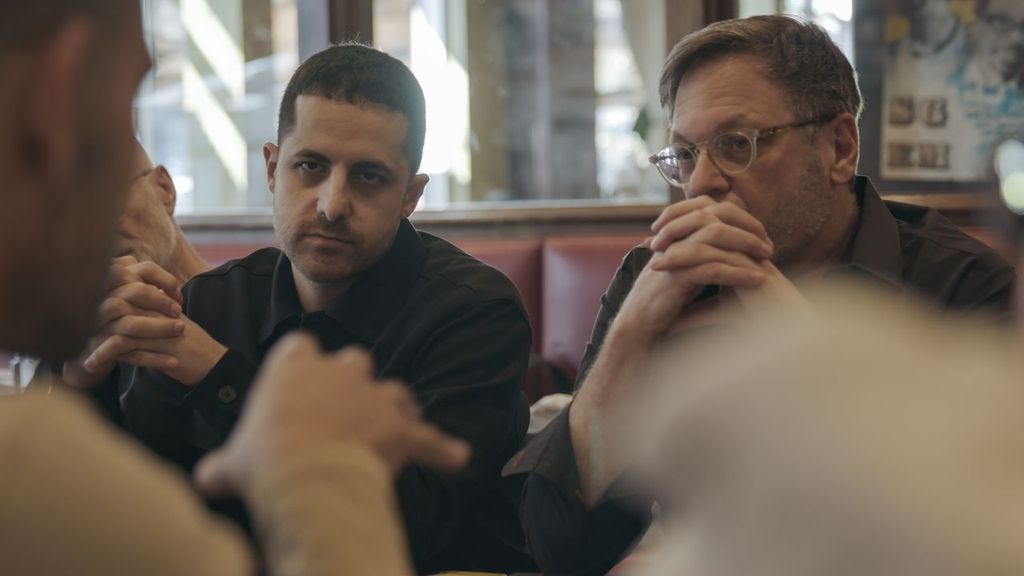
At a board meeting, six DeSantis-appointed college trustees make their first appearance, including ultraconservatives Christopher Rufo (famed for his attacks on “critical race theory”) and Matthew Spalding (who would later play a major role in Project 2025). At the same time, the college’s popular president is fired and immediately replaced by Richard Corcoran, an interim president who’s amenable to the new trustees’ applecart-upsetting plans.

After observing these proceedings, a student ruefully observes that tyrannies always have an advantage over democracies when it comes to speed, since one person can make changes faster than a group can decide what to do about them.

It becomes obvious that the newly appointed trustees intend to take full advantage of that speed, quickly targeting the tenure that protects the jobs of professors who support the college’s longtime traditions. But it also becomes obvious that neither New College’s students nor its parents and alumni intend to let those traditions die without a fight.
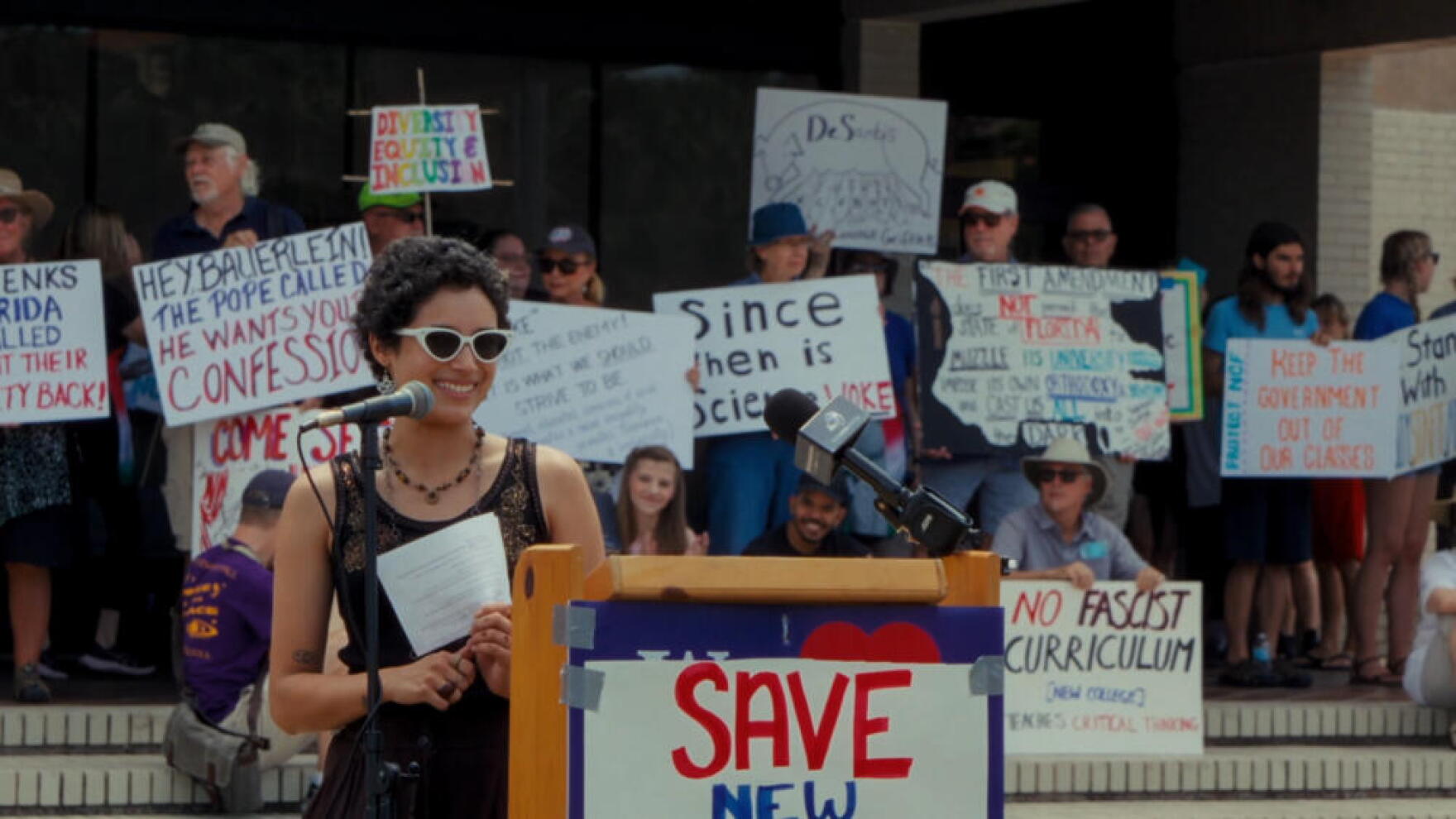
New College student Gaby Batista speaks at a rally against the school’s conservative takeover.

In meeting after meeting, despite being limited to one minute apiece, these critics don’t spare the decibels as they complain about the school’s new rightward drift.

While recording responses to New College’s forced metamorphosis, director Bresnan particularly focuses on the staff of The Catalyst, a student newspaper run under the guidance of Professor Maria Vesperi. Week after week, the young journalists meet to complain and commiserate as they attempt to report on the changes happening around them.

From time to time, Bresnan also takes a look at the artistic efforts—including painting, theater and filmmaking—that have always been a big part of New College life. These interludes offer a break from all the political turmoil, but the break isn’t completely tension-free, since it shows us what could be lost once the new trustees complete the school’s transformation.

And the transformation does continue apace, past the end of the semester and throughout the following school year. Covering it all with sensitivity and drama, Bresnan’s film benefits greatly from composer Michael Montes’s evocative score.

First They Came for My College manages to be at once uplifting, depressing and infuriating. It offers portraits of tenacity in the face of change, along with a virtual blueprint for the kind of political tyranny that has become all too common in our supposedly free society.

Rating: 4½ stars (out of 5)

First They Came for My College is currently showing in Gainesville, St. Petersburg and Miami, Florida, and opens next week in Milwaukee, Austin and New York City. An Oct. 22 screening is planned at the Wexner Center in Columbus, Ohio. For a list of other upcoming screenings, visit firsttheycameformycollege.com/screenings.
Docs serve in a war where they’re often the target

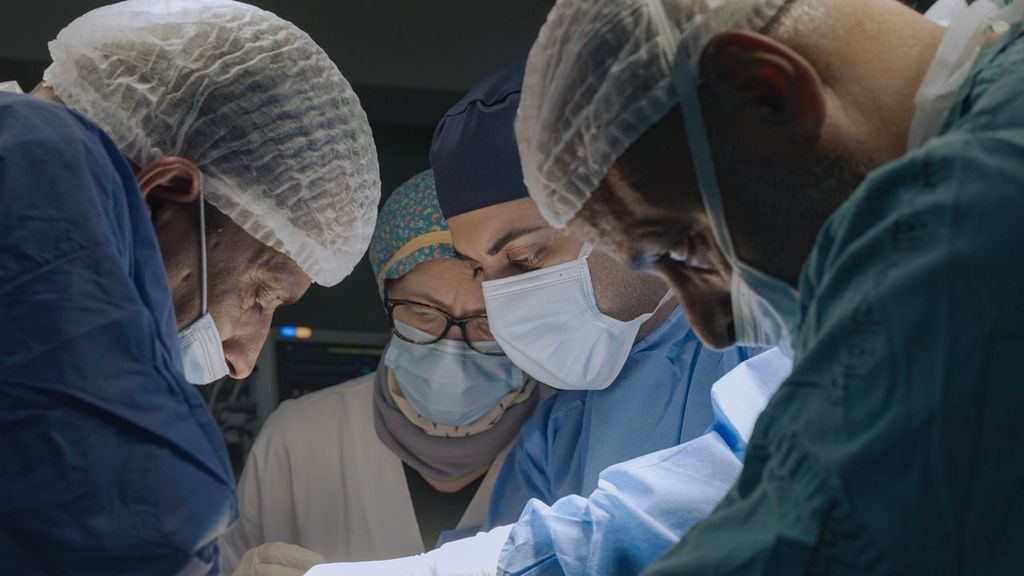
Dr. Feroze Sidhwa (second from right) works to save a patient at Gaza’s Nasser Hospital. (Photos courtesy of MPI Media)

By Richard Ades

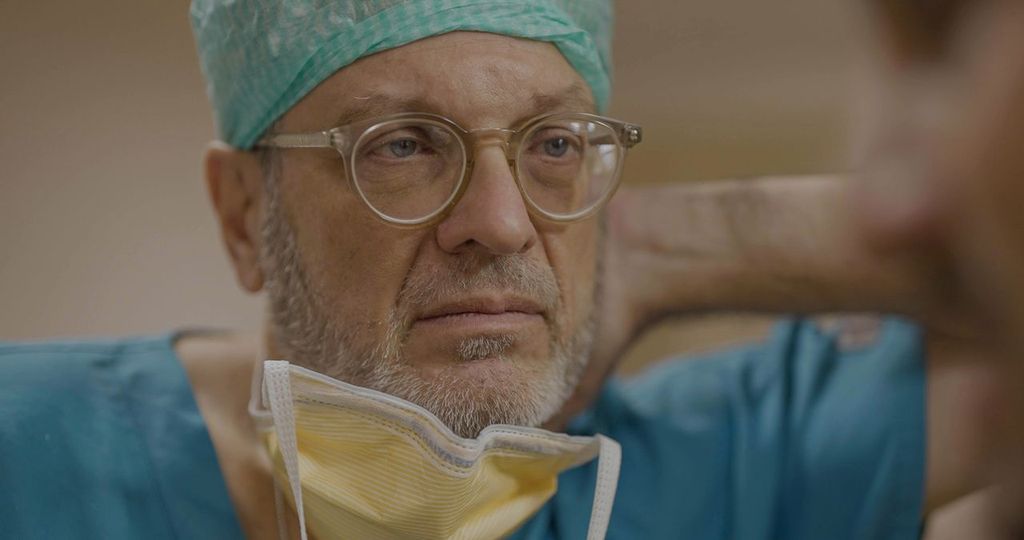
American Doctor offers a devastating look at the war in Gaza through the eyes of three physicians who’ve served there. Sharing their experiences is important to them—but only if they’re shared fully and honestly, one of them insists early on.

North Carolina-based surgeon Mark Perlmutter is attempting to show an image of children who’ve been mortally wounded in the conflict. “This is what my tax dollars did,” he tells director Poh Si Teng, referring to the U.S.’s support for the Israeli military.

Teng tells him the graphic image may need to be blurred to preserve the children’s dignity, but Perlmutter says doing so would amount to “journalistic malpractice.” The image is shown as is.  

Perlmutter, a Jewish American, has been a passionate opponent of Israel’s devastating war on Gaza, which it launched in response to Hamas’s Oct. 7, 2023, terrorist attack. In fact, Perlmutter’s passion reportedly was what inspired Teng to quit her job and take on the task of bringing the Gazan conflict home to America.

Teng has said she also was inspired by medical dramas like The Pitt, with their built-in emotional resonance. Showing real-life medical emergencies in Gaza could create the same resonance, she reasoned, and help make Americans care about a U.S.-supported war that they’ve largely ignored. And, indeed, the documentary’s scenes of surgeons working frantically to save lives and limbs are just as tense as their scripted counterparts.

There’s one major difference, though: The Pitt’s “Dr. Robby” and other fictional physicians don’t have to worry about being bombed or otherwise murdered while doing their jobs. That’s not the case in Gaza, where Israel has often ignored the rules of military engagement by attacking hospitals and other medical facilities.

North Carolina-based Dr. Mark Perlmutter is a longtime critic of the war in Gaza.

“You don’t bomb hospitals,” says Feroze Sidhwa, a California-based emergency doctor who’s also featured in the film. “This is barbarity.”

Sidhwa acknowledges Israeli claims that some hospitals are legitimate targets because Hamas tunnels run underneath them, but he claims the military’s “evidence” for such tunnels is nothing more than AI-created fabrications.

Both Perlmutter and Sidhwa also charge the military with targeting children, the latter claiming that kids are hundreds of times more likely to be killed in Gaza than they are in Russia’s war with Ukraine.

Rounding out the three featured American doctors is Thaer Ahmad, a Chicago-based Palestinian-American who spends much of the film fighting an Israeli bureaucracy that seems determined to keep him from practicing medicine in Gaza.

Drs. Thaer Ahmad (left) and Mark Perlmutter in a scene from American Doctor

Effectively edited by Ema Ryan Yamazaki and Christopher White, the film skips back and forth between time periods and locations. When they’re not fighting to save lives in Gaza operating rooms, the doctors are shown fighting another kind of battle as they talk to groups and the media about what’s really going on in the war. At one point, they and others also converge on Washington D.C. to talk to members of Congress.

One of their messages is that Israel should be pressured to stop targeting non-combatants, including health care workers. It often seems like a pointless exercise, however, as they make little headway against a government long committed to supporting Israel, and against a society that often equates criticism of Israel with anti-Semitism.

Sensitively scored by composer Suad Bushnaq, the film reaches its emotional peak when what the doctors had long feared comes to pass: Their hospital is hit by a bomb, showing it’s no more immune from attacks than other Gaza medical facilities.

As a portrait of men trying to do good in the midst of an impossible situation, American Doctor will likely inspire and inform you, and it will most certainly infuriate you. What it won’t do is leave you unmoved.

Rating: 5 stars (out of 5)

American Doctor opens Sept. 4 at Columbus’s Gateway Film Center, as well as in Austin, Baltimore, Chicago, Dallas, Denver, Detroit, Minneapolis, New Orleans, Portland (Oregon), Richmond (Virginia), Seattle-Tacoma and Washington D.C. The film will expand to other areas Sept. 11.