
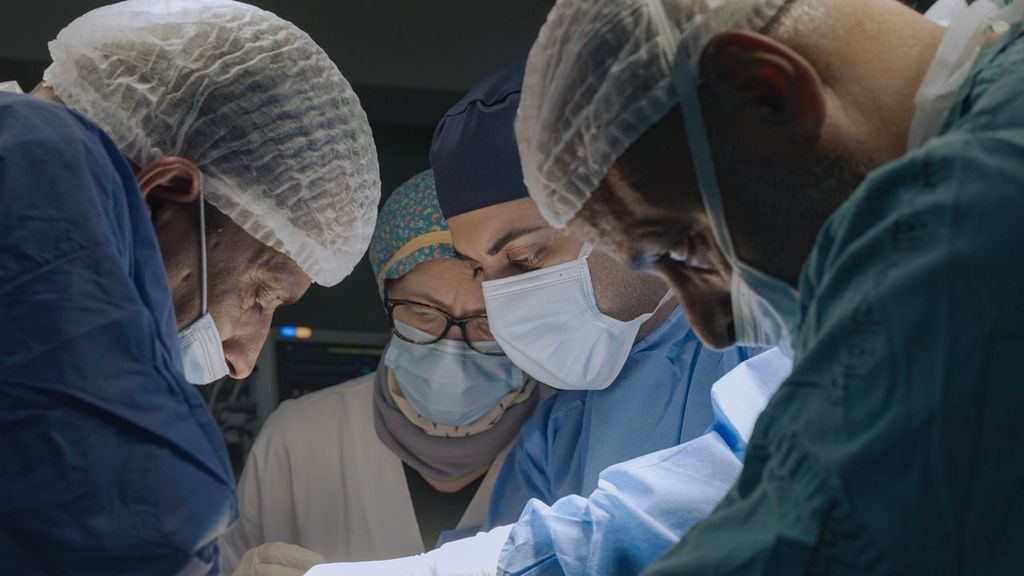
Dr. Feroze Sidhwa (second from right) works to save a patient at Gaza’s Nasser Hospital. (Photos courtesy of MPI Media)
By Richard Ades
American Doctor offers a devastating look at the war in Gaza through the eyes of three physicians who’ve served there. Sharing their experiences is important to them—but only if they’re shared fully and honestly, one of them insists early on.
North Carolina-based surgeon Mark Perlmutter is attempting to show an image of children who’ve been mortally wounded in the conflict. “This is what my tax dollars did,” he tells director Poh Si Teng, referring to the U.S.’s support for the Israeli military.
Teng tells him the graphic image may need to be blurred to preserve the children’s dignity, but Perlmutter says doing so would amount to “journalistic malpractice.” The image is shown as is.
Perlmutter, a Jewish American, has been a passionate opponent of Israel’s devastating war on Gaza, which it launched in response to Hamas’s Oct. 7, 2023, terrorist attack. In fact, Perlmutter’s passion reportedly was what inspired Teng to quit her job and take on the task of bringing the Gazan conflict home to America.
Teng has said she also was inspired by medical dramas like The Pitt, with their built-in emotional resonance. Showing real-life medical emergencies in Gaza could create the same resonance, she reasoned, and help make Americans care about a U.S.-supported war that they’ve largely ignored. And, indeed, the documentary’s scenes of surgeons working frantically to save lives and limbs are just as tense as their scripted counterparts.
There’s one major difference, though: The Pitt’s “Dr. Robby” and other fictional physicians don’t have to worry about being bombed or otherwise murdered while doing their jobs. That’s not the case in Gaza, where Israel has often ignored the rules of military engagement by attacking hospitals and other medical facilities.
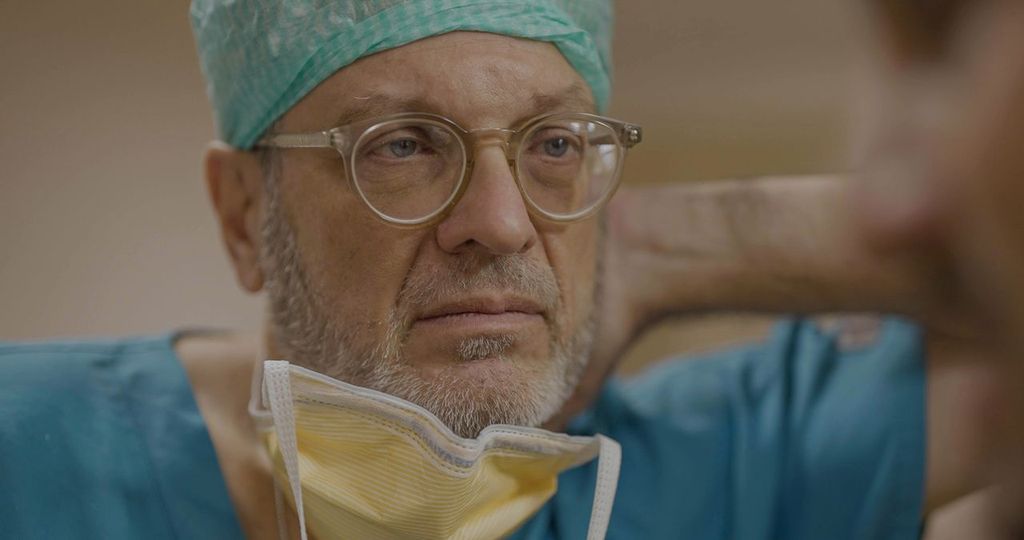
North Carolina-based Dr. Mark Perlmutter is a longtime critic of the war in Gaza.
“You don’t bomb hospitals,” says Feroze Sidhwa, a California-based emergency doctor who’s also featured in the film. “This is barbarity.”
Sidhwa acknowledges Israeli claims that some hospitals are legitimate targets because Hamas tunnels run underneath them, but he claims the military’s “evidence” for such tunnels is nothing more than AI-created fabrications.
Both Perlmutter and Sidhwa also charge the military with targeting children, the latter claiming that kids are hundreds of times more likely to be killed in Gaza than they are in Russia’s war with Ukraine.
Rounding out the three featured American doctors is Thaer Ahmad, a Chicago-based Palestinian-American who spends much of the film fighting an Israeli bureaucracy that seems determined to keep him from practicing medicine in Gaza.
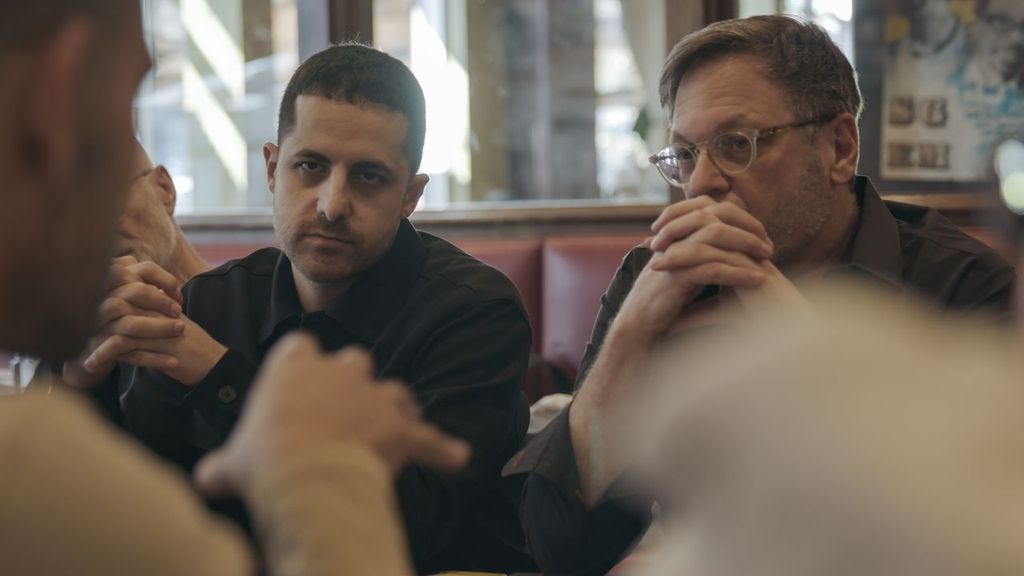
Drs. Thaer Ahmad (left) and Mark Perlmutter in a scene from American Doctor
Effectively edited by Ema Ryan Yamazaki and Christopher White, the film skips back and forth between time periods and locations. When they’re not fighting to save lives in Gaza operating rooms, the doctors are shown fighting another kind of battle as they talk to groups and the media about what’s really going on in the war. At one point, they and others also converge on Washington D.C. to talk to members of Congress.
One of their messages is that Israel should be pressured to stop targeting non-combatants, including health care workers. It often seems like a pointless exercise, however, as they make little headway against a government long committed to supporting Israel, and against a society that often equates criticism of Israel with anti-Semitism.
Sensitively scored by composer Suad Bushnaq, the film reaches its emotional peak when what the doctors had long feared comes to pass: Their hospital is hit by a bomb, showing it’s no more immune from attacks than other Gaza medical facilities.
As a portrait of men trying to do good in the midst of an impossible situation, American Doctor will likely inspire and inform you, and it will most certainly infuriate you. What it won’t do is leave you unmoved.
Rating: 5 stars (out of 5)
American Doctor opens Sept. 4 at Columbus’s Gateway Film Center, as well as in Austin, Baltimore, Chicago, Dallas, Denver, Detroit, Minneapolis, New Orleans, Portland (Oregon), Richmond (Virginia), Seattle-Tacoma and Washington D.C. The film will expand to other areas Sept. 11.


