‘Parasite’ occupies top spot at 18th annual Columbus Film Critics Association awards

Columbus Film Critics Association logo

Director/co-writer Bong Joon-ho’s Parasite (Gisaengchung) has been named Best Film in the Columbus Film Critics Association’s 18th annual awards, which recognize excellence in the film industry for 2019. The thrilling film about a struggling family that schemes to obtain lucrative jobs in a wealthy household also claimed three other awards. Parasite was named Best Foreign Language Film, and Bong was honored as Best Director and for Best Original Screenplay with his co-writer Han Jin-won.

Two other individuals won multiple awards. Adam Driver was named Best Actor for Marriage Story and Actor of the Year, which recognizes his exemplary 2019 body of work that also consists of The Dead Don’t Die, The Report and Star Wars: Episode IX – The Rise of Skywalker. Florence Pugh was tabbed as Best Supporting Actress for Little Women and Breakthrough Film Artist for her performance in that film as well as in Fighting With My Family and Midsommar.

Columbus-area critics lauded Best Film runner-up Knives Out with Best Ensemble and Bob Ducsay for Best Film Editing. Us also won two awards with Lupita Nyong’o selected as Best Actress and Michael Abels honored for Best Score. In addition to Pugh’s Best Supporting Actress win, Little Women’s other prize went to Greta Gerwig for Best Adapted Screenplay. Other individuals commended for their achievements include Best Supporting Actor Willem Dafoe (The Lighthouse) and Roger Deakins (1917) for Best Cinematography.

Other winners were: Best Documentary Apollo 11; Best Animated Film Toy Story 4; and Best Overlooked Film The Last Black Man in San Francisco.

Founded in 2002, the Columbus Film Critics Association, formerly the Central Ohio Film Critics Association, comprises film critics based in Columbus, Ohio, and its surrounding areas. Its membership consists of 28 print, radio, television and online critics. COFCA’s official website at www.cofca.org contains links to member reviews and past award winners.

Winners were announced at a private party on Jan. 2.

Complete list of awards:

Best Film
1. Parasite (Gisaengchung)
2. Knives Out
3. 1917
4. Little Women
5. Marriage Story
6. The Farewell
7. Once Upon a Time… in Hollywood
8. The Irishman
9. Uncut Gems
10. Jojo Rabbit

Best Director
-Bong Joon-ho, Parasite (Gisaengchung)
-Runner-up: Sam Mendes, 1917

Best Actor
-Adam Driver, Marriage Story
-Runner-up: Adam Sandler, Uncut Gems

Best Actress
-Lupita Nyong’o, Us
-Runner-up: Florence Pugh, Midsommar

Best Supporting Actor
-Willem Dafoe, The Lighthouse
-Runner-up: Joe Pesci, The Irishman

Best Supporting Actress
-Florence Pugh, Little Women
-Runner-up: Scarlett Johansson, Jojo Rabbit

Best Ensemble
Knives Out
-Runner-up: Parasite (Gisaengchung)

Actor of the Year (for an exemplary body of work)
-Adam Driver (The Dead Don’t Die, Marriage Story, The Report and Star Wars: Episode IX – The Rise of Skywalker)
-Runner-up: Florence Pugh (Fighting with My Family, Little Women and Midsommar)

Breakthrough Film Artist
-Florence Pugh (Fighting with My Family, Little Women and Midsommar) – (for acting)
-Runner-up: Joe Talbot, The Last Black Man in San Francisco – (for directing, producing and screenwriting)

Best Cinematography
-Roger Deakins, 1917
-Runner-up: Jarin Blaschke, The Lighthouse

Best Film Editing
-Bob Ducsay, Knives Out
-Runner-up: Lee Smith, 1917

Best Adapted Screenplay
-Greta Gerwig, Little Women
-Runner-up: Taika Waititi, Jojo Rabbit

Best Original Screenplay
-Bong Joon-ho and Han Jin-won, Parasite (Gisaengchung)
-Runner-up: Rian Johnson, Knives Out

Best Score
-Michael Abels, Us
-Runner-up: Thomas Newman, 1917

Best Documentary
Apollo 11
-Runner-up: American Factory

Best Foreign Language Film
Parasite (Gisaengchung)
-Runner-up: Portrait of a Lady on Fire (Portrait de la jeune fille en feu)

Best Animated Film
Toy Story 4
-Runner-up: I Lost My Body (J’ai perdu mon corps)

Best Overlooked Film
The Last Black Man in San Francisco
-Runner-up: Ready or Not

COFCA offers its congratulations to the winners.

Previous Best Film winners:

2002: Punch-Drunk Love
2003: Lost in Translation
2004: Million Dollar Baby
2005: A History of Violence
2006: Children of Men
2007: No Country for Old Men
2008: WALL·E
2009: Up in the Air
2010: Inception
2011: Drive
2012: Moonrise Kingdom
2013: Gravity
2014: Selma
2015: Spotlight
2016: La La Land
2017: Lady Bird
2018: If Beale Street Could Talk

For more information about the Columbus Film Critics Association, please visit www.cofca.orgor e-mail info@cofca.org.

Dramatization of real-life scandal could be better

BombshellTrio
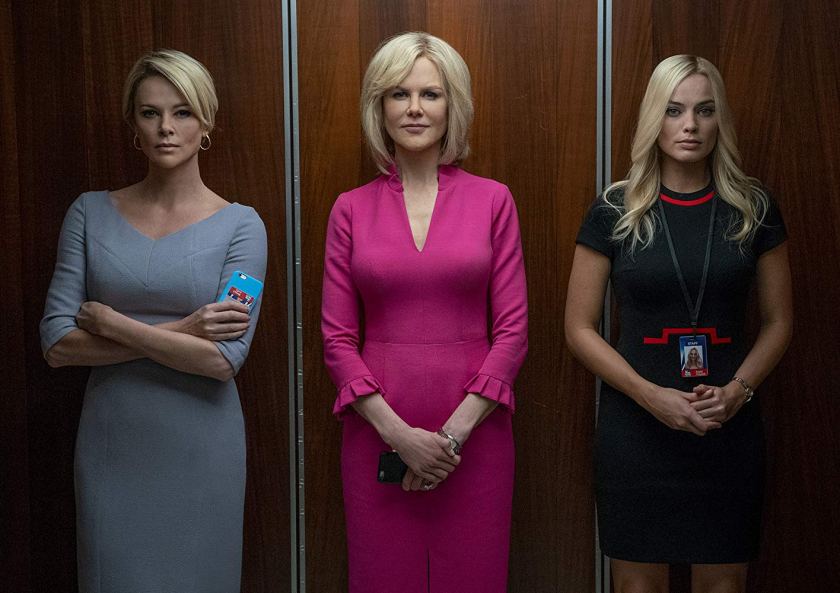
Megyn Kelly, Gretchen Carlson and Kayla Pospisil (Charlize Theron, Nicole Kidman and Margot Robbie, from left) share an elevator ride in Bombshell. (Lionsgate)

By Richard Ades

Bombshell isn’t a complete dud, but neither is it as effective as it could be. Perhaps that’s because it spreads too little explosive power over too wide an area.

The flick is designed as an expose of Fox News and particularly of the sexual-harassment charges that in 2016 brought down chairman and CEO Roger Ailes. On the way there, however, it stops to explain such things as how Fox and President Donald J. Trump became joined at the hip, and why the network’s women journalists tend to be pretty blondes in short skirts.

It also attempts to tell a tale of feminist empowerment, but its ability to inspire is stymied by the fact that most of the female characters display more loyalty to their careers than to each other. Further weakening the message is the film’s tone, which wanders haphazardly between drama and spoofery.

Maybe director Jay Roach (Meet the Parents, Meet the Fockers) was not the right person to helm this ambitious take on a real-life scandal. Or maybe Charles Randolph was not the right person to write it, even though he co-wrote a much better historical expose, 2015’s The Big Short.

But the cast, at least, is perfect.

Particularly laudable is Charlize Theron’s impersonation of Megyn Kelly, whose questioning of Trump’s misogynistic tendencies during a 2015 presidential debate made her the target of his unquenchable fury. Kelly serves as the story’s main narrator, which is a mixed blessing.

As a prominent Fox talent, she is well-suited to explaining the company’s power structure, including the fact that Ailes ultimately answers to owner Rupert Murdoch and his sons. But, like her real-life counterpart, Theron’s Kelly is difficult to like. When the scandal begins unfolding, she reacts as the lawyer she is, refusing to get involved until she’s had a chance to weigh the evidence—and the risk to herself.

BombshellTheronLithgow
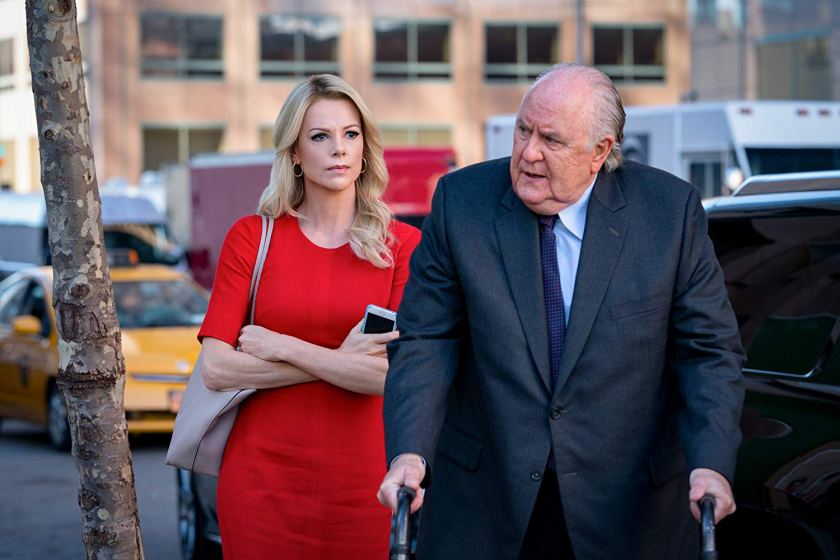
Megyn Kelly (Charlize Theron) takes a walk with her boss, Roger Ailes (John Lithgow). (Photo by Hilary B Gayle)

More relatable is fellow newswoman Gretchen Carlson (Nicole Kidman), who is fired after doing such un-Fox-like things as appearing on air without makeup and calling for assault weapons to be banned. She subsequently sues Ailes for sexual harassment and surprised to find that none of his other victims is eager to follow her lead.

Those other victims include Kayla Pospisil (Margot Robbie), an ambitious producer and self-described “evangelical millennial” who receives a first-hand lesson in Ailes’s tendency to hide sexual innuendo under a demand that she prove her “loyalty.” (Kayla, one of the story’s few fictional characters, is said to be based on several former Fox employees.)

The decrepit Ailes himself is played by a barely recognizable John Lithgow as an executive who has been manipulating women for so long that he seems genuinely surprised when his behavior becomes a legal matter.

Bombshell reveals several interesting historical tidbits, including the antipathy that Fox’s bigwigs originally held for the upstart Trump. It also includes a few laughs, though they don’t always work to the film’s benefit.

When Kayla falls into bed with co-worker Jess Carr (SNL’s Kate McKinnon), their relationship is defined by light banter that makes no attempt to explain why the evangelical Kayla has so little trouble squaring lesbian sex with her religious beliefs.

Other laughs are engendered by the appearance of stand-ins for rascally celebrities such as Rudy Giuliani (Richard Kind) and Geraldo Rivera (Tony Plana). In such cases, the movie’s uncanny impersonations undermine the story by shoving it unceremoniously into spoof territory.

Bombshell benefits from a strong cast and a subject that is both timely and fascinating. If it hadn’t been weakened by so-so execution, it might have lived up to its name.

Rating: 3 stars (out of 5)

Bombshell (rated R) opens Dec. 20 at theaters nationwide.

Tale of hero’s ordeal marred by stereotypical depiction of woman journalist

Richard Jewell crowd control
The title character (Paul Walter Hauser) tries to keep bystanders safe from an imminent bombing in Richard Jewell. (Photos by Claire Folger/Warner Bros. Pictures)

By Richard Ades

Richard Jewell is the fact-based story of a hero who was turned into a pariah by the media and the FBI. Clint Eastwood’s dramatization of the scandal would be rather effective if it weren’t guilty of the same kind of injustice.

The real-life Jewell was working as a security guard during the 1996 Olympics in Atlanta when he happened upon a suspicious-looking backpack that had been abandoned at a public concert. He alerted the police, who reluctantly investigated and found three pipe bombs inside. Jewell then helped police clear the area, so that when the bombs went off, many members of the public were injured, but only one was killed.

Jewell was at first celebrated for saving lives, but he soon became the FBI’s prime suspect because he fit the profile of a ne’er-do-well who would create such a disaster in order to cast himself as the hero. When the media got hold of this theory, Jewell was effectively tried in the press even though he hadn’t been officially charged.

Eastwood’s account of the injustice, scripted by Billy Ray, begins slowly and effectively. Jewell (a pitch-perfect Paul Walter Hauser) is depicted as an individual whose lifelong dream of becoming a police officer is undercut by his gung-ho attitude. At one point, he loses a job as a college security guard because he insists on barging into dorm rooms and even stopping cars on the highway in order to enforce campus rules.

Stymied in his career and perpetually ridiculed because of his weight and because he lives with his mother (Kathy Bates), Jewell considers himself a loser. In other words, the FBI’s suspicions following the bombing are not completely out of left field.

What is out of left field is Eastwood’s depiction of Kathy Scruggs, the Atlanta Journal-Constitution reporter who broke the story. From the moment she appears, Scruggs (Olivia Wilde in full balls-out mode) comes off as the kind of anything-for-a-story journalist who is more prevalent in movies than in real life.

So single-minded is Scruggs that when the bombs go off in Atlanta’s Centennial Park, her first response is not to express concern for the victims but to pray for a scoop: “Dear God, whoever did this, please let us find him before anyone else does.” (I’m not kidding. Eastwood and Ray actually have her saying this.) Later, apparently not content to rely on divine intervention, she literally trades sex for an FBI agent’s tip on the bureau’s suspicions.

Richard Jewell layer
Jewell (Paul Walter Hauser, right) is comforted by his attorney, Watson Bryant (Sam Rockwell).

Obviously, the FBI doesn’t come off too well here, as the agent (played by Jon Hamm as an extension of the corruptible Don Draper) allows himself to be manipulated into sharing investigative secrets. And it comes off even worse when the bureau ignores evidence that it has the wrong suspect.

But it’s Scruggs who comes off the worst, especially in the movie’s fabricated claim that she was willing to prostitute herself for a story. This ludicrously exaggerated portrayal is a slap not only at the late reporter but at every woman journalist who dares to take her job seriously.

This being 2019, and Eastwood being the conservative who once pretended a chair was Barack Obama at the Republican National Convention, it’s also tempting to interpret the movie’s denigration of the media and the FBI as a reflection of the current president’s continuous attacks on the Fourth Estate and the so-called “deep state.” Fairly or not, many will see the film as a product of its times and its director’s biases.

If one is able to divorce Richard Jewell from politics and from its outdated depiction of a woman journalist, it has much to recommend it. Besides Hauser’s portrayal of the title character, it boasts relatable performances by Bates as Jewell’s supportive mom; Sam Rockwell as Watson Bryant, the friend who reluctantly becomes his defense attorney; and Nina Arianda as the lawyer’s immigrant/secretary.

Bryant’s attempt to help a good man reclaim his reputation adds up to absorbing drama. It’s just a shame that it’s weakened by the movie’s own dive into character assassination.

Rating: 2½ stars (out of 5)

Richard Jewell (rated R) opens Dec. 13 at theaters nationwide.

Sly script and unlikely casting fuel delightful whodunit

Knives Out detectives
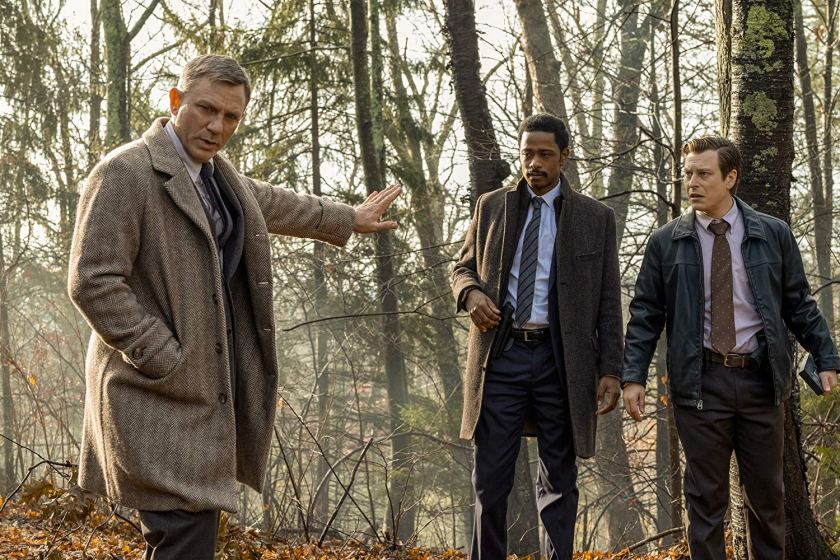
Private eye Benoit Blanc (Daniel Craig, left) searches for clues with the help of police Lt. Elliott (LaKeith Stanfield, center) and Trooper Wagner (Noah Segan). (Photo by Claire Folger/MRC II Distribution Co.)

By Richard Ades

Unfolding like a typical murder mystery, Knives Out dares viewers to answer the all-important question: Who cast Daniel Craig as a Southern private eye?

No, actually, the question is: Who killed Harlan Thrombey? As for Craig, it eventually becomes apparent that the erstwhile James Bond was cast as Virginia gumshoe Benoit Blanc simply for the hell of it, or perhaps as a sign that writer/director Rian Johnson (Star Wars: The Last Jedi) plans to have a little fun with the genre film.

And with the help of Craig and additional big-name stars, that’s just what he does.

The tale starts out conventionally enough. After a housekeeper finds successful mystery writer Harlan (Christopher Plummer) with his throat slit on the morning after his 86th birthday, police Lt. Elliott (LaKeith Stanfield) and Trooper Wagner (Noah Segan) begin investigating. Forensic evidence points to a suicide, but there are reasons to suspect foul play.

Not the least of them is the presence of Blanc, who is helping with the investigation after being hired by someone whose identity even he doesn’t know. Why would an anonymous benefactor pay the “gentleman detective” big bucks to investigate a suicide?

With Blanc’s help, the police also discover that several members of Harlan’s extended family—all of whom were present for his birthday party the night before—had motives for wishing him harm. Flashbacks show that Harlan had last-minute confrontations with others over misdeeds ranging from larceny to an extramarital affair. In some cases, he simply decided they were no longer worthy of his financial support.

Those caught up in the web of suspicion include:
• Linda (Jamie Lee Curtis), a real estate mogul and Harlan’s daughter
• Richard (Don Johnson), Linda’s husband
• Ransom (Chris Evans), their playboy son
• Walt (Michael Shannon), Harlan’s son, who runs his publishing house
• Donna (Riki Lindhome, Walt’s wife
• Jacob (Jaeden Martell), Walt and Donna’s internet-trolling son
• Joni (Toni Collette), a lifestyle guru and widow of Harlan’s older son
• Meg (Katherine Langford), Joni’s daughter

Knives Out Marta in middle
Embroiled in Harlan Thrombey’s murder investigation are (from left): Trooper Wagner and Lt. Elliott (Noah Segan and LaKeith Stanfield); Harlan’s caretaker, Marta Cabrera (Ana de Armas); his grandson, Hugh “Ransom” Drysdale (Chris Evans); and detective Benoit Blanc (Daniel Craig).

Also around, but considered beyond suspicion, are Fran (Edi Patterson), Harlan’s housekeeper; Marta Cabrera (Ana de Armas), his loving nurse; and “Great Nana” Wanetta Thrombey, Harlan’s ancient and mostly silent mother.

As the investigation proceeds, Marta becomes an increasingly important resource to Blanc and the police. A young immigrant with an undocumented mother at home, she earns Blanc’s trust because (1) she clearly was Harlan’s closest friend and (2) she has an odd, if disgusting, disorder that renders her incapable of lying without vomiting.

With its plethora of suspects and red herrings, Knives Out at first resembles a typical murder mystery. Surely, we think, it’s only a matter of time before Blanc arrives at the truth. But then writer/director Johnson confounds our expectations by allowing us to learn what happened while the investigators are still in the dark—except that he doesn’t really, because there’s still a last-minute reveal that will take pretty much everyone by surprise.

Further differentiating the flick from the average whodunit is its class-consciousness. Marta, as portrayed by de Armas, comes off as a kind-hearted caretaker who’s been treated shabbily by Harlan’s entitlement-blinded relatives. Not only do they fail to invite her to her beloved patient’s funeral, but they can’t even remember what country she’s from.

In short, Knives Out amounts to sly, quirky fun brought to life by a great, committed cast. Leading it all, Craig revels in the role of the drawling, cigar-smoking Blanc, who may or may not live up to his reputation as a brilliant detective. As with everything else in the flick, we just have to wait and see.

Rating: 4 stars (out of 5)

Knives Out (PG-13) opens Nov. 27 at theaters nationwide.

Uncovering the CIA’s torture coverup

The Report - Still 1
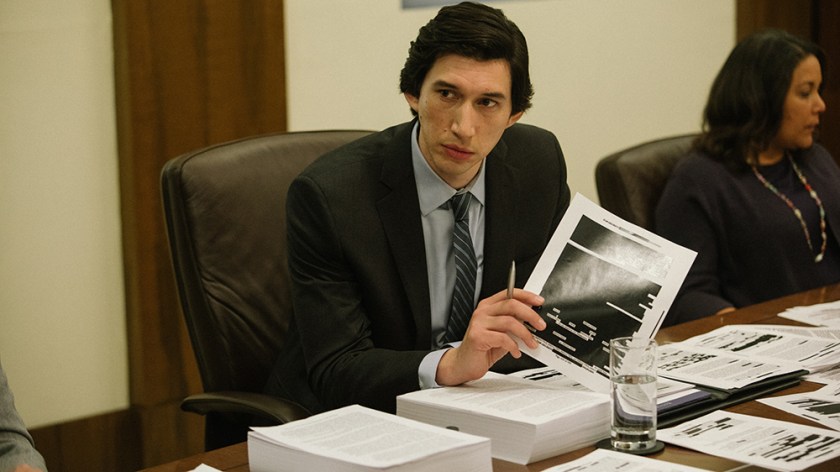
Daniel Jones (Adam Driver) takes on the task of investigating the CIA’s use of “enhanced interrogation techniques” in The Report.

By Richard Ades

About three-quarters of the way through The Report, I had a sudden urge to re-watch Z. Like Costa-Gavras’s 1969 political thriller, the new film is about a dogged effort to uncover a vast, bureaucratic lie.

Written and directed by Scott C. Burns, The Report is based on an actual congressional investigation into the CIA’s use of “enhanced interrogation techniques” in the post-9/11 war on terrorism. Adam Driver stars as Daniel Jones, who in 2007 is hired by Democratic Sen. Dianne Feinstein (Annette Bening) to lead the investigation.

It proves to be a slow and nearly impossible task. Because the CIA is offering minimal cooperation, Jones’s team must uncover the evidence one piece at a time by looking through the records surrounding terrorist suspects who fell into the agency’s custody. All the while, team members are assaulted with the charge that they’re being unpatriotic.

Torture was necessary, officials tell them, in order to save lives by uncovering terrorist plots before they could be carried out. But as the years pass, Jones begins gathering evidence that torture was actually ineffective and even counterproductive.

Unlike the exciting, sometimes satirical Z, The Report is filmed in a low-key docudrama style that takes us step-by-step through Jones’s search for the truth. It takes breaks from that search only in the form of painful flashbacks to the years when suspects were subjected to waterboarding and other forms of torture supposedly based on scientific research.

The Report (2019)
Jon Hamm as White House chief of staff Denis McDonough

Through it all, Driver makes Jones a stalwart figure whose commitment to the investigation begins to resemble obsession. Even more interesting is Bening’s Feinstein, who is being pulled in two ways. She clearly wants to uncover the truth, but she is being pressured by the Obama administration—as represented by White House chief of staff Denis McDonough (Jon Hamm)—to let the CIA keep its secrets. After all, the last thing the Democrats need is to be accused of being soft on terrorism.

The resulting clash between conscience and political expediency creates a dramatically satisfying tale that’s also a fascinating piece of history.

Rating: 4 stars (out of 5)

The Report (rated R) opens Nov. 15 at the Gateway Film Center in Columbus.

Misconceived romcom may appeal to Wham! fans

Last Christmas
Things start looking up for Kate (Emilia Clarke) after she meets Tom (Henry Golding) in Last Christmas. (Universal Studios)

By Richard Ades

Take the trappings of a romcom, add a dash of A Christmas Carol, set the tale in a festively lit-up London and fill the soundtrack with a whole bunch of George Michael songs. What you end up with is a holiday movie that’s guaranteed to appeal to—well, George Michael fans.

It’s hard to see who else would be attracted to the gauzy, glittery confection known as Last Christmas. Especially after the flick throws in a last-minute twist that is likely to please no one.

Co-written and produced by Emma Thompson, the story centers on Kate (the lovable Emilia Clarke), a young woman who is spiraling downward for no reason that is immediately apparent.

Maybe it’s because she works as an “elf” in a Christmas-themed store but really wants to be an actor. Or maybe it’s because she can’t stand being around her mother (Thompson), who insists on singing downbeat songs from their native Yugoslavia.

Then again, the store is run by a Chinese immigrant named Santa (Michelle Yeoh) who is supportive and patient even when Kate screws up. And her mother is a kind woman whose main fault is doting on her wayward daughter. So what is Kate’s problem?

Eventually, it comes out that her doldrums began after a health crisis that would have killed her if she hadn’t received a heart transplant. But again, it’s not quite clear why the ordeal has left her feeling depressed rather than lucky to be alive.

No matter. Things start looking up after Kate meets Tom (Henry Golding), a buoyant stranger who encourages her, literally, to start looking up—the better to discover overhead surprises she otherwise would have missed. She quickly grows to love this mysterious stranger who seems too good to be true.

Uh-oh. If you’re a romcom fan, you’ll know that can only mean their relationship is about to hit a snag, though it’s probably not the kind you envisioned.

Last Christmas is directed by Paul Feig, who helmed 2011’s entertaining Bridesmaids and 2016’s disappointing Ghostbusters. Here, he compounds the script’s problems by turning London into a sparkling wonderland where even homelessness is a joyful experience. He also stops the action frequently for perky music video-style montages. None of this helps us to understand miserable Kate or her need for a savior like Tom.

London, of course, was the setting for Dickens’s A Christmas Carol, the classic tale of a miser who finally learns that the purpose of life is to help others. Last Christmas tries to teach a similar lesson, but it mostly gets buried under the glut of glitz, jollity and George Michael tunes.

Rating: 2 stars (out of 5)

Last Christmas (PG-13) opens Nov. 8 at theaters nationwide.

Quirky tale of a boy and his führer

Jojo Rabbit
Jojo (Roman Griffin Davis, right) shares a run with his friend Adolf (Taika Waititi) in Jojo Rabbit. (20th Century Fox Film Corp.)

By Richard Ades

Those who hate war, prejudice and mass murder rightly view Adolf Hitler as one of history’s foremost villains. So it comes as a shock when a seemingly kind-hearted version of the dictator serves as a German boy’s imaginary friend in Jojo Rabbit.

Set in the chaotic final months of World War II, the dark comedy centers on the struggles of Jojo (Roman Griffin Davis), who lives with his mother (Scarlett Johansson) following the disappearance of his soldier/father under mysterious circumstances.

Jojo is a true believer in the Nazi cause and is looking forward to attending a government-run training camp for youths as the story opens. Once there, however, the 10-year-old balks at a demand that he prove his combat readiness by killing a defenseless rabbit. His refusal turns him into an object of ridicule by the instructors and everyone else.

Everyone that is, except the supportive friend that only he can see. Hitler (Taika Waititi) assures Jojo that he did the right thing and says he will be a better soldier than all the others if he learns to emulate rabbits’ survival instincts. “Be the rabbit,” he counsels the boy.

Directed by Waititi (Thor: Ragnarok), who adapted the story from Christine Leunens’s novel, Jojo Rabbit often functions as a satirical reflection on authoritarianism and prejudice. When the imagined Hitler isn’t soothing Jojo’s spirits, he’s parroting the party line on the supposedly horned and subhuman creatures known as Jews. It’s something Jojo and his real-life friend Yorki (Archie Yates) have long heard and mostly accept, even though it doesn’t always jibe with what they’ve witnessed for themselves.

Then Jojo happens to venture into an upstairs room while his mother is out and is horrified to learn she’s been hiding a Jewish teenager named Elsa (Thomasin McKenzie). As a loyal Nazi, he feels obligated to turn her in, but Elsa warns him that doing so will land his mother in trouble with the authorities. Elsa also thwarts his attempt to overpower her by deftly snatching away his party-issued knife. She’s like a “female, Jewish Jesse Owens,” Hitler later comments, sharing the boy’s indecision over how to handle the situation.

The resulting stalemate between Jojo and Elsa gradually becomes the central core of the story, taking it in new and emotionally charged directions thanks to sincere portrayals by actors Davis and McKenzie. Most of the other cast members also give carefully gauged performances, including Sam Rockwell as an eccentric German officer and Rebel Wilson as the gung-ho Fraulein Rahm. The one exception is Johansson, who never quite comes to life as Jojo’s secretive mother.

As for Waititi, he does fine in the on-screen portion of his triple contribution, making the imaginary Hitler humorously boyish without ignoring the danger he represents. As the screenwriter and director, he allows occasional sections of the film to fall flat, but he’s on target more often than not.

Given that its subject is the prime evil of the 20th century, it’s likely that not everyone will be comfortable with this quirky tale. But for those who can get into the spirit, it’s a subversive experience with an unexpectedly effective payoff.

Rating: 4 stars (out of 5)

Jojo Rabbit (PG-13) opens Oct. 31 in Columbus at the Drexel Theatre, Gateway Film Center, AMC Lennox Town Center 24 and Crosswoods Cinema.

Affection for a musical trailblazer

Ronstadt
Photos courtesy of Zachary Martin (Greenwich)

By Richard Ades

Linda Ronstadt was the first female singer to attain the kind of arena-filling star power previously achieved only by males. As a result, the now-73-year-old legend still has plenty of fans, even though Parkinson’s disease has in recent years deprived us of her beautiful voice.

Directors Rob Epstein and Jeffrey Friedman seem to have counted on those fans’ interest when they put together Linda Ronstadt: The Sound of My Voice. Rather than trying to pique viewers’ curiosity with a preview of what Ronstadt achieved, the film biography assumes they already know all that. Instead, it starts at the beginning—or even before the beginning—of her career, allowing the singer to conjecture on how her future was shaped by a father who invented the electric stove and a grandfather who sang Mexican folk songs.

Epstein and Friedman then recount Ronstadt’s career in more or less chronological order. This approach, combined with an account that is long on admiration and short on drama, requires viewers to have a good bit of patience. But Ronstadt’s fans probably won’t mind, especially since they’re given the chance to relive many high points of her musical history courtesy of old concert footage.

The main point the doc puts across is the groundbreaking nature of Ronstadt’s award-winning career. Thanks to a string of hit singles such as 1973’s “Desperado” and hit albums such as 1974’s “Heart Like a Wheel,” she was able to crash the former boys’ club of rock stardom. Astoundingly, not being a songwriter herself, she did it solely on the strength of her vocal instincts and ability.

Ronstadt singing

The second point that comes across is Ronstadt’s fearlessness in the face of new challenges. She periodically insisted on breaking out of her well-paid comfort zone by, for instance, taking a stage role in a Gilbert and Sullivan light opera. Later, in perhaps her boldest move, she honored her family’s heritage by recording traditional Mexican songs in Spanish, though she didn’t actually speak the language.

If anyone ever makes a scripted biopic out of Ronstadt’s life, they’ll probably try to dramatize her inevitable clashes with music executives who wanted her to skip such adventures and stick to what had earned money in the past. Or maybe the flick will seek drama in her brief experiences with diet pills and other drugs, or her romances with singer-songwriter J.D. Souther and celebs such as California Gov. Jerry Brown, filmmaker George Lucas and comedian Jim Carrey.

For its part, the doc treats such subjects in an underplayed, matter-of-fact fashion. The executives wanted Ronstadt to stick to what she knew; she said no. She did drugs; then she stopped. She and Souther were together; then they weren’t. (Souther himself says he can’t remember why they broke up but suggests they were too independent and career-oriented to be tied down.)

In general, the film comes off more as a love letter rather than a documentary. Presumably, Ronstadt’s fans won’t mind, especially since that love letter is accompanied by wonderful music.

Rating: 3 stars (out of 5)

Linda Ronstadt: The Sound of My Voice (PG-13) opens Sept. 13 at the Drexel Theatre in Bexley and the Gateway Film Center in Columbus.

Mystical Mexican tale pits kids against drug gang

Tigers Are Not Afraid Estrella Shine
Estrella (Paola Lara) comforts Shine (Juan Ramon Lopez) in a scene from Tigers Are Not Afraid.

By Richard Ades

In most horror films, ghosts or other supernatural entities endanger the lives of ordinary people. In Tigers Are Not Afraid, there are supernatural entities galore, but the real danger comes from human beings.

The tale takes place in a Mexican city where the ongoing drug war has left many children to fend for themselves after their parents have been killed or have simply disappeared. Imaginatively written and directed by Issa Lopez, it’s scary and sad, but also mystical and inspirational.

We meet our adolescent heroine, Estrella (Paola Lara), in a classroom where her teacher assigns the students to write stories incorporating magical figures such as princes and, at one child’s suggestion, tigers. We then are engulfed in Estrella’s story, in which a boy steals a gang thug’s phone and pistol and contemplates shooting him but can’t—because, the narrator decides, he’s forgotten how to be a prince.

Suddenly, we’re dragged back into the classroom, where the sound of gunfire has forced the students to hit the floor. In the aftermath, the school is closed, and Estrella returns home to learn her mother has joined the ranks of missing parents. Hungry and destitute, she throws herself on the mercy of a ragtag group of orphaned boys led by the gruffly macho Shine (Juan Ramon Lopez).

Tigers Are Not Afraid Boys
Shine’s gang of homeless orphans

Shine, it turns out, has recently stolen a gang thug’s phone and pistol. From this point on, Estrella’s life seems to merge with her unfinished tale. She also has entered a state of reality in which ghostly figures and portentous streams of blood intrude on the already-terrifying everyday world.

One of film’s most compelling storylines is the evolving relationship between Estrella and Shine’s followers. She quickly takes a maternal interest in the youngest boy, Morrito (Nery Arredondo), who clings for comfort to his little stuffed tiger. But others see girls as bad luck, and Estrella is ordered to prove her worth by killing the owner of the stolen phone, a gang member named Caco (Ianis Guerrero). When she uses a magical wish in an attempt to avoid the task, it backfires, putting all of them in the crosshairs of ruthless drug kingpin Chino (Tenoch Huerta Mejia).

As the plucky heroine, Lara sometimes underplays Estrella, perhaps suggesting that the girl is in shock or sleepwalking through the nightmarish predicament in which she’s been thrust. Leading the wonderful supporting cast, Lopez makes Shine a boyishly insecure leader who’s tormented by his fears, failures and losses.

Juan Jose Saravia’s cinematography unobtrusively melds the supernatural with the natural, turning the film into a prime example of Latin American “magical realism.” Vince Pope’s musical score provides the final complement to Lopez’s drama of children forced to live in a dangerous world not of their own making.

Seeing this fantasy-laden take on the real-life suffering of children is a devastating experience. But, as a morality tale and an innovative work of cinema, it’s also uplifting and unforgettable.

Rating: 4½ stars (out of 5)

Tigers Are Not Afraid (originally titled Vuelven) opens Sept. 13 at the Gateway Film Center in Columbus. The film is unrated but contains rough language and violence.

Thrown-together fugitives become huckleberry friends

Peanut Butter Falcon
Tyler, Eleanor and Zak (Shia LaBeouf, Dakota Johnson and Zack Gottsagen, from left) wander through the waves in The Peanut Butter Falcon.

By Richard Ades

The name “Mark Twain” comes up in an early scene of The Peanut Butter Falcon. It happens when a nursing-home attendant runs into an unemployed fisherman named Tyler and asks if he’s seen the runaway she’s seeking. Rather than give her a straight answer, Tyler coyly suggests the escapee may be off on the kind of adventure Twain might have thought up.

That pretty much describes this warmhearted tale, which in many ways resembles an updated version of Huckleberry Finn.

To be sure, there are key differences. Rather than being a motherless boy and a runaway slave, the heroes are Tyler (Shia LaBeouf), who’s lost both his job and his brother, and Zak (Zach Gottsagen), a 22-year-old man with Down syndrome. Like their literary counterparts, though, they’re on a trek in search of freedom and happiness. At one point, they even commandeer a raft.

We first meet Zak when he’s living in a North Carolina facility for senior citizens—the only place the state could find for him after he was abandoned by his family. Sharing a room with the sympathetic Carl (Bruce Dern), he spends his evenings watching old wrestling videotapes and dreaming of becoming a wrestler himself. If only he can escape, he plans to learn grappling moves by enrolling in the school run by his hero, the Salt Water Redneck (Thomas Haden Church).

Despite the efforts of friendly attendant Eleanor (Dakota Johnson), Zak does escape and soon runs into Tyler, who is on the lam himself. Frustrated at his inability to obtain a crab-fishing license following his brother’s untimely death, Tyler has resorted to stealing from other fishermen’s traps. Beaten up for his efforts, he then retaliates by starting a fire that turns out to be more destructive than planned. He takes off in his boat, with two revenge-seeking fishermen in fierce pursuit.

It’s at this point that Tyler realizes Zak—a short, chubby man clad only in underwear—has been hiding on his boat. Thus begins a reluctant collaboration that eventually grows into a close friendship.

Co-writers and directors Tyler Nilson and Mike Schwartz tell the tale with warmth and wit. With help from a down-home musical score, they also do a good job of capturing the time (roughly the 1990s, judging from one character’s flip phone) and place (the coastal Carolinas and Georgia). The perfectly cast actors do the rest.

Despite playing a shotgun-toting character who’s down and out, LaBeouf projects grit and an undercurrent of decency. Whether he’s gruffly laying down the rules to his traveling companion or flirting with a woman who seems out of his league, you know he’s essentially a good guy.

As Eleanor, whose job requires her to track down Zak and bring him back to the nursing home whether he wants to go or not, Johnson combines a sense of duty with genuine caring.

But it’s Gottsagen’s portrayal of Zak that gives the film its soul. In fact, according to a producer who spoke at a preview screening, the whole film was built around the actor’s talents. As a mentally challenged man who’s determined to live the life he wants, not the one others have proscribed for him, Gottsagen paints an indelible portrait of naïve faith and brave determination.

Surprisingly, he’s also funny, with help from a script that knows how to laugh at someone’s foibles without ridiculing their challenges. In its respectful but non-pandering treatment of a person with disabilities, The Peanut Butter Falcon is a model of sensitivity.

Most of all, though, it’s a delightful and entertaining adventure—one that I’m already looking forward to seeing again.

Rating: 4½ stars (out of 5)

The Peanut Butter Falcon (PG-13) opens Aug. 23 at theaters nationwide.