Film recalls historic setback for democracy

PETERLOO
Henry Hunt (Rory Kinnear, center) prepares to speak at a fateful pro-democracy rally in Peterloo. (Simon Mein photo courtesy of Amazon Studios)

By Richard Ades

If you know British writer-director Mike Leigh only through contemporary tales such as Secrets & Lies (1996) or Happy-Go-Lucky (2008), Peterloo may take you by surprise. Based on actual 1819 event, the period piece brings out a different side of the filmmaker’s personality.

This time around, rather than creating indelible characters involved in highly personal struggles, Leigh delivers a panoramic history lesson stocked with multitudes of conniving bureaucrats and idealistic commoners. The result is an epic film that, for most of its running time, is far less involving than the aforementioned earlier works.

That is, unless you are as committed to the subject as Leigh apparently is. The title refers to a military attack that disrupted a peaceful pro-democracy rally in his hometown of Manchester, leaving several dead and many others wounded.

Leigh’s depiction of the attack itself is painfully effective, but the road he takes to the tragedy is long, slow and meandering.

The movie begins at the end of the Battle of Waterloo, when a British bugler named Joseph (David Moorst) is stumbling around a field filled with fallen comrades. Another early scene takes place in the office of the British home secretary, where Gen. Byng (Alastair Mackenzie) is being assigned to deal with suspected seditious activity in northern England. Both scenes help to set the stage for what’s to follow.

In between them, however, is a detour to the halls of Parliament, where a more illustrious general, the Duke of Wellington, is being awarded a large sum of money for defeating Napoleon at Waterloo. Since Wellington actually plays no role in the film, we can only surmise that this scene is meant to explain Byng’s obvious dissatisfaction with his new assignment. In any case, it’s clear that he has little interest in keeping order in northern England, which may be a contributing factor to the coming disaster.

Leigh spends the bulk of the film spelling out the conditions that created the “seditious” feelings that Byng has been assigned to quell. The shell-shocked Joseph returns to his native Manchester to find wages falling and jobs nonexistent due to a mixture of industrial developments and governmental policies. The residents are keenly aware that they have no representative in Parliament and therefore can expect no help from London. In a series of public meetings, they discuss strategies for seeking redress.

At the same time, those in power seek ways to squash what they see as the beginnings of a dangerous rebellion. Having witnessed the bloody chaos that revolution created across the channel in France, everyone from local magistrates to the prime minister is determined to keep order at all costs.

This volatile situation could have made for a fascinating historical tale if Leigh had taken a less preachy approach. For starters, he could have had his characters spend less time preaching, as those pushing for democracy are constantly giving speeches at each other. Though their oratory is as powerful as their cause is just, the film begins to feel like an endless political campaign.

The sheer size of the cast gives few characters a chance to stand out. One who eventually does is Henry Hunt (Rory Kinnear), a London-based radical who’s given a hero’s welcome when he arrives in Manchester to headline a huge pro-democracy rally. However, the film suggests that the ultimate heroes are the handful of journalists who cover the event. If it were not for them, the world might never have known how horribly wrong it all went—or why.

Despite the film’s shortcomings, Leigh likewise deserves credit for carrying on the noble task of reporting a historic injustice.

Rating: 2½ stars (out of 5)

Columbus showings: Peterloo (rated PG-13) opens April 19 at the Drexel Theatre and AMC Lennox Town Center 24.

Good Samaritan’s generosity doesn’t extend to herself

DIANE_Still6
Mary Kay Place plays a determined do-gooder in Diane. (Photo courtesy of IFC Films)

By Richard Ades

The title character in Diane is selfless to a fault. Played by a stalwart Mary Kay Place, she ignores her own needs while looking after her addicted son, visiting ailing friends and volunteering in a soup kitchen. In return for these efforts, she’s rewarded with resentment, long-held grudges and only an occasional “thank you.”

A rough parallel can be drawn between Diane and Place herself, who has rarely received much attention despite the many years she’s spent both in front of and behind the camera. Unlike Diane, though, Place has finally been rewarded.  Portraying the long-suffering Diane allows her to reveal her talent for inhabiting a struggling character without indulging in excessive histrionics.

Written and directed by Kent Jones, the film follows Diane as she drives along rural Massachusetts roads from one disappointing encounter to another.

The most painful moments involve son Brian (Jake Lacy), who insists he’s kicked his drug habit though it’s all too clear he hasn’t. “Can’t you leave me be?” he begs. Maybe it would be better for him if she did, as her attempts to help by supplying him with food and clean clothes only turn her into an enabler. But ignoring someone in need is simply not in her nature.

Also painful is her relationship with her cancer-stricken cousin, Donna (Deirdre O’Connell), who harbors a resentment over a long-ago indiscretion. Other people in Diane’s life are more appreciative, including best friend Bobbie (Andrea Martin). Maybe Diane would benefit from their support and advice if she weren’t so busy beating herself up over what she sees as her own failings.

Jones’s low-key film boasts the participation of several skilled actors, including Estelle Parsons and other veterans who are less recognizable. The result is a convincing slice of rustic New England life. After it was over, though, I couldn’t help wishing it had been more.

People struggle, people disappoint each other, people die. In the process, neither Diane nor anybody else seems to learn anything. Unfortunately, the same goes for the viewer, unless you count the realization that Mary Kay Place is a very fine actor.

Rating: 3 stars (out of 5)

Local showings: Diane (rated R) opens April 5 at the Gateway Film Center in Columbus.

Beloved comedy duo tries for a comeback

By Richard Ades

stan & ollie
John C. Reilly (left) as Oliver Hardy and Steve Coogan as Stan Laurel in Stan & Ollie

Stan & Ollie is an entertaining story for all viewers, but it’s a special treat for anyone who’s seen old Laurel and Hardy flicks. Besides being physically transformed to look like these iconic comedians, stars John C. Reilly and Steve Coogan do a great job of incorporating the pair’s mannerism into their portrayals.

Reilly’s Oliver Hardy is especially spot-on, right down to his eye-rolling exasperation at his friend’s antics. Coogan’s Stan Laurel is slightly less recognizable, but that’s partly because he’s revealed to be the duo’s leader, the hard-working guy who creates their routines and arranges their business deals. It seems the real-life Laurel had little in common with the simpleton he played in films and onstage.

Screenwriter Jeff Pope bases the story on an actual tour Laurel and Hardy undertook in the UK in 1953, a few years after their cinematic career had faded to black.

We learn that Laurel is convinced the tour will spark a comeback by helping them land a deal to film their own take on the Robin Hood legend. In order to accomplish this, however, he and Hardy have to prove they can still attract and amuse the paying public. Unfortunately, tour organizer Bernard Delfont (Rufus Jones) has booked them in second-rate theaters that garner little attention. Only after they agree to take part in publicity stunts that recreate old comedy bits do they begin to catch fire with the British public.

Director Jon S. Baird lends a gentle and loving touch to the tale, whether it delves into nostalgic comedy or bittersweet drama. Flashbacks reveal that a contract dispute some 16 years in the past nearly broke up the team, sparking resentments that still linger. Hardy’s health is another concern. He always presented a rotund contrast to his thin partner, and he’s gained even more weight over the years. The grueling tour proves to be a challenge, first to his stamina and eventually to his very existence.

Every cast member delivers a well-crafted portrayal, even in minor roles such as a doting fan or a hotel clerk who marvels that the pair is still performing. In a welcome addition to the tale’s second half, spouses Lucille Hardy (Shirley Henderson) and Ida Kitseva Laurel (Nina Arianda) arrive from America to reunite with their hubbies. The Russian-born Ida, a frankly outspoken former performer, is particularly amusing.

For Laurel and Hardy fans, the flick offers the chance to revisit the kind of comedy routines that made the pair beloved the world over, along with insights into the real-life people behind the laughs. For everyone else, it’s a warm-hearted but never maudlin reverie on age, fame and friendship.

Rating: 4 stars (out of 5)

Stan & Ollie (PG) opens Jan. 25 at AMC Lennox Town Center 24, AMC Easton Town Center 30, the Drexel Theatre, the Gateway Film Center and Marcus Crosswoods Cinema.

A portrait of the jurist as a young woman

OTBOS_06794_R
Felicity Jones (center) as a young Ruth Bader Ginsburg in On the Basis of Sex

By Richard Ades

After seeing last year’s documentary RBG, it was easy to understand how Ruth Bader Ginsburg nodded off during President Obama’s 2015 State of the Union address. The film depicts the Supreme Court justice as a lifelong workaholic who treats sleep as a low priority. Though she admitted that wine played a role in her televised catnap, it could also be that the long hours simply caught up with her.

For an understanding of just why Ginsburg is such a sleep-deprived dynamo, see the new biopic On the Basis of Sex. It suggests that late hours became a habit when she was a young law student.

As depicted in the film, Ruth (Felicity Jones) and husband Marty (Armie Hammer) are attending Harvard Law School in the 1950s when Marty is diagnosed with testicular cancer. Rather than allow him to fall behind in his studies, Ruth starts attending Marty’s classes as well as her own. Add the motherhood duties required by their baby daughter, and sleep becomes a luxury.

Despite a dire prognosis, Marty somehow survives his cancer. So does the movie, though it’s touch and go for a while. Director Mimi Leder and screenwriter Daniel Stiepleman take advantage of Marty’s illness to depict Ruth as a loving, selfless wife and mother. Doubtless she was, but their syrupy, sentimental approach reduces her to little more than a generic romantic heroine rather than the determined woman who would one day become a groundbreaking supporter of sexual equality.

Ginsburg’s feminist sentiments do come out in scenes that show the challenges she faces as one of Harvard’s earliest female law students. In an incident that would be unbelievable if it weren’t verified by the documentary, the dean (Sam Waterston) asks the female students why they’re taking up spots that should have gone to men. Subtly mocking his patriarchal mindset, Ginsburg responds that she wants to understand her husband’s field so she can be a more “patient” wife.

Despite such scenes, the flick doesn’t really hit its stride until Marty, as an established tax lawyer, introduces Ruth, as a law professor, to the case from which the title is derived. A Colorado man (Chris Mulkey) wants to claim a tax deduction to help pay for nursing care for his invalid mother, but the law says the deduction is available to women but not to single men like himself.

Recognizing a chance to start questioning the myriad of laws that discriminate on the basis of gender, Ruth is eager to take on the case. The struggle that ensues, exacerbated by the realization that she’s going up against decades of precedents that support traditional gender roles, is historically fascinating.

Speaking of gender roles, actor Hammer offers a sympathetic depiction of Marty Ginsburg as a man ahead of his time when it comes to his support and appreciation of his talented wife. As that wife, Jones is hampered by a Brooklyn accent that comes and goes and by the aforementioned scenes that are more sentimental than realistic. But once Jones’s Ginsburg starts taking on legal impediments to gender equality, she becomes a convincing combination of trepidation and determination.

RBG remains the definitive portrait of a judicial superhero, but On the Basis of Sex complements it by providing an inspirational origin story.

Rating: 4 stars (out of 5)

On the Basis of Sex (PG-13) opens Jan. 10 or 11 at theaters nationwide.

Conversion therapy’s true nature outed in ‘Boy Erased’

BOY ERASED
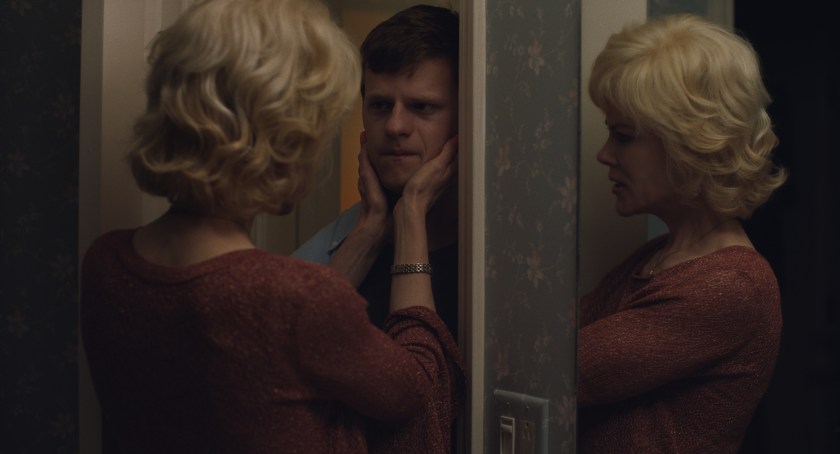
Nancy Eamons (Nicole Kidman) comforts her conflicted son, Jared (Lucas Hedges), in Boy Erased. (Photo courtesy of Focus Features)

By Richard Ades

Most of us know gay conversion therapy is a hoax that preys on the fears of gay people and their families, especially those whose religion rejects non-traditional sexual orientations. What most of us don’t know—unless we’ve been unlucky enough to go through it—is just how this therapy attempts to bring about its unlikely transformation.

One person who does know is Gerrard Conley, whose parents pushed him into conversion therapy and who subsequently wrote Boy Erased, a memoir about his experience. The book has been brought to the big screen in a tale that is both harrowing and illuminating.

Directed by Joel Edgerton, who also wrote the screenplay and portrays a key supporting character, the flick begins by spelling out the dilemma faced by its teenage protagonist.

Jared Eamons (Lucas Hedges) is the son of a Baptist preacher in a conservative Arkansas community. In an early scene, the Rev. Marshall Eamons (Russell Crowe) stops in the middle of a sermon to ask those who are imperfect to raise their hands. Of course, everyone does, but Jared seems to ponder the question before joining in. Maybe he’s already worried about the troubling thoughts he has hidden from others and barely acknowledges himself.

On the surface, Jared appears to be a “normal” kid. He even has a girlfriend, whom his father and mother, Nancy (Nicole Kidman), fully expect to become his future wife. They’re disappointed when Jared breaks up with her before going off to college.

But their real shock comes when they receive an anonymous phone call from someone on campus who accuses their son of homosexual leanings. Jared initially denies the charge but eventually admits it may be true. Faced with an ultimatum from his father—change or be ostracized from the family—he agrees to give conversion therapy a try.

Jared’s first days in the program seem harmless enough. Instructors led by Victor Sykes (director Edgerton in a restrained but creepy performance) try to reason the participants out of their sexual preference. You’re not born gay, they’re told, any more than athletic participant Cameron (Britton Sear) was born wanting to play football. And if you choose to be gay, the argument goes, you can choose to stop being gay.

It’s not long, though, before Jared begins noticing signs that the therapy is neither as effective nor as benign as he’d hoped. A fellow participant urges him to simply play along with the program in order to convince the instructors he’s on his way to a cure. But playing along becomes more difficult when increasingly coercive measures are used to achieve the desired results.

The film reveals Jared’s state of mind with the help of well-placed flashbacks to times when he was torn between his religious beliefs and his sexual longings. He dearly wants to change in order to remain part of his family, but his faith in the therapy falters as his experiences at the clinic become more and more nightmarish. The resulting tension builds to a wrenching climax.

This earnest tale is told with the help of a cast that is almost uniformly fine. I seldom find Kidman’s portrayals completely convincing, but she’s at least adequate as Jared’s concerned mother. Meanwhile, Hedges wins our sympathy as Jared, and Crowe does a fine job of convincing us the Rev. Eamons is a caring parent despite the hell he puts his son through.

Because the story is based on actual people, it ends by relating what eventually happens to the characters’ real-life counterparts. Some of the developments are uplifting, and at least one is surprising. Or maybe it won’t be to those who are good at reading between the lines.

Rating: 4 stars (out of 5)

Boy Erased (rated R) opened Nov. 15 at the Gateway Film Center and AMC Lennox Town Center 24.


McCarthy pulls off against-type turn as misanthropic con-woman

Can You Ever Forgive Me
Richard E. Grant and Melissa McCarthy in Can You Ever Forgive Me? (Photo by Mary Cybulski/Twentieth Century Fox Film Corp.)

By Richard Ades

Lee Israel’s abrasive and self-destructive personality is established in the first scene of Can You Ever Forgive Me? While working a late-night job, Lee (Melissa McCarthy) hits the wrong person with an F-bomb and is immediately fired.

This launches a downward spiral that threatens to expel Lee from the New York apartment she shares with her ailing cat. The spiral ends only when it’s replaced by a moral and legal spin out of control.

The fateful catalyst is a letter from a famous author that falls into Lee’s hands. Attempting to sell it to a dealer in literary ephemera, she’s told it would be worth more if only the subject matter weren’t so bland. An author herself—though one who has trouble even giving her latest books away—Lee seizes on the idea of manufacturing spicy correspondence supposedly written by luminaries such as Dorothy Parker and Noel Coward.

Her success in this dishonest new venture is ironic. After being told by her agent (Jane Curtin) that she won’t attract readers until she finds her own literary voice, Lee learns she can pull in big bucks by aping other writers’ voices.

Directed by Marielle Heller (The Diary of a Teenage Girl) and based on the real-life Israel’s story, Can You Ever Forgive Me? gives McCarthy the chance to prove she has something to offer beyond her usual comic shtick. She doesn’t slough off the opportunity. Other than a brief scene near the end, McCarthy totally immerses herself in the skin of a woman who is not above lying and cheating others, yet is still her own worst enemy.

Though officially a lesbian, Lee is so leery of human interaction that she undermines every relationship or potential relationship. When a bookseller and would-be author (Dolly Wells) shows obvious interest in getting to know her, she responds with caution and defensiveness. We can’t admire Lee, but McCarthy’s portrayal makes it impossible not to feel for her. Her performance is by turns funny and touching.

If McCarthy’s portrayal is impressive for its depth and deviation from her usual output, co-star Richard E. Grant’s performance is memorable for its bravura spirit. Grant plays Jack Hock, an aging loner who seems to get through life on the strength of his wit and wits. After meeting in a gay bar, Jack and Lee are drawn together by their mutual fear of commitment and love of nasty pranks and alcohol. Though they obviously aren’t good for each other, they become inseparable.

Through all this, Nicole Holofcener and Jeff Whitty’s screenplay moves nimbly between acid humor and pathos. But it’s McCarthy’s sensitive performance and Heller’s equally sensitive direction that make it possible to care about Israel because we can see her moral compass is defective but not entirely beyond repair.

Rating: 4 stars (out of 5)

Can You Ever Forgive Me? (rated R) opens Nov. 8 at the Drexel Theatre, Gateway Film Center, Marcus Crosswoods Cinema and AMC Lennox Town Center 24.

Musical moments outshine remake’s tragic love story

A STAR IS BORN
Ally (Lady Gaga) and Jackson (Bradley Cooper) share a stage for the first time in A Star Is Born. (Warner Bros. Entertainment Inc. and Metro-Goldwyn-Mayer Pictures Inc.)

By Richard Ades

A Star Is Born has been made and remade so often, it must hit a chord with the American psyche. Either that, or it’s such a perfect star vehicle that Hollywood just can’t let it gather dust for long.

Whether it’s set in the movie industry (like the 1937 and 1954 versions) or the music industry (like the 1976 and current 2018 iterations), the tale centers on a couple who fall in love while her career is rising and his is drowning in a pool of alcohol. The result is a potent mix of drama, romance, histrionics and (in most versions) music, giving both of its stars a chance to shine.

Certainly Bradley Cooper and Lady Gaga shine brightly in the current remake, which Cooper also co-wrote, produced and directed. The beginning is a particular joy.

The first scene throws us into the middle of a country-rock concert in which singer-songwriter Jackson Maine (Cooper) holds forth to the adoration of his fans. Afterward, in desperate need of a drink, he instructs his driver to drop him off at what turns out to be a drag bar. It’s there he first hears and marvels at the vocal talents of Ally (Gaga), the only woman in the night’s lineup.

Having recently broken up with an insensitive boyfriend, Ally is at first reluctant when Jackson introduces himself and insists on getting to know both her and her music. But, encouraged by a co-worker (Anthony Ramos) and her supportive father (Andrew Dice Clay)—who thinks the attentions of a rock star would help get her own singing career off the ground—she eventually gives in. She accepts Jackson’s invitation to an out-of-town gig, where he unexpectedly prods her into joining him in a rendition of one of her own songs. The resulting duet is one of the most powerful musical moments in recent cinematic history.

So far, so good. Cooper is likably humble as Jackson, while Gaga offers an appealing portrayal of the self-doubting Ally and puts her powerful singing voice on full display without ever succumbing to melodramatic overkill. As a director, Cooper also proves to be competent, allowing not only him and Gaga but co-stars like Sam Elliott and Dave Chappelle a chance to make their mark.

It’s only after the story begins down its preordained path toward tragedy that it loses some of its potency. Possible reasons:

1) A major part of the story is Jackson’s decline from popularity, but the singer seems to put on a good show no matter how drugged or boozed up he is. Why, exactly, are his fans turning against him?

2) Jackson urges Ally to remain true to herself rather than letting fame change her. Yet when she allows her agent, Rez (Rafi Gavron), to turn her into a glitzy singer of shallow anthems, he says nothing. It thus becomes unclear whether their growing relationship problems are due to Jackson’s jealousy over her success or his disappointment over how she achieved it. (The situation also raises the question of whether the movie downplays the issue of Ally’s selling out to avoid biting the hand of the industry that feeds Lady Gaga in real life.)

The upshot of these weaknesses is that the tale’s tragic ending seems less organic and inevitable than it should. It’s certainly less organic and inevitable than it was in 1954’s blockbuster remake, which also benefited from Judy Garland’s best-ever performance as a rising movie star and James Mason’s depiction of the fading matinee idol who becomes her mentor.

As a tale of blossoming romance, the latest version of A Star Is Born strikes gold. As a musical, it strikes platinum. It’s only when the flick reaches for tragedy that it fails to find the mother lode.

Rating: 3½ stars (out of 5)

A Star Is Born (rated R) opens Oct. 5 in theaters nationwide.

Frantic search for amore (and laughs)

Though Catholic, Domenico Nesci is not above donning a yarmulke for a romantic encounter arranged through JDate. (Photo courtesy of Random Media)

By Richard Ades

The Lonely Italian is being marketed as the “Borat of online dating.” I doubt many fans of that raunchy 2006 comedy will think it measures up, but there are a couple of similarities.

First, the star (L.A.-based TV and radio host Domenico Nesci) has an accent, though in this case it’s an actual accent. And second, most of the folks who meet Nesci in the documentary-style film are apparently unaware they’re being used as comic foils.

Directed by Lee Farber, the flick’s premise is that Nesci is frustrated over his inability to find female companionship. His explanation is that modern women have their noses buried so deep in their computers that it’s impossible to strike up a conversation with them.

Figuring the only way to meet them is through those computers, Nesci throws himself into the online dating scene with a vengeance. Once he finds Tinder, for example, he figures he’s hit the motherlode and “swipes right” on every profile he finds.

Other sampled sites include the old staple, Match.com, as well as more specialized offerings such as JDate. The latter is a stretch for Nesci because he’s Catholic rather than Jewish, but he doesn’t seem to care. After landing a date, he simply dons a yarmulke and fakes it until he thinks the woman is sufficiently charmed to overlook his duplicity. (She isn’t.)

In another stretch, Nesci tries DateMeDateMyPet.net and scores an impromptu meetup for which he’s forced to borrow a dog from a reluctant friend. This leads to a somewhat amusing encounter during which Nesci tells the woman his pooch is a 26-year-old female, only to be informed that 26 is improbably old and that the dog clearly has a penis.

Several of the dates fall into the “somewhat amusing” category because it’s all too obvious Nesci is doing a comic shtick by being either impossibly dense or willfully coarse. For the most part, the women react with smiling indulgence, though it’s not clear whether they give him a pass because (1) he’s an immigrant and they figure he doesn’t know better, or (2) they suspect it’s all a joke.

One date in which a woman doesn’t react with smiling indulgence is also one of the funnier episodes. When Nesci offers the woman a meat-and-cheese sandwich, she reminds him that she clearly told him she’s vegan and eats no animal products. The encounter goes downhill after the hungry Nesci tries to sneak a piece of meat himself.

Though the dates are hit or miss in terms of laughs and credibility, they generally fare better than staged scenes that feature Nesci and a concerned friend named Marquesa (Mark Chuakay). Especially unwelcome is a belated attempt at drama that sees Nesci supposedly having an attack of conscience over the self-centered way he’s been pursuing romance.

Yeah, right. Nesci clearly has been pursuing laughs rather than love, making this development about as convincing as the average online dating profile.

Rating: 2½ stars (out of 5)

The Lonely Italian was released Aug. 15 through VOD outlets.

Teenage romance suffers from terminal niceness

Maddy Whittier (Amandla Stenberg, right), a teenager with a rare health condition, is afraid to tell her mother (Anika Noni Rose) she’s fallen for the boy next door. (Warner Bros. Entertainment/Metro-Goldwyn-Mayer Pictures Inc.)

By Richard Ades

Maddy Whittier has been diagnosed with a rare condition called severe combined immune deficiency, or SCID. As a result, the teen is never allowed to leave the sterile home her physician-mother has designed to protect her from the world.

Stella Meghie, the director of Everything, Everything, seems to think we viewers need to be similarly protected from the world—or, at least, from the ebbs and flows that make it a challenging place to live. Together with screenwriter J. Mills Goodloe, she’s adapted Nicola Yoon’s best-selling novel in a way that filters out any darkness or unpleasantness. In the process, she also filters out most of the character quirks and dramatic tension that would have brought the story to life.

All that’s left is the bland, if heavy-breathing, tale of a teenage romance that faces more than the usual number of obstacles.

When we first meet Maddy (Amandla Stenberg), she seems to have come to terms with a life that must be lived within her L.A. home’s four walls. She never sees anyone other than her widowed mother (Anika Noni Rose), her sympathetic nurse (Ana de la Reguera) and Rosa (Danube Hermosillo), a friend who will soon leave town.

Then, about the time she turns 18, Maddy notices that the family moving in next door has a teenage son, Olly (Nick Robinson). Olly also notices her and immediately starts trying to get to know her. Though Maddy’s protective mom attempts to keep them apart, the two soon succeed in exchanging phone numbers and texts. From that point, it’s only a matter of time before Maddy starts conniving ways to meet this charming young man in person, whatever health risks it might pose for herself.

I haven’t read Yoon’s novel, but I get the feeling it’s far less filtered than Meghie’s film. One clue is that we’re told Olly has dark tendencies, but he doesn’t come across that way at all other than uttering the PG-13-rated flick’s one cuss word. We also see only hints of the difficult family situation that would explain his alleged darkness: a father who is abusive toward Olly, his sister and particularly toward his mother.

As written by screenwriter Goodloe and played by Robinson, Olly is simply a nice guy. He’s the kind of boyfriend any mother would be glad to find for her daughter—unless, of course, her daughter was living with SCID.

Even blander is Stenberg’s portrayal of Maddy. Viewers who caught last year’s Loving might be reminded of a younger Mildred, the woman (played by Ruth Negga) who bravely challenged her state’s laws against interracial marriage. Not only is there a vague physical resemblance, but both possess an inner calm that survives anything life throws at them. If Mildred’s calm seemed more deep and profound than Maddy’s, it may be because she wasn’t forced to utter romantic inanities like “Love can’t kill me” and “I loved you before I knew you.”

As a teenage romance involving a girl with a serious medical problem, Everything, Everything is likely to be compared to 2014’s The Fault in Our Stars. Such comparisons collapse, however, in the face of that tear-jerker’s believable characters and complicated emotions.

The would-be lovers in Everything, Everything are as generic as the tale’s title and as sterile as the environment in which they meet. The romantic fantasy may find its share of young fans, but only if they can overlook the complete lack of depth beneath its glossy, unruffled surface.

Rating: 2 stars (out of 5)

Everything, Everything (PG-13) opens Friday (May 19) at theaters nationwide.

Beatty’s return to the silver screen is as eccentric as his subject

By Richard Ades

Rules Don’t Apply is Warren Beatty’s first appearance in front of a camera since 2001’s Town & Country—and his first appearance behind a camera since 1998’s Bulworth. That probably explains why the flick is filled with so many familiar faces.

Frank Forbes (Alden Ehrenreich, left) listens as Howard Hughes (Warren Beatty) testifies before Congress in Rules Don’t Apply.

Paul Sorvino, Matthew Broderick, Candice Bergen, Martin Sheen, Oliver Platt, Ed Harris, Dabney Coleman and Annette Bening (aka Mrs. Beatty) are among the veteran A-listers who apparently were eager to take part in the actor/director’s return to the silver screen. That makes it ironic that two of the younger cast members emerge as the best reasons to see a tale based on a late chapter in the life of eccentric billionaire Howard Hughes.

Lily Collins and Alden Ehrenreich have appealing chemistry as two people in Hughes’s employ: Marla Mabrey, a would-be starlet, and Frank Forbes, a driver who’s assigned to chauffer her around. Because both Marla and Frank are devout Christians—and more particularly because Hughes forbids them to have anything but a professional relationship—that chemistry has plenty of time to percolate as the two are forced to sublimate their growing attraction for each other.

Beyond this budding romance, the film offers Beatty fans the pleasure of seeing the ex-matinee idol’s take on the secretive and exceedingly bizarre Hughes. But beyond that, it offers very little.

Set primarily in Hollywood in 1959, Rules Don’t Apply reveals Hughes’s odd penchant for signing contracts with young actresses who are given sumptuous housing but little opportunity to launch a film career. When Marla arrives along with her equally Christian mom (Bening), she’s said to be one of perhaps 26 such women who wait around for an opportunity that almost never comes.

It’s a fascinating situation, whether or not it’s entirely accurate. (The movie begins with a Hughes quotation advising us to “Never check an interesting fact.”) But the film built around that situation is frankly a mess. Early scenes end so abruptly and pointlessly that you have to wonder what the editors were thinking. Later, after Hughes emerges from the shadows, the film takes a long detour into his chaotic life that is as frustrating for us as it seems to be for the underlings who are forced to share it.

Lily Collins as aspiring movie star Marla Mabrey

Throughout, consistent tone is conspicuously absent. Early developments and sumptuous visuals, including fleets of shiny vintage cars, help to establish a mood of affectionate nostalgia. But the script (co-written by Beatty) has no qualms about switching to broad comedy when chauffer Frank finally lets Marla take the wheel, only to watch her morph from a cautious and conservative young woman to a highway terror.

Collins’s character undergoes another transformation for the sake of a later plot point. Though a demure teetotaler, Marla turns into a booze-guzzling vamp the first time alcohol passes her lips. Despite being every parent’s worst nightmare, the scene just doesn’t ring true.

Like his many co-stars, Beatty’s fans will no doubt be glad to see him back after so many years of absence. But they might wish he’d taken a refresher course in filmmaking before attempting his return.

Rating: 2½ stars (out of 5)

Rules Don’t Apply (PG-13) opens Wednesday (Nov. 23) at theaters nationwide.