Revised musical drops its pedantic personality

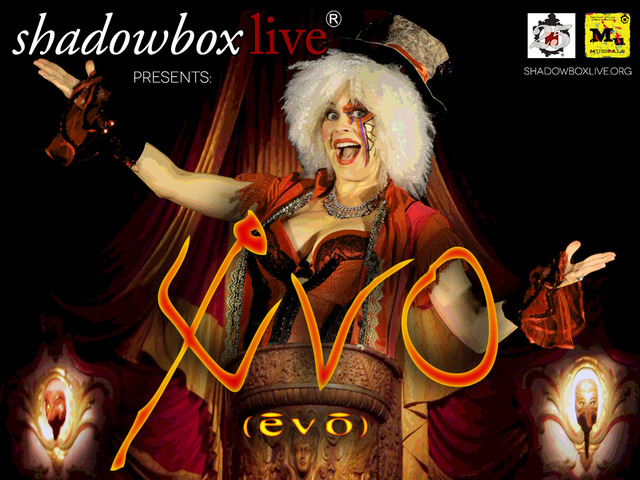
Stacie Boord as the Ringmaster in Evo (Shadowbox Live photo)
Stacie Boord as the Ringleader in Evo (Shadowbox Live photo)

By Richard Ades

Over the past 25 years, Shadowbox Live has settled into a comfortable role as the troupe that plies viewers with skits, food, booze and rock tunes.

It wasn’t always this way. Back in the early days, Shadowbox head honcho Stev Guyer was determined to create big, important works about big, important topics. The result was a series of original musicals such as 1995’s Evolution.

Like the others, Evolution was loud, flashy and ambitious. Sometimes, particularly in the dance sequences, it was impressive.

More often, though, it came across as a lecture set to music. How could it seem otherwise, when it methodically introduced each topic before discussing it with billboard-style dialogue and lyrics?

Now, apparently, Guyer wants to take another crack at creating important art. With help from Shadowbox head writer Jimmy Mak and musical director Matthew Hahn, he’s revisited Evolution and renamed it Evo.

Thankfully, the new version has lost more than a portion of its name. It’s also lost the pedantic attitude that made viewers of Evolution feel like they deserved college credit just for sitting through it.

Guyer and his fellow Shadowboxers have learned a lot about showmanship in the past quarter-century, and they’ve funneled it all into Evo.

The new show still addresses some of the same questions about human beings and our relationships with ourselves, each other and society: Why are we so prone to violence? Is “justice” just another word for “revenge”? And, most basically, what is the point of our existence?

Sex, love, parenting and old age also are taken up.

The most obvious change from the previous version is that all of these topics are introduced by the Ringleader, a flawed character energetically portrayed by Stacie Boord. Her presence helps to put a recognizably human face on the proceedings.

Another difference is that the show often makes effective use of humor to get its points across.

Often the humor is of the darker variety, as it is in a segment on parenting and the complications it creates in romantic relationships. When “Mr. Know It All” (Billy DePetro) and “Mrs. Don’t Tell Me What to Think” (Katy Psenicka) are asked which part each wants to play in a knife-throwing act, the latter eagerly grabs a handful of blades. It seems she has a wealth of pointed comments that she’s been dying to aim at her hubby.

As in the original Evolution, music and dance are at the center of the action.

From the first notes of Risking It All, with its ever-changing time signatures, the music is an interesting combination of melodies and intricate rhythms. The heavy percussion often carries echoes of traditional African drumming, reminding us of the continent where human evolution likely has its roots.

The dancing, choreographed by Psenicka, is as varied as the show’s many moods. Though it can be frenetic and exciting, it also can be sensitive and graceful. In a particularly lovely segment, Guyer and Boord sing a song about aging desire while JT Walker III and Nikki Fagin act it out through dance.

Throughout the show, Scott Aldridge’s dramatic lighting is a key component. So are the colorful and flowing costumes (designed by Linda Mullin, Myah Shaffer and Lyn Walker), which help to establish the circus-like atmosphere.

Occasionally, the show still carries a whiff of the classroom. One example is a section that delves into the ancient practice of taking aged tribe members out into the wilderness to die. It seems like a needless digression since society now treats its oldsters a bit more humanely.

But most of the show is entertaining and engrossing, and it’s consistently so after intermission. Even when Evo preaches, as it does in the section titled Revenge, it drains the self-righteousness from the sermon by delivering it with a comedic touch.

Shadowbox clearly has evolved for the better through the years by learning from its past mistakes. If only we could say the same for the rest of humankind.

Evo will be presented at 2 and 7 p.m. Sundays through Nov. 2. Running time: 1 hour, 50 minutes (including intermission). Tickets are $25, $20 for students and seniors. 614-416-7625 or shadowboxlive.org.

Shadowbox gets anniversary season off to a freaky start


By Richard Ades

Fabulous costumes, a smokin’ guitar solo and a very funny Jack Hanna. These are some of the highlights of Shadowbox Live’s Freak Show.

More generally, the show offers some really smart comedy, including a vintage skit that’s being repeated as part of the troupe’s 25th anniversary celebration.

Let’s start with Jack Hanna. The Columbus Zoo’s director emeritus has demonstrated his deadpan sense of humor over the years during his many appearances on The Late Show With David Letterman, but he’s never been funnier than he is here.

In a video segment, Shadowbox executive producer Stev Guyer seeks out Hanna’s advice on how to keep the troupe going for another 25 years. Instead, Jungle Jack begins paddling down a stream of consciousness that carries us into areas that are hilariously personal.

As for the guitar solo, it takes place in a cover of Van Halen’s House of Pain and features the nimble fingers of Brent Lambert. Amy Lay ably handles the vocals, but make no mistake: Lambert’s screaming guitar is the tune’s reason for being.

And the costumes? Designed by Linda Mullin, Nick Wilson and Lyn Walker, they accentuate the show’s spooky theme while turning several musical numbers into visual as well as aural treats. My favorites include the colorful tutus lead vocalist Anita McFarren and her backup singers don for Mz. Hyde.

Comedy-wise, Shadowbox theme shows easily beat the success ratio of Saturday Night Live, but that’s really damning with faint praise. For Freak Show, director Guyer, head writer Jimmy Mak and the cast actually approach the success ratio of Modern Family.

Not everything inspires big laughs. Jason’s Scary Poem, a narrated and mimed homage to Dr. Seuss, is more apt to inspire appreciative nods and chuckles. And Zombie or Not to Be?, a faux TV show about the undead, is mostly unfunny. But an astounding number of skits are ingeniously written and brilliantly performed. Some of the standouts:

Modern Day Freaks: A carnival barker (JT Walker III) introduces such contemporary oddities as a 6-year-old girl who hates Frozen and a tea partier who’s down with gay marriage.

Literal Wizard: A substitute teacher (Tom Cardinal) uses his wizardly skills to instruct his students on the proper use of the word “literally.” (English majors will love this one!)

The Line: Disney makes a horror film inspired by Disneyland’s scariest attraction of all: those endless lines.

Haunted House Training: The socially inept Gary (Mak) thinks he knows how to scare people at a Halloween haunted house because he’s so good at inadvertently scaring them in real life.

Captain’s Kirk’s Advice: Office worker Herb (Jamie Barrow) is too shy to ask out co-worker Lisa (Carrie Lynn McDonald) until he’s goaded on by video clips of that planet-hopping Lothario himself, James T. Kirk.

Incidentally, McDonald is a former Shadowbox regular who’s making a return visit for this show, probably in honor of the anniversary season. Other welcome returnees include the final skit, The Exorsister, and the spectacular final tune, Thriller, featuring vocals by Leah Laviland and a stageful of creepy dancers.

There’s much more of worth in Freak Show, including such musical numbers as Save Me (sung by a gruff-voiced Walker) and the familiar Mama Told Me Not to Come (talk-sung by Brandon Anderson).

Even the video segments, which normally function as semi-cute fillers, are great. Besides the Jungle Jack interview, my favorite is Flashback, in which a prophetic spirit tells young Shadowbox founder Steve Guyer to postpone his ambitious dream of staging original rock operas and concentrate on sketch comedy. And, oh yes, he’s advised to change his first name to Stev.

Sure, it’s self-referential and maybe even self-indulgent. But after 25 years, Shadowbox is entitled.

Freak Show continues through Nov. 1 at Shadowbox Live, 503 S. Front St. Show times are 7:30 and 10:30 p.m. Fridays and Saturdays. Running time: 2 hours, 5 minutes (including intermission). Tickets are $20-$40. 614-416-7625 or shadowboxlive.org.

Roommate comedy launches assault on fourth wall

Featured in The Playdaters are (from left) MaryBeth Griffith as Stephanie, Audrey Rush as Erma, Josh Kessler as Erwin and Chad Hewitt as Spencer (photo by Andy Batt)

By Richard Ades

Remember the big restaurant scene from When Harry Met Sally? I thought of it after attending Thursday’s preview performance of The Playdaters.

Specifically, I thought of the comment a stranger makes to her waiter after witnessing Sally’s simulated orgasm: “I’ll have what she’s having.” In my case, the line would have been “I’ll have what they’re having.”

It wasn’t so strange that the MadLab viewers laughed early and often. That’s not unusual for a first-night audience, often made up of friends of the cast who are eager to be supportive.

What set these folks apart was that they started laughing before the play even began. When the pre-curtain soundtrack included a naughty Garfunkel and Oates song about hand jobs, they burst into prolonged hysterics. They then remained in stitches for much of the play’s hour-long running time, and I suspect most of them stayed to laugh all over again when MadLab presented a second performance with a juggled cast.

Written by Neil Haven, The Playdaters is about a pair of roommates who dare each other to set up dates with strangers, then misbehave in bizarre ways when they meet. The roommates generally are portrayed by men, but MadLab is trying an interesting experiment by offering two versions: On Fridays, men play the lead roles while women play their dates; on Saturdays, the genders are switched.

At Thursday’s preview, both versions were staged in succession. Since the female version was presented first (as determined by a coin toss), that’s the one I saw.

OK, the gender switch is a cute idea, but what about the play itself? Is it as hilarious as those first-nighters thought it was? Well, not in its entirety, but director Jim Azelvandre and his cast do deliver lots of funny moments.

In the women-led version, most of them belong to Erma, who’s played by Audrey Rush with the kind of roly-poly physicality that will remind many of Melissa McCarthy. Foul-mouthed and mischievous, Erma throws herself into such first-date shenanigans as pretending to be German or drinking half a bottle of whiskey on the sly.

As Stephanie, Erma’s relatively conservative roommate, MaryBeth Griffith is far more subdued. That’s natural, but Griffith probably could land a few more laughs of her own if she played up the character’s strait-laced tendencies.

As for the men, Chad Hewitt gives a similarly low-key performance as Stephanie’s near-perfect date, but Josh Kessler finds droll humor in the men (and one woman) who are unlucky enough to end up on prank dates with Erma.

It should be noted that The Playdaters is not simply the tale of two fun-loving gagsters. Haven also throws a couple of complications into the mix.

The first concerns the relationship between the roommates, which seems to be in flux. Erma loves it and wants it to stay the same forever, and she reacts with jealousy when it becomes clear that Stephanie wants to progress from gag dates to the real thing. If you see the show’s male version, you’ll probably be reminded of movie bromances such as Superbad or 22 Jump Street.

The second complication—and the one that makes things a bit too messy for my taste—involves the characters’ tendency to break through the “fourth wall.” Erma and Stephanie constantly stop the action in order to explain things to the audience or to bicker about how the plot is proceeding. Toward the end, Erma goes so far as to accuse Stephanie of getting herself caught up in a typical romantic comedy.

Maybe Haven felt his play needed something to distinguish itself from the average rom-com, bromance or bramance. Maybe that’s why he added all the fourth-wall busting and winking self-awareness.

If you’re like me and have a low tolerance for this kind of gimmicky, you’ll wish he hadn’t imposed it on what is otherwise an agreeable comedy. But if you’re like that preview audience, you won’t mind at all.

The Playdaters continues through Sept. 13 at MadLab Theatre and Gallery, 227 N. Third St. Show times are 8 p.m. Friday-Saturday. Running time: 1 hour. Tickets are $12, $10 for students and seniors, $8 for members. 614-221-5418 or madlab.net.


Latest ‘Burlesque’ show has a biographical spin

Amy Lay, Leah Haviland and Nikki Fagin put their best foot forward in Burlesque Biographie (photo by Will Shively)

By Richard Ades

Semi-nudity and seminal comedy are once again on tap at Shadowbox Live.

Burlesque Biographie reunites us with a fictitious troupe that specializes in vaudeville-style skits and erotic dancing. It’s our third visit with the company, following Burlesque de la Voyage (2012) and Burlesque Behind the Curtain (2013).

Is the new show fun? Yes, though not quite as much fun as its immediate predecessor.

Burlesque Biographie is so-named because the entire show is built around a biographical interview with troupe leader Bea (Julie Klein), whose stage name is Busty. While reporter Kimberly (Michelle Daniels) quizzes Busty about her past—including a life-altering trip to Paris in her youth—flashbacks reveal early routines that helped to shape her career.

The good thing about this format is that it gives the players plenty of opportunities to be funny and/or sexy. The bad thing is that the interview proves to be a rather tedious framing device.

Busty is normally fun to be around, being just as raunchy and foul-mouthed offstage as she is on. Here, though, she seems to be in an uncharacteristically mellow mood, even remaining unfazed when a distraught troupe member locks himself in the closet just minutes before the next performance. As a result, much of the French-named show proceeds at an escargot’s pace.

The show does redeem itself during those flashbacks, however.

The comedy bits are pretty funny, though two of the most prominent suffer from over-exposure. Amy Lay does a great job of impersonating Madeline Kahn singing I’m Tired from Blazing Saddles; and Brandon Anderson, David Whitehouse and Jim Andes are decent stand-ins for the Three Stooges in the vaudeville routine “Slowly I Turned.” Still, both bits are likely to be funniest to those who haven’t seen them multiple times.

The show fares best in the sexy song-and-dance numbers, where over-exposure is hardly a drawback. Good singing and Katy Psenicka’s playfully sensual choreography combine with risqué costumes to create several memorable moments.

Klein gets things off to a sultry start with Whatever Lola Wants. Other Act 1 musical highlights include Boogie Woogie Bugle Boy, featuring Andrews Sisters-style harmonies, and Hit ’Em Up Style, in which a humorously awkward male striptease is accompanied by singers Noelle Grandison, Stacie Boord, Nikki Fagin and Leah Haviland.

Haviland, by the way, is convincing as a younger version of Busty, whom she plays in flashback scenes.

Act 2’s musical highpoints include Come On-a My House, with lead vocals by Brandon Anderson; Bang Bang, sung by Haviland; and the show-closing Zoot Suit Riot, delivered by Stev Guyer. But for sheer, colorful spectacle, the winner is The Mating Game, sung by Amy Lay and featuring a bevy of dancers in pasties and exotic headdresses.

As is the norm at Shadowbox, the musicians provide first-rate accompaniment. Considering what’s going on in front of them, they also display amazing powers of concentration.

Burlesque Biographie continues through Oct. 30 at Shadowbox Live, 503 S. Front St. Show times are 7:30 p.m. select Wednesdays and Thursdays. Running time: 1 hour, 50 minutes (including intermission). Tickets are $25, $20 for students, seniors and military. 614-416-7625 or shadowboxlive.org.
Love triangle turns deadly in offbeat rock musical

By Richard Ades

Chances are you’ve never seen a musical quite like Murder Ballad. On the other hand, chances are the show’s characters will seem very familiar.

In the first act, young New Yorkers Sara (Kaitlin Descutner) and Tom (Jason Carl Crase) begin a wild affair that appears to be based solely on physical attraction. (Well, maybe alcohol plays a supporting role.)

When they break up two years later, a drunk and lonely Sara bumps into Michael (Nick Cirillo), who is kind, decent, sensitive and, in general, everything Tom is not. They hook up and begin planning a future together.

It’s not hard to predict what will happen next. We know that Sara is attracted to “bad boys.” We know that Michael doesn’t fit that description. We know that Tom is still around—and easy to find, since he tends bar on the Lower East Side. It’s only a matter of time, it would seem, before Sara and Tom reunite.

About the only thing we don’t know is how Murder Ballad will live up to its name. Who gets murdered, and who does the murdering?

The one character who doesn’t seem familiar in Julia Jordan and Juliana Nash’s rock musical is the Narrator (Corinne Davis). Narrators generally are neutral reporters of the action, and that’s the way this Narrator starts out. As time goes on, however, she seems to be increasingly troubled by what she sees—so troubled that at one point she picks up a bottle from Tom’s bar and begins taking deep swigs between songs.

The emotionally involved Narrator is one thing that sets Murder Ballad apart, despite its familiar plot and characters. The staging is another.

Director/production designer Edward Carignan has transformed Short North Stage’s Green Room by installing a high, rectangular “bar top” in the center, with the audience seated around the periphery. The characters often climb onto this elevated platform or other precarious perches, underlining the dangerousness of their situation. Occasionally, they wander among the viewers, making them feel like they’re in the midst of the action.

Since this is a sung-through musical (no spoken dialogue), the songs are designed to tell the story rather than stand alone. Even so, a few have catchy tunes, and all are powerfully delivered by the cast and the four-piece band led by keyboardist Matthew Ebright. The only disappointment is that the lyrics are sometimes hard to pick out on the louder numbers.

Murder Ballad premiered at Manhattan Theatre Club’s Studio at Stage II in late 2012 and reopened in 2013 at an off-Broadway venue. Though the original production reportedly sold out, the off-Broadway version closed after only two months. After seeing Short North Stage’s revival, it’s not hard to guess why. The offbeat production design is striking, but you can’t help wishing the characters were a bit less generic.

Still, it’s fun to see what caught the attention of New York theatergoers a couple of years back. Bravo to Short North Stage for bringing this still-fresh slice of the Big Apple to Columbus.

Short North Stage will present Murder Ballad through Aug. 16 at the Garden Theater, 1187 N. High St. Show times are 8 p.m. Thursday-Saturday. Running time: 1 hour, 30 minutes (including intermission). Tickets are $30. 614-725-4042 or shortnorthstage.org.

Third time is hardly a charm for Shakespeare’s Falstaff

Appearing in The Merry Wives of Windsor are (from left): Elizabeth Harelick as Mistress Ford, Adam Simon as Sir John Falstaff and Michelle Weiser as Mistress Page (photo by Nick Pershing)

By Richard Ades

Fat and vain, cowardly and conniving, Sir John Falstaff is one of Shakespeare’s greatest comic inventions. But you have to catch him in one of the Bard’s Henry IV plays to see him at his best.

In The Merry Wives of Windsor—which some believe was written because Queen Elizabeth I wanted to see more of the entertaining scamp—he’s simply the butt of the joke. The result is a comedy that’s less fun than it would have been if he were as sly and resourceful as he is in Henry IV, Parts 1 and 2.

On the Schiller Park stage, director Beth Kattelman and her cast try their hardest to extract laughs from his misadventures, and sometimes they succeed. More often, though, they merely succeed in raising the volume with shouted lines and over-the-top acting.

The plot starts promisingly enough. While staying at an inn in Windsor, Falstaff (Adam Simon) realizes he can no longer afford his hard-partying lifestyle. He quickly comes up with the idea of improving his finances by romancing Mistresses Ford and Page (Elizabeth Harelick and Michelle Weiser), two local married ladies.

Unfortunately for Falstaff, the ladies are close friends who share everything—including the identical love notes he sent them. Insulted, they agree to concoct a romantic trap in order to teach him a lesson.

What happens next should be a delicious case of comeuppance, and it would be if Falstaff weren’t so darn gullible. Instead, he’s such an easy mark that the wives are able to fool him over and over. What starts out amusingly soon becomes predictable and repetitious. And it doesn’t help matters that the mostly admirable Harelick and Weiser go overboard on the faux melodramatics whenever they’re conning the lascivious knight.

An added complication provides a few chuckles. After Falstaff’s disgruntled former servants tell the wives’ husbands what their ex-boss is up to, the jealous Ford (Micah Logsdon) decides to investigate. Introducing himself as a man named Brook, he tells Falstaff he has long lusted after Mistress Ford but can’t persuade her to abandon her marital vows. He invites Falstaff to compromise her integrity in order to make her more open to his advances.

The early scenes between Falstaff and the disguised Ford are nicely handled by Simon and Logsdon, but the latter eventually gives in to the production’s tendency toward over-emoting.

A romantic subplot involves the Pages’ daughter, Anne (a winsome Cecelia Bellomy), who is being courted by a trio of suitors. Here, some characters stand out thanks to inspired comic performances, including the idiotic Slender (Dayton Willison), the extravagantly French Dr. Caius (Daniel Turek) and Caius’s mischievous servant, Mistress Quickly (Jennifer Feather-Youngblood). Meanwhile, Jesse Massarro shows welcome restraint as third suitor Fenton, as does Nick Baldasare as Anne’s father.

Stefan Langer also fares well as Welsh clergyman Sir Hugh Evans. He doesn’t actually display the incoherent accent that others joke about, but it’s hard to blame him for that. Apparently the Welsh accent was pretty heavy in Shakespeare’s time, but nowadays it’s far more subtle.

Thus, the Welsh jokes fall as flat as pretty much everything else in this heavy-handed comedy.

Actors’ Theatre will present The Merry Wives of Windsor through Aug. 31 at the Schiller Park amphitheater, 1069 Jaeger St. Show times are 8 p.m. Thursday-Sunday. Running time: 2 hours, 30 minutes (including intermission). Admission is “pay what you will.” Bring a blanket or lawn chair. 614-444-6888 or theactorstheatre.org.

Keeler-like lass sets out to conquer Broadway

Ruby (Haley Jones, on floor) shows off her flexibility in Dames at Sea, which also stars (from left) Ian Taylor, Erin Ulman, Jordan Donica, Courtney Dahl and Sam Parker (photo by Andrew Beers)

By Richard Ades

Otterbein is presenting its summer series on the stage of Cowan Hall. That is, both the audience and the actors share the stage, making for an intimate experience.

At first, it seems like an odd setup for Dames at Sea, a takeoff on 1930s movie musicals. You may find yourself wondering why they didn’t use the entire auditorium, as they do with their spring musical productions.

But it turns out the cozy surroundings work just fine for this George Haimsohn/Robin Miller/Jim Wise comedy, which is far more modest in size than the movies it spoofs. Originally opening off-Broadway in 1966, it features only seven major roles—and two of them are played by the same actor.

In Otterbein’s production, Haley Jones stars as Ruby, who’s determined to make her mark on Broadway even though she’s fresh off the bus from Utah. She’s clearly modeled after the kind of talented lass Ruby Keeler played on Depression-era movie screens, and Jones imbues her with the same kind of fresh-faced innocence and spunk. Almost as appealing is Sam Parker’s portrayal of Dick, the sailor who falls in love with Ruby after learning they both hail from the same small town.

The same town? Gee, what are the chances of that? Well, pretty good in this show, which takes none-too-subtle jabs at the amazing coincidences and strokes of luck that propelled Keeler’s heroines to instant fame and romance.

Also playing important roles are Jordan Donica as flop-prone director Hennesey, Erin Ulman as spoiled diva Mona Kent, Courtney Dahl as sarcastic hoofer Joan and Ian Taylor as Joan’s sailor-boyfriend, Lucky. In Act 2, Donica does double duty as the Captain, whose battleship is commandeered by Hennesey and his cast after their theater becomes unavailable.

Supporting roles are played by Anthony Cason, Emily Vanni, Jeff Gise and—upstaging all the rest—Tux. This pooch, who plays Mona’s lapdog, is the biggest, calmest Pomeranian you’ve ever seen.

In a show this campy, it’s a good idea not to camp up the performances, which amounts to overkill. Working under Doreen Dunn’s spirited direction, most of the cast members manage to avoid this most of the time. The biggest exception is Ulman, who makes Mona a caricature of diva-hood.

On the other hand, Ulman sings and tap-dances well, as she proves in the first musical number, Wall Street. Other cast members also get ample opportunities to show off their fine pipes and moves, with strong help from Molly Sullivan’s choreography and Dennis Davenport and Lori Kay Harvey’s keyboard accompaniment. Fittingly, no one gets more opportunities than Jones, who is especially impressive on her two ballads, The Sailor of My Dreams and Raining in My Heart.

Rob Johnson’s scenery is nearly nonexistent in Act 1, set on a largely bare stage, but the Captain’s Navy ship is amusingly depicted in Act 2.

Plot-wise, Dames at Sea is little more than a string of self-consciously absurd developments. Music-wise, it’s marked by tunes that are pleasant but mostly unmemorable. It’s a slight pleasure, but a pleasure nonetheless.

Otterbein Summer Theatre will present Dames at Sea at 8 p.m. Wednesday-Saturday (July 23-26), plus 2 p.m. Friday, in Cowan Hall, 30 S. Grove St., Westerville. Running time: 2 hours, 5 minutes (including intermission). Tickets are $25. 614-823-1109 or www.otterbein.edu/drama.

Long-gone troupe returns with homage to Broadway belter

Heather Carvel as the title performer in Big Voice: The Ethel Merman Experience (photo courtesy of Warehouse Theatre Company)

By Richard Ades

It’s been about a decade since the Warehouse Theatre Company made a brief but impressive appearance on the Columbus theater scene. Now it’s returned with Big Voice: The Ethel Merman Experience, written and directed by artistic director Kristofer Green.

Part biography and part musical revue, the original work is a bold choice for a comeback. But it’s also a risky choice, as it relies on viewers’ fond memories of the belter who was known as the “first lady” of musical comedy. Since Merman reached her peak long before her death in 1984, only older viewers will have such memories.

Those who do will realize that leading lady Heather Carvel is doing a pretty good imitation of Merman’s brassy vocal style. My maim complaint is that Carvel’s portrayal often comes off as a caricature rather than an impersonation. She’s at her best on the more dramatic songs, such as the Jule Styne/Stephen Sondheim number Rose’s Turn from Gypsy.

If Carvel’s voice is the show’s greatest strength, its biggest weakness may be the choice of material.

Following a format similar to that of the current Broadway hit Lady Day at Emerson’s Bar and Grill, Big Voice finds Merman playing a nightclub and recalling highlights of her career between renditions of her favorite tunes. The trouble is, you can take the word “highlights” literally. Though Merman’s life had its share of disappointments, they seldom make it into the show.

Warehouse says Big Voice is “based on the words of Ethel Merman,” which may explain why it’s so stubbornly upbeat. Since Green apparently was unwilling to put words into Merman’s mouth, the play is seldom more revealing or dramatic than typical nightclub patter.

Adding a little variety, each of the two acts comes with its own “guest star”: Donald O’Connor (Cody Michael Shope) in Act 1 and Mary Martin (Elisabeth Tate) in Act 2. O’Connor’s bit is enjoyable, as Shope sings and dances well. On the other hand, the Carvel/Tate duets could do more to exploit the personality differences between the bombastic Merman and the sweetly refined Martin. (For a real-life Merman/Martin duet, check out this link.)

Though Big Voice isn’t as dramatically interesting as it might have been, a show that includes tunes such as I’ve Got Rhythm, Everything’s Coming Up Roses and There’s No Business Like Show Business can’t help supplying a good deal of musical fun. Still, the best thing about the play is that it marks the return of Warehouse Theatre.

If you’re old enough to remember Warehouse productions such as 2003’s Assassins or A Piece of My Heart, its reappearance will give you cause for hope.

Warehouse Theatre Company will present Big Voice: The Ethel Merman Experience through June 28 at the Columbus Performing Arts Center, 549 Franklin Ave. Show times are 8 p.m. Friday and 3 p.m. Saturday. Running time: 1 hour, 50 minutes (including intermission). Tickets are $25; student rush tickets are available for $15. 614-371-5940 or warehousetheatre.org.

Musical takes young lovers on ‘fantastick’ voyage

Appearing in The Fantasticks are (clockwise from top): Ian Taylor (the Mute), Alex Huffman (Hucklebee), Preston Pounds (Matt), Natalie Szczerba (Luisa) and Kyle Hansen (Bellomy) (photo by Andrew Beers)

By Richard Ades

The Fantasticks is a subtle, tricky work that deals in mood and feeling rather than plot. When you think about it, it’s kind of amazing that the original off-Broadway production made it the world’s longest-running musical.

How did it happen? The biggest factor is likely Tom Jones and Harvey Schmidt’s gorgeous music, beginning with the show-opening Try to Remember. It establishes a sad, wistful tone that colors everything that follows—that is, unless the actors break the spell by mishandling the subsequent forays into silliness and cynicism.

At Otterbein, director David Caldwell leads a production that gets just about everything right.

Sam Parker speaks simply and sings beautifully as El Gallo, the narrator who comes to play a pivotal role in the lives of the young central characters, Matt and Luisa.

Growing up next to each other but separated by a wall erected by their fathers, the two have fallen in love. Or have they simply fallen in love with the idea of falling in love? Truthfully, Matt and Luisa are so filled with youthful optimism and romantic notions that they have little understanding of how the world really works.

Before El Gallo is done with them, that will all change.

Natalie Szczerba imbues the teenaged Luisa with an exalted sense of her own specialness and an operatically soaring voice. As Matt, Preston Pounds is slightly more limited vocally, but he sells us on the young man’s passionate approach to Luisa and everything else.

Alex Huffman and Kyle Hansen give lightly comic turns as the pair’s fathers, who are not as opposed to the developing romance as they’ve let on. In fact, they conspire with El Gallo and itinerant actors Henry and Mortimer to concoct a way to push them together.

As Henry, Jeff Gise at first struggles to give a believable impersonation of old age, but he grows more effective as the show goes on. As Mortimer, a faux Native American who specializes in death scenes, Anthony Cason gives the show’s funniest performance.

Oddly, one of the production’s most expressive performances is delivered by Ian Taylor as the aptly named Mute, who silently portrays the wall and otherwise makes himself useful throughout.

Rob Johnson’s scenery is minimal, as is traditional. Andy Baker’s lighting design is handsome and dramatic.

Accompanying the singers from positions on opposite sides of the stage are music director/pianist Dennis Davenport and harpist James Predovich. Predovich’s playing is lovely, while Davenport’s keyboard work is extraordinary.

How did The Fantasticks attain its legendary popularity? Now that I’ve seen Otterbein’s production, the feat is a bit easier to understand.

Otterbein Summer Theatre will present The Fantasticks through June 21 in the Fritsche Theatre, Cowan Hall, 30 S. Grove St., Westerville. Show times are 8 p.m. Thursday-Saturday, plus 2 p.m. this Friday (June 13). Running time: 2 hours, 5 minutes (including intermission). Tickets are $25. 614-823-1109 or www.otterbein.edu/drama.

Shadowbox’s best skits stand up to repeat viewings

This original version of Slumber Party—Bloody Good Time (seen here) appeared in Shadowbox’s 2013 Halloween show. The new version again features Edelyn Parker (right) as Bloody Mary. (Studio 66 photo)

By Richard Ades

Catching the annual Best of Shadowbox Live show gave me the chance to cogitate on just what makes a skit (or a movie or a TV show) worth seeing more than once. My conclusion was that it’s pretty much the same kind of thing that makes it worth seeing in the first place.

If a skit bases its appeal on a single twist, chances are it won’t be as much fun when you’ve already seen it and know what’s coming. But it’s also likely that you didn’t get more than a few chuckles out of it the first time around.

I’m thinking, for example, of Coming Out and Going Home, in which college student Benjy (Jimmy Mak) visits his parents (Robbie Nance and Stacie Boord) with a secret he’s dying to get off his chest. The secret, as you might guess from the title, is that he’s gay. The revelation gets an unexpected response.

But the real twist comes after Benjy unloads a second secret that he considers less momentous and is met with the kind of response he expected from his first revelation. OK, it’s a clever idea, but that’s all it is: a single clever idea. The rest of the skit simply tries to build on that idea, and it does it in a rather formulaic way.

The skits that remain the most fun over multiple viewings are those that are entertaining for multiple reasons.

Take Horror for Kids, the latest installment of Sneak a Peek, in which two TV hosts preview films that supposedly are coming to the multiplex. It boasts the usual back-and-forth between the insipid John (David Whitehouse) and the long-suffering Shelly (Julie Klein), which is always fun. Beyond that, it also has a trio of clever scenes from horror films based on children’s TV shows. The funniest reimagines Dora the Explorer (Boord) as a murderer but retains those educational moments during which audience members are prompted to shout out answers to her questions. Example: Which of these implements is best for bashing in someone’s head?

Other welcome repeats include Slumber Party—Bloody Good Time, in which a trio of girls accidentally summon the spirit of a long-dead murderer; and Good Driver Discount, in which an insurance company tries to make a TV commercial but keeps running headlong into insulting stereotypes. Besides their clever concepts, both benefit from funny dialogue and characters. In the first, Stephanie Shull is especially amusing as an elderly woman who over-indulges in face makeup. In the second, an out-of-her-element Bloody Mary (Edelyn Parker) begins aping the “OMG”-spouting girls who brought her back to life.

The best of the repeated skits is the last, Face to Facebook, which pokes fun at all-too-common denizens of social media: the conspiracy theorist, the champion of political correctness, the mom who posts photo after photo of her newborn, and on and on. It’s sure to make you click “like” unless you’re a total “tard brain.”

Besides repeating the best of the previous year’s skits, The Best of Shadowbox Live also repeats the best musical numbers. It’s less of a mystery what makes these worth hearing again: catchy cover tunes augmented by great vocals and instrumentals. My favorite resurrections (and their lead vocalists) include Face Down (Boord), I Put a Spell on You (Shull), Father Figure (JT Walker III) and Led Zeppelin’s exotic Kashmir (Klein).

The Best of Shadowbox Live continues through Sept. 6 at Shadowbox Live, 503 S. Front St. Show times are 7:30 and 10:30 p.m. Friday-Saturday (no shows July 4, 12, 19, 25-26 or Aug. 1). Running time: 2 hours, 10 minutes (including intermission). Tickets are $20-$40. 614-416-7625 or shadowboxlive.org.