Columbus School for Girls grad excels as melancholy Dane

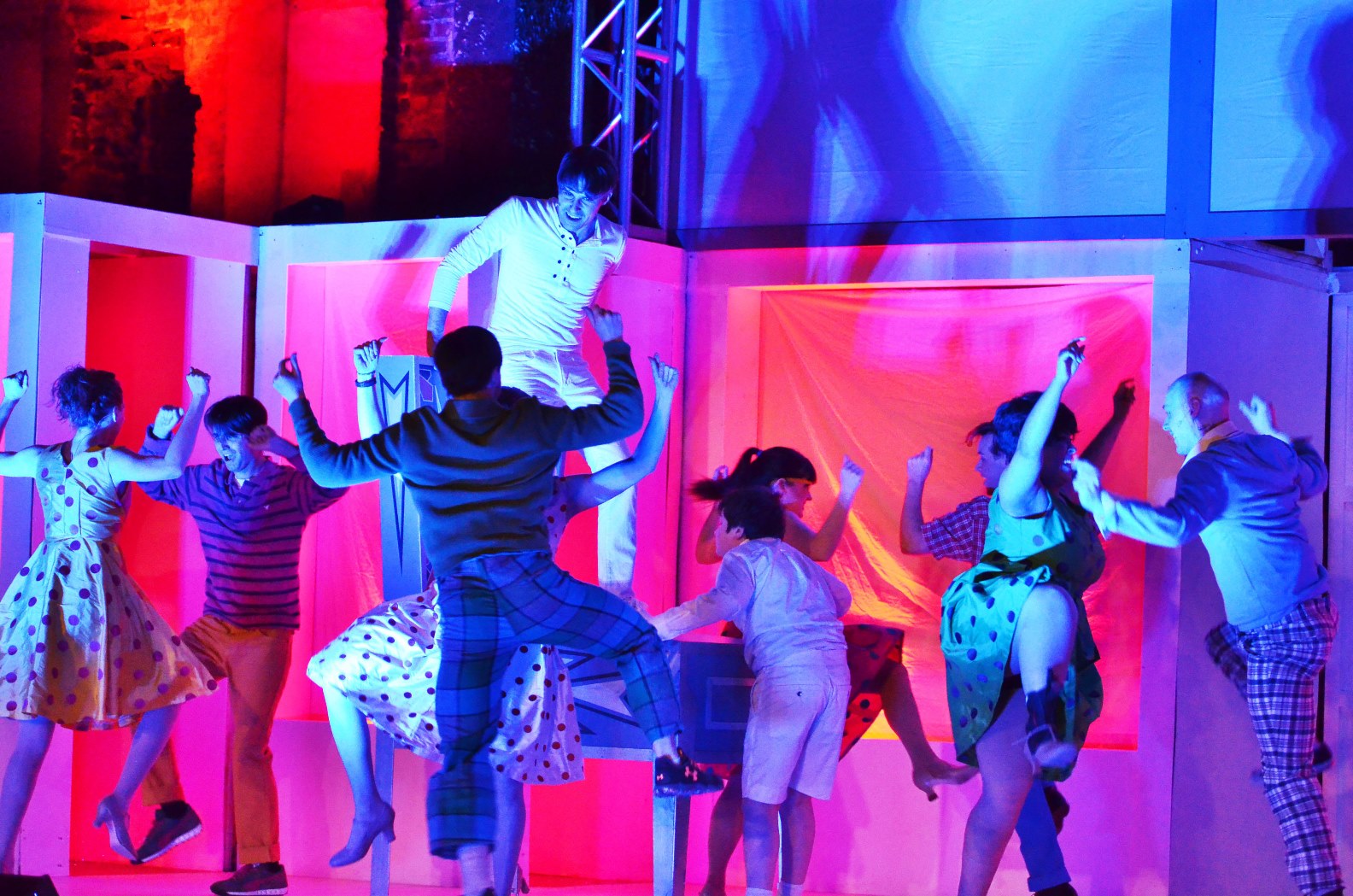
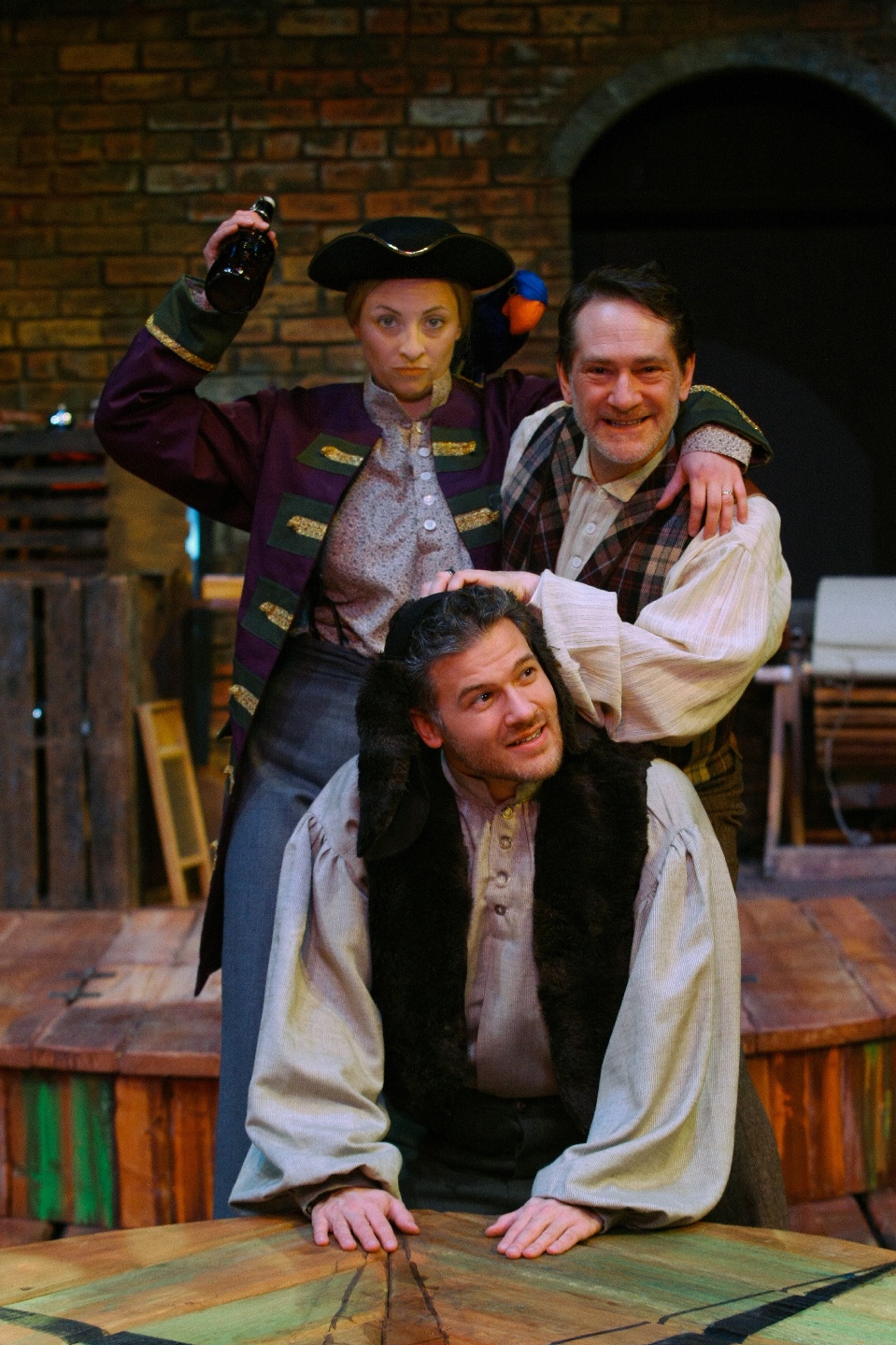
Grace Bollander, a graduating senior at Columbus School for Girls, plays the conflicted title character in Hamlet (photo by Nick Pershing)
Grace Bolander, a graduating senior at Columbus School for Girls, plays the conflicted title character in Hamlet (photo by Nick Pershing)

By Richard Ades

Can an 18-year-old high school student do justice to one of the greatest roles in the English language? When that student is Grace Bolander, yes, indeed.

Actors’ Theatre has pushed the envelope with its season-opening production of Hamlet, giving the title role to an actor who is not only a teenager but a female to boot. If you suspect the casting is simply an attention-getting gimmick, you obviously haven’t seen the show. Once you do, you’ll realize that Bolander was simply the best person for the part.

Over the years, I’ve witnessed various takes on the Danish prince, all attempting to explain a puzzling man who seems eager to avenge his father’s murder, yet keeps finding excuses to delay action. Bolander quickly puts her own stamp on the character, portraying him as tearfully emotional one moment and wickedly humorous the next.

She also ups the tempo at key moments, allowing the familiar words to tumble out in a dazzling torrent. Once or twice, the words come a little too fast, rushing the dialogue, but overall her performance is remarkable.

Despite Bolander’s star-making turn, the best thing about Actors’ Theatre’s production is that every performance is remarkable. Co-directed by Nick Baldasare and John S. Kuhn and set in the late Victorian era, this Hamlet interprets each character with clarity and conviction.

John Heisel is a combination of dull-witted malice and honest remorse as King Claudius, the uncle who allegedly stole his throne by murdering Hamlet’s father. As Gertrude, Hamlet’s mother and Claudius’s new bride, Janetta Davis exhibits both wifely support and—after her distraught son shows signs of mental instability—maternal concern.

Josh Katawick is a rock as Horatio, the one friend Hamlet trusts. John Quickley and Sarah Gehring portray Rosencrantz and Guildenstern as such superficial simps that it’s clear why they’re the friends Hamlet doesn’t trust.

As the aged Polonius, John Feather is humorously doddering and sanctimonious. As Ophelia, his daughter and the object of Hamlet’s affection, Rachel Gaunce projects sweetness and innocent virtue.

More solid work is turned in by John Connor as Laertes, Greg Hoffman as the ghost of Hamlet’s father, Jordan Estose as Osric/Messenger, John Beeler as Marcellus/Lucianus, Andy Falter as the Leading Player and Christina Yoho as the acrobatic Player Queen.

Providing able technical support are designers Trent Bean (set), Emily Jeu (costumes), Jarod Wilson (lighting) and William Bragg (sound). Jason Speicher choreographed the climactic fight scene.

In recent years, Actors’ Theatre has branched out from its traditional focus on Shakespeare in an attempt to broaden its audience. And when it did take on the Bard, it sometimes did so in a way that was designed to amuse non-Shakespeare fans: for example, by mixing puppets with live actors (good idea) or by adding jokey pop-culture references and slapstick (bad idea).

Despite its unconventional casting, the current production provides welcome evidence that Actors’ remains capable of doing Shakespeare straight and putting on a great show in the process.

Actors’ Theatre will present Hamlet through June 22 at the Schiller Park amphitheater, 1069 Jaeger St. Show times are 8 p.m. Thursday-Sunday. Running time: 2 hours, 15 minutes (including intermission). Admission: Pay what you will. Bring a blanket or lawn chair. 614-444-6888 or theactorstheatre.org.

Special event: A memorial for Columbus actor Carl Novak, who died unexpectedly last month, will be held at 2 p.m. Friday (May 30) at the Schiller Park amphitheater.
‘Mormon’ musical isn’t just a raunchy satire

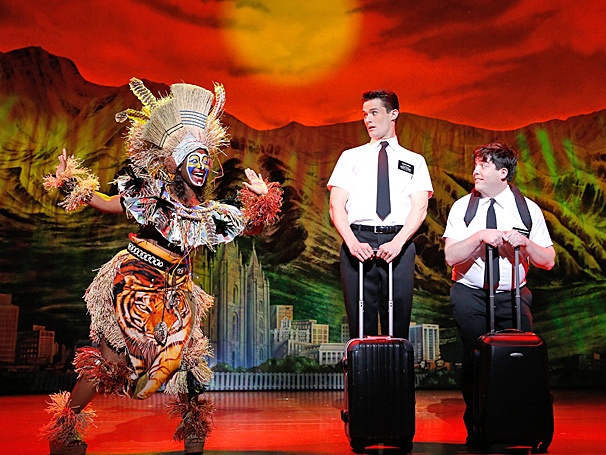
Elder Price (Mark Evans, left) and Elder Cunningham (Christopher John O’Neill) are given a rousing sendoff as they prepare to take the Mormon message to Uganda (Broadway.com photo)

By Richard Ades

The Book of Mormon has finally arrived in Columbus, and I’ve now had the chance to form a second opinion on the show I saw nearly a year ago on Broadway.

That opinion: I like it even better the second time.

Admittedly, the first act was a bit of a letdown when I attended the show Wednesday at the Ohio Theatre, partly because it had lost the element of surprise. But the second act delivered even more of a payoff, both comically and emotionally.

Emotionally? Yes. This hit musical by Avenue Q’s Robert Lopez and South Park creators Trey Parker and Matt Stone does have some inspiring and heartfelt moments in between all the F-bombs and sexual references.

You’ve probably heard that The Book of Mormon takes a satirical look at the titular faith, including its odd belief that Jesus visited what is now upper-state New York during the brief time between his crucifixion and his resurrection. Yes, it has religious zingers aplenty, and they’re both sly and hilarious. At its core, though, this is the story of a friendship between two young missionaries.

Elder Kevin Price (Mark Evans) is the fair-haired child of his missionary class, so flawless that people assume “Heavenly Father” will grant him any wish he desires. And what Kevin desires is to be assigned to spread the Mormon message in Disney-fied Orlando, which he considers the most perfect place on earth.

Elder Arnold Cunningham (Christopher John O’Neill) is Kevin’s opposite, a roly-poly ne’er-do-well with a propensity for stretching the truth. Kevin is chagrined to learn that he and Arnold have been assigned to spend their two-year mission together, and he’s even more chagrined to learn that they’ll be spending it in northern Uganda.

His chagrin turns to terror when he learns that the local people are oppressed not only by poverty, AIDS and superstition, but by a warlord who threatens to “circumcise” (i.e., genitally mutilate) all the women. After the colorfully named General Butt Fucking Naked (Corey Jones) proves his ruthlessness by shooting a detractor in the face, Kevin decides his best option is to request a transfer out of this godforsaken land.

The Book of Mormon’s success depends most heavily on Arnold, an irresponsible scamp who ultimately is forced to Man Up, as he sings in the rousing number that caps off Act 1. In the touring production at the Ohio, O’Neill hits every note just right whether he’s singing or speaking. Over the show’s 2½ hours, he builds a portrayal of a lovably needy but surprisingly resourceful man-child.

Evans also hits every note just right as Kevin, revealing a sweet voice and an innate decency hiding just beneath the character’s self-important surface. He even projects a modicum of vulnerability after a guilty conscience lands Kevin in the middle of a Spooky Mormon Hell Dream. The gaudy musical number surrounds him with threatening demons, a dismissive Jesus and even dancing Starbucks cups. (Mormons, of course, are forbidden from drinking either alcohol or caffeine.)

The show’s third important character is Nabulungi (Alexandra Ncube), a young village woman who responds to the Mormon message because it offers her hope in a hopeless world. Ncube projects charming naiveté and a beautiful singing voice, particularly in her wistful solo Sal Tlay Ka Siti.

Parker co-directs the large and energetic cast with choreographer Casey Nicholaw, who fills the production numbers with clever, spirited dance steps. Justin Mendoza conducts the orchestra, which puts forth a full and satisfying sound despite relying heavily on keyboards. Scott Pask’s scenery, augmented by Brian MacDevitt’s lighting, efficiently moves the action from continent to continent and century to century as needed.

Though The Book of Mormon delights in ridiculing the most eccentric beliefs of the Church of Jesus Christ of Latter-day Saints, it can’t really be described as anti-religious. It accepts and even celebrates religion’s ability to offer hope to people who need it.

The show may not inspire to re-evaluate your beliefs the next time men in white shirts and dark ties ring your doorbell, but you probably won’t slam your door in their faces, either.

Broadway in Columbus and CAPA will present The Book of Mormon through May 25 at the Ohio Theatre, 39 E. State St. Show times are 7:30 p.m. Tuesday-Thursday, 8 p.m. Friday, 2 and 8 p.m. Saturday, and 1 and 6:30 p.m. Sunday. Running time: 2 hours, 30 minutes (including intermission). Tickets are $43-$145. 614-469-0939, 1-800-745-3000 or ticketmaster.com.

Past, politics put a damper on family gathering

By Richard Ades

Other Desert Cities may be one of those plays that you either love or you hate.

A New York Times critic praised the family drama when it opened at Lincoln Center and subsequently moved to Broadway in 2011. But some viewers who responded to his opinions clearly hated the play, even going so far as to leave at intermission.

After seeing Gallery Players’ production, I can understand where they’re coming from. Jon Robin Baitz’s work starts with at least two strikes against it.

First, there are the characters of Lyman and Polly Wyeth, a secular Jewish couple living in Palm Springs. Lyman is a former movie star who became an ambassador during the Reagan administration, and both he and his wife have immersed themselves in right-wing politics. Trouble is, they’ve immersed themselves so totally that, when faced with a painful dilemma involving their grown children, they respond with conservative talking points. Polly, in particular, is little more than a living, breathing cliché.

Add to that Baitz’s tendency to have his characters “communicate” by making long-winded speeches at each other. In the current production, at least, that adds up to uncomfortable moments during which everyone else is reduced to standing or sitting around in stiff silence.

Faced with the play’s shortcomings, director April Olt and her cast have a tough theatrical row to hoe. Despite this, a couple of the performances do manage to bear dramatic fruit.

Jill Taylor is intense and believably agitated as Brooke Wyeth, an author who’s struggling to recover from a seven-year bout with depression. Brooke is visiting her parents on Christmas Eve, 2004, with manuscripts of her new tell-all book about Henry, a brother who apparently committed suicide after being involved in a leftist-inspired bombing. She wants her parents to approve the book even though it basically blames them for Henry’s death.

Even more energy is provided by Jay Rittberger as Brooke’s surviving brother, Trip. The producer of a TV reality show, Trip finds himself in the middle of the resulting battle between his parents and sister. Thanks to Rittberger’s hyper and earnest performance, his response results in some of the production’s most compelling moments.

Tom Holliday and Catherine Cryan have less success as parents Lyman and Polly. Cryan doesn’t seem monstrous enough to say some of the horrible things that come out of Polly’s mouth, while Holliday delivers his lines as if ex-actor Lyman were simply playing one of his old Hollywood roles. And neither Holliday nor Cryan manages to inspire much sympathy, an admittedly hard task but one that is probably necessary in order to keep viewers involved.

Similarly unconvincing is Cheryl Jacobs as Polly’s sister Silda. Jacobs doesn’t convey enough edge or bitterness as the alcoholic ex-screenwriter, who plays a continually developing role in the battle of wills between Brooke and her parents.

In general, what’s missing from the production is a sense of the connections and tensions that would help the characters rise above their often cliché-ridden and wordy dialogue. At least Jon Baggs’s handsome set gives viewers something to look at while they endure all the speechifying.

Baitz does look at interesting questions in Other Desert Cities, such as whether an author has the right to use her own life as subject matter regardless of its impact on those around her. He also rewards viewers’ patience with some startling revelations.

But his play presents many obstacles to both actors and viewers, and the current production hasn’t been able to overcome them.

Gallery Players will present Other Desert Cities through May 18 at the Jewish Community Center, 1125 College Ave. Show times are 7:30 p.m. Thursday, 8 p.m. Saturday and 2:30 p.m. Sunday. Running time: 2 hours, 20 minutes (including intermission). Tickets are $20 ($15 JCC members), $18 for seniors ($13 JCC members), $10 for students and children. 614-231-2731 or www.jccgalleryplayers.org.

Great art inspires great music

Amy Lay as one of several mutated creatures that appear in Gallery of Echoes’ take on the sculpture Bird by Aldo Casanova (Shadowbox Live photo)

By Richard Ades

My Free Press preview of Gallery of Echoes describes it as an experiment in “art appreciation.” If that sounds dull to you, buck up. Shadowbox Live’s offbeat show does try to be educational, but it works even harder at being entertaining.

Taking a break from its usual skits and rock cover songs, the troupe spends about two hours examining 21 pieces from the Columbus Museum of Art’s permanent collection. It does this with the help of narration, dance and video projected on a 9-by-27-foot screen. Best of all, it does it with original music composed and performed by an in-house band called Light.

Seriously, no matter how impressed you are by the show in general, you can’t help being blown away by the music. Shadowbox has thrown original numbers into its shows from time to time, but these pieces are in a class by themselves. The best ones complement their respective artworks perfectly, and all are flawlessly performed by Stev Guyer, Gabriel Guyer, Jennifer Hahn, Matthew Hahn, Brandon Smith and Brent Lambert, along with occasional vocalists and a host of auxiliary players.

Other elements of the show also have their moments, sometimes even overshadowing the music. That’s the case in the first number, based on King Lake, California, an 1870s oil painting by Albert Bierstadt. Though the music for this piece is not particularly memorable, the video images allow viewers to feel like they’re exploring Bierstadt’s untamed Western landscape.

When a segment is really cooking, though, all of the elements combine to create an experience that stands on its own, regardless of how you feel about the featured artwork.

One of my favorite pieces is based on Bird, a sculpture by Ohio State-educated (and environmentally conscious) artist Aldo Casanova. While the band plays one of the show’s nicer instrumental numbers, a succession of actors pose and strut across the stage in the guise of bizarre, mutated birds. Brava to Linda Mullin for the ingenious costume designs.

Another favorite is Shadowbox’s take on The Assassination by James Ensor. As the video explores every detail of the grotesque painting, the band nimbly picks its way through appropriately shrill music with unbelievably intricate timing.

Since Shadowbox bills Gallery of Echoes as an aid to appreciating the featured art, it’s fair to ask whether it accomplishes its task. In this respect, it’s a mixed success.

The narration sometimes offers valuable background information, as when we’re told that German/Danish artist Emile Nolde created Sunflowers in the Windstorm (1943) after the Nazi Party had forbidden him from painting. But the video then goes on to insert images of marching soldiers and even Hitler himself in the midst of the swaying flowers. It seems like overkill, and it doesn’t help us to understand Nolde’s position as a Nazi whose style of art had fallen out of official favor.

Art enthusiasts may also be bothered by various segments’ attempts to interpret their respective works. One of the joys of great art is that it invites viewers to come up with their own interpretation.

Yes, Gallery of Echoes does sometimes work as an unusually lively class in art appreciation. But it’s best enjoyed as an innovative show that uses classic artworks as a jumping-off point: the inspiration for graceful dancing, colorful costumes and some really fine music.

Gallery of Echoes will be presented through Sunday (May 4) at Shadowbox Live, 503 S. Front St. Remaining show times are 7:30 and 10:30 p.m. Saturday, and 2 and 7 p.m. Sunday. Running time: 2 hours, 20 minutes (including intermission). Tickets are $25-$40, $20-$35 for students, seniors, military and Columbus Museum of Art members. 614-416-7625 or shadowboxlive.org.

You’ve seen the show, now see the art

Despite renovation projects now going on at the Columbus Museum of Art, 11 of the 21 pieces featured in Gallery of Echoes are currently on display. They are:
King Lake, California by Albert Bierstadt
Thunderstorm by Arthur Dove
The Assassination by James Ensor
Into the Past by Hananiah Harari
The Swimmer by Yasuo Kuniyoshi
Sunflowers in the Windstorm by Emile Nolde
Female Nude by Pablo Picasso
Bouquet of Light by Christopher Ries
Melanie, the Schoolteacher by Chaim Soutine
Cornice by George Tooker
Portrait of Andries Stilte II by Kehinde Wiley
For more information, visit columbusmuseum.org.

Pinball Wizard, Acid Queen return in pioneering rock opera

JJ Parkey as pinball wizard Tommy (center) revels in the adulation of his dancing fans while Griffin Giannone, as his 10-year-old self, racks up a score at the pinball machine in The Who’s Tommy (photo by Heather Wack)

By Richard Ades

Check out Short North Stage’s program for The Who’s Tommy, and you’ll see that Edward Carignan is billed as both the director and the choreographer. The jobs aren’t as distinct as you might assume.

There’s dancing, of course, but even when there isn’t, the scenes move along with such speed, precision and complexity that they feel like they’ve been choreographed rather than merely directed. As often happens during Short North Stage musicals, you can’t help sitting up and thinking, “Wow!”

JJ Parkey (formerly seen in the troupe’s Cabaret and Hedwig and the Angry Inch) stars as the adult version of the English title character, who becomes oblivious to the world after witnessing a shocking event at the age of 4: His father (David Bryant Johnson) returns from World War II and finds his wife (Emily Brockway) having an affair. A struggle ensues, and the lover (Jason Carl Crase) is killed.

Over the years, the helpless Tommy endures mistreatment at the hands of his perverted Uncle Ernie (Ryan Stem) and sadistic Cousin Kevin (Josh Houghton). He also is subjected to his parents’ endless attempts to “cure” him with the help of either science or religion. Nothing can break him out of his mental prison.

Then Tommy stumbles across a pinball machine and proves to have so much innate skill at the game—possibly because his disabilities eliminate all distractions—that he becomes a minor celebrity.

Much more happens, including Tommy’s eventual rise from a minor celebrity to a major one, but the musical reaches its high point when our hero discovers his unexpected talent to the tune of the rousing Act 1 capper, Pinball Wizard. Post-intermission developments never attain this level of emotional power.

Musically speaking, however, it’s a different matter. Composer/lyricist/co-book writer Pete Townshend, with help from bandmates John Entwistle and Keith Moon, has filled the album-based musical with songs that not only advance the plot but are memorable in their own right.

At Thursday’s preview, conductor P. Tim Valentine’s backstage band sometimes overwhelmed the singers and rendered lyrics indecipherable. Hopefully, a few tweaks on the soundboard will improve that situation.

In the leading role, Parkey’s vocals are as strong as ever, though some of his Act 2 dialogue comes off as stilted. Two young brothers, Christian and Griffin Giannone, give poised performances as Tommy at ages 4 and 10, respectively.

The rest of the cast is uniformly good, but Kendra Lynn Lucas stands out for making the most of her showy role as the drug-pushing Acid Queen. Another indelible impression is made by Tommy Batchelor (a former Billy Elliot on Broadway), who emerges from the ensemble to give an amazing balletic dance solo during the Act 2 Underture.

Rob Kuhn’s scenic and lighting designs are complementary, as the set is a series of white doors and panels that goes through chameleonic changes whenever the lighting changes hues. Director Carignan’s costume designs are inventive and colorful.

First appearing as a double album in 1969 and as a stage show in 1992, The Who’s Tommy helped to found the genre of the rock musical. In 2014, its audacity and musical sophistication still inspire awe.

Short North Stage will present The Who’s Tommy through April 27 at the Garden Theater, 1187 N. High St. Show times are 8 p.m. Thursday-Saturday and 3 p.m. Sunday. Running time: 2 hours, 35 minutes (including intermission). Tickets are $25-$40. 614-725-4042 or shortnorthstage.org.

Stage version of Addams Family is more lovable than creepy

Stars of The Addams Family include (from left) Amanda Bruton (Grandma), Jennifer Fogarty (Wednesday), Dan Olson (Lurch), Jesse Sharp (Gomez), KeLeen Snowgren (Morticia), Shaun Rice (Uncle Fester) and Jeremy Todd Shinder (Pugsley). Note: Alternate actors play Lurch and Pugsley in the current touring production. (photo by Carol Rosegg)

By Richard Ades

The musical comedy now unfolding at the Palace is called The Addams Family, but it bears only a superficial resemblance to its macabre source material.

Fans of Charles Addams’s New Yorker cartoons or the 1960s TV series will recognize the basic characters. They look much as they did on TV and in subsequent movies, except that daughter Wednesday (Jennifer Fogarty) has grown into a romance-minded young woman. Book authors Marshall Brickman and Rick Elice (Jersey Boys) have even retained touches of the old Addams quirkiness, such as the family’s fondness for torture devices and graveyards.

Beneath these surface aberrations, though, these stage Addamses are surprisingly normal.

The thin plot hinges on Wednesday’s plan to introduce Ohio-bred boyfriend Lucas Beineke (Bryan Welnicki) to the family by inviting him and his parents (Mark Poppleton and Blair Anderson) to dinner. Confiding in her father, Gomez (Jesse Sharp), Wednesday reveals that she and Lucas have already agreed to marry, but she asks Gomez not to tell her mother, Morticia (KeLeen Snowgren). Her fear is that Morticia will try to sabotage the relationship if she learns of the engagement before she’s gotten to know the Beinekes.

Gomez protests that he’s never lied to his wife, but he reluctantly agrees to keep the secret from Morticia until that night’s dinner party. And on that brief bit of deception rests the entire storyline.

Musicals probably have been built on slimmer ideas, though I can’t think of any offhand. But the oddest thing about The Addams Family is how conventional the characters are beneath their gothic exteriors.

Gomez is like any devoted husband and father who’s trying to keep peace in the household. Wednesday is like any embarrassed teenager who thinks her family is weird (except that her family really is weird). Her brother, Pugsley (Connor Barth), may be tortured by his big sister literally rather than figuratively, but he loves her just the same.

Perhaps the most Addams-like of the characters are the herb-gathering Grandma (Amanda Bruton) and grunting butler, Lurch (Ryan Jacob Wood). The least Addams-like is Uncle Fester (Shaun Rice), who has metamorphosed from an anti-social, blunderbuss-brandishing curmudgeon into a romantic who enlists the souls of his dead ancestors in the cause of promoting Wednesday and Lucas’s love.

The result of all the changes made to the original characters—and of the subsequent changes made in response to the show’s mixed success on Broadway in 2010-11—is a warmhearted, rather conventional musical that’s designed to appeal to everyone but hardcore Addams fans.

Its pluses include Andrew Lippa’s songs, which are sometimes pretty (Wednesday and Pugsley’s Pulled) and sometimes catchy (the hummable Full Disclosure). The six-piece band is synthesizer-dominated and sounds it, but the players’ voices range from serviceable to great. Fogarty (Wednesday) and Anderson (Alice) are especially strong.

Working under Jerry Zaks’s direction, the cast is as funny as the material allows it to be. Jonathan Ritter’s choreography is especially enjoyable when it includes both living and non-living participants, as it does in Act 2’s Tango de Amor. The set and costumes (designed by original directors Julian Crouch and Phelim McDermott, with later set tweaks by James Kronzer) are appropriately gothic.

Amid all the singing and dancing, The Addams Family seeks to purvey the message that you have to be true to yourself. Considering the liberties it takes with its creepy characters, some might see that as a bit ironic.

Broadway in Columbus and CAPA will present The Addams Family through April 13 at the Palace Theatre, 34 W. Broad St. Show times are 7:30 p.m. Tuesday-Thursday, 8 p.m. Friday, 2 and 8 p.m. Saturday and 1 and 6:30 p.m. Sunday. Running time: 2 hours, 25 minutes (including intermission). Tickets are $28-$78. 614-469-0939, 1-800-745-3000 or ticketmaster.com.

Homage to silent performer is a bit too talkative

Sarah Ware as Bip in Ohio State University Department of Theatre’s production of There Is No Silence (photo by Matt Hazard)

By Richard Ades

The title There Is No Silence is surprisingly accurate. Even though Ohio State’s original work is inspired by the life of renowned mime artist Marcel Marceau (1923-2007), there’s a whole lot of talking going on.

The show is only minutes old when we’re introduced to Trixie (Jane Elliott), a mime-in-training who can’t seem to keep her mouth shut. At times, she asks for suggestions from the viewers—for example, what should be on the other end of the invisible rope she’s about to pull. (“Me!” an enthusiastic little girl called from the audience on opening night.)

Trixie, who later reappears as a revised character named Marbles, is a lively and personable presence, but she’s too verbose to be an effective mime. It’s not clear why she’s given such a prominent role in an homage to the French master of silence.

However, the show’s main problem is its lack of focus, which is likely due to the number of hands involved in its creation. Conceived and directed by former Marceau student Jeanine Thompson, it also was “devised” by the MFA Acting Cohort and written by Jennifer Schlueter and Max D. Glenn. Add the technological input of the Advanced Computing Center for the Arts and Design, and it’s easy to understand why the production goes off in so many directions.

One minute it comes across as a classroom lecture, dutifully ticking off the now-obscure performers who inspired Marceau. At other times, it allows performers to expound at length about their own connections to the artist or his craft.

At still other times, the show delves into Marceau’s challenging relationships with his daughter, Aurelia (Camille Bullock), and collaborator/wife, Anne Sicco (Melonie Mazibuko). In fact, a fierce argument between Cousteau and Sicco ends Act 1—an odd choice, since viewers don’t know enough about the wife to care about the fight’s outcome.

Much more enlightening is an Act 2 historical section that details Marceau’s anti-Nazi activities during World War II. But the show is the most engrossing when its performers honor Marceau’s craft by showing off their own silent grace.

The most graceful of all is Sarah Ware, who captures the essence of Marceau’s stage alter ego, Bip. Another wordless (but musically accompanied) highlight is a dance performed by Aaron Michael Lopez, one of four men who take turns playing Marceau. (The others are Sifiso Mazibuko, Brent Ries and Patrick Wiabel.)

The ACCAD-aided sections, such as one in which the electronically produced outlines of Marceau and a live performer move in perfect unison, are technologically impressive. But our appreciation of Marceau is bolstered more by the segments that honor the mime in the most appropriate way: by showing just how expressive the silent human body can be.

Ohio State Theatre will present There Is No Silence through April 13 in the Thurber Theatre, Drake Performance Center, 1849 Cannon Drive. Show times are 7:30 p.m. Thursday-Friday, 3 and 7:30 p.m. Saturday and 3 p.m. Sunday. Running time: 2 hours, 15 minutes (including intermission). Tickets are $20; $18 for faculty, staff, alumni association members and senior citizens; $15 for students and children. 614-292-2295 or theatre.osu.edu.

Live, from Columbus! It’s the Beatles!

Andy Ankrom takes the helm in Yellow Submarine, one of 33 Beatles tunes featured in Bigger Than Jesus (photo by Will Shively)

By Richard Ades

Even if you’ve always idolized the Beatles, chances are you’ll learn something new from Bigger Than Jesus. Shadowbox Live’s “live rockumentary” intersperses songs from the Fab Four’s incredible canon with tidbits of information about the group.

For instance, did you know that in 1964 the Liverpudlian quartet refused to play the Gator Bowl until the Florida facility set aside its segregated ways? Or that Blackbird (whose title was mod slang for “black girl”) was a response to the civil rights movement?

And did you know that Eric Clapton had an uncredited guitar solo in While My Guitar Gently Weeps?

Well, maybe you knew that, but you won’t mind if the show’s narrators occasionally tell you stuff you’ve already heard. You’ll be too busy enjoying the music that makes up the bulk of its running time. Performed in roughly chronological order, the songs are some of the band’s biggest and best hits.

Given John, Paul, George and Ringo’s well-known expertise as musicians and recording innovators, a Beatles retrospective is a dangerous undertaking. Viewers won’t be satisfied unless the song renditions approximate the fun and excitement of the originals. For the vast majority of the show, Shadowbox succeeds.

After a few early numbers that are merely pleasant, things begin to heat up with Kevin Sweeney’s electrifying delivery of Help! JT Walker III then slows things down with the first of several numbers to benefit from his golden touch, the gorgeous Norwegian Wood.

Afterward, director Stev Guyer explains the John Lennon quote that gave the show its name. According to documentary footage projected on the room’s video screen, Lennon’s sardonic comment that the Beatles would surpass Jesus in popularity led to a boycott in at least one Southern city. The KKK also jumped on the anti-Beatles bandwagon, we learn.

Guyer begins the evening by jokingly apologizing to viewers whose favorite songs were inevitably left out. There were simply too many great ones to choose from, he says.

Indeed, it’s not hard to think of classics that didn’t make the cut: Yesterday, for one. Or She Loves You, the joyous anthem that helped to define the mopheads during their first appearance on The Ed Sullivan Show.

But there are so many other gems that are included. Some of the most memorable (and their featured vocalists): Sgt. Pepper’s Lonely Hearts Club Band (Leah Haviland), Magical Mystery Tour (Amy Lay and Walker), Penny Lane (Will Macke), Helter Skelter (Stephanie Shull), While My Guitar Gently Weeps (Jeff Simpson) and She Came in Through the Bathroom Window (Sweeney).

Many numbers are marked by fine harmonizing on the part of backup singers. In others, the Matthew Hahn-led band plays a leading role, as when surreal instrumental crescendos interrupt in A Day in the Life.

The psychedelic and colorful costumes (designed by Linda Mullin, Nick Wilson and Lyn Helenberger) help to recapture an era and a band that were increasingly influenced by mind-altering drugs. Katy Psenicka’s choreography is another important element of the proceedings. It’s especially enjoyable when the vocalists themselves bust a few moves, as they do in When I’m Sixty-Four (sung by Tom Cardinal, Haviland and Macke).

If you’re old enough to remember the Beatles, Bigger Than Jesus is nostalgic fun. If you’re not, it’s one hell of a history lesson.

Bigger Than Jesus: A Live Rockumentary About the Band That Changed the World continues through Aug. 7 at Shadowbox Live, 503 S. Front St. Show times are 7:30 p.m. select Wednesdays and Thursdays, 2 and 7 p.m. select Sundays. Running time: 2 hours, 20 minutes (including intermission). Tickets are $25, $20 for students and seniors. 614-416-7625 or shadowboxlive.org.

Stranded seafarer lives to tell his tale

Lisa Thoma, Robert Behrens and Joe Dallacqua (clockwise from top) perform in CATCO’s production of Shipwrecked! An Entertainment – The Amazing Adventures of Louis de Rougemont (as Told by Himself) (photo by Dave Alkire)

By Richard Ades

Louis de Rougemont had quite an adventure, and he desperately wants to tell us about it. With a combination of narration, acting, shadow figures and sound effects, the 19th century Londoner explains how he left home as a youth and went to sea, only to be shipwrecked and stranded for years on a desert island.

A giant octopus, a rare black pearl and a tribe of Australian Aborigines also figure in his tale, which unfolds in Donald Margulies’s Shipwrecked! An Entertainment—The Amazing Adventures of Louis de Rougemont (as Told by Himself).

When I first saw the play in a 2010 Whistling in the Dark production, I thought it was a bit long-winded, but I enjoyed the way it captured the spirit of its real-life adventurer’s times. Because it was presented in a theater that was designed to be environmentally friendly, the production took a low-tech approach that added to the period feel. The live piano accompaniment was particularly effective.

CATCO’s current production, directed by Mark Seamon, is less low-tech and, thus, seems less authentic. Moreover, Seamon and company punctuate the story with goofy sound effects (a slide whistle and the like) that probably are designed to tickle younger viewers. Well, maybe they do, but they detract from the show’s credibility. De Rougemont clearly wants us to amaze us, not amuse us.

Beyond those quibbles, the show has much to recommend it. Shakespearean actor/director Robert Behrens makes a rare stage appearance as the title adventurer, and he gives an entertaining performance. Enthusiastic supporting actors Lisa Thoma and Joe Dallacqua play all the characters de Rougemont comes into contact with, especially a friendly Aborigine woman (Thoma) and an even friendlier dog (Dallacqua).

Even before the action starts, Michael S. Brewer’s handsome set is sure to elicit a few “oohs” and “aahs.” The broad-beamed stage floor is a good stand-in for the ship deck on which the young de Rougemont begins his adventures.

Yes, the play still seems a bit long-winded (I’ve heard of other productions that wrapped things up in less than 90 minutes, though I can’t imagine how). But the tale it tells is a fascinating one, made even more so by the fact that we’re not entirely sure we should believe it.

CATCO will present Shipwrecked! An Entertainment—The Amazing Adventures of Louis de Rougemont (as Told by Himself) through Feb. 23 in Studio Two, Riffe Center, 77 S. High St. Show times are 11 a.m. Wednesday, 8 p.m. Thursday-Saturday and 2 p.m. Sunday. Running time: 1 hour, 45 minutes. Tickets are $11.50 for Wednesday matinees, $45 on Fridays and Saturdays, $41 for other shows. Discount student tickets ($15) are offered two hours before show time. 614-469-0939 or catco.org.

Annual theater celebration features awards, speeches, songs

Matt Clemens (seen sharing a scene with Laura Griffith) received a Theatre Roundtable award for his leading role in Short North Stage's production of Sunday in the Park With George (photo by Megan Leigh)
Matt Clemens (seen sharing a scene with Laura Griffith) received a Theatre Roundtable award for his leading role in Short North Stage’s production of Sunday in the Park With George (photo by Megan Leigh)

By Richard Ades

It’s all over but the Facebook posts.

The Central Ohio Theatre Roundtable held its annual awards night Sunday at the Jewish Community Center. As in the past, the fast-paced show punctuated its presentations and speeches with songs from some of the past year’s musical productions.

The treats included Matt Clemens’s emotional rendition of Finishing the Hat from Stephen Sondheim’s Sunday in the Park With George. The number provided proof that Clemens richly deserved the award the Roundtable gave him for his leading role in the Short North Stage production.

One of the night’s most heartwarming moments came when the Central Ohio Theatre Critics Circle—representing local print, on-air and online critics—presented a citation to Short North Stage for that same production. When troupe co-founders Rich Gore and Peter Yockel came onstage to accept the award, Yockel found himself getting a little choked up. That prompted Gore to observe that he hadn’t seen his partner tear up like that since their recent wedding day.

In a conversation prior to the show, the two recalled that they were just one of many same-sex couples who’d headed to New York and queued up to get hitched in a civil ceremony on Halloween. But they stood out from the crowd, they noted, being one of the few pairs who hadn’t turned up in Halloween costumes.

Two troupes received the Roundtable’s Harold Awards for, essentially, persevering: Columbus Children’s Theatre for turning 50 and Shadowbox Live for turning 25 (as measured from the appearance of Stev Guyer and company’s earliest “rock operas”). Accepting his Harold, Guyer explained why he and his cohorts had stuck it out in a profession that kept them working longer-than-average hours for lower-than-average pay.

“It’s a calling,” he said. “It’s what you do.”

Guyer also praised Columbus theatergoers who were willing to take a chance on unknown productions—such as most of those presented by Shadowbox.

For a list of other Theatre Roundtable nominees and winners, visit www.theatre-roundtable.org/trnominations/. For a list of the Central Ohio Theatre Critics Circle’s 20th annual round of citations, which were presented at Sunday’s event, see below:

▪ To CATCO and the Columbus Museum of Art, for educating Central Ohio about the power of art and the creative challenges of artists by jointly scheduling CATCO’s area premiere of Red, John Logan’s 2010 Tony winner for best play about Rothko at a pivotal point in his career, and “Mark Rothko: The Decisive Decade,” the museum’s first major exhibit of works by the abstract master.

▪ To Short North Stage, for raising the standard in locally produced musicals with an ambitious 2013 season that culminated in the long-awaited Central Ohio premiere of Stephen Sondheim and James Lapine’s Sunday in the Park With George, a challenging 1985 Pulitzer Prize winner that was brought to vivid life by blending local talents with such New York experts as sound designer Leon Rothenberg, a 2013 Tony Award winner, and director Sarna Lapine, niece of James Lapine.

▪ A Roy Bowen Lifetime Achievement Award to William Goldsmith for nurturing the talents and imaginations of tens of thousands of children and for writing and directing many popular stage adaptations of classic tales as youth theater director at Players Theatre Columbus in the 1970s and ’80s and, for 25 years since 1989, as artistic director of Columbus Children’s Theatre, a troupe that celebrated its 50th anniversary in 2013.