Reviews

NYC-set flick inspired by romantic classic

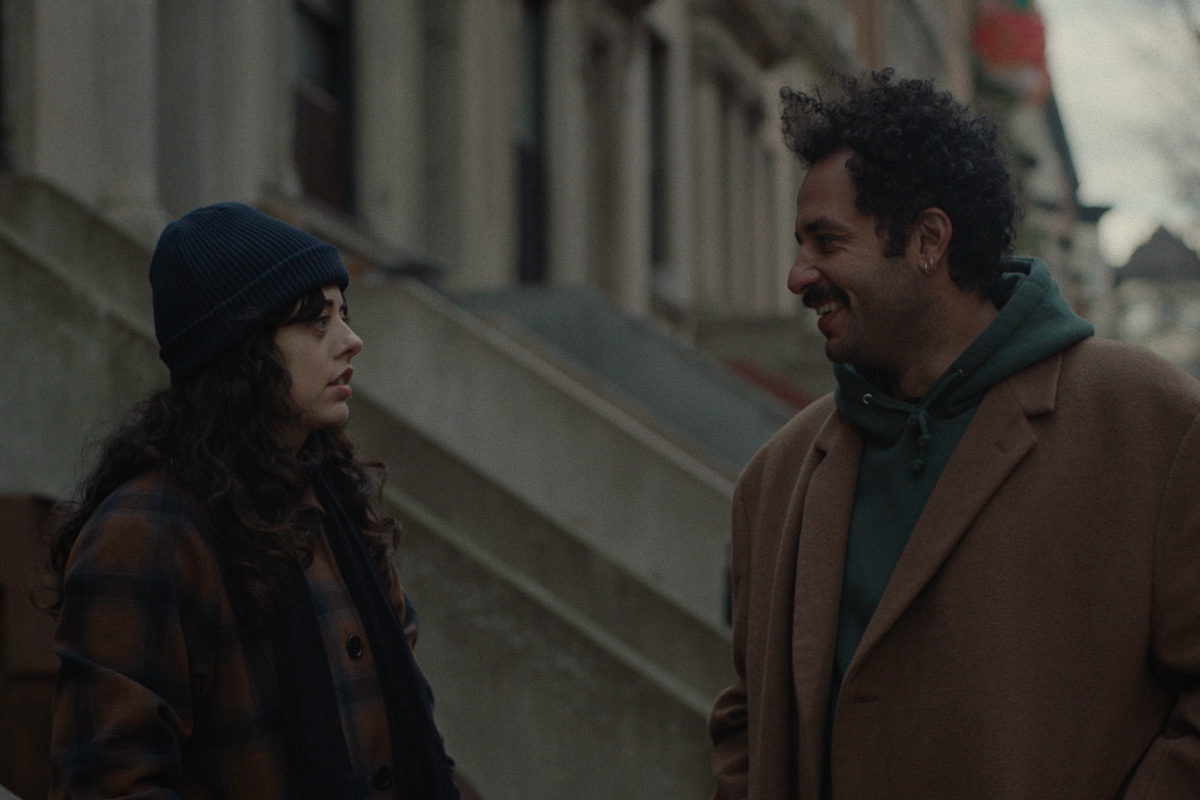
Olivia (Mary Neely, left) and Amir (Kareem Rahma) are strangers who meet at the apartment of a man who owes each of them money. (Photos courtesy of Factory 25)

By Richard Ades

In 1995, director Richard Linklater came out with Before Sunrise, the tale of a man and a woman who meet on a train and decide to spend an eventful night exploring Vienna. Laced with philosophical discussions and flirtatious banter, the achingly romantic film explored possibilities that remained unfulfilled, as the two had commitments that forced them to go their separate ways in the morning.

Before Sunrise was such a success that Linklater reunited the characters in two sequels: Before Sunset (2004) and Before Midnight (2013). The former was even more romantic than its predecessor, but the final film was rather sour-natured, depicting the lovers in a stagnant relationship marked by constant bickering.

I bring all this up because Or Something, a film by first-time director Jeffrey Scotti Schroeder, is obviously inspired by the flick that launched Linklater’s lauded trilogy.

Like Before Sunrise, it brings together two strangers and forces them to spend a day wandering the streets of a big city—in this case, New York. At first, they struggle to get along, but soon they’re sharing opinions on subjects of increasing depth, even including religion and God. Finally, they begin revealing some of their darkest secrets.

The open-ended script is well suited to a low-budget production that reportedly was shot on location in only six days. It also gives the lead actors plenty of room to flesh out their characters—not surprisingly, since it was written by the actors themselves.

Mary Neely plays the tense and closed-off Olivia, whom we first meet when she’s trying to raise cash by selling some of her clothes to a thrift shop. Kareem Rahma plays the more outgoing Amir, who needs money for personal reasons that eventually come out.

The two first meet outside the apartment of a mutual acquaintance, Teddy (Brandon Wardell), who coincidentally owes each of them $1,200. The film is a bit vague on just why he owes them that exact amount, but it makes it clear that Teddy is either unable or unwilling to pay it.

Instead, he tells Olivia and Amir to get the money from someone named Uptown Mike, though he can’t tell them how to contact this mysterious figure other than directing them to a certain corner in Harlem. Thus begins a crosstown trek that will throw the two strangers together for the next several hours.
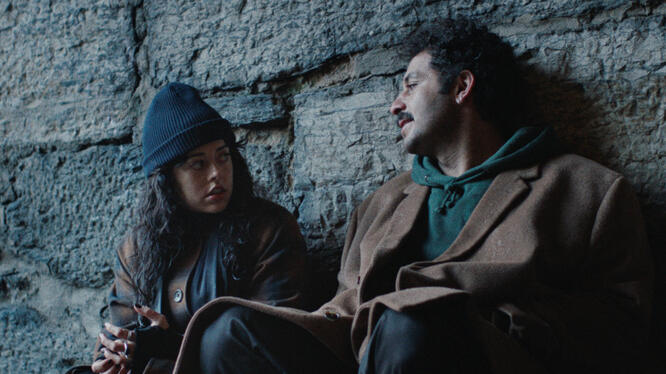
Much of the conversation that follows is entertaining and character-defining, such as the argument that arises when Olivia asserts that men are nice to women only when they want to have sex with them. On the other hand, some of the more cerebral topics arise less organically and less convincingly.

Still, Neely and Rahma play well off each other, keeping viewers vested in their characters’ fledgling relationship right up until the script makes two unfortunate detours.

The first leads Olivia and Amir into a karaoke bar at what seems like an unlikely moment. The second, and far more devastating, detour is a development that apparently is thrown in for shock value. It’s neither what we expected nor—especially for fans of Before Sunrise—what we wanted.

Look at it this way: Richard Linklater took 18 years to throw a sour note into his romantic “Before” saga, but Schroeder did it in only 82 minutes. If the director and his screenwriting stars want to redeem themselves, they need to bring Olivia and Amir back for a sequel.

Rating: 3 stars (out of 5)

Or Something (no MPA rating) opened Aug. 22 at the Quad Cinema in New York City and is scheduled for a special engagement Sept. 14 at Brain Dead Studios in Los Angeles. Additional screenings or VOD outlets have yet to be announced.
Fight for freedom is fueled by revolutionary art

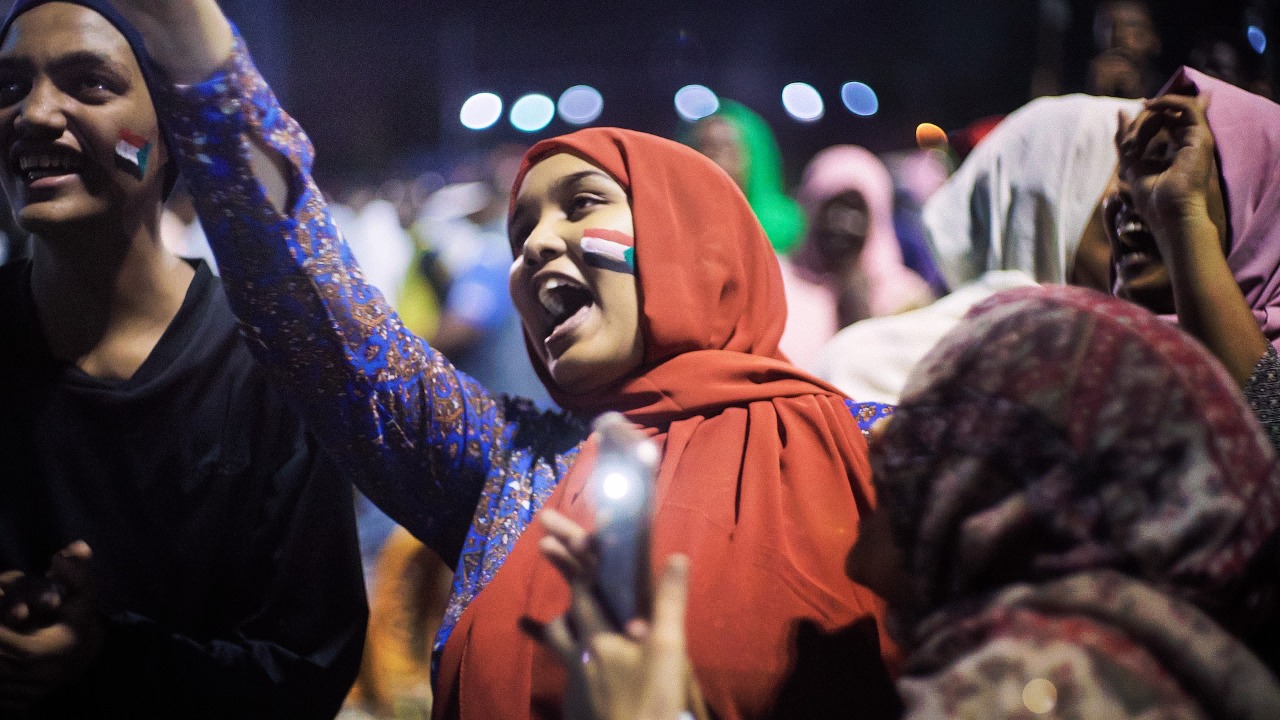
A woman demonstrates against repression in the documentary Sudan, Remember Us.

By Richard Ades

While much of the world is rightfully concerned about what’s going on in Gaza, the northeast African country of Sudan may be the site of even greater misery, if only because its population is far larger. After years of dictatorships, military coups, rebellion and civil war, its people—those who haven’t fled—find life a daily struggle.

The documentary Sudan, Remember Us is a record of the ways young Sudanese rebels tried to head off the current situation by fighting repression and pushing for change. These protesters are remarkable for the courage they display, but also for their creativity, as they often use poetry and other forms of art to make their points.

Written and directed by French-Tunisian filmmaker Hind Meddeb, the doc begins with scenes of military strife in Khartoum in 2023, representing the beginning of the civil war that still engulfs the country. It then flashes back four years to the spring of 2019, when a rebellion has ended the long reign of dictator Omar Al-Bashir.

The victory leaves the rebels, all young and many of them female, filled with optimism and resolve. With signs, murals, chants, songs, poems and sit-ins, they push for the freedoms they were denied under Al-Bashir’s rule.

Unfortunately, Sudan’s window of opportunity for change is short-lived. On the last night of Ramadan, soldiers attack a sit-in demonstration, leaving many of the protesters dead and ushering in a military crackdown.

The main frustration of watching Meddeb’s documentary is that it’s so embedded in Sudan’s struggles that it makes little attempt to explain them to outsiders. We’re seldom told what the political situation is at any particular moment, though the film makes it clear just how the changes affect the gutsy rebels.

After the initial crackdown in 2019, they continue protesting via poetry, songs and other means, but at one point the atmosphere becomes even more ominous. We’re told that the internet has been shut down and that political arrests are now carried out in secret by unidentified men in plain clothes.

This development is guaranteed to send chills down the spines of Americans who’ve noticed the parallels in our own country: the attempts to silence and even defund critical media voices, as well as the expanding army of masked agents who seize people off the streets or at their jobs, often ignoring their rights or legal status.

An important difference is that Sudan doesn’t have America’s history of democracy, though so far it has failed to stop the executive branch’s adoption of an autocratic playbook. On the other hand, Sudan seems to have an unusual affinity for inspirational music, poetry and other art, which buoyed rebels’ spirits and determination when their quest seemed increasingly hopeless.

Any American who was alive back in the 1960s knows that we once had a similar appetite for revolutionary art. Maybe it’s time we got it back.

Rating: 4 stars (out of 5)

Sudan, Remember Us can be seen at select theaters and will open Aug. 15 at the Gateway Film Center in Columbus.

Landless refugees resort to desperate measures  

Reda (Aram Sabbah, left) and Chatila (Mahmood Bakri) see an escape to Germany as their only hope for a brighter future.

By Richard Ades

To a Land Unknown is a film shaped by its director’s dual allegiances.

As a man of Palestinian descent (though he now lives in Denmark), Mahdi Fleifel is devoted to telling the stories of his people. But as a cinephile, he seems equally devoted to recreating the magic of the American films he watched growing up in the 1980s.

The result is the story of two Palestinian refugees that combines the unvarnished realism of a documentary with the kind of alternately warm and testy relationship you might find in an American “buddy flick.”

The tale’s setting is Athens, Greece, where Chatila and his cousin Reda (Mahmood Bakri and Aram Sabbah, both excellent) are barely scraping by with the help of petty thefts and, in Reda’s case, paid sexual trysts. Their situation is desperate, but they see it as temporary.

If they can save up enough money, they plan to purchase fake passports and make their way to what they see as the greener pastures of Germany. Once there, they hope to open a café with the help of Chatila’s wife and son, who are now living in a refugee camp in Lebanon. 

From the beginning, it’s clear that Chatila is the more ruthless of the two, justifying their illegal activities as the products of dire necessity. Reda is both more soft-hearted and less self-disciplined, struggling to escape the drug addiction that threatens to control him.

Reda and Chatila meet Malik (Mohammad Alsurafa, left), a 13-year-old Palestinian orphan.

The men’s personality differences complicate what is already a difficult quest to escape Athens, but they forge ahead with the help of a 13-year-old Palestinian orphan named Malik (Mohammad Alsurafa) and a lonely Greek woman named Tatiana (Angeliki Papoulia). Later, others are involved as well, though not always by their own choice.

Indeed, the film eventually evolves into a kind of crime caper, though one that bears little resemblance to any caper flick you’ve ever seen. The emphasis is not so much on whether the men’s plot will succeed as it is on just how far they’ll go to achieve their goal.

If there’s one line that sums up To a Land Unknown, it’s one person’s assertion that people who’ve been treated like dogs are apt to attack each other. It helps to explain much of the characters’ behavior, as well as the film’s refusal to condemn them for it.

That thought alone would leave viewers with much to ponder, but then director/co-writer Fleifel adds a development that can only be seen as an homage—an unconscious homage, according to Fleifel—to an Oscar-winning classic from decades past.

Some will disagree, but for me it’s an unwelcome complication, upsetting the film’s delicate balance between stark reality and cinematic tropes. Up until then, however, Fleifel’s full-length debut is an engrossing examination of the lengths desperate people will go to in order to survive.

Rating: 3½ stars (out of 5)

To a Land Unknown (no MPA rating) can be seen in select theaters and is scheduled to open July 18 at Columbus’s Gateway Film Cen

Judo contender risks ayatollah’s wrath

Iranian martial artist Leila Hosseini (Adrienne Mandi) contemplates her next move after her government orders her to withdraw from an international judo competition.

By Richard Ades

One of my favorite movies of 2024 was The Seed of the Sacred Fig, about a family torn apart by Iran’s theocratic dictatorship. In the same year, one of my favorite guilty pleasures was Cobra Kai, the Karate Kid-inspired TV series that was wrapping up its six-season run.

So maybe it’s no surprise that one of my favorite films of 2025 is Tatami, which combines a jab at Iranian authoritarianism with youthful martial arts.

Before you let your imagination run wild, no, this is not the tale of two dojos that trade chops and kicks while arguing over Islamic principles. Instead, it centers on Leila Hosseini, an Iranian athlete who travels to Tbilisi, Georgia to take part in an international judo competition.

Portrayed with fierce determination by Adrienne Mandi, Leila psyches herself up for what she knows will be a grueling test of her skill and stamina. In one long day, a series of bouts will pit her against some of the world’s toughest competitors.

Providing advice and pep talks from the sidelines is her coach, Maryam Ghanbari (sensitively played by Zar Amir Ebrahimi). Between matches, Leila receives additional support via phone calls from her cheerleading husband, Nader (Ash Goldeh), who’s watching the proceedings on TV along with their young son and a houseful of relatives.

Leila (Adrienne Mandi, right) and her coach, Maryam Ghanbari (Zar Amir Ebrahimi), find themselves in an unexpected dilemma.

Then something happens that in most societies would be unthinkable. Coach Maryam receives orders from government officials that Leila must throw a match, fake an injury or simply withdraw from the competition. The reason: Leila’s early successes make it likely that she’ll end up vying for the championship with the top competitor from Iran’s mortal enemy, Israel.

The order reportedly comes from the “Supreme Leader” himself, the ayatollah, which means disobeying would spell big trouble for Leila, her coach and even her family. Realizing the danger, Maryam urges Leila to do as she’s told, even though it means giving up her lifelong dream.

Stubbornly, though, Leila refuses. Her decision immediately ostracizes her from her coach and teammates, leaving her on her own as she returns to the mat over and over to encounter increasingly tough competitors. All the while, the governmental threats continue.

Leila (Adrienne Mandi, in white) meets her latest competitor while competing for an international title.

Co-directed by Israeli filmmaker Guy Nattiv and Ebrahimi, the Iranian-born actor who plays Maryam, Tatami effectively combines sports action with political intrigue to create a tense viewing experience. Todd Martin’s stark black-and-white cinematography gives the film the look of a vintage documentary, lending it an air of veracity.

Indeed, the script by Nattiv and Elham Erfani is said to be inspired by actual athletes’ experiences. That doesn’t mean it all rings true, as one key development seems as contrived as it is predictable.

Even so, committed performances by Mandi, Ebrahimi and the rest of the cast keep viewers attentive and concerned, while composer Dascha Dauenhauer’s music underscores each scene’s emotions without ever overplaying its hand.

Coming out in the midst of the current confrontation among Iran, Israel and the U.S., Tatami’s timing is near perfect—just like the film itself.

Rating: 4½ stars (out of 5)

Tatami (no MPA rating) can be viewed in select theaters and is scheduled to open May 27 at the Gateway Film Center in Columbus.

Shooting survivor fights back by going to the gym

Jeannette Feliciano is a personal trainer and bodybuilder who survived the 2016 Pulse nightclub shooting in Orlando, Florida. (Photos courtesy of Gravitas Ventures)

By Richard Ades

As a documentary about a woman who deals with trauma with the help of exercise, Jeannette reminds me of a movie I wanted to make years ago. The main difference is that my film never got made, probably because I didn’t know how to create a space in which the woman in question felt safe enough to tell her story.

Director Maris Curran, obviously, does know how. She partly accomplishes this by avoiding the kind of probing interviews one generally sees in documentaries. Instead, she allows her subject to simply live her life in front of the camera.

Curran’s subject is Jeannette Feliciano, a survivor of 2016’s horrific mass shooting at Pulse, a gay nightclub in Orlando, Florida.

Besides being a survivor, Jeannette is also a lesbian, a single mom, a Latina, a personal trainer and a competitive bodybuilder. All of these facets of her life are represented in the documentary’s one hour and 18 minutes, though some are given more space than others.

For example, we see a lot of Jeannette’s nurturing relationship with her son, Anthony, but little of her relationship with girlfriend Yaris. Presumably, that’s because Jeannette isn’t comfortable revealing that part of her life to strangers.

One thing Jeannette is not shy about revealing is the extent to which her near-death experience has continued to haunt her. When she’s in public, she admits at one point, she can’t help imagining what she would do if a similar incident were to arise.

It’s not surprising, as the Pulse shooting was a tragedy of immense proportions. Entering the club during “last call” on that fateful night, a single gunman was able to kill 49 people and wound 53 more.

Jeannette was an up-and-coming competitive bodybuilder prior to the 2016 shooting at an Orlando nightclub.

Even so, as the film demonstrates, Jeannette has fought back against fear and the kind of spiritual paralysis her ordeal could have created. This comes out most clearly in an early scene, when she invites fellow survivors to her local gym for a workout session aimed at strengthening their psyches as well as their bodies.

The doc’s slice-of-life style is well served by cinematographer Jerry Henry’s sensitive images. Nevertheless, its limitations are sometimes evident.

When a handgun-toting Jeannette visits a shooting range to take aim at a paper target, there’s no explanation of how she came to be there. Has she always been a gun owner, or did she become one in response to her traumatic experience?

Given the U.S.’s endless debate over guns, gun control and gun violence, it’s an interesting question, but it’s one the film never brings up.

Likewise, when Jeannette visits Puerto Rico to help out family members dealing with the devastation left by 2017’s Hurricane Maria, the documentary keeps the focus solely on her heroic efforts. It ignores the storm’s political fallout, including the Trump administration’s delayed relief efforts.

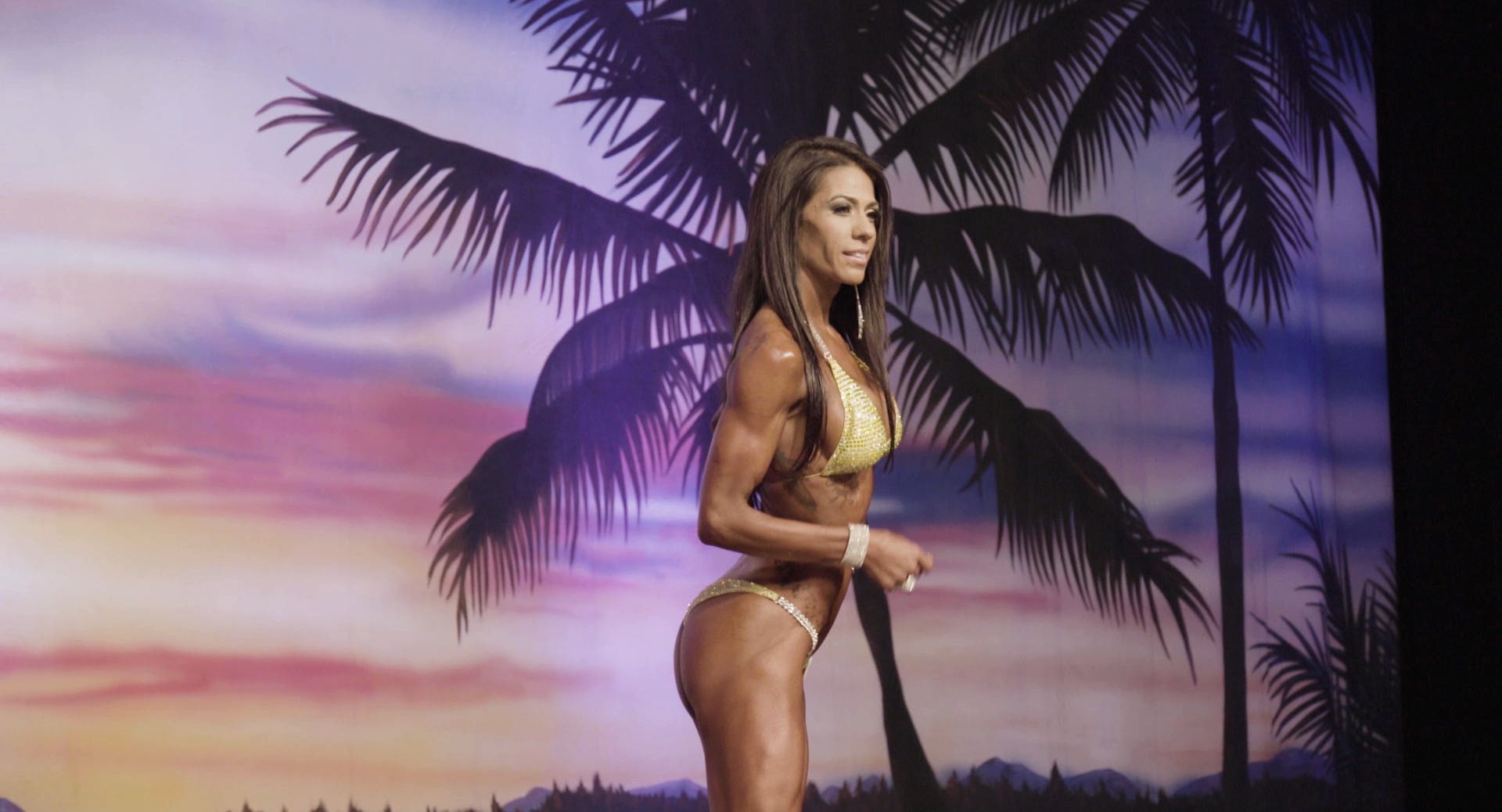
As the film goes on, it deals more and more with Jeannette’s attempt to return to the competitive bodybuilding she set aside following the Pulse attack. It all leads to a major contest at which she and other jacked-up women strike poses before an admiring crowd.

Jeannette shares a hug with her teenage son, Anthony.

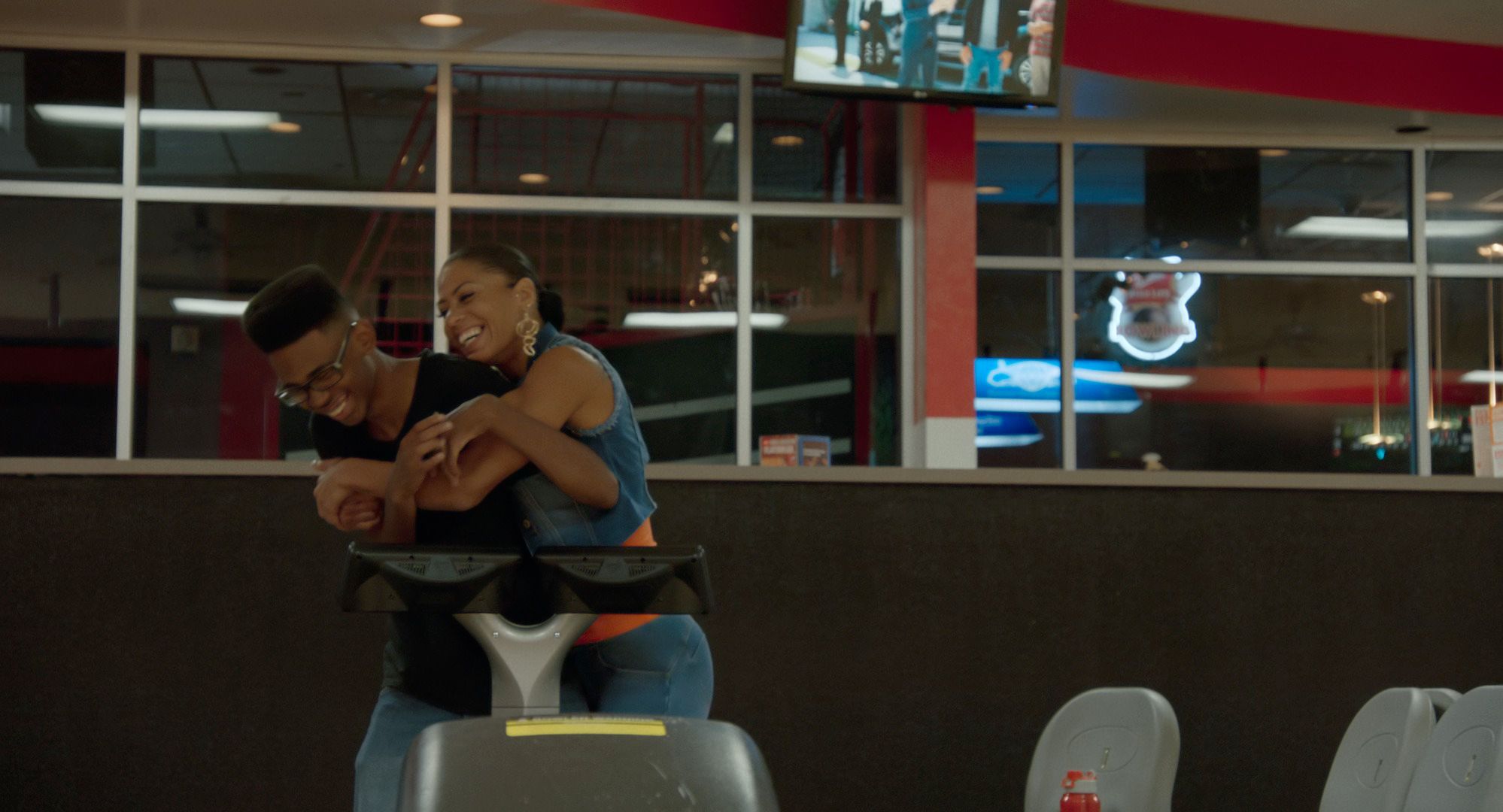
If Curran had stopped the film there, it would have provided an ending worthy of a Hollywood sports drama. Interestingly, though, she instead follows Jeannette and Anthony to a bowling alley, where they enjoy a little mother-son rivalry.

The modest scene completes the doc’s depiction of Jeannette’s attempt to move beyond the trauma left over from the Pulse shooting. We understand that every attempt she makes to live a normal life—whether she’s trying to get back into competitive bodybuilding or simply going bowling with her son—is a way of fighting back.

If Curran’s film has a message, that’s it.

Rating: 3½ stars (out of 5)

Jeannette will be available through major VOD outlets beginning June 17. 

How the GOP keeps its White voters faithful—and scared

Republican strategist Steve Bannon talks politics in the documentary White With Fear.

By Richard Ades

When Donald Trump talked about immigrants eating people’s pets during a 2024 presidential debate, he was carrying on a longtime Republican campaign tactic: Win the votes of White Americans by scaring the hell out of them.

According to Andrew Goldberg’s documentary White With Fear, this strategy can be traced back at least as far as the 1968 presidential campaign. Even though the controversial Vietnam War was still raging, we learn, the campaign of Republican Richard Nixon focused mainly on race.

Among the film’s many interviewees is author Rick Perlstein (Nixonland), who explains that the GOP worked to recapture the White House by tapping into many White Americans’ hatred of Blacks. This was done largely through innuendo and dog whistles.

When Nixon pledged to support “law and order” and fight crime, for example, it was understood that he was talking specifically about Black crime. The candidate’s subtext was hard to miss when he made statements such as referring to Black-majority Washington, D.C. as “the crime capital of the world.”

 The fearmongering tactic apparently worked, as Nixon captured the presidency. And it obviously continues to work, the documentary points out, as the GOP has won the majority of White votes in every presidential election ever since.

Not that the targets of GOP fearmongering have always remained the same.

When Al-Qaeda-backed terrorists attacked the World Trade Center on Sept. 11, 2001, brown-skinned Muslim extremists became the new source of fear. Republican Vice President Dick Cheney fed the paranoia with warnings about sneak attacks involving “chemical agents,” and the fledgling Fox News catapulted to prominence by offering its own nonstop appeals to prejudice and mistrust.

Later, the advent of Barack Obama as a national figure allowed the GOP to launch a two-pronged attack that combined White Americans’ fear of Blacks with their fear of Muslims. Obama actually wasn’t Muslim, but the persistent rumor that he was ran hand in hand with the Trump-fed suspicion that he wasn’t even born in this country.

Then 2020 arrived along with the worldwide COVID pandemic, allowing Republicans to target yet another race: Asians. Falling back on his love for nicknames, Trump led the attack by persistently referring to the scourge as the “Chinese virus” or “kung flu.”   

Hillary Clinton is one of many voices from both the left and the right who are interviewed in White With Fear.

Several years earlier, according to White With Fear, the Grand Old Party had actually considered changing its racially divisive ways. This happened after Obama was elected to a second term in 2012, and Republicans realized it might be a good idea to win over some of the non-White Americans who would one day become the majority.

Their solution: Work to pass immigration reform. But when that proved unpopular with their most conservative representatives, Republicans instead went back to their old ways by launching an attack on immigrants.

Strategists such Steve Bannon came up with the tactic, and then-candidate Trump adopted it with a vengeance. Thus was born his endless attack on immigrants as rapists, murderers and drug dealers; as stealers of American jobs; as replacements for American voters; and, most surreally, as eaters of American pets. It all culminated in the expensive and court-defying effort to expel immigrants that has become a cornerstone of Trump’s second term in office.

One of the most interesting aspects of Goldberg’s documentary is that it tackles its provocative topic with the help of experts from both the left and the right.

There are the expected liberal voices such as Hillary Clinton, who has several incisive things to say about her 2016 presidential opponent. But there are also conservative voices, including some former Trump supporters who have since repented, and others—including Bannon himself—who remain among the MAGA faithful.

This diversity of viewpoints gives us not only a critique of the GOP’s race-baiting approach to politics but a behind-the-scenes look at how it came to be.

Rating: 4 stars (out of 5)

White With Fear will be available through VOD outlets beginning June 3.

Tale of love and loneliness set in massage parlor

Immigrants and massage parlor workers Amy (Ke-Xi Wu, left) and Didi (Haipeng Xu) share a happy moment in Blue Sun Palace.

By Richard Ades

When you’re living in a foreign land, human connections can be as precious as they are rare. Maybe that’s the message of Constance Tsang’s debut feature film, Blue Sun Palace.

Then again, maybe it’s not. Writer/director Tsang doesn’t force an interpretation on you, any more than she tells you what to think of her characters, all Chinese or Taiwanese immigrants eking out a living in Queens, New York. She merely invites you to sit back and watch their stories unfold.

In the case of one of them, their story doesn’t unfold nearly long enough.

We first meet a young woman named Didi (Haipeng Xu) when she’s sharing a restaurant meal with Cheung (Kang-sheng Lee), a somewhat older man who seems to be a good friend and maybe a future boyfriend. The two clearly enjoy each other’s company, and Didi even invites Cheung to spend the night after he misses the last bus home.

The next morning, however, the couple’s relationship seems less certain. When Cheung begins talking about possibly sharing a home someday, Didi jokingly shuts him down, saying her ultimate plan is to move to Baltimore and open a restaurant with her friend Amy (Ke-Xi Wu).

We then learn that Didi and Amy, along with two other immigrant women, manage and work at a massage parlor—a neighborhood business that claims it doesn’t offer sexual services even though we’ve seen evidence to the contrary. Since Cheung is one of the parlor’s clients, the exact nature of his relationship with Didi becomes even more nebulous.

What isn’t nebulous is that Didi is the heart and soul of the parlor’s little community, keeping the other women’s spirits up and organizing dinners that remind them of the traditions and families they left behind. This makes it all the more devastating when Didi suddenly disappears from the story due to a tragic development that thankfully is left off-screen.

Amy (Ke-Xi Wu) wonders what to do about the leaking ceiling in her Queens massage parlor.

From then on, the film changes its focus to Amy and Cheung and their struggles to deal with Didi’s departure. In the process, they reveal a little more about themselves. We learn, for example, that Cheung has a wife and daughter in Taiwan but seems either unable or unwilling to be reunited with them.

Tentatively, Amy and Cheung begin spending time together. Do they feel a real connection, or are they merely trying to fill the emptiness left by Didi’s loss? Tsang’s script neither judges the characters nor explains all their motives, but it does supply an ending that ties up enough loose ends to be satisfying.

A film that avoids overt sentimentality and proceeds at its own pace, Blue Sun Palace is not for every taste. But it has multiple charms, including a wonderful cast giving understated, naturalistic performances.

Mix in Sami Jano’s subtle musical score, Caitlin Carr’s unhurried editing and Norm Li’s elegant cinematography, and you end up with a calm viewing experience that may remind some of the great Japanese director Yasujiro Ozu.  

Who knows? Maybe someday people will be talking with equal reverence about the films of the great Chinese American director Constance Tsang.

Rating: 4 stars (out of 5)

Blue Sun Palace (no MPA rating) opens April 25 in New York and Los Angeles, with further screenings planned in subsequent weeks. It is scheduled to screen at 9:30 p.m. May 9 at the Gateway Film Center in Columbus.

Deneuve as a first lady out to reinvent herself

Catherine Deneuve stars as the title character in The President’s Wife, a fictionalized biopic of French first lady Bernadette Chirac. (Photo courtesy of Cohen Media Group)

By Richard Ades

What’s it like to be the wife of a leader who forces you to live in his shadow and ignores your political advice? The President’s Wife answers that question with its feminism-informed biography of former French first lady Bernadette Chirac.

But don’t expect a sober-minded piece of historical revisionism. The film, directed and co-written by Lea Domenach, refuses to take itself too seriously, and it’s clear from the first scene that we shouldn’t, either.

As Bernadette (the legendary Catherine Deneuve) makes her way to a confessional booth for a heart-to-heart with her priest, the church choir informs us that what we’re about to see is based only loosely on reality. In fact, the singers warn us, it’s a “work of fiction.” 

Still, it’s hard not to hope that what follows is least partly true, because it’s a delicious story of self-reinvention and political comeuppance.

We first meet Bernadette in 1995, when her husband, Jacques Chirac (Michel Vuillermoz), is on the verge of winning the presidency. A politician in her own right, Bernadette has worked hard to bring about this long-sought victory, but once the new administration takes office, she’s quickly pushed to the background.

With her dated wardrobe and occasionally loose lips, Bernadette is seen as a liability by both her husband and her younger daughter, Claude (Clara Giraudeau), who works as one of his chief aides. The two even go so far as to assign a communications adviser named Bernard (Denis Podalydes) to help Bernadette hone her image. The idea is to keep the first lady from embarrassing and upstaging the president.

However, the plan soon backfires.

After a series of events provide proof of (1) Bernadette’s political smarts and (2) Jacques’s marital unfaithfulness, Bernard switches his allegiance from the husband to the wife. Together, Bernard and Bernadette begin working to improve her image through such tacks as promoting charities, rubbing elbows with celebrities and, mostly, just being herself.

To put it mildly, their efforts prove fruitful for Bernadette and entertaining for the audience. (Watch for the trained bear!)

Anyone who’s less than fully knowledgeable about French politics might lose a reference here and there, but it’s just a slight inconvenience. Thanks to Domenach’s witty script and playful direction—and thanks to a great cast and especially to Deneuve’s droll and assured performance as Bernadette—The President’s Wife is one history class you won’t want to skip.

Rating: 4 stars (out of 5)

The President’s Wife opened April 18 in major cities and will expand to other markets beginning April 25. It is scheduled to open May 9 at Columbus’s Gateway Film Center.

West Bank tale doesn’t pull its punches

Basem (Saleh Bakri, right) offers comfort to distraught student Adam (Muhammad Abed Elrahman) in The Teacher. (Photos courtesy of MPI Media Group)

By Richard Ades

The Teacher takes on one of the most divisive issues in the world today: the struggle between Israel and the Palestinians. And it does it in a way that is thoughtful, provocative and dramatic.

The title character is Basem El-Saleh (Saleh Bakri), who teaches in a poor community in the West Bank. Anyone who’s seen the Oscar-winning documentary No Other Land—or the final episodes of the Netflix series Mo—won’t be surprised to learn that Basem’s students have more to worry about than passing tests.

Two of them, brothers Yacoub and Adam (Mahmoud Bakri and Muhammad Abed Elrahman), return from school one day just in time to see their home torn down by Israeli forces. “It was just their turn,” Basem explains to British social worker Lisa (Imogen Poots), noting that most houses in the village have been marked for demolition.

Adding to the residents’ worries are the Israeli settlers whose red-roofed homes can be seen multiplying in the distance. Though the settlers have moved to the occupied territory illegally, the residents know the government is likely to take the newcomers’ side if any dispute arises. 

And soon a dispute does arise, with tragic consequences. When a group of settlers sets fire to Palestinian-owned olive trees, Yacoub tries to intervene and is killed for his trouble. Community members vow to seek justice, but they know it may be beyond their reach.

Adam (Muhammad Abed Elrahman, left) shares a couch with his teacher (Saleh Bakri) after watching his home be demolished by Israeli troops.

Making her feature-length film debut, British-Palestinian writer-director Farah Nabulsi doesn’t shy away from showing the hardships West Bank residents face under Israeli occupation. Nor is she afraid to take the story into controversial areas.

A subplot that eventually melds with the main storyline involves an Israeli soldier being held hostage by a resistance group that hopes to exchange him for Palestinian prisoners. The soldier’s American parents (Stanley Townsend and Andrea Irvine) pressure the government to approve the exchange, but Israeli officials seem more interested in finding and punishing his kidnappers.

Leading the cast, Bakri is slightly hampered by director Nabulsi’s tendency to exploit his movie-star good looks (i.e., he takes off his shirt a lot). Still, he’s stalwartly effective as the teacher who tries to give his students the help that, as flashbacks reveal, he was unable to give his own son.

As Lisa, Basem’s colleague and possible love interest, Poots projects courage, sincerity and a useful amount of wiliness. As young Adam, who becomes increasingly distraught following his brother’s death, Elrahman provides some of the tale’s most unsettling moments.

Gilles Porte’s cinematography and composer Alex Baranowski’s score perfectly complement the film’s perilous setting and changing moods.

Though some may quibble that its ending is overly tidy, The Teacher is a brave and nuanced attempt to reveal the humanity lurking beneath one of the world’s most intractable political standoffs.

Rating: 4 stars (out of 5)

The Teacher opens April 11 in New York City and expands to other markets beginning April 18. It is scheduled to open April 25 at the Gateway Film Center in Columbus.

The songwriting teen who jolted society’s conscience

Singer/songwriter Janis Ian performs at a 1975 concert. (Photo by Peter Cunningham)

By Richard Ades

Janis Ian was only 14 when she wrote one of the most influential—and controversial—songs of a generation. The story behind the anthem is told in Varda Bar-Kar’s new biographical documentary, Janis Ian: Breaking Silence.

A Jewish girl growing up in a mostly Black New Jersey neighborhood, the then-Janis Fink was inspired after seeing a young interracial couple cuddling on a bus despite the disapproving glares of those around them. The result was “Society’s Child,” about a White girl whose romance with a Black boy sets her up for harassment and demands to “stick to your own kind.”

Recorded in 1965, the song touched on such a raw nerve that it almost didn’t get released. Ian’s producer, Shadow Morton, had anticipated the problem and suggested that she play it safe by changing its first line: “Pick me up from school, baby, face is clean and shining black as night.” When Ian refused, Morton was forced to pitch the song to more than 20 record labels before finding one that was willing to take a chance on it.

Even after the song’s belated 1966 release, as the documentary relates, many radio stations were afraid to play it. And when Ian tried to perform it at a concert, she was met with racist chants of “n—– lover” from audience members who apparently had bought tickets just to prevent her from singing it.

Recalling the incident in the film, Ian admits that her first response was to flee the stage in tears, only to be shamed for her cowardice by a concert official. When she gathered enough courage to return and finish the song, ushers quickly rounded up the 20 or so haters and escorted them out.

“It was a life-changing moment for me,” Ian says, as it taught her that music could make some people angry, but it could also inspire folks to stand up for what’s right.

Ian poses in 1973 with fellow musicians Bruce Springsteen (left) and Billy Joel (right), along with radio DJ Ed Sciaky. (Photo by Peter Cunningham)

This and other anecdotes from Ian’s years of teenage stardom will be fascinating to anyone old enough—or “woke” enough—to care about the role she played in the 1960s’ culture of protest and liberation. Helping to underscore her importance are cameos from luminaries such as Joan Baez and Arlo Guthrie.

Whether the bulk of the film will be equally fascinating depends on the viewer’s interest in a singer/songwriter who’s best known for just two major hits: “Society’s Child” and 1975’s “At Seventeen,” a touching lament about the pangs of growing up unpopular.

Besides revisiting these mileposts, Breaking Silence is basically a chronological synopsis of what Ian was doing when she was largely out of the public eye. There were romantic relationships with both men and women; there were professional liaisons and breakups; there was a concert tour to apartheid South Africa that Ian agreed to only after ensuring that her audiences would be racially integrated.

There was also a run-in with the pre-disgraced Bill Cosby, who accused the 16-year-old singer of being in a lesbian relationship and tried to have her blacklisted. He was wrong, Ian says, though decades later she did come out as a lesbian at the same time she released her appropriately titled 1993 album, Breaking Silence. Further cementing her status as a gay icon, Ian has written columns for The Advocate, and in 2003 she traveled to Canada to marry longtime girlfriend Patricia Snyder.

Ian is interviewed by Johnny Carson (right) on The Tonight Show in 1967, the year after “Society’s Child” was released.

All the while, as the documentary tells us, Ian has continued writing music, releasing albums and, until recently, giving occasional performances. One fact it neglects to mention is that she’s also become an avid science fiction fan and has written several genre stories of her own.

Otherwise, Janis Ian: Breaking Silence does an admirable job of answering the question: Whatever happened to that plucky teen who wrote a song about interracial dating and forced society to face its own prejudice?

Rating: 3½ stars (out of 5)

Janis Ian: Breaking Silence opens in select theaters March 28.