Reviews

How do you want your theater: toe-tapping or thought-provoking?

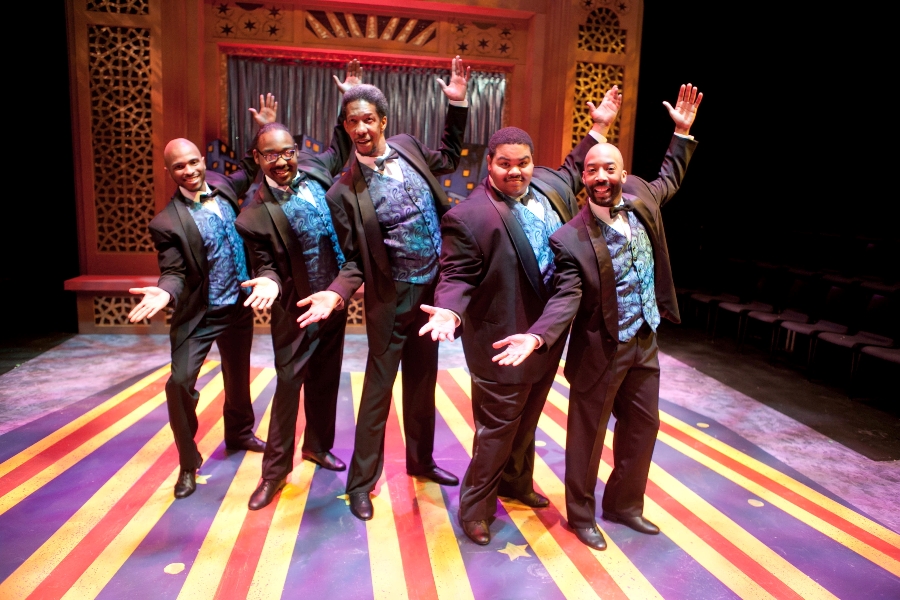
Playing the Moes in Five Guys Named Moe are (from left): Franklin Grace, LeRon Lee Hudson, Troy Anthony Harris, Japheal Bondurant and Terrence Brian Brown (Red Generation Photography)
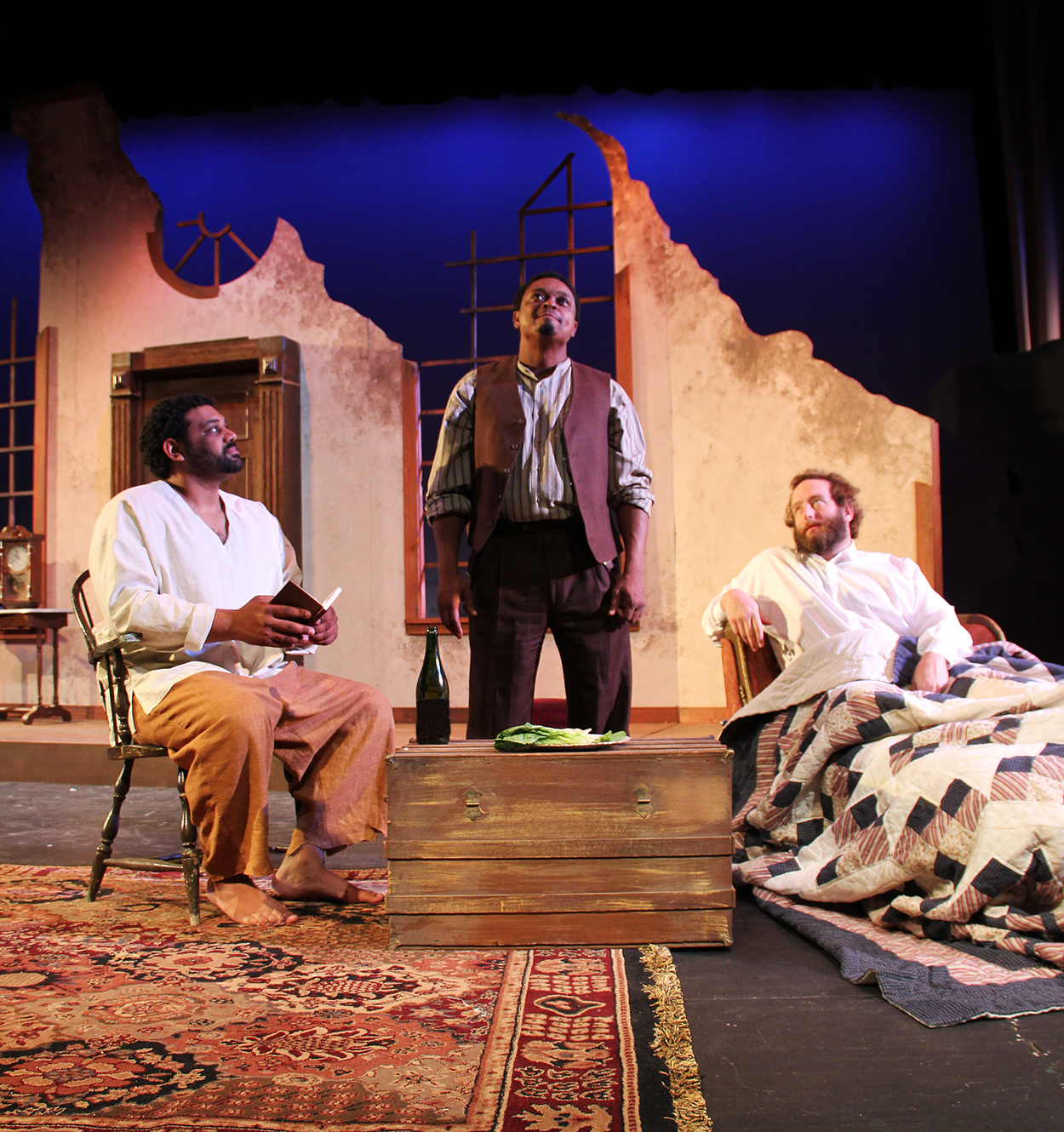
Christopher Austin, Bryant Bentley and Chris Tucci (from left) in The Whipping Man  (photo by Matt Hermes)
Christopher Austin, Bryant Bentley and Chris Tucci (from left) in The Whipping Man (photo by Matt Hermes)

By Richard Ades

I didn’t mean to eavesdrop, but it was unavoidable. I happened to be standing nearby when a couple of theatergoers were discussing the then-current CATCO production.

I’d seen the show—a black comedy with nudity and adult situations—and loved it. But it seemed to have rubbed one of the strangers the wrong way, to the extent that he was disappointed he’d wasted his time seeing it.

OK, it’s a small incident, and one that happened several years ago. Still, it sticks in my mind because it’s so unlikely to be repeated anytime soon.

The lineup for CATCO’s upcoming 2013-14 season suggests that Columbus’s premier theater troupe is increasingly devoting itself to the tried and true rather than the offbeat and unfamiliar—i.e., works that could potentially disappoint or offend anyone. With one or two exceptions, these are plays and musicals that the average theatergoer has had one or multiple chances to see.

You can’t blame CATCO, let alone artistic director Steven Anderson, for taking a cautious approach to programming. The troupe is probably doing what it has to do to survive in an increasingly tough artistic environment. And, truthfully, its shows are likely to please most people.

That description certainly fits the current production, Five Guys Named Moe, which sets toes a-tapping while giving audience members a chance to join in the singing or even get up and dance. With a book by Clarke Peters and music and lyrics by “jump blues” composer/bandleader Louis Jordan and others, it’s basically a musical revue held together by a bare-bones plot.

Nomax (Kevin Ferguson) is lamenting his recent breakup with his girlfriend when he’s accosted by the titular five Moes. They proceed to give him lessons on love and life with the help of vintage songs ranging from the romantic Azure Te to the silly I Like ’Em Fat Like That and the nonsensical sing-along Push Ka Pi Shi Pie.

Of the five Moes, Big Moe (Troy Anthony Harris) has the most personality and Four-Eyed Moe (LaRon Lee Hudson) has the handsomest voice, but all of the actors sing pleasantly. With direction by Anderson, music direction by Matt Clemens and spare choreography by Liz Wheeler, it all amounts to breezy entertainment.

On opening night, Ferguson had a few pitchy notes, and the actors and the backstage band sometimes had trouble agreeing on a tempo. Otherwise, problems were few. The only people who’ll be disappointed by this show are those who wax nostalgic for the old days when CATCO was more willing to challenge its audience.

Then again, there are other, smaller troupes that don’t mind pushing the envelope. And two of them, Gallery Players and New Players Theater, have joined forces to present a play that’s as dramatic and provocative as Five Guy Named Moe is safe and soothing.

Matthew Lopez’s The Whipping Man is set in the ruins of a Richmond, Va., home in the immediate aftermath of the Civil War. But this is no ordinary tale of the postwar era. That becomes clear as soon as freed slave Simon (Bryant Bentley) begins speaking in Hebrew.

We learn that Simon and fellow servant John (Christopher Austin) belonged to a Jewish family and were raised in that faith. The irony that members of one oppressed group owned members of another oppressed group is one of the issues that are explored dramatically after their former master’s son, Caleb (Chris Tucci), returns home from the war with a grievous wound.

Sometimes long-winded, sometimes stomach-churning and finally a bit abrupt, The Whipping Man is nevertheless fascinating. Best of all, it’s exquisitely staged by director Tim Browning and his cast.

Of the three actors, only Tucci seems overly restrained, and that’s partly because he’s limited by his role. As the kind and ethical Simon, Bentley gives one of the strongest performances of recent memory, one that gains depth and passion as the play proceeds. Meanwhile, Austin adds touches of humor and a sense of danger as the unscrupulous John.

Important contributions are made by scenic designer Peter Pauze, who’s created a depiction of a once-grand house that’s been devastated by war, and by lighting/sound designer Jarod Wilson, who sets key moments in the midst of a storm that mirrors the psychological turmoil the characters are experiencing.

Overall, it’s a powerful experience.

So you have a choice, theatergoers. If you like to be entertained, see Five Guys Named Moe. If you like to be entertained, educated and challenged, see The Whipping Man.

CATCO will present Five Guys Named Moe through May 26 in Studio Two, Riffe Center, 77 S. High St. Show times are 11 a.m. Wednesday, 8 p.m. Thursday-Saturday and 2 p.m. Sunday. Running time: 2 hours (including intermission). Tickets are $11.50 for Wednesday matinees, $45 for evening performances and $41 for Sunday matinees. 614-469-0939 or catco.org.

Gallery Players and New Players Theater will present The Whipping Man through May 19 at the Jewish Community Center, 1125 College Ave. Show times are 7:30 p.m. Thursday (no show May 16), 8 p.m. Saturday and 2:30 p.m. Sunday. Running time: 1 hour, 50 minutes (including intermission). Tickets are $20 ($15 for JCC members), $18 for seniors ($13 for senior JCC members), $10 for students and children. 614-231-2731, jccgalleryplayers.org or newplayers.org.

Teens take the stage at Shadowbox

By Richard Ades

It could have been called Revenge of the Nerds, but Shadowbox Live preferred to call it STEM Rocks the Box.

Presented Monday, it was the latest edition of an annual show that gives students from local Science, Technology, Engineering and Mathematics high schools the chance to prove that they can cut up with the best of them.

Arranged like a regular Shadowbox show, with a mixture of skits and rock songs, it was an impressive display of talent. More than that, it was a lot of fun.

It helped that the skits were some of the funniest that Shadowbox has presented recently. But it’s saying a lot that they remained as funny as ever—if not funnier—with teenage thespians playing key roles in each.

Trevon Mobley exuded paranoia as a 1985 employee startled by the sudden appearance of his business’s first computer in The Office Zone. Henry Kangas generated spastic energy as a boy who wants to adopt a supernatural critter in The Boy Who Cried Werewolf. Rachel Eldridge-Allegra carried off an impersonation of an awkwardly love-struck girl in Slumber Party.

Perhaps the most challenging task was taken on by Annalisa Hartlaub, who matched Shadowbox regular Julie Klein note for note in the musical spoof Divas Do Hard Rock.

Shadowbox probably toned down its usual adult content a bit in some cases, but one skit might have made some viewers squeamish.

Damsels & Dates had a trio of nerds playing a Dungeons & Dragons-type game in which one boy imagined giving away marijuana in order to achieve his goal of making out with one of his school’s most popular girls. The combination of sex and drugs might have produced some uncomfortable moments at tables shared by parents and siblings of featured teens. In any case, Metro High School student Jeremy Boyd portrayed one of the game players with Michael Cera-like appeal.

Metro, by the way, contributed the vast majority of Monday’s teenage performers, but Columbus’s West, Africentric and Linden-McKinley also were represented.

On the musical side of the ledger, Kelly Hooper was stuck with the unenviable task of honchoing the night’s first musical number, Missionary Man. After a brief lapse, she carried it off with aplomb. Launching Act 2, Kangas growled his way through Cross-Eyed Mary with rock-god swagger.

Several other students made strong impressions on vocals and instrumentals. Perhaps the most charismatic was guitarist Jordan Griffith, who leaped around athletically before finally being granted a solo on Aeroplane.

Monday’s show demonstrated that Central Ohio’s STEM students are as comfortable performing onstage as they are peering into a test tube or working out an equation. Bravo to Shadowbox for giving them the chance to prove their versatility.

Not as outrageous as you might think

Betsy Shortt (left) and Julie Klein in The Lost Girl, one of three Don Nigro works featured in Viva Vagina (Studio 66 photo)

By Richard Ades

If the Shadowboxers are going to do a show called Viva Vagina, they really should include a production number in which an Elvis-impersonating drag king sings the title to the tune of Viva Las Vegas.

Also, for the sake of fairness, they really should plan a sequel called, say, Up With Penises.

Sadly, though, Shadowbox has announced no plans for a follow-up, and the current show does not feature any Viva Las Vegas takeoffs.

It does feature a musical number that’s even more fun and outrageous: Storm Large’s 8 Miles Wide (as in “My vagina is 8 miles wide”). But for most of its running time, this Stage 2 production is pretty close to the low-key spirit of Shadowbox’s long-gone spinoff, 2Co’s Cabaret.

That’s not a bad thing, but it does make the title a tad misleading.

As at 2Co’s, the evening is a combination of songs, one-acts and monologues. Three of the theater pieces are by 2Co’s mainstay Don Nigro.

Of these, the best is Ballerinas, an atmospheric tale that stars Stacie Boord, Leah Haviland and Amy Lay as performers in a run-down dance hall. The other Nigro works, in descending order of interest, are Genesis, in which Eve (Michelle Daniels) remembers life in the Garden of Eden; and The Lost Girl, a metaphorical piece about—well, if you figure it out, let me know.

Better than all three is Martha King De Silva’s The Waiter, in which former flames Ivy (Haviland) and Andrew (David Whitehouse) are chagrined to learn they’ve each arranged to meet someone else at the same restaurant. Boord, Amy Lay and Anita McFarren are also featured in this gentle comedy about a romance that fizzled for reasons that aren’t completely clear.

Besides 8 Miles Wide, a couple of the musical numbers achieve the feminist brand of outrageousness promised by the show’s title: Bitch (sung by Lay) and Sisters Are Doin’ It for Themselves (sung by Boord and others). Both are fun and nicely done.

But other musical highlights are considerably less fierce. Steve Guyer is a smooth stand-in for Joe Cocker on You Are So Beautiful; Julie Klein’s rendition of The Mind of Love is accompanied by a wistful/lustful dance delicately delivered by Lay; and Boord gives what could be the vocal performance of the year on When a Man Loves a Woman.

Though all of this suggests a show that only occasionally is as provocative as its title, a few monologues and standup routines do help to nudge it back into envelope-pushing territory.

The scariest of these, performed by Klein and based on “Being That Woman” by Morgan Moss, explains the difference between a “bitch” and a “crazy bitch” and speaks admiringly of Lorena Bobbitt. It might be easier to enjoy if Klein delivered it as a character rather than as herself—otherwise, you can’t help wondering if someone shouldn’t frisk her for sharp objects.

But I suspect the evening’s most outrageous act is the Nickey Winkelman standup routine that launches Act 2. I can’t say for sure because Winkelman was unfortunately absent on the night I was there, but her online videos suggest that her presence would go a long way toward making the show as vagtastic as its title.

Viva Vagina will be presented at 7:30 p.m. Wednesdays and Thursdays through July 11 at Shadowbox Live, 503 S. Front St. Running time: 1 hour, 55 minutes (including intermission). Tickets are $30, $20 for students and seniors. 614-416-7625 or shadowboxlive.org.

Unlucky horse hardly leads a stable existence

Conscripted horses Joey (right) and Topthorn prepare to charge the Germans in a battle scene from War Horse (photo © Brinkhoff/Mogenburg)

By Richard Ades

When you saw The Phantom of the Opera or Miss Saigon for the first time, chances are you didn’t come out of the theater exclaiming, “What a chandelier!” or “What a helicopter!”

The special effects, as spectacular as they were, simply played supporting roles to the stories and the music of the night.

When you come out of War Horse, conversely, chances are you will say something along the lines of “What a horse!” Which is to say, “What a puppet!”

The life-size puppets that portray titular steed Joey and other equines are the best thing about this Tony-winning British import. They trot and gallop, fight and play, eat, swat flies and generally behave like real-life horses.

In Act 1, frankly, they’re more believable than their human co-stars. Working under Bejan Sheibani’s direction (which is based on the work of original co-directors Marianne Elliott and Tom Morris), the actors often emote in melodramatic tones that suggest every moment of every day is a life-or-death struggle.

Credibility does improve in Act 2, when both the humans and the horses actually are engaged in a life-or-death struggle—namely, World War I. But even then, the tale is less impressive than the stagecraft with which it’s told: not only the horses, but the sights and sounds that suggest, rather than depict, the horrors of battle.

Adapted by Nick Stafford from a novel by Michael Murpugo, War Horse is a simple story.

In Devon, England, a poor farmer named Ted Narracott (Todd Cerveris) buys a foal at auction simply to show up his brother. Ted’s wife, Rose (Angela Reed), is not pleased, as the family can’t afford a horse that was bred as a hunter rather than a beast of burden. But their son, Albert (Alex Morf), quickly makes friends with the colt and takes on its care and training.

The real drama begins years later, when war breaks out and Ted sells the now-grown Joey to the army to fight the Germans. Though underage, a heartbroken Albert secretly enlists and is sent to France, where he hopes to be reunited with his old friend. What he doesn’t know is that Joey has fallen into German hands—in particular, those of a horse lover named Capt. Muller (a nuanced Andrew May), who does what he can to keep this beautiful animal away from the battlefield.

There are complications and close calls throughout the adventure, some of them quite harrowing. Even so, most viewers will have little trouble predicting how it will come out. As a result, the main surprises involve the way the tale is told, rather than the tale itself.

Besides the puppeteers, the real heroes are behind-the-scenes talents such as set designer Rae Smith, lighting designers Paule Constable and Karen Spahn, and “horse” choreographer Toby Sedgwick. An onstage singer (Megan Loomis replaced regular vocalist John Milosich on opening night) also plays an influential role by contributing mournful folk-style tunes.

War Horse is melodrama—melodrama that is sometimes overdone and ultimately predictable. But for most viewers, the innovative staging should make it a memorable ride.

Broadway in Columbus and CAPA will present War Horse through Sunday (April 28) at the Ohio Theatre, 39 E. State St. Show times are 8 p.m. Wednesday and Friday, 1 and 8 p.m. Thursday, 2 and 8 p.m. Saturday, and 1 p.m. Sunday. Running time: 2 hours, 40 minutes (including intermission). Tickets are $35-$95. 614-469-0939, 1-800-745-3000 or ticketmaster.com.

Restless teen has a ticket to ride

The Youth (Taylor Moss, center) discovers Dutch-style free love with the help of Amsterdam friends (from left) David Glover, Zoe Lathan, Rico Parker and Mia Angelique Fowler (photo by Megan Leigh)

By Richard Ades

If you saw American Idiot during the touring show’s recent Columbus stop, Passing Strange may give you a feeling of déjà vu. But it won’t last.

Though both musicals are about youthful angst and wanderlust, Passing Strange is infinitely more personal and personable. The black teen at its center may be known simply as the Youth, but his globe-trotting adventures are far from generic.

With book and lyrics by Stew, who co-wrote the music with Heidi Rodewald, the tale is also filled with heart and satirical humor. That distinguishes it from American Idiot and its angry punk-rock rants.

In short, the average (read: non-Green Day-worshipping) theatergoer is more likely to enjoy Passing Strange, especially given the wonderful production that Short North Stage and director Mark Clayton Southers have put together.

It’s hard to imagine a more perfect cast.

Taylor Moss is graceful, impressionable and self-centered as the Youth, who believes he’ll never come into his own as a musician until he escapes his South Central L.A. home. Michelle Golden is devoted, possessive and pitiable as the Mother, who wants her son to be happy but can’t understand why he has to leave home to do it.

Each member of the supporting cast plays multiple roles and has one or two chances to really stand out. For example, Rico Romalus Parker raises spirits as the sermonizing Rev. Jones, while David Glover is delightfully mischievous as his pot-smoking son. Mia Angelique Fowler and Zoe Lathan leave indelible impressions as various girls and women who pull the Youth into their spheres of influence.

All display fine voices, but the mightiest pipes properly belong to Ron Jenkins, who pushes the tale along as the all-seeing Narrator.

The musical’s satirical bent comes out early in its depiction of an African-American church as a weekly fashion show. Later, after the Youth seeks his fortune in Amsterdam and Berlin, it hilariously dissects the self-righteousness of young leftist radicals. When a musician touts Clash as an example of music’s political relevance, a German naysayer retorts, “Punk rock was a marketing strategy.”

Though Passing Strange’s 2008 Broadway production won a Tony only for its book, the songs throb with wit, spirit and warmth. A charismatic band supplies both instrumental and vocal support under the direction of P. Tim Valentine, while gyrating cast members often carry the infectious beats into the aisles.

Back on the somewhat echo-y stage, Robert Kuhn’s two-story set is marked by a series of doors that symbolize the Youth’s quest for relevance and fulfillment.

Speaking of that quest, the musical makes it clear that all choices come with a price. The finale is tinged with regret as it questions the value of art. In creating fiction, the rueful Narrator asks, are artists merely attempting to make up for their real-life shortcomings?

Humorous and uplifting, thoughtful and heartbreaking, Passing Strange is the kind of transcendent musical experience that comes along all too rarely in Columbus. If you miss it, you’ll regret it.

Short North Stage will present Passing Strange through May 5 at the Garden Theater, 1187 N. High St. Show times are 8 p.m. Friday and Saturday and 3 p.m. Sunday. Running time: 2 hours, 45 minutes (including intermission). Tickets are $30. 614-725-4042 or shortnorthstage.org.

Simon’s homage to TV pioneers

Max Prince (Donovan Johnson, kneeling at right) is attacked by Kenny Franks (Roddey Nagy, left) and Val Slotsky (Aleksandar Bulajic) in a Julius Caesar parody from Laughter on the 23rd Floor (photo by Lillian DeDomenic)

By Richard Ades

Laughter on the 23rd Floor should be a nostalgia trip for those old enough to remember the early days of television. Others may see it as a joke-filled history lesson.

Though the Neil Simon comedy opened on Broadway in 1993, it’s inspired by Simon’s work as a writer for Your Show of Shows, a 90-minute comedy/variety program that debuted in 1950. Hosted by Sid Caesar and performed live, it ran until 1954, when it was replaced by a similar but shorter program called Caesar’s Hour.

Simon’s fictionalized account is set in 1953, when Caesar stand-in Max Prince (Donovan Johnson) is battling NBC execs over what he sees as their attempt to dumb the show down for Middle America. When the network cuts the program’s running time by 30 minutes and simultaneously slashes its budget, Prince interprets the development as a sign that he’s losing the war.

Prince shares his worries with his writers, who are said to represent actual Show of Shows contributors. That explains why Simon makes the cast bigger than seems absolutely necessary.

The best-known real-life counterparts are Mel Brooks, represented by Ira Stone (Joel B. Cohen); future M*A*S*H contributor Larry Gelbart, represented by Kenny Franks (Roddey Nagy); and Simon himself, represented by neophyte writer Lucas Brickman (Kyle Snyder).

These obviously are/were funny people, but Simon mostly relegates their fictional alter egos to one comic attribute apiece. Stone, for example, is a hypochondriac who arrives late each day because he’s busy consulting doctors about his latest imagined ailment. Cohen plays him with panache, but Stone still seems a pale shadow of Brooks, the clown who went on to create The Producers, Blazing Saddles and Young Frankenstein.

Likewise, Prince mainly is characterized by his violent excitability, which causes him to inflict a good deal of damage on Edith Wadkins’s set. Caesar reportedly was a volatile guy, but it would have been nice to see other aspects of his personality reflected in Simon’s script.

Director Janetta Davis pulls distinctive portrayals out of her cast, which also includes Mark Passerrello, Aleksandar Bulajic, Jason David Collins, Keely M. Kurtas-Chapman and Katharine Pilcher. Some of the biggest guffaws are won by Bulajic, who displays spot-on timing as Val Slotsky, a Russian immigrant who struggles to deliver the F-bomb with the proper pronunciation.

Others also win laughs, though more sporadically. The material is mostly to blame, though a snappier tempo might help matters in the weaker sections.

One section that doesn’t need help is a read-through of a skit making fun of the 1953 film version of Julius Caesar. It reveals the kind of parody that would turn up in many later TV shows, as well as an anarchic spirit that has seldom been matched in the past 60 years of television.

The skit, more than all the backstage intrigue that makes up the bulk of Laughter on the 23rd Floor, demonstrates why Your Show of Shows was such an important and influential part of our cultural past.

SRO Theatre Company will present Laughter on the 23rd Floor through Sunday (April 21) at the Columbus Performing Arts Center, 549 Franklin Ave. Running time: 2 hours, 15 minutes (including intermission). Show times are 8 p.m. Friday-Saturday and 2 p.m. Sunday. Tickets are $20, $17 seniors (55-plus), $15 members and $10 students (grades 6-12 and college). 614-258-9495 or srotheatre.org.

Shadowbox has a new theme; Red Herring has a new life

Nikki Fagin belts out a song in Taboo (photo courtesy of Shadowbox Live)

By Richard Ades

Appropriately titled Taboo, Shadowbox Live’s latest theme show is designed to raise people’s hackles. So it’s not surprising that one of its skits raised mine.

In Waiting for Paradise, Stacie Boord plays a Presbyterian who runs into a Catholic (Tom Cardinal) in heaven’s “waiting room” and insinuates that she’s more deserving of salvation because she’s a “true” Christian. Having been raised as a Presbyterian, I can tell you that’s very unlikely to happen. Presbyterians subscribe to the Calvinist doctrine of predestination, which means they can take little credit for anything that happens to them. So how can they feel qualified to lord it over anyone?

But what really irks me is that Boord’s character is mislabeled to begin with. The Catholic insults her by charging that the only things Presbyterians need for baptism are a swimming pool and a pocket Bible. Wrong! You show me a Presbyterian who was baptized in a pool, and I’ll show you a Baptist.

Obviously, Shadowbox is confusing Presbyterians with another brand of Protestants who are all too often known for their “my way or the hell way” attitude.

This denominational error notwithstanding, Waiting for Paradise does make a valid point about religious intolerance. It just makes it a little too bluntly to be really funny. But that’s OK, because there are other skits here that are really funny.

One of the wittiest is Good Driver Discount, in which an attempt to diversify a commercial for car insurance keeps running into cultural stereotypes. Show a black guy eating at the wheel? Fine, but can we find him something to eat besides a bucket of fried chicken? And let’s not, by any means, suggest that Asian women are prone to accidents.

Also hilarious is Face to Facebook, though I hesitate to say why for fear of offending my Facebook friends. Suffice it to say that its targets include anti-Obama ranters, PC-minded carpers and parents who think every image of their newborn is deserving of Web-wide attention.

Several other skits are at least worthy of an appreciate chuckle. An example is Coming Out & Going Home, about a college student (Jimmy Mak) who has a potentially shocking announcement to make to his backwoods parents (Robbie Nance and Boord). The bit builds to a clever twist before petering off in a formulaic way.

The scattered video segments are similarly edgy, including Too Taboo, in which JT Walker III unwittingly reveals his encyclopedic knowledge of kinky sexual practices.

As for the songs, they’re both complementary and fun. Highlights include Don’t Stand So Close to Me (sung by Stephanie Shull), Face Down in the Dirt (sung by Boord) and Let’s Go Get Stoned (delivered by a soulful and bluesy Walker).

Starting it all off in an amusingly outrageous manner—if you’re lucky enough to attend one of the performances where he appears—is a standup routine by comedian Justin Golak. His act reaches its envelope-pushing zenith with a joke about Hitler, Beethoven and the Right to Life movement.

Many Shadowbox shows seem to be variations on each other. Taboo takes off in a whole new direction and makes the most of the virgin territory.

Taboo continues through June 8 at Shadowbox Live, 503 S. Front St. Show times are 7:30 and 10:30 p.m. Fridays and Saturdays. Running time: 2 hours (including intermission). Tickets are $30, $20 for students and seniors. 614-416-7625 or shadowboxlive.org.

Watch out for that banana peel!

If you paid attention to the Columbus theater scene in the 1990s, you were familiar with Red Herring. Michael Herring’s troupe was responsible for some of the decade’s more offbeat offerings.

The company closed down soon after the turn of the millennium, and Herring left town in 2003. But now the actor/director appears ready to bring Red Herring back with the help of former collaborator John Dranschak.

The first glimpse of its rebirth is Krapp’s Last Tape, a semi-autobiographical one-man play by Samuel Beckett. Dranschak directs and Herring stars, appearing onstage for the first time since the early aughts.

His performance won’t surprise the average Red Herring alum. Playing a 69-year-old writer who revisits his youth with the help of boxes full of reel-to-reel audiotapes, Herring is physically precise and dramatically understated.

Long moments are spent shuffling back and forth between the tape recorder and the closet where Krapp stores his tapes—and his alcohol. An early gag involving a banana peel unfolds so slowly that you anticipate the payoff minutes before it actually happens.

Herring’s performance is impressive in its self-control, but some will find it too deliberate and repressed to be dramatically stimulating. Longtime theater fans will find it exciting in another way, though. Given what Herring and his troupe once meant to Columbus, seeing him onstage in 2013 is like watching a piece of history come back to life.

With any luck, that piece of history will morph into a harbinger of theater yet to come.

Red Herring Productions will present Krapp’s Last Tape at 8 p.m. Thursday-Saturday (April 4-6) at MadLab Theatre, 227 N. Third St. Running time: 50 minutes. Tickets: $20 in advance, pay what you want at the door. 614-723-1996 or redherring.info.

‘Dream play’ reflects a boomer’s worst nightmare

Simon (Nick Baldasare, right) tells his troubles to his therapist (Jeff Horst) in The Promised Land (Red Generation Photography)

By Richard Ades

Simon can’t quite bring himself to go to work. He just can’t shake the premonition that something bad is about to happen.

As it turns out, his premonition is correct. His boss is getting ready to “restructure” him out of the job to which he’s devoted more than 20 years of his life.

Thus begins The Promised Land, a comedy about a baby boomer’s worst nightmare.

The one-act is the latest work from local playwright Bill Cook. Like Cook’s 2012 offering Love in an Age of Clamor, this is the story of a middle-aged man facing a sudden loss. At age 55—too early to retire but too late to be attractive to many employers—the financial analyst finds himself back on the job market.

Also like Clamor, The Promised Land is devised as a “dream play,” meaning it’s a fast-moving chain of events that don’t always resemble reality. There’s a subtle difference, though. Clamor was more or less surreal throughout, but The Promised Land has isolated moments of surrealism that are explained away as dreams or even hallucinations. The rest of the time, it’s more like a hyperactive version of real life.

Personally, I found the earlier approach more entertaining, but that’s partly because I’m a fan of surrealists such as 20th century Spanish director Luis Buñuel. Viewers who are more down-to-earth may feel otherwise.

In any case, both of Cook’s works share a playful approach that incorporates a slew of lively supporting roles. In the current production, Jeff Horst portrays all of them and makes the most of the opportunity. For instance, he incorporates witty bits of business as a potential employer who appears in two very different states of being—as a shot-downing bar patron and as his morning-after counterpart, who gulps down coffee like it’s crucial to his survival.

Director Joe Bishara also encourages Josie Merkle to stretch her acting muscles as Simon’s wife, especially during a (possibly) hallucinogenic scene in which she takes a job as a cocktail waitress.

As Simon, Nick Baldasare projects the appropriate amounts of confusion, terror and determination. He makes the job seeker a fairly sympathetic figure even though Simon doesn’t always behave in ways that will be relatable to many viewers. In particular, he exhibits an outdated patriarchal attitude toward Grace, as when she seeks to boost the household income by taking a job.

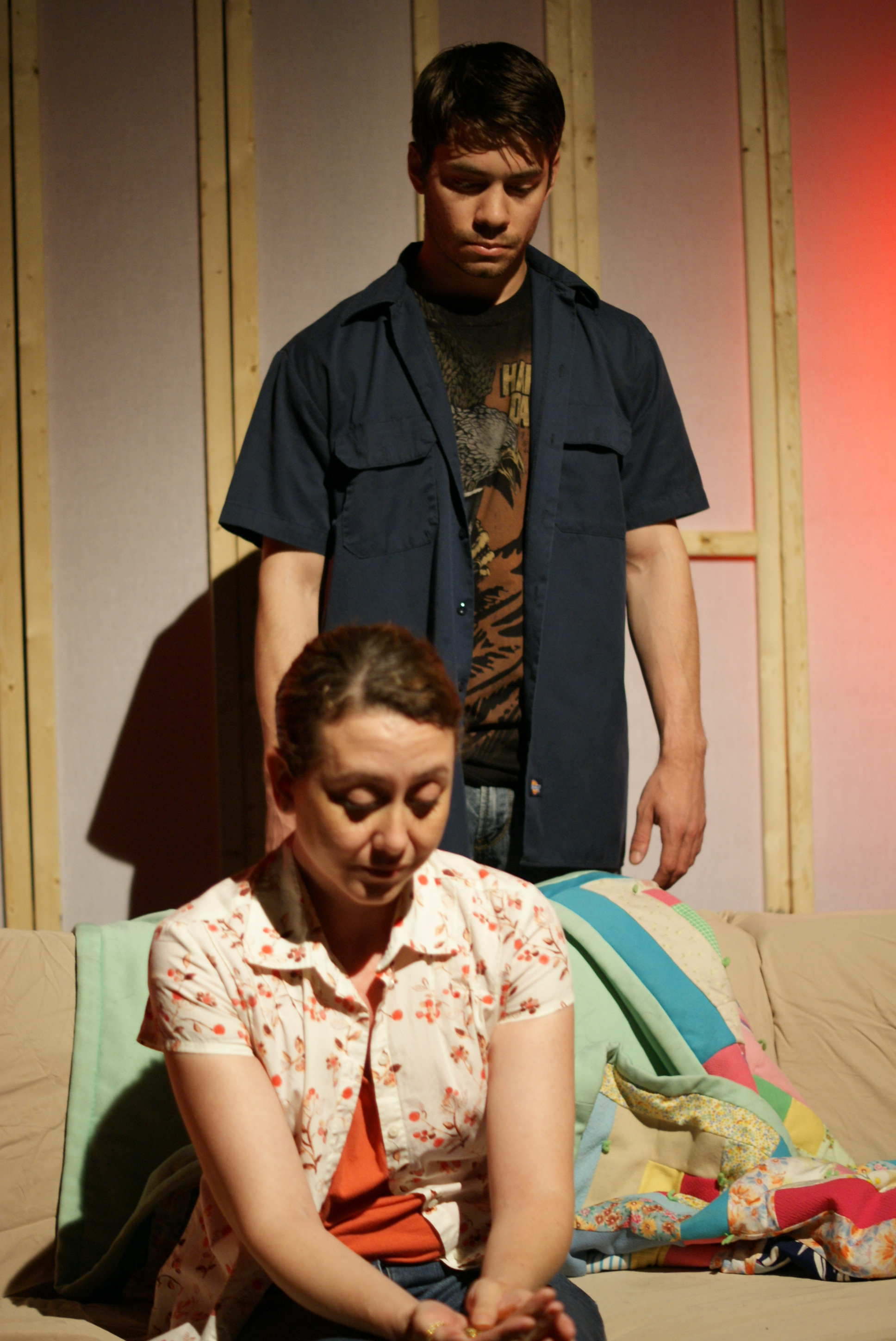
Add an ending that doesn’t quite wrap things up, and you have a play that fails to reach its full potential as a parable of contemporary paranoia. Fortunately, none of this prevents the comedy from scoring as a showcase for its talented cast.

A&B Theatricals will present The Promised Land at 8 p.m. today and Saturday (March 29-30) at the Columbus Performing Arts Center, 549 Franklin Ave. in Downtown Columbus. Running time: 1 hour, 30 minutes. Tickets are $12, $8 for students. For reservations, visit brownpapertickets.com. For more information, visit ab-theatical.com.

DIY playwright returns with new ‘dream play’

Nick Baldasare (lying down), Jeff Horst and Josie Merkle in The Promised Land (Red Generation Photography)

By Richard Ades

More and more, creative types are refusing to let rejection hold them back.

Authors who can’t find a publisher are publishing their own books. Critics whose publications get shut out from under them are starting their own blogs. (Yes, that’s a situation I know well.)

Then there’s Bill Cook, Columbus State professor and fledgling playwright. When he was ready to stage an original comedy called Love in an Age of Clamor last year, he figured he might as well produce it—i.e., make the necessary arrangements and put up the money—himself. His reasoning was that it would be difficult to find a theater troupe that wanted to take a chance on a new work by an unknown playwright.

“If you do a work that’s already been done—you know, already has press, people know of it—it’s less risky to do,” he said.

So, rather than look around for a troupe that was willing to try something untried, he formed his own theater company and booked space at the Columbus Performing Arts Center. He even planned to direct the play himself, but then he ran into a snag: He couldn’t find a cast.

“I didn’t know any actors, and nobody showed up to the audition,” Cook said.

Luckily for him, the person in charge of managing the venue was Joe Bishara, associate artistic director of CATCO and an experienced thespian. Even more luckily, Bishara took an interest in the project.

“We ran into each other, and I said, ‘Hmm, nobody’s shown up,’” Cook recalled. “He said, ‘Well, let me see the script.’ And then he liked it, and so he decided to (direct) it.”

The upshot was that Love in an Age of Clamor was performed last spring, with Nick Baldasare leading a cast of three. It apparently was enough of a success that Cook and his company, A&B Theatricals, are now back with another original play called The Promised Land.

Opening tonight at CPAC, the play reunites director Bishara with leading man Baldasare. Filling out the cast are Josie Merkle as Baldasare’s wife and Jeff Horst as assorted other characters.

Another similarity to the previous work: Like Clamor, it’s a “dream play,” which means it unfolds with the not-quite-real logic of a dream.

“It’s a form that just comes naturally to me,” said Cook, 61. “(It allows me to) follow an idea rather than plotting in a conventional way.”

He added that it also allows him to move events along at a fast clip. “I like a lot of action in plays, whether they’re mine or others’,” he said.

Still another similarity to Clamor: In that play, Baldasare’s character lost his home and, possibly, his marriage. In this one, he loses his job.

Why is Cook so fascinated by the theme of loss?

“I think what I’m addressing is middle-class anxieties,” he said, mentioning fears of potential dangers such as unemployment or infidelity. “They lurk in the background of most people’s middle-class life.”

And all this adds up to a comedy? Yes, Cook said, though it’s a comedy “with a certain amount of pain in it, too.”

“I don’t think comedy precludes pain and desperation, or even the tragic,” he said. “Chekhov, right?”

And like Anton Chekhov, Cook has more than two plays in him. He’s already working on yet another dream play about yet another kind of loss.

“It’s about the ultimate middle-class nightmare, which is going to prison.”

A&B Theatricals will present The Promised Land March 22-30 at the Columbus Performing Arts Center, 549 Franklin Ave. in Downtown Columbus. Show times are 8 p.m. today and Saturday, 2 p.m. Sunday and 8 p.m. Thursday through March 30. Tickets are $12, $8 for students. For reservations, visit brownpapertickets.com. For more information, visit ab-theatical.com.

Punk rock comes to the Palace

By Richard Ades

American Idiot begins with its title song, which tries to explain the alienation of the trio of teens at the show’s center by describing the mindset of post-9/11 America.

Johnny (Alex Nee, left) and the drug-pushing St. Jimmy (Trent Saunders) perform a number from American Idiot (photo by John Daughtry)

Unless you’re familiar with the Green Day concept album that inspired the show, however, you’ll probably miss the song’s point. It’s blasted out at a volume that renders most of the lyrics indecipherable.

But don’t worry. The time and setting aren’t all that important anyway. Johnny, Will and Tunny feel alienated for reasons that have more to do with youthful angst than with politics. If they’d lived in the 1950s, they would have been just as mad, though they probably would have expressed that anger with rockabilly rather than punk rock.

Another reason not to worry is that the bombastic opening eventually gives way to calmer songs that are easier to understand and relate to. Many of them are both catchy and beautiful, making them the show’s chief draw.

They’re certainly more rewarding than the plot, which sees the teens living up to the show’s title by making a series of moves that are as ill-conceived as they are generic.

Johnny (Alex Nee) moves to the big city and falls for the lusty Whatsername (Alyssa DiPalma), then undermines the relationship by becoming addicted to hard drugs under the tutelage of the charismatic St. Jimmy (Trent Saunders). Tunny (Thomas Hettrick) accompanies Johnny to the city but—apparently because he thinks women can’t resist a man in uniform—joins the Army just in time to get sent to Iraq.

Will wants to join his friends in the city, but he’s forced to stay behind after girlfriend Heather (Kennedy Caughell) announces she’s pregnant. Rather than embrace his new family, he tries to drown his disappointment in drink and drugs.

Nee, DiPalma and Saunders are particularly impressive, but all of the performers are committed and sport fine singing voices. The latter is important because this is a sung-through musical other than a few words of narration that Johnny delivers in the form of letters to his mother.

Michael Mayer directs the show, whose book he co-wrote with Green Bay’s Billie Joe Armstrong. Mayer also directed the 2010-11 Broadway version, which was up for the Tony for Best Musical but won only for scenic design and lighting.

Those elements are equally award-wordy in the touring production. Christine Jones’s stark scenery is highlighted by more than two dozen TV sets built into the walls. Kevin Adams’s lighting includes such dazzling special effects as cascades of ascending shadows.

Steven Hoggett’s choreography is characterized by violent head-banging. It turns graceful only when a wire-suspended Hettrick and Jenna Rubaii perform acrobatic moves several yards above the stage in Extraordinary Girl.

Though American Idiot is being presented as part of the Broadway in Columbus series, it’s hardly typical of the touring shows the group normally brings to town. Besides the loud rock and drug use, it includes an explicit sex scene. Add the generic characters and plot, and it’s easy to understand why several older patrons walked out during Tuesday’s opening-night performance.

Devotees of traditional musicals might feel as alienated as its leading characters, but those familiar with Green Day, punk rock and youthful angst will feel right at home.

Broadway in Columbus and CAPA will present American Idiot through Sunday (March 24) at the Palace Theatre, 34 W. Broad St. Show times are 8 p.m. through Friday, 2 and 8 p.m. Saturday, and 1 and 6:30 p.m. Sunday. Running time: 1 hour, 40 minutes. Tickets are $28-$78. 614-469-0939, 1-800-745-3000 or ticketmaster.com.