Susan (Michaela Watkins, left) reluctantly takes in her daughter’s ex-boyfriend, Gage (Charlie Gillespie), in Suze.
By Richard Ades
Are you looking for a way to show your love for our neighbors to the north? Do you want to make it up to them for our president’s threats to either absorb them or tax them into oblivion?
Well, now you can, thanks to the new Canadian flick Suze. Written and directed by filmmaking spouses Dane Clark and Linsey Stewart, it’s an offbeat comedy with a Yukon-sized heart.
Title character Susan (Michaela Watkins) is a mid-level manager and mom who left her husband after finding him sharing bodily fluids with another woman. Fast forward five years, and she now has two new problems: the unwelcome arrival of perimenopause and the impending departure of her college-bound daughter, Brooke (Sara Waisglass).
Oh, and one more: Susan can’t stand Brooke’s himbo-esque boyfriend, Gage (Charlie Gillespie), because he’s not bound for college, has no prospects and therefore seems unworthy of her beloved offspring. As a result, Susan urges Brooke to drop him as soon as possible.
A few weeks go by, during which Susan has trouble concentrating at work because she’s frantic to get news from her absent and stubbornly uncommunicative daughter. Then, she finally gets news, but it’s from a surprising source—Gage’s father, Rick (Aaron Ashmore), who tells her his son injured himself jumping off a water tower because Brooke sent him a “Dear John” text.
Rick clearly blames Susan’s daughter for what happened and figures that entitles him to a big ask: Can Susan watch his distraught and possibly suicidal son for a few weeks while his work takes him out of town? Motivated by either guilt or just common decency, Susan reluctantly agrees and opens her home to the volatile teen who still pines for her daughter.
So what happens next? After putting a lonely, middle-aged woman and a hunky, lovesick youth under the same roof, there’s an obvious way this story could have gone. Fortunately for us, Clark and Stewart take a more interesting tack by focusing on the fact that these two vulnerable people have one thing in common: They both love and miss the same person.
That’s not to say Suze never takes the obvious road. Waisglass’s Brooke and Ashmore’s Rick come across rather heavy-handedly as a spoiled brat and distant dad, respectively. And some scenes seem a little familiar, including one that could have been copied from a recent Jennifer Lawrence comedy (though it probably wasn’t).
But as long as the spotlight remains on the two central characters, none of that matters. Gillespie is often hilarious and always lovable as the outgoing Gage, while Watkins holds onto our sympathy even when Susan’s maternalistic needs lead her into cringe-worthy excesses.
Thanks to a sensitive script and these two wonderful leads, Suze is a treat. It might not take you where you expect to go, but once you get there, you’ll be glad you made the trip.
Rating: 4 stars (out of 5)
Suze (no MPA rating) opens Feb. 7 in theaters and on demand.
The recently widowed Rose Goldberg (Francoise Fabian) heads to her next adventure in Rose. (Photos courtesy of Cohen Media Group)
By Richard Ades
After watching the widowed title character enjoy a surprising romantic adventure in Rose, a fellow viewer was confused. Did this really happen, she asked, or did Rose merely fantasize it?
The answer is that the adventure really happened, but it happened in a film that almost qualifies as a fantasy itself. Director/co-writer Aurelie Saada consistently sees her 78-year-old heroine’s life through what can only be called rose-colored glasses, resulting in a flick that tries a bit too hard to be upbeat and inspirational.
Originally released in 2021, the French drama previously made the rounds of American Jewish film festivals, including one in my own area. It’s now being given a wider release in U.S. theaters, perhaps as a lead-in to Valentine’s Day.
At its center is Rose Goldberg (Francoise Fabian), who’s spent the last 50 years as a devoted wife and mother. A homebody with no outside career of her own, she’s led a rather isolated existence.
As a result, she retreats into herself when her beloved husband suddenly succumbs to a medical condition that’s been hidden from her. Despite her grown children’s entreaties, she reacts to his unexpected death by refusing to leave her apartment or even bathe.
A breakthrough finally comes when daughter Sara (Aure Atika) convinces Rose to accompany her to a dinner party. Most of the guests are her daughter’s age, but the last to arrive is a lively senior named Marceline (Michele Moretti) who quickly makes herself the center of attention.
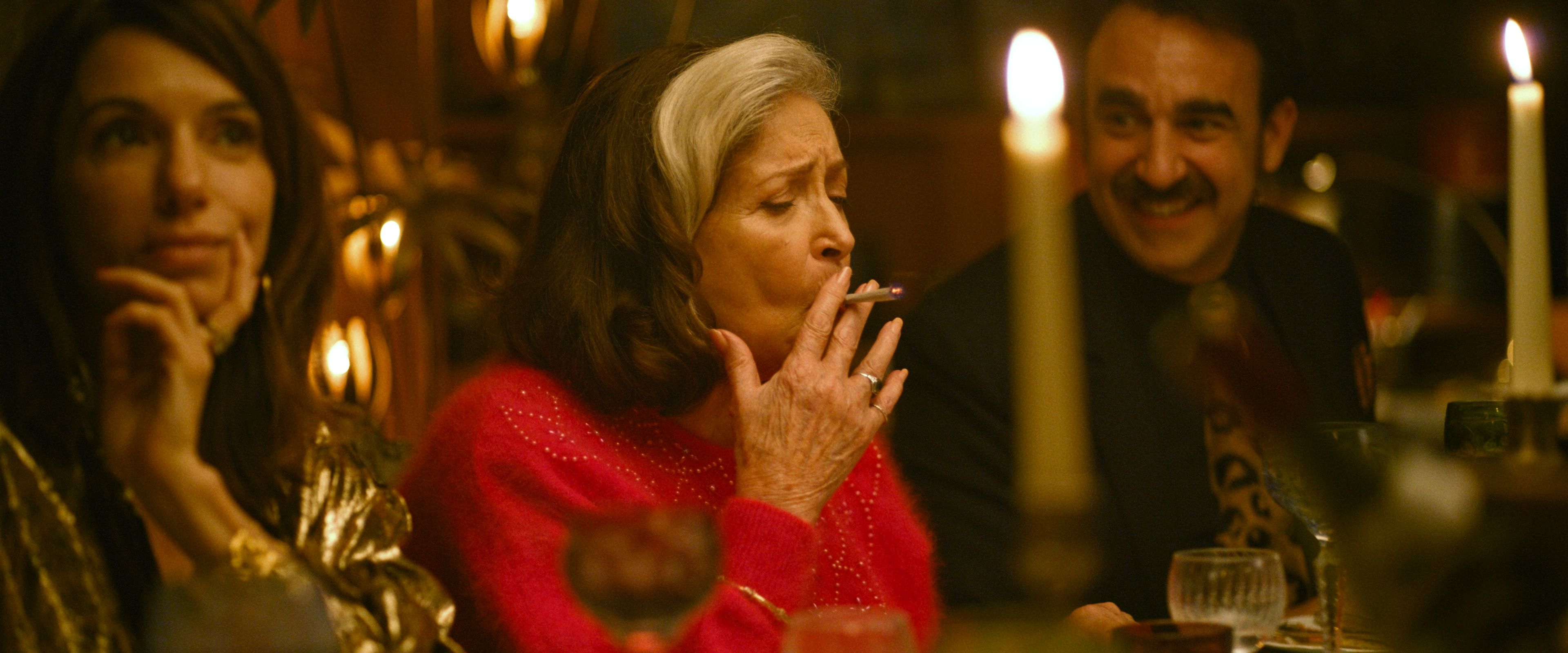
Rose (Francoise Fabian) samples a little pot while attending a dinner party with her daughter, Sara (Aure Atika, left).
Seeing this aging free spirit seems to have an immediate effect on Rose, who is inspired to cast aside her own inhibitions. Before the party is over, the former teetotaler is indulging in alcohol and even taking a few hits off a communal joint.
Still more changes follow the event, including the aforementioned romantic adventure. Rose apparently has decided to enjoy life to the fullest, even though it’s a life that previously was completely foreign to her.
In contrast, Rose’s three children all appear to be stuck in their own lives. Sara is hung up on her long-estranged husband; married son Pierre (Gregory Montel) carries a torch for a former flame; and single son Leon (Damien Chapelle) is still living with his mother, in addition to being in trouble with the law.
The contrast between the unhappy children and their suddenly joyous mother would be touching if the former’s situations and the latter’s transformation had been fleshed out more.
Though the tale could be stronger dramatically speaking, it benefits from a fine cast and especially from Fabian’s luminous portrayal of the evolving Rose. It also benefits from Martin de Chabaneix’s warm cinematography and director Saada’s lively musical score, which reflects the title character’s Jewish heritage and Tunisian roots.
It all adds up to a film whose joy would be contagious if it were just a bit more convincing.
Rating: 3 stars (out of 5)
Rose (no MPA rating) opens Jan. 24 in New York and Los Angeles and expands to other markets in subsequent weeks, including Columbus’s Gateway Film Center on Feb. 14.
A motion-captured Jonno Davies plays a simian version of British pop star Robbie Williams in Better Man. (Photo courtesy of Paramount Pictures)
By Richard Ades
This is the time of year when critics get a chance to catch up on recent flicks they might have missed, courtesy of studios in search of buzz and, hopefully, award nominations. While I don’t claim to be clairvoyant when it comes to the latter, I can confidently say this: If the Oscars and other competitions gave out prizes for bravery, these three films and their creators would win hands down.
One filmmaker displays creative courage by breaking the mold in a familiar genre, while the others put their liberty and even their lives at risk in order to bring their truths to the screen.
Let’s look at them one by one.
Biopic with a difference
By now, we all know the drill when it comes to film biopics: The would-be celeb claws his or her way to the top, but success comes at a steep cost. Friends are abandoned, spouses are cheated on, and alcohol and/or drugs are abused.
Better Man, based on the life of British pop superstar Robbie Williams, follows that general pattern, but with a difference. The entire story unfolds through the eyes (and narration) of Williams himself, who emerges as someone who desperately wants fame but is convinced he doesn’t deserve it.
And, oh yes: Williams is portrayed by a CGI-generated chimpanzee (a motion-captured Jonno Davies). It sounds weird—and, frankly, it is—but it also makes sense in a brilliant and emotionally satisfying way.
Even as a child, Williams suffers from self-doubt, self-loathing and what he later comes to identify as depression. By making him the lone ape in a world of humans, the film has found a clever way of symbolizing Williams’s fear that he’s an imposter unworthy of the success he seeks.
Directed with theatrical flair by Michael Gracey (The Greatest Showman), Better Man is marked by gee-whiz, over-the-top production numbers and surreal fantasy sequences, in addition to its simian protagonist. But what really sets it apart is its honesty and warmth.
Despite being depicted as an ape, Williams comes off as a recognizably flawed human who earns our sympathy, as well as the heart-on-its-sleeve sendoff the film gives him. Director Gracey’s gamble has paid off with a flick that’s as moving as it is massively entertaining.
Rating: 4½ stars (out of 5)
Better Man (rated R) opened Dec. 25 in select theaters and expands nationwide Jan. 10.
National unrest and a missing gun upset the lives of Iranian student Rezvan (Mahsa Rostami, center), her mother (Soheila Golestani, left) and sister (Setareh Maleki) in The Seed of the Sacred Fig.
Criticizing—and then escaping—Iran
As an attack on Iran’s government and justice system, The Seed of the Sacred Fig is the kind of film that can’t be made in that country. And yet veteran writer/director Mohammad Rasoulof succeeded in making it—in secret—before fleeing to Europe for his own safety.
The thriller concerns Iman (Missagh Zareh), who aspires to be a judge but learns that the path to success will force him to ignore his moral compass. He lands a position that requires him to sentence people to death without being given a chance to consider the evidence.
As it turns out, the position endangers more than just his conscience. Because of the job’s controversial nature, he and his wife, Najmeh (Soheila Golestani), and their family are forced to live in secrecy. Meanwhile, daughters Rezvan and Sana (Mahsa Rostami and Setareh Maleki) become embroiled in the widespread unrest that erupts after a young woman is beaten and killed for not sufficiently covering her head.
Then the gun that Iman keeps for protection turns up missing, and the national turmoil threatens to spread to his household as he searches for the culprit. Interrogations ensue, along with a car chase and a tense finale that may remind some of a certain horror film set in a snowbound hotel.
Considering it was made in secret and by a director who’d already gotten in trouble for earlier works, The Seed of the Sacred Fig should fill viewers with admiration for Rasoulof’s resourcefulness, as well as his courage. The film deserves an Oscar nomination, but it probably won’t get one, because who would nominate it? Certainly not Iran.
Rating: 4½ stars (out of 5)
The Seed of the Sacred Fig (PG-13) can be seen in select theaters and is scheduled to open Jan. 30 at Columbus’s Gateway Film Center.
Palestinian activist Basel Adra (left) joins forces with Israeli journalist Yuval Abraham in the documentary No Other Land.
Palestinian, Israeli expose West Bank abuses
Basel Adra has spent years documenting the Israeli army’s systematic attacks on his West Bank community, Masafer Yatta. In No Other Land, he continues that work along with Israeli journalist Yuval Abraham and fellow writer/directors Hamdan Ballal and Rachel Szor.
The result is an eye-opening expose of the abuses Adra and his Palestinian neighbors have had to endure living in the occupied territory. Houses and other buildings are destroyed on the shortest of notices and flimsiest of excuses, such as that the army needs the land for training exercises. Those who want to rebuild are told to get permits that they know are unobtainable.
Much of the film consists of footage taken with amateur video equipment or cellphones. It shows locals trying in vain to reason with soldiers, government officials and, in some cases, illegal Israeli settlers, all of whom are clearly trying to force them to abandon their rural community.
Other footage, shot by Szor, centers on the growing friendship between the Palestinian Adra and Israeli journalist Abraham, who are allied by their concern over the situation but separated by their approaches to dealing with it. Abraham is frustrated that his muckraking stories have had so little impact, but Adra counsels patience, saying a solution could take years or even decades.
The differing approaches reflect the men’s vastly different backgrounds. While Abraham is relatively new to the situation, Adra has been dealing with it for much of his life. In the face of constant, officially sanctioned abuse, he and his neighbors have no recourse but to greet it with steadfast determination and even flashes of dark humor.
Made under the most difficult of circumstances, No Other Land is a portrait of courage that is, in and of itself, an act of courage.
Rating: 5 stars (out of 5)
No Other Land is available through VOD outlets and can be seen at select theaters beginning Jan. 31.
Benji Kaplan (Kieran Culkin, left) and his cousin David (Jesse Eisenberg) get reacquainted while touring Polish Holocaust sites in A Real Pain. (Photos courtesy of Searchlight Pictures)
By Richard Ades
When Jesse Eisenberg made his debut as a writer/director with 2022’s When You Finish Saving the World, some found its depiction of familial squabbles heavy-handed and its characters insufferable.
Now Eisenberg is back with another comedy-drama about family relations, and he seems to have taken the criticisms to heart. A Real Pain’s two leading characters are flawed but likable, and its depiction of their squabbles is hardly heavy-handed. To the contrary, Eisenberg makes us work to figure out just what is behind them.
David Kaplan (played by Eisenberg himself) is a successful New Yorker with a wife and young son. His cousin Benji (Kieran Culkin) is single, jobless and lives in his mother’s upstate home.
Though the two were close boyhood friends, they’ve grown increasingly distant as adults, separated by their lifestyles and personalities as much as by geography. Now, however, they have a chance to reconnect thanks to their late grandmother, a Holocaust survivor who left them money specifically set aside for a visit to her native Poland.
So the cousins fly to Warsaw to join a multi-day tour of Holocaust-related sites led by a Brit named James (Will Sharpe). Also on the tour are a recently divorced American (Jennifer Grey) and a Rwandan-born Jewish convert (Kurt Egyiawan), among others. Each is briefly introduced, but Eisenberg keeps his main focus on the two cousins and their increasing discomfort with each other.
David, uptight and buttoned-down, watches with simmering resentment as the unrepressed Benji easily connects with other members of the group. For his part, Benji complains that David has made little attempt to see him recently, and he pushes him to smoke pot and otherwise reclaim some of the wildness that made them inseparable childhood companions.
Benji (Kieran Culkin) gives his cousin David (Jesse Eisenberg) a hug while following other members of their tour group.
As the tour goes on, the tension between the two grows due to Benji’s increasingly angry and erratic behavior. Whether it’s caused by the loss of his beloved grandmother or other, unidentified problems, it leaves David profoundly uncomfortable. The fact that it’s happening while the group is touring sites intimately connected to the last century’s worst atrocity only adds to the stress.
As an actor, Eisenberg doesn’t stretch himself, playing David much like he’s portrayed other socially awkward characters. As a director, on the other hand, he generously allows Culkin to imbue Benji with passion, unexpected quirks and unexplored depths.
What does it all mean? Eisenberg relies on the viewers to come up with their own explanations for the cousins’ difficult relationship and their disparate responses to the tragic history they’re revisiting. His approach is unobtrusive to a fault—with one exception.
An almost constant companion to the proceedings is a score consisting of works by 19th century piano virtuoso Frederic Chopin. Other than the fact that the composer was Polish, the music seems to have little to do what’s happening onscreen. What’s worse, the dramatic and often familiar passages sometimes upstage what’s going on.
For viewers struggling to find meaning in Eisenberg’s interesting but understated story, it’s an unwelcome distraction.
Rating: 3½ stars (out of 5)
A Real Pain (rated R) opens Nov. 15 in theaters nationwide.
New York stripper Ani (Mikey Madison, right) enjoys a lavish lifestyle provided by new boyfriend Vanya (Mark Eydelshteyn) in Anora.
By Richard Ades
Sean Baker is fascinated by folks who make their living in the sex industry. For evidence, look at his last three films, which featured a trans sex worker (Tangerine, 2015), a down-and-out stripper (The Florida Project, 2017) and an aging porn star (Red Rocket, 2021).
So it’s no surprise that the writer/director’s latest flick again centers on someone plying a corner of the sex trade. Anora may differ from its predecessors in other ways, but Baker’s preoccupation with the world’s oldest occupation remains the same.
When we first meet the title stripper (Mikey Madison), who goes by the nickname Ani, she’s confidently hawking drinks and lap dances at a New York club. Then she meets a customer named Vanya (Mark Eydelshteyn), who turns out to be the son of a wealthy Russian oligarch.
Faster than you can say Pretty Woman, Ani’s life undergoes a sea change. Swept away by the 21-year-old’s boyish charm and fun-loving ways, not to mention his bottomless wallet, she’s soon enjoying (paid-for) sex, drugs and raucous parties in his luxurious mansion.
Obviously smitten, Vanya then offers Ani $10,000 in exchange for a week’s worth of exclusivity, and she happily accepts—though only after he meets her counter-demand of $15K. The week includes an extravagant trip with friends to Vegas, where Ani and Vanya engage in more sex, drugs and partying before ending up where inebriated Vegas visitors often end up: an all-night wedding chapel.
And they both live happily after ever, right? Nope, because this isn’t Pretty Woman, despite its initial similarities.
Vanya is soon contacted by his father’s fixer, Toros (Karren Karagulian), who warns him that his parents will never accept his marriage to a woman they consider a prostitute. In an attempt to squash the union, Toros then forces his way into the New York mansion accompanied by hired goons Garnick and Igor (Vache Tovmasyan and Yura Borisov). And chaos ensues.
Anora has been called a romcom, but it’s hard to see how it qualifies. What passes for romance often seems more like a business arrangement—for instance, Ani accepts Vanya’s proposal only on the condition that he put a 3-carat ring on her finger. And as for comedy, the flick does feature gobs of near-slapstick violence and property destruction, but they result in laughs only if you can ignore the threatened disaster that produces them.
What this is, actually, is a Sean Baker film, in which success is a distant goal, and mere survival is a hard-won commodity. As stated earlier, though, it’s not quite like previous Baker films.
While its predecessors offer quiet moments and revealing dialogue that help us understand the characters, much of Anora is a cavalcade of frantic scenes featuring partying, screaming and endless F-bombs. For many, this adds up to an impressive achievement, as the film has already won the Cannes Palme D’or and is rumored to be a shoo-in for multiple Oscar noms.
Personally, while I appreciate Baker’s usual sympathetic treatment of societal underdogs, I wish he had exercised a bit more restraint in terms of tone—and in terms of length, especially during the flick’s repetitive second act.
Back on the plus side, the film’s strengths include its cast, especially the actors in the two lead roles. In very different ways, Madison’s Ani and Eydelshteyn’s Vanya are both forces of nature.
Gratifyingly, the film also boasts a strong and emotionally complex ending. Though Pretty Woman fans might be disappointed, it should make Baker fans feel right at home.
Rating: 3½ stars (out of 5)
Anora (rated R) opens Nov. 1 at theaters nationwide.
As a boy dealing with a debilitating medical condition, Mats Steen often escaped into the virtual world of gaming. (Photo by Bjorg Engdahl Medieop/Netflix)
By Richard Ades
Growing up with a degenerative muscular disease, Mats Steen found it harder and harder to take part in everyday life. As a result, the young Norwegian spent most of his time playing video games.
“His world seemed so limited,” said his father, Robert.
Finally, at the age of 25, Mats succumbed to his condition. That’s when Robert and his wife, Trude, realized that their son’s world hadn’t been so limited after all.
The reason is revealed in Benjamin Ree’s unconventional documentary The Remarkable Life of Ibelin.
The film explains that Robert, after losing Mats in 2014, announced the sad news to followers of his son’s blog, “Musings of Life.” The grieving father expected that to be the end of it, but he soon was inundated with condolences from people around the world who had come to know Mats through their shared love of the video game World of Warcraft.
In the real world, the adult Mats had spent his days in a wheelchair, unable to take care of his most basic needs by himself. That much, his parents knew.
What they didn’t know was that once his wheelchair was pushed up to the computer, Mats had entered the virtual world and become Ibelin, a muscle-bound hero who busied himself sprinting through verdant landscapes, fighting monsters and forming bonds with his fellow avatars—bonds that eventually evolved into real-life friendships.
Ibelin (right), Mats Steen’s virtual alter ego, spends time with Rumour, the avatar of a Dutch girl named Lisette.
As in Ree’s 2020 documentary, The Painter and theThief, the director tells this fascinating story in a way that surpasses genre conventions.
In the early moments, Mats’s boyhood and young adulthood are captured through a combination of home movies and interviews with his parents and sister, Mia. Nothing out of the ordinary here. Later, though, the film immerses itself in images and characters derived from Mats’s favorite video game.
With the help of material gleaned from World of Warcraft archives, Rees uses animation and voice actors to recreate scenes from Mats’s online life.
In some cases, they’re tender, as when he first meets the flirtatious Rumour, the avatar of a Dutch girl named Lisette. In other cases, they’re painful, as when Ibelin lashes out against other avatars. Determined to keep his health problems to himself, Mats hides the fact that his character’s flintiness stems from his own frustration over his worsening condition.
In his better moments, though, Mats’s virtual alter ego could be kind and thoughtful. Interspersed with the animated segments are interviews with Lysette and others that reveal the ways in which Mats affected their lives for the better. The result was that their make-believe relationships grew into actual friendships—friendships that became all the more passionate once Mats finally revealed his real-world challenges.
The Remarkable Life of Ibelin benefits greatly from Rasmus Tukia and Ada Wikdahl’s expressive animation and Tore Vollan’s subtle score. Combined with Ree’s innovative approach to documentary-making, they turn a unique story into a rewarding and moving experience.
Rating: 4½ stars (out of 5)
The Remarkable Life of Ibelin (PG-13) will be available through Netflix beginning Oct. 25.
Andy Singer (Michael Zegen, right) is forced to spend a hectic day with his daughter, Anna (Kasey Bella Suarez), in Notice to Quit.
By Richard Ades
As the cheating husband who drove his wife to a life of comedy in The Marvelous Mrs. Maisel, Michael Zegen proved he can play a cad without losing the audience’s sympathy. By the end of the series, in fact, we were rooting for him almost as much as we were for his joke-telling ex.
In the comedy-drama Notice to Quit, as actor-turned-real estate agent Andy Singer, Zegen again relies on his natural likability. So, it seems, does first-time writer/director Simon Hacker.
Perhaps more than he should.
To be blunt, Hacker gives us almost no reason to cheer for Andy, an ethics-challenged New Yorker who’s down on his luck. To name just one of his vices, he regularly makes extra bucks by stealing appliances out of vacant properties and selling them to a ragtag gang of thugs.
Then, just as Andy is being evicted from his apartment because he’s behind on the rent, 10-year-old daughter Anna (a relatable Kasey Bella Suarez) shows up and wants to spend the day with him. She’s mad because her mom (Andy’s ex) is moving to Florida, and she doesn’t want to go.
So how does Andy react to the presence of the daughter he hasn’t seen in months? Not well. In fact, he doesn’t want to be bothered and unsuccessfully tries to palm her off on his retired father (Robert Klein).
To some extent, it’s understandable that Andy can’t deal with Anna on this day, as he’s desperate to scrape together enough bucks to avoid ending up on the street. Mainly, though, his lack of filial devotion just makes it that much harder to care about him.
That is, it makes it harder for us to care about him. For her part, Anna seems to love her dad and enjoys this rare opportunity to spend time with him. Why? Did they have a close relationship in the past, when her parents were still together?
Hacker’s script never explains, any more than it clarifies just why we’re supposed to see Andy as anything other than a self-centered scumbag. And yet we are, because it quickly becomes obvious that the film has something warm and fuzzy in its long-range sights.
When that something arrives, it lands with all the impact of a wet noodle, both because it was telegraphed well in advance and because it wasn’t earned. It’s clear that Hacker wants us to care about what happens, but it’s equally clear that he doesn’t know how to make us care.
Well, with one exception: He lucked out by casting Zegen as Andy, who retains at least a portion of our sympathy even though he doesn’t deserve it, and Suarez as Anna, the daughter who loves him for no apparent reason. The chemistry these two create is the flick’s main selling point.
Rating: 3 stars (out of 5)
Notice to Quit (PG-13) opens Sept. 27 in theaters nationwide.
One of many flashy moments from the touring production of MJ: The Musical (Photo by Mathew Murphy of MurphyMade)
By Richard Ades
A good fireworks show begins with a “wow” and ends with a “WOW,” filling the space in between with enough peaks to fuel our anticipation. MJ: The Musical, based on the life of Michael Jackson, follows that formula almost exactly.
The action has barely begun when the title character (an amazing Jamaal Fields-Green) launches into an MTV-worthy rendition of the Jackson classic “Whip It.” Then, nearly 2½ hours later, the show is only minutes from its finale when it delivers the song-and-dance number we’ve all been waiting for: “Thriller.”
And by the way: When I say “delivers,” imagine the word being followed by multiple exclamation points. The number is so over-the-top astounding that it alone would nearly justify the original Broadway production’s Tonys for choreography (Christopher Wheeldon, who also directs), lighting design (Natasha Katz) and sound design (Gareth Owen).
In between these two high points, it must be said, the production falls a bit short of a good fireworks show’s standards. There are impressive peaks here and there, but there are also valleys that slow down the momentum.
Set in 1992 during a rehearsal for Jackson’s upcoming “Dangerous” world tour, the jukebox musical addresses some of the rumors then swirling around the “King of Pop.” These are uncovered with help from nosy documentary maker Rachel (Cecilia Petrush) and her cameraman, Alejandro (Anthony J. Garcia).
Through flashbacks, the show also introduces us to two earlier Jackson incarnations: the Jackson 5’s pipsqueak frontman (alternately played by Josiah Benson and Bane Griffith) and the young adult seeking to launch a solo career (Erik Hamilton).
Also featured in the flashbacks are the rest of the Jackson family, including the mom, Katherine (Anastasia Talley), and dad, Joseph (Devin Bowles). Bowles plays the latter as a domineering bully who pushed his talented children relentlessly and was particularly abusive toward young Michael.
The implication is that Joseph’s behavior was responsible for MJ’s later problems, but the argument is only partially convincing. To some extent, that’s because Jackson had so many problems and eccentricities, some of which didn’t come out until after the musical’s time frame, that it’s hard to pin them all on any single source.
Despite his flaws, the one undeniable thing you can say about Michael Jackson is that he was a showman of the first degree, and MJ is most successful when it concentrates on that fact. Along with singing, dancing was obviously central to his appeal, and his devotion to the craft comes out brilliantly in an Act II fantasy that shows him trading steps with virtuosos who apparently inspired him: Fred Astaire, Bob Fosse and the tapdancing Nicholas Brothers.
Though all of the cast members sing and dance well, it clearly takes a special skillset to portray someone as unique as Michael Jackson. In the original Broadway production, Myles Frost filled the bill and thereby won the show’s fourth and final Tony.
In the current touring production, Fields-Green displays the voice, the moonwalk and all the other flourishes that won the King of Pop his title. (Jordan Markus alternates in the role at some performances.)
Fields-Green’s portrayal, backed up by a stellar band and some of the most awe-inspiring stagecraft you’ll ever see, makes MJ a pulse-quickening trip down memory lane.
MJ: The Musical runs through Sept. 15 at the Ohio Theatre, 39 E. State St., Columbus. Showtimes are 7:30 p.m. through Friday, 2 and 7:30 p.m. Saturday, 1 and 6:30 p.m. Sunday. Running time: 2 hours, 40 minutes (including intermission). For ticket information, visit columbus.broadway.com. For information on future tour stops, visit tour.mjthemusical.com.
Sam (Lily Collias) explores the Adirondacks with her father and his best friend. (Photos courtesy of Metrograph Pictures)
By Richard Ades
When you’re hiking through nature, you miss a lot if you’re not paying attention. The same holds true when you’re viewing Good One, the story of a teenage girl’s hike through the Adirondacks with her dad and his best friend.
Seen mostly through the eyes of 17-year-old Sam (Lily Collias), the flick is full of telling moments, but few of them hit you over the head. Instead, writer/director India Donaldson expects you to watch and listen for clues about what Sam is going through.
Fortunately, Collias’s face registers the girl’s most fleeting thoughts, and cinematographer Wilson Cameron’s lens is right there to capture them.
Taking place over three days, the film follows along as Sam goes on what seems to be a family tradition: an extended hike with her dad, Chris (James Le Gros). They were supposed to be accompanied by both Chris’s friend Matt (Danny McCarthy) and his teenage son, but the son bails out following a last-minute family argument.
This leaves Sam alone with two divorced, middle-aged men whose egos and life experiences sometimes make them difficult traveling companions.
They not only trade insults with each other, but they force her into a second-class status by, for example, relegating her to the back seat in the car or the floor in their shared hotel room. They also rely on her to take the lead on such stereotypically female tasks as cooking and cleaning.
Sam’s hiking companions are her father, Chris (James Le Gros, right), and his friend Matt (Danny McCarthy).
Sexual roles and outright sexism are understated themes here, but they’re not the only ones. An uncomfortable incident far into the journey forces Sam to question whether she can count on her father to be in her corner, or even to recognize what her corner is. It’s a sad, life-changing moment that filmmaker Donaldson delivers with her usual restraint.
Though the film is only 90 minutes long, its leisurely tempo might test some viewers’ patience. On the other hand, the pace allows us to enjoy the pristine Adirondak scenery, which is complemented by composer Celia Hollander’s evocative score.
More importantly, it allows us to appreciate Le Gros and McCarthy’s portrayals of two flawed but vulnerably human men, along with Collias’s portrayal of a young woman who is still on the cusp of adulthood and yet more mature than either of them.
Rating: 4 stars (out of 5)
Good One (rated R) can be seen in select markets and expands to theaters nationwide on Aug. 23.
Members of the Kneecap hip-hop band are (from left): Liam Og O’Hannaidh (stage name Mo Chara), JJ O’Dochartaigh (DJ Provai) and Naoise O’Carrolean (Moglai Bap). All play themselves in the new film Kneecap. (Photos courtesy of Sony Pictures)
By Richard Ades
Kneecap is a movie about Irish rappers who deliver their rhymes in their native Irish. As such, it can be a lot for American viewers to absorb, especially since it unfolds at a take-no-prisoners pace.
Once you get your bearings, though, writer/director Rich Peppiatt’s debut flick is a blast and a hoot.
The title refers to an actual Northern Ireland hip-hop band that took its name from the painful punishment often meted out by republican enforcers during the period of upheaval known as “The Troubles.” Set in 2019 or so, long after relative peace has arrived, the film purports to be the band’s origin story.
I say “purports” because Peppiatt’s clever script no doubt takes massive liberties with reality. If the story still has an air of authenticity, it’s partly because the band members all play themselves, and they do so with panache and conviction.
The trio’s founding members are Naoise O’Carrolean and Liam Og O’Hannaidh, lifelong friends who rap in their spare time but make their living selling drugs. The final member is JJ O’Dochartaigh, a bored music teacher who becomes involved with Naoise and Liam by pure chance.
But before that happens, a whirlwind prologue efficiently defines the characters and the divided society in which they live.
While Naoise is still a baby, his Catholic parents take him into the woods for a secret baptism ceremony, only to see it interrupted by a hovering military helicopter. Angry at the English- and Protestant-dominated government that he blames for curtailing his rights, the father, Arlo (Michael Fassbinder), becomes a republican activist and eventually fakes his own death to avoid being captured. This leaves Naoise virtually fatherless and forces his mother (Simone Kirby) to play the role of a grieving widow.
Liam is also affected, since Arlo has been a father figure to him. Like Naoise, he grows up into an angry young man who champions the Irish language as an act of rebellion.
Naoise O’Carrolean (left) has a rare meeting with his fugitive father, Arlo (Michael Fassbinder).
Meanwhile, JJ is plodding along, teaching students who don’t seem to be all that interested. When fate brings him into contact with two rappers who share his passion for music and the Irish language—and, it must be said, for drugs—he doesn’t need much prodding to join their band.
It’s a fascinating story, and writer/director Peppiatt tells it in an anarchic, wildly creative style that fits its subject. Watch for “sound waves” to be represented by squiggly lines, or for Irish rhymes to be translated in ever-changing fonts of lettering. And in one of several scenes of drug use, watch as the three hallucinating musicians suddenly morph into Claymation figures.
Raunchiness—in terms of language, nudity and sex—is another of the film’s defining elements. The sex scenes generally involve Liam and Georgia (Jessica Reynolds), the latest in a string of Protestant girlfriends. In an amusing twist, Liam always dates Protestant women because only they can stimulate the anger that apparently is needed to awaken his sex drive.
Though Kneecap takes on serious subjects, including the desire for Irish solidarity and the fight to make their native tongue an official language, the film seldom takes itself seriously. More often, it’s laugh-out-loud funny.
For a debut feature film—or any film, really—it’s quite an achievement.
Rating: 4 stars (out of 5)
Kneecap (rated R) opens Aug. 2 in theaters nationwide.









 Reel Time With Richard Ades