Reviews

Love triangle turns deadly in offbeat rock musical

By Richard Ades

Chances are you’ve never seen a musical quite like Murder Ballad. On the other hand, chances are the show’s characters will seem very familiar.

In the first act, young New Yorkers Sara (Kaitlin Descutner) and Tom (Jason Carl Crase) begin a wild affair that appears to be based solely on physical attraction. (Well, maybe alcohol plays a supporting role.)

When they break up two years later, a drunk and lonely Sara bumps into Michael (Nick Cirillo), who is kind, decent, sensitive and, in general, everything Tom is not. They hook up and begin planning a future together.

It’s not hard to predict what will happen next. We know that Sara is attracted to “bad boys.” We know that Michael doesn’t fit that description. We know that Tom is still around—and easy to find, since he tends bar on the Lower East Side. It’s only a matter of time, it would seem, before Sara and Tom reunite.

About the only thing we don’t know is how Murder Ballad will live up to its name. Who gets murdered, and who does the murdering?

The one character who doesn’t seem familiar in Julia Jordan and Juliana Nash’s rock musical is the Narrator (Corinne Davis). Narrators generally are neutral reporters of the action, and that’s the way this Narrator starts out. As time goes on, however, she seems to be increasingly troubled by what she sees—so troubled that at one point she picks up a bottle from Tom’s bar and begins taking deep swigs between songs.

The emotionally involved Narrator is one thing that sets Murder Ballad apart, despite its familiar plot and characters. The staging is another.

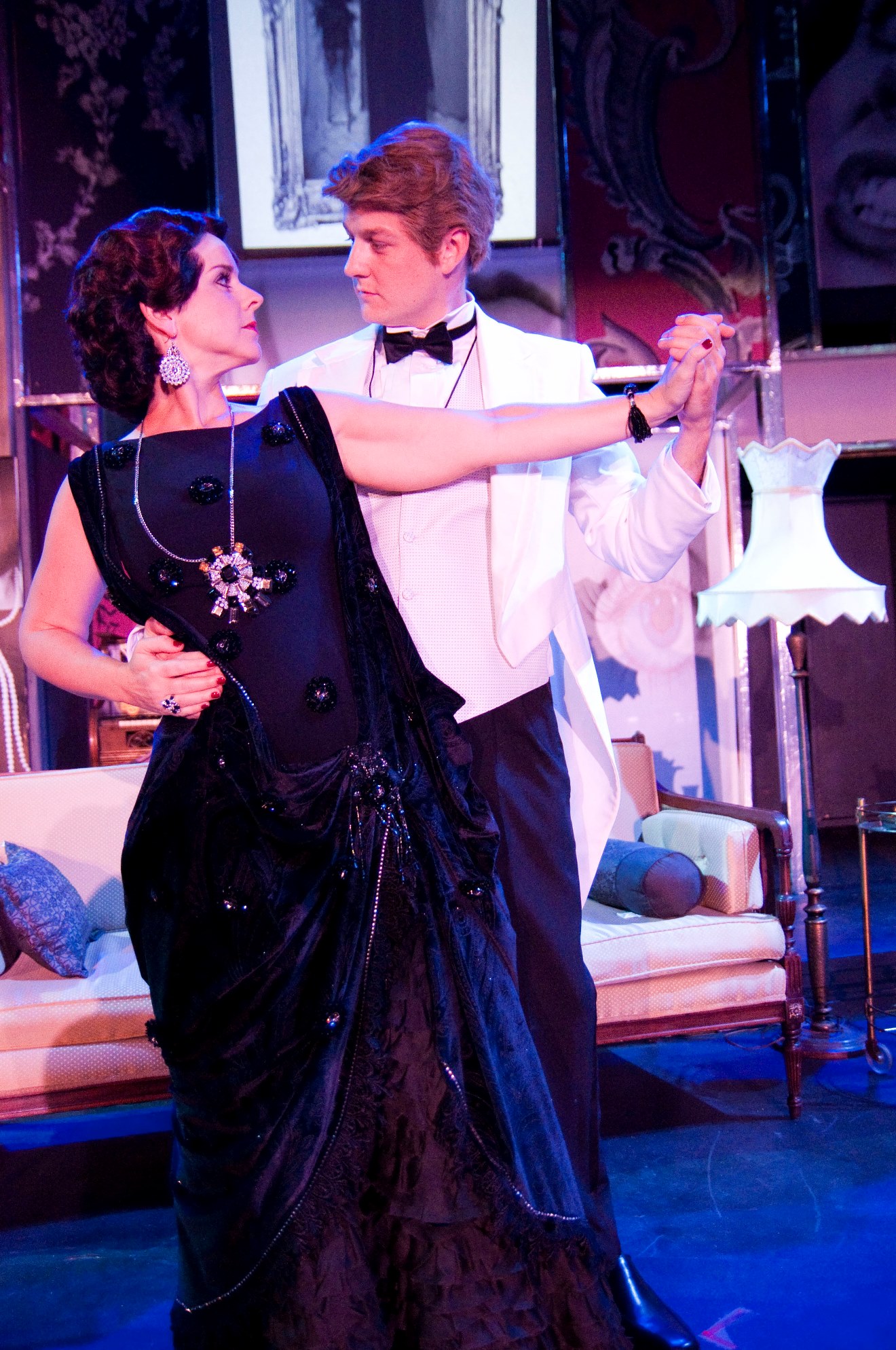
Director/production designer Edward Carignan has transformed Short North Stage’s Green Room by installing a high, rectangular “bar top” in the center, with the audience seated around the periphery. The characters often climb onto this elevated platform or other precarious perches, underlining the dangerousness of their situation. Occasionally, they wander among the viewers, making them feel like they’re in the midst of the action.

Since this is a sung-through musical (no spoken dialogue), the songs are designed to tell the story rather than stand alone. Even so, a few have catchy tunes, and all are powerfully delivered by the cast and the four-piece band led by keyboardist Matthew Ebright. The only disappointment is that the lyrics are sometimes hard to pick out on the louder numbers.

Murder Ballad premiered at Manhattan Theatre Club’s Studio at Stage II in late 2012 and reopened in 2013 at an off-Broadway venue. Though the original production reportedly sold out, the off-Broadway version closed after only two months. After seeing Short North Stage’s revival, it’s not hard to guess why. The offbeat production design is striking, but you can’t help wishing the characters were a bit less generic.

Still, it’s fun to see what caught the attention of New York theatergoers a couple of years back. Bravo to Short North Stage for bringing this still-fresh slice of the Big Apple to Columbus.

Short North Stage will present Murder Ballad through Aug. 16 at the Garden Theater, 1187 N. High St. Show times are 8 p.m. Thursday-Saturday. Running time: 1 hour, 30 minutes (including intermission). Tickets are $30. 614-725-4042 or shortnorthstage.org.

Third time is hardly a charm for Shakespeare’s Falstaff

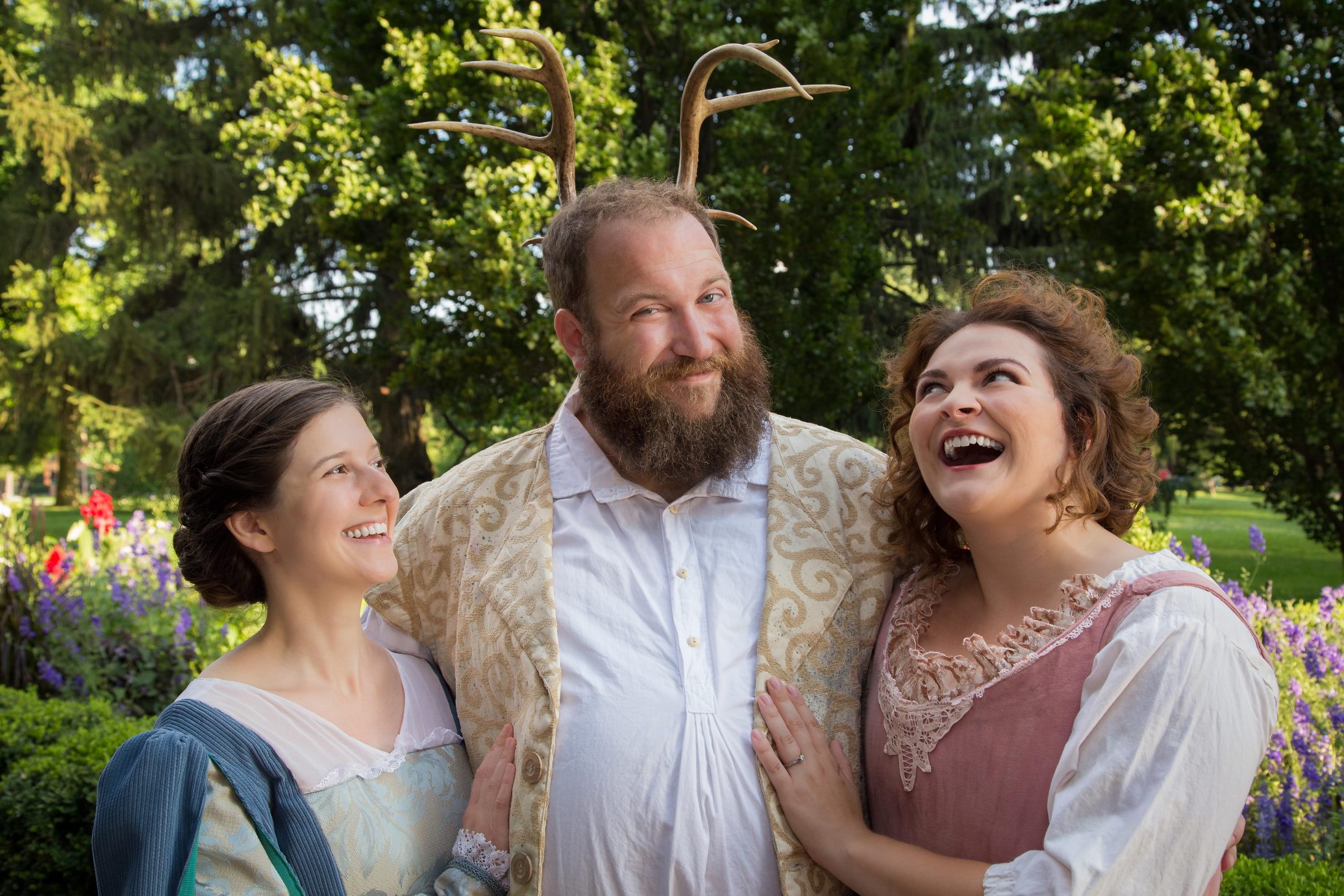
Appearing in The Merry Wives of Windsor are (from left): Elizabeth Harelick as Mistress Ford, Adam Simon as Sir John Falstaff and Michelle Weiser as Mistress Page (photo by Nick Pershing)

By Richard Ades

Fat and vain, cowardly and conniving, Sir John Falstaff is one of Shakespeare’s greatest comic inventions. But you have to catch him in one of the Bard’s Henry IV plays to see him at his best.

In The Merry Wives of Windsor—which some believe was written because Queen Elizabeth I wanted to see more of the entertaining scamp—he’s simply the butt of the joke. The result is a comedy that’s less fun than it would have been if he were as sly and resourceful as he is in Henry IV, Parts 1 and 2.

On the Schiller Park stage, director Beth Kattelman and her cast try their hardest to extract laughs from his misadventures, and sometimes they succeed. More often, though, they merely succeed in raising the volume with shouted lines and over-the-top acting.

The plot starts promisingly enough. While staying at an inn in Windsor, Falstaff (Adam Simon) realizes he can no longer afford his hard-partying lifestyle. He quickly comes up with the idea of improving his finances by romancing Mistresses Ford and Page (Elizabeth Harelick and Michelle Weiser), two local married ladies.

Unfortunately for Falstaff, the ladies are close friends who share everything—including the identical love notes he sent them. Insulted, they agree to concoct a romantic trap in order to teach him a lesson.

What happens next should be a delicious case of comeuppance, and it would be if Falstaff weren’t so darn gullible. Instead, he’s such an easy mark that the wives are able to fool him over and over. What starts out amusingly soon becomes predictable and repetitious. And it doesn’t help matters that the mostly admirable Harelick and Weiser go overboard on the faux melodramatics whenever they’re conning the lascivious knight.

An added complication provides a few chuckles. After Falstaff’s disgruntled former servants tell the wives’ husbands what their ex-boss is up to, the jealous Ford (Micah Logsdon) decides to investigate. Introducing himself as a man named Brook, he tells Falstaff he has long lusted after Mistress Ford but can’t persuade her to abandon her marital vows. He invites Falstaff to compromise her integrity in order to make her more open to his advances.

The early scenes between Falstaff and the disguised Ford are nicely handled by Simon and Logsdon, but the latter eventually gives in to the production’s tendency toward over-emoting.

A romantic subplot involves the Pages’ daughter, Anne (a winsome Cecelia Bellomy), who is being courted by a trio of suitors. Here, some characters stand out thanks to inspired comic performances, including the idiotic Slender (Dayton Willison), the extravagantly French Dr. Caius (Daniel Turek) and Caius’s mischievous servant, Mistress Quickly (Jennifer Feather-Youngblood). Meanwhile, Jesse Massarro shows welcome restraint as third suitor Fenton, as does Nick Baldasare as Anne’s father.

Stefan Langer also fares well as Welsh clergyman Sir Hugh Evans. He doesn’t actually display the incoherent accent that others joke about, but it’s hard to blame him for that. Apparently the Welsh accent was pretty heavy in Shakespeare’s time, but nowadays it’s far more subtle.

Thus, the Welsh jokes fall as flat as pretty much everything else in this heavy-handed comedy.

Actors’ Theatre will present The Merry Wives of Windsor through Aug. 31 at the Schiller Park amphitheater, 1069 Jaeger St. Show times are 8 p.m. Thursday-Sunday. Running time: 2 hours, 30 minutes (including intermission). Admission is “pay what you will.” Bring a blanket or lawn chair. 614-444-6888 or theactorstheatre.org.

Keeler-like lass sets out to conquer Broadway

Ruby (Haley Jones, on floor) shows off her flexibility in Dames at Sea, which also stars (from left) Ian Taylor, Erin Ulman, Jordan Donica, Courtney Dahl and Sam Parker (photo by Andrew Beers)

By Richard Ades

Otterbein is presenting its summer series on the stage of Cowan Hall. That is, both the audience and the actors share the stage, making for an intimate experience.

At first, it seems like an odd setup for Dames at Sea, a takeoff on 1930s movie musicals. You may find yourself wondering why they didn’t use the entire auditorium, as they do with their spring musical productions.

But it turns out the cozy surroundings work just fine for this George Haimsohn/Robin Miller/Jim Wise comedy, which is far more modest in size than the movies it spoofs. Originally opening off-Broadway in 1966, it features only seven major roles—and two of them are played by the same actor.

In Otterbein’s production, Haley Jones stars as Ruby, who’s determined to make her mark on Broadway even though she’s fresh off the bus from Utah. She’s clearly modeled after the kind of talented lass Ruby Keeler played on Depression-era movie screens, and Jones imbues her with the same kind of fresh-faced innocence and spunk. Almost as appealing is Sam Parker’s portrayal of Dick, the sailor who falls in love with Ruby after learning they both hail from the same small town.

The same town? Gee, what are the chances of that? Well, pretty good in this show, which takes none-too-subtle jabs at the amazing coincidences and strokes of luck that propelled Keeler’s heroines to instant fame and romance.

Also playing important roles are Jordan Donica as flop-prone director Hennesey, Erin Ulman as spoiled diva Mona Kent, Courtney Dahl as sarcastic hoofer Joan and Ian Taylor as Joan’s sailor-boyfriend, Lucky. In Act 2, Donica does double duty as the Captain, whose battleship is commandeered by Hennesey and his cast after their theater becomes unavailable.

Supporting roles are played by Anthony Cason, Emily Vanni, Jeff Gise and—upstaging all the rest—Tux. This pooch, who plays Mona’s lapdog, is the biggest, calmest Pomeranian you’ve ever seen.

In a show this campy, it’s a good idea not to camp up the performances, which amounts to overkill. Working under Doreen Dunn’s spirited direction, most of the cast members manage to avoid this most of the time. The biggest exception is Ulman, who makes Mona a caricature of diva-hood.

On the other hand, Ulman sings and tap-dances well, as she proves in the first musical number, Wall Street. Other cast members also get ample opportunities to show off their fine pipes and moves, with strong help from Molly Sullivan’s choreography and Dennis Davenport and Lori Kay Harvey’s keyboard accompaniment. Fittingly, no one gets more opportunities than Jones, who is especially impressive on her two ballads, The Sailor of My Dreams and Raining in My Heart.

Rob Johnson’s scenery is nearly nonexistent in Act 1, set on a largely bare stage, but the Captain’s Navy ship is amusingly depicted in Act 2.

Plot-wise, Dames at Sea is little more than a string of self-consciously absurd developments. Music-wise, it’s marked by tunes that are pleasant but mostly unmemorable. It’s a slight pleasure, but a pleasure nonetheless.

Otterbein Summer Theatre will present Dames at Sea at 8 p.m. Wednesday-Saturday (July 23-26), plus 2 p.m. Friday, in Cowan Hall, 30 S. Grove St., Westerville. Running time: 2 hours, 5 minutes (including intermission). Tickets are $25. 614-823-1109 or www.otterbein.edu/drama.

‘Sex Tape’ is a case of comedius interruptus

Cameron Diaz and Jason Segel in Sex Tape

By Richard Ades

Sex Tape actually isn’t terrible until they decide to do it doggie-style. Comedy, I mean.

It all starts promisingly enough. Like many longtime couples, Jay and Annie (Jason Segel and Cameron Diaz) have seen their sex life whittled away by familiarity and the demands of parenthood.

The solution they come up with is to record their lovemaking on Jay’s iPad. The resulting three-hour marathon has its desired effect on their libido, after which Annie feels it’s served its purpose and orders Jay to erase the evidence.

Unfortunately, Jay doesn’t. Instead, he accidentally shares the video with previous iPads that he’s given to family members and acquaintances. They include Annie’s mom and Hank (Rob Lowe), a corporate executive who could become Annie’s new boss. Panicked, the couple set out to recover the devices.

The real trouble—for them and for us, the viewers—begins when they arrive unannounced at Hank’s mansion. Rather than thinking of a logical excuse for getting their hands on the iPad, they come up with the most absurd plan imaginable: Hank asks to use the bathroom so he can search the house while Annie keeps their host engaged in conversation.

That’s when the canine antics get under way. A vicious guard dog begins chasing Jay from room to room, taking a bite out of him whenever he catches up. Meanwhile, Annie reluctantly accepts Hank’s invitation to indulge in a little cocaine.

The concurrent chasing and snorting do result in a few laughs. In the process, though, they completely derail the flick’s original premise. What had been a lighthearted look at a racy anecdote to marital boredom becomes a scattershot affair that misses its target because it can’t decide just what that target is.

Director Jake Kasdan (Bad Teacher) has a game cast, especially in his butt-baring leads. But they’re all stymied by the three-person writing team, which consists of Kate Angelo (The Back-up Plan), Segel and Nicholas Stoller (co-writers of The Muppets).

Like a stereotypical committee, they’ve concocted a mess that lacks a unifying structure. Rather than building on the theme of marital ennui, they’ve thrown together a hodgepodge of unlikely and unfunny developments.

They can’t even decide on a proper tone, ricocheting from The Hangover-style raunchiness to pure mush. At its mushiest, Sex Tape actually has the head of a porn website preaching to Jay and Annie on the importance of remembering the love that drew them together in the first place. Good grief.

Great title, great premise, likable cast and enough nudity and sexual shenanigans to justify its “R” rating. It’s just too bad the script didn’t rise to the occasion.

Rating: 2 stars (out of 5)

Long-gone troupe returns with homage to Broadway belter

Heather Carvel as the title performer in Big Voice: The Ethel Merman Experience (photo courtesy of Warehouse Theatre Company)

By Richard Ades

It’s been about a decade since the Warehouse Theatre Company made a brief but impressive appearance on the Columbus theater scene. Now it’s returned with Big Voice: The Ethel Merman Experience, written and directed by artistic director Kristofer Green.

Part biography and part musical revue, the original work is a bold choice for a comeback. But it’s also a risky choice, as it relies on viewers’ fond memories of the belter who was known as the “first lady” of musical comedy. Since Merman reached her peak long before her death in 1984, only older viewers will have such memories.

Those who do will realize that leading lady Heather Carvel is doing a pretty good imitation of Merman’s brassy vocal style. My maim complaint is that Carvel’s portrayal often comes off as a caricature rather than an impersonation. She’s at her best on the more dramatic songs, such as the Jule Styne/Stephen Sondheim number Rose’s Turn from Gypsy.

If Carvel’s voice is the show’s greatest strength, its biggest weakness may be the choice of material.

Following a format similar to that of the current Broadway hit Lady Day at Emerson’s Bar and Grill, Big Voice finds Merman playing a nightclub and recalling highlights of her career between renditions of her favorite tunes. The trouble is, you can take the word “highlights” literally. Though Merman’s life had its share of disappointments, they seldom make it into the show.

Warehouse says Big Voice is “based on the words of Ethel Merman,” which may explain why it’s so stubbornly upbeat. Since Green apparently was unwilling to put words into Merman’s mouth, the play is seldom more revealing or dramatic than typical nightclub patter.

Adding a little variety, each of the two acts comes with its own “guest star”: Donald O’Connor (Cody Michael Shope) in Act 1 and Mary Martin (Elisabeth Tate) in Act 2. O’Connor’s bit is enjoyable, as Shope sings and dances well. On the other hand, the Carvel/Tate duets could do more to exploit the personality differences between the bombastic Merman and the sweetly refined Martin. (For a real-life Merman/Martin duet, check out this link.)

Though Big Voice isn’t as dramatically interesting as it might have been, a show that includes tunes such as I’ve Got Rhythm, Everything’s Coming Up Roses and There’s No Business Like Show Business can’t help supplying a good deal of musical fun. Still, the best thing about the play is that it marks the return of Warehouse Theatre.

If you’re old enough to remember Warehouse productions such as 2003’s Assassins or A Piece of My Heart, its reappearance will give you cause for hope.

Warehouse Theatre Company will present Big Voice: The Ethel Merman Experience through June 28 at the Columbus Performing Arts Center, 549 Franklin Ave. Show times are 8 p.m. Friday and 3 p.m. Saturday. Running time: 1 hour, 50 minutes (including intermission). Tickets are $25; student rush tickets are available for $15. 614-371-5940 or warehousetheatre.org.

‘Jersey Boys’ fails to recapture stage show’s magic

Playing the Four Seasons in a scene from Jersey Boys are (from left): John Lloyd Young (Frankie Valli), Erich Bergen (Bob Guadio), Vincent Piazza (Tommy DeVito) and Michael Lomenda (Nick Massi) (Warner Bros. Entertainment Inc.)

By Richard Ades

Chicago was a great movie. So were Cabaret, West Side Story and The Sound of Music.

But for every stage musical that made a successful transition to the multiplex, you can probably think of four or five that didn’t. So it’s not really surprising that the movie version of Jersey Boys isn’t half as much fun as its live predecessor.

Director Clint Eastwood made some good choices and some bad choices when he went about adapting Marshall Brickman and Rick Elice’s biographical tribute to the Four Seasons. One of the good choices was casting people who’d already proved themselves in the stage version, rather than following the usual practice of hiring film stars. That guaranteed that the actors playing the 1960s rock group could actually sing (unlike, say, Russell Crowe in the big-screen version of Les Miz).

One of Eastwood’s questionable choices was hiring Brickman and Elice to adapt their own hit musical. You’d think that would be a plus, as it would encourage the movie to stay true to the original, but staying true to the original isn’t necessarily a good thing.

Not to belabor the obvious, but a movie and a stage musical are two entirely different animals. On the stage, we can put up with dramatic developments being delivered in a kind of shorthand, as their main purpose is to propel us toward the next tune. In a movie, we generally need more realism.

We don’t get that in Eastwood’s Jersey Boys. Not only do many of the characters come off as Italian-American stereotypes, but the dramatic developments often hit us without warning, depriving them of their potential power. That’s especially true of lead singer Frankie Valli (John Lloyd Young), who’s faced with one emotional setback after another involving the women in his life—none of whom we’ve really gotten to know.

Compounding the problem, Young gives a rather unemotional performance in the role he originated on Broadway, though he makes up for it every time he launches into his dead-on impersonation of Valli’s falsetto warbling.

The actors playing the other members of the group—Vincent Piazza as unscrupulous control freak Tommy DiVito, Erich Bergen as songwriter Bob Guadio and Michael Lomenda as bass-voiced Nick Massi—are all fine. Even so, the movie seldom gives us a feel for what drives them other than their egos. And economic necessity: In an early voice-over, Tommy says the only ways to escape from their blue-collar New Jersey neighborhood are the Army, the mob and fame.

Speaking of the mob, it’s well represented by Christopher Walken as “Gyp” DeCarlo, a paternal gangster with a soft spot for the group’s music.

The film does manage to open the story up a bit in the first act, as when Frankie is roped into an attempt to rob a jewelry store. The heist goes humorously wrong when the would-be crooks attempt to load a huge safe into the trunk of an old Studebaker, with disastrous results.

Mostly, though, Eastwood sticks to the stage musical’s arc, which allows the members of the group to take turns narrating the Four Seasons’ rise from obscurity to Top 40 success, even as the quartet is wracked by jealousies and financial problems.

Like the original, the movie is at its best when it re-creates the band’s big hits, like Sherry, Walk Like a Man and, best of all, the Valli solo Can’t Take My Eyes Off You. Unfortunately, there aren’t nearly enough moments when the musicians are allowed to set aside their problems and just rock out.

As if to make up for this dearth, the closing credits are projected over a Bollywood-style song-and-dance number involving the whole cast, belatedly capturing the kind of energy that made the stage production a Broadway hit.

Rating: 3 stars (out of 5)

Musical takes young lovers on ‘fantastick’ voyage

Appearing in The Fantasticks are (clockwise from top): Ian Taylor (the Mute), Alex Huffman (Hucklebee), Preston Pounds (Matt), Natalie Szczerba (Luisa) and Kyle Hansen (Bellomy) (photo by Andrew Beers)

By Richard Ades

The Fantasticks is a subtle, tricky work that deals in mood and feeling rather than plot. When you think about it, it’s kind of amazing that the original off-Broadway production made it the world’s longest-running musical.

How did it happen? The biggest factor is likely Tom Jones and Harvey Schmidt’s gorgeous music, beginning with the show-opening Try to Remember. It establishes a sad, wistful tone that colors everything that follows—that is, unless the actors break the spell by mishandling the subsequent forays into silliness and cynicism.

At Otterbein, director David Caldwell leads a production that gets just about everything right.

Sam Parker speaks simply and sings beautifully as El Gallo, the narrator who comes to play a pivotal role in the lives of the young central characters, Matt and Luisa.

Growing up next to each other but separated by a wall erected by their fathers, the two have fallen in love. Or have they simply fallen in love with the idea of falling in love? Truthfully, Matt and Luisa are so filled with youthful optimism and romantic notions that they have little understanding of how the world really works.

Before El Gallo is done with them, that will all change.

Natalie Szczerba imbues the teenaged Luisa with an exalted sense of her own specialness and an operatically soaring voice. As Matt, Preston Pounds is slightly more limited vocally, but he sells us on the young man’s passionate approach to Luisa and everything else.

Alex Huffman and Kyle Hansen give lightly comic turns as the pair’s fathers, who are not as opposed to the developing romance as they’ve let on. In fact, they conspire with El Gallo and itinerant actors Henry and Mortimer to concoct a way to push them together.

As Henry, Jeff Gise at first struggles to give a believable impersonation of old age, but he grows more effective as the show goes on. As Mortimer, a faux Native American who specializes in death scenes, Anthony Cason gives the show’s funniest performance.

Oddly, one of the production’s most expressive performances is delivered by Ian Taylor as the aptly named Mute, who silently portrays the wall and otherwise makes himself useful throughout.

Rob Johnson’s scenery is minimal, as is traditional. Andy Baker’s lighting design is handsome and dramatic.

Accompanying the singers from positions on opposite sides of the stage are music director/pianist Dennis Davenport and harpist James Predovich. Predovich’s playing is lovely, while Davenport’s keyboard work is extraordinary.

How did The Fantasticks attain its legendary popularity? Now that I’ve seen Otterbein’s production, the feat is a bit easier to understand.

Otterbein Summer Theatre will present The Fantasticks through June 21 in the Fritsche Theatre, Cowan Hall, 30 S. Grove St., Westerville. Show times are 8 p.m. Thursday-Saturday, plus 2 p.m. this Friday (June 13). Running time: 2 hours, 5 minutes (including intermission). Tickets are $25. 614-823-1109 or www.otterbein.edu/drama.

Shadowbox’s best skits stand up to repeat viewings

This original version of Slumber Party—Bloody Good Time (seen here) appeared in Shadowbox’s 2013 Halloween show. The new version again features Edelyn Parker (right) as Bloody Mary. (Studio 66 photo)

By Richard Ades

Catching the annual Best of Shadowbox Live show gave me the chance to cogitate on just what makes a skit (or a movie or a TV show) worth seeing more than once. My conclusion was that it’s pretty much the same kind of thing that makes it worth seeing in the first place.

If a skit bases its appeal on a single twist, chances are it won’t be as much fun when you’ve already seen it and know what’s coming. But it’s also likely that you didn’t get more than a few chuckles out of it the first time around.

I’m thinking, for example, of Coming Out and Going Home, in which college student Benjy (Jimmy Mak) visits his parents (Robbie Nance and Stacie Boord) with a secret he’s dying to get off his chest. The secret, as you might guess from the title, is that he’s gay. The revelation gets an unexpected response.

But the real twist comes after Benjy unloads a second secret that he considers less momentous and is met with the kind of response he expected from his first revelation. OK, it’s a clever idea, but that’s all it is: a single clever idea. The rest of the skit simply tries to build on that idea, and it does it in a rather formulaic way.

The skits that remain the most fun over multiple viewings are those that are entertaining for multiple reasons.

Take Horror for Kids, the latest installment of Sneak a Peek, in which two TV hosts preview films that supposedly are coming to the multiplex. It boasts the usual back-and-forth between the insipid John (David Whitehouse) and the long-suffering Shelly (Julie Klein), which is always fun. Beyond that, it also has a trio of clever scenes from horror films based on children’s TV shows. The funniest reimagines Dora the Explorer (Boord) as a murderer but retains those educational moments during which audience members are prompted to shout out answers to her questions. Example: Which of these implements is best for bashing in someone’s head?

Other welcome repeats include Slumber Party—Bloody Good Time, in which a trio of girls accidentally summon the spirit of a long-dead murderer; and Good Driver Discount, in which an insurance company tries to make a TV commercial but keeps running headlong into insulting stereotypes. Besides their clever concepts, both benefit from funny dialogue and characters. In the first, Stephanie Shull is especially amusing as an elderly woman who over-indulges in face makeup. In the second, an out-of-her-element Bloody Mary (Edelyn Parker) begins aping the “OMG”-spouting girls who brought her back to life.

The best of the repeated skits is the last, Face to Facebook, which pokes fun at all-too-common denizens of social media: the conspiracy theorist, the champion of political correctness, the mom who posts photo after photo of her newborn, and on and on. It’s sure to make you click “like” unless you’re a total “tard brain.”

Besides repeating the best of the previous year’s skits, The Best of Shadowbox Live also repeats the best musical numbers. It’s less of a mystery what makes these worth hearing again: catchy cover tunes augmented by great vocals and instrumentals. My favorite resurrections (and their lead vocalists) include Face Down (Boord), I Put a Spell on You (Shull), Father Figure (JT Walker III) and Led Zeppelin’s exotic Kashmir (Klein).

The Best of Shadowbox Live continues through Sept. 6 at Shadowbox Live, 503 S. Front St. Show times are 7:30 and 10:30 p.m. Friday-Saturday (no shows July 4, 12, 19, 25-26 or Aug. 1). Running time: 2 hours, 10 minutes (including intermission). Tickets are $20-$40. 614-416-7625 or shadowboxlive.org.

Columbus School for Girls grad excels as melancholy Dane

Grace Bollander, a graduating senior at Columbus School for Girls, plays the conflicted title character in Hamlet (photo by Nick Pershing)
Grace Bolander, a graduating senior at Columbus School for Girls, plays the conflicted title character in Hamlet (photo by Nick Pershing)

By Richard Ades

Can an 18-year-old high school student do justice to one of the greatest roles in the English language? When that student is Grace Bolander, yes, indeed.

Actors’ Theatre has pushed the envelope with its season-opening production of Hamlet, giving the title role to an actor who is not only a teenager but a female to boot. If you suspect the casting is simply an attention-getting gimmick, you obviously haven’t seen the show. Once you do, you’ll realize that Bolander was simply the best person for the part.

Over the years, I’ve witnessed various takes on the Danish prince, all attempting to explain a puzzling man who seems eager to avenge his father’s murder, yet keeps finding excuses to delay action. Bolander quickly puts her own stamp on the character, portraying him as tearfully emotional one moment and wickedly humorous the next.

She also ups the tempo at key moments, allowing the familiar words to tumble out in a dazzling torrent. Once or twice, the words come a little too fast, rushing the dialogue, but overall her performance is remarkable.

Despite Bolander’s star-making turn, the best thing about Actors’ Theatre’s production is that every performance is remarkable. Co-directed by Nick Baldasare and John S. Kuhn and set in the late Victorian era, this Hamlet interprets each character with clarity and conviction.

John Heisel is a combination of dull-witted malice and honest remorse as King Claudius, the uncle who allegedly stole his throne by murdering Hamlet’s father. As Gertrude, Hamlet’s mother and Claudius’s new bride, Janetta Davis exhibits both wifely support and—after her distraught son shows signs of mental instability—maternal concern.

Josh Katawick is a rock as Horatio, the one friend Hamlet trusts. John Quickley and Sarah Gehring portray Rosencrantz and Guildenstern as such superficial simps that it’s clear why they’re the friends Hamlet doesn’t trust.

As the aged Polonius, John Feather is humorously doddering and sanctimonious. As Ophelia, his daughter and the object of Hamlet’s affection, Rachel Gaunce projects sweetness and innocent virtue.

More solid work is turned in by John Connor as Laertes, Greg Hoffman as the ghost of Hamlet’s father, Jordan Estose as Osric/Messenger, John Beeler as Marcellus/Lucianus, Andy Falter as the Leading Player and Christina Yoho as the acrobatic Player Queen.

Providing able technical support are designers Trent Bean (set), Emily Jeu (costumes), Jarod Wilson (lighting) and William Bragg (sound). Jason Speicher choreographed the climactic fight scene.

In recent years, Actors’ Theatre has branched out from its traditional focus on Shakespeare in an attempt to broaden its audience. And when it did take on the Bard, it sometimes did so in a way that was designed to amuse non-Shakespeare fans: for example, by mixing puppets with live actors (good idea) or by adding jokey pop-culture references and slapstick (bad idea).

Despite its unconventional casting, the current production provides welcome evidence that Actors’ remains capable of doing Shakespeare straight and putting on a great show in the process.

Actors’ Theatre will present Hamlet through June 22 at the Schiller Park amphitheater, 1069 Jaeger St. Show times are 8 p.m. Thursday-Sunday. Running time: 2 hours, 15 minutes (including intermission). Admission: Pay what you will. Bring a blanket or lawn chair. 614-444-6888 or theactorstheatre.org.

Special event: A memorial for Columbus actor Carl Novak, who died unexpectedly last month, will be held at 2 p.m. Friday (May 30) at the Schiller Park amphitheater.

‘Mormon’ musical isn’t just a raunchy satire

Elder Price (Mark Evans, left) and Elder Cunningham (Christopher John O’Neill) are given a rousing sendoff as they prepare to take the Mormon message to Uganda (Broadway.com photo)

By Richard Ades

The Book of Mormon has finally arrived in Columbus, and I’ve now had the chance to form a second opinion on the show I saw nearly a year ago on Broadway.

That opinion: I like it even better the second time.

Admittedly, the first act was a bit of a letdown when I attended the show Wednesday at the Ohio Theatre, partly because it had lost the element of surprise. But the second act delivered even more of a payoff, both comically and emotionally.

Emotionally? Yes. This hit musical by Avenue Q’s Robert Lopez and South Park creators Trey Parker and Matt Stone does have some inspiring and heartfelt moments in between all the F-bombs and sexual references.

You’ve probably heard that The Book of Mormon takes a satirical look at the titular faith, including its odd belief that Jesus visited what is now upper-state New York during the brief time between his crucifixion and his resurrection. Yes, it has religious zingers aplenty, and they’re both sly and hilarious. At its core, though, this is the story of a friendship between two young missionaries.

Elder Kevin Price (Mark Evans) is the fair-haired child of his missionary class, so flawless that people assume “Heavenly Father” will grant him any wish he desires. And what Kevin desires is to be assigned to spread the Mormon message in Disney-fied Orlando, which he considers the most perfect place on earth.

Elder Arnold Cunningham (Christopher John O’Neill) is Kevin’s opposite, a roly-poly ne’er-do-well with a propensity for stretching the truth. Kevin is chagrined to learn that he and Arnold have been assigned to spend their two-year mission together, and he’s even more chagrined to learn that they’ll be spending it in northern Uganda.

His chagrin turns to terror when he learns that the local people are oppressed not only by poverty, AIDS and superstition, but by a warlord who threatens to “circumcise” (i.e., genitally mutilate) all the women. After the colorfully named General Butt Fucking Naked (Corey Jones) proves his ruthlessness by shooting a detractor in the face, Kevin decides his best option is to request a transfer out of this godforsaken land.

The Book of Mormon’s success depends most heavily on Arnold, an irresponsible scamp who ultimately is forced to Man Up, as he sings in the rousing number that caps off Act 1. In the touring production at the Ohio, O’Neill hits every note just right whether he’s singing or speaking. Over the show’s 2½ hours, he builds a portrayal of a lovably needy but surprisingly resourceful man-child.

Evans also hits every note just right as Kevin, revealing a sweet voice and an innate decency hiding just beneath the character’s self-important surface. He even projects a modicum of vulnerability after a guilty conscience lands Kevin in the middle of a Spooky Mormon Hell Dream. The gaudy musical number surrounds him with threatening demons, a dismissive Jesus and even dancing Starbucks cups. (Mormons, of course, are forbidden from drinking either alcohol or caffeine.)

The show’s third important character is Nabulungi (Alexandra Ncube), a young village woman who responds to the Mormon message because it offers her hope in a hopeless world. Ncube projects charming naiveté and a beautiful singing voice, particularly in her wistful solo Sal Tlay Ka Siti.

Parker co-directs the large and energetic cast with choreographer Casey Nicholaw, who fills the production numbers with clever, spirited dance steps. Justin Mendoza conducts the orchestra, which puts forth a full and satisfying sound despite relying heavily on keyboards. Scott Pask’s scenery, augmented by Brian MacDevitt’s lighting, efficiently moves the action from continent to continent and century to century as needed.

Though The Book of Mormon delights in ridiculing the most eccentric beliefs of the Church of Jesus Christ of Latter-day Saints, it can’t really be described as anti-religious. It accepts and even celebrates religion’s ability to offer hope to people who need it.

The show may not inspire to re-evaluate your beliefs the next time men in white shirts and dark ties ring your doorbell, but you probably won’t slam your door in their faces, either.

Broadway in Columbus and CAPA will present The Book of Mormon through May 25 at the Ohio Theatre, 39 E. State St. Show times are 7:30 p.m. Tuesday-Thursday, 8 p.m. Friday, 2 and 8 p.m. Saturday, and 1 and 6:30 p.m. Sunday. Running time: 2 hours, 30 minutes (including intermission). Tickets are $43-$145. 614-469-0939, 1-800-745-3000 or ticketmaster.com.