Reviews

If Miracle-Gro doesn’t work, try blood

Seymour (Preston Pounds) and Audrey II are surrounded by “Urchins” Monica Brown, Marina Pires and Haley Jones (from left) in Little Shop of Horrors (photo by Ed Syguda)

By Richard Ades

One of my favorite musical experiences of all time was Otterbein’s 2011 production of The Drowsy Chaperone, whose many perks included Preston Pounds’s portrayal of the agoraphobic central character.

Now Pounds is back as Seymour, the unfortunate plant-shop employee in Little Shop of Horrors. His presence guarantees that the movie-based musical will have a core of likable vulnerability that keeps it from drowning in silliness.

The presence of director David Hemsley Caldwell, an old hand at Otterbein musicals (including Chaperone), is another harbinger of good things to come. Caldwell keeps things fun and quirky while only occasionally allowing the proceedings to descend into self-conscious campiness.

With a book by Howard Ashman and based on Roger Corman’s 1960 cult flick, Little Shop is set in a Skid Row plant shop that’s seen better times. (Or maybe it hasn’t—it is located on Skid Row.)

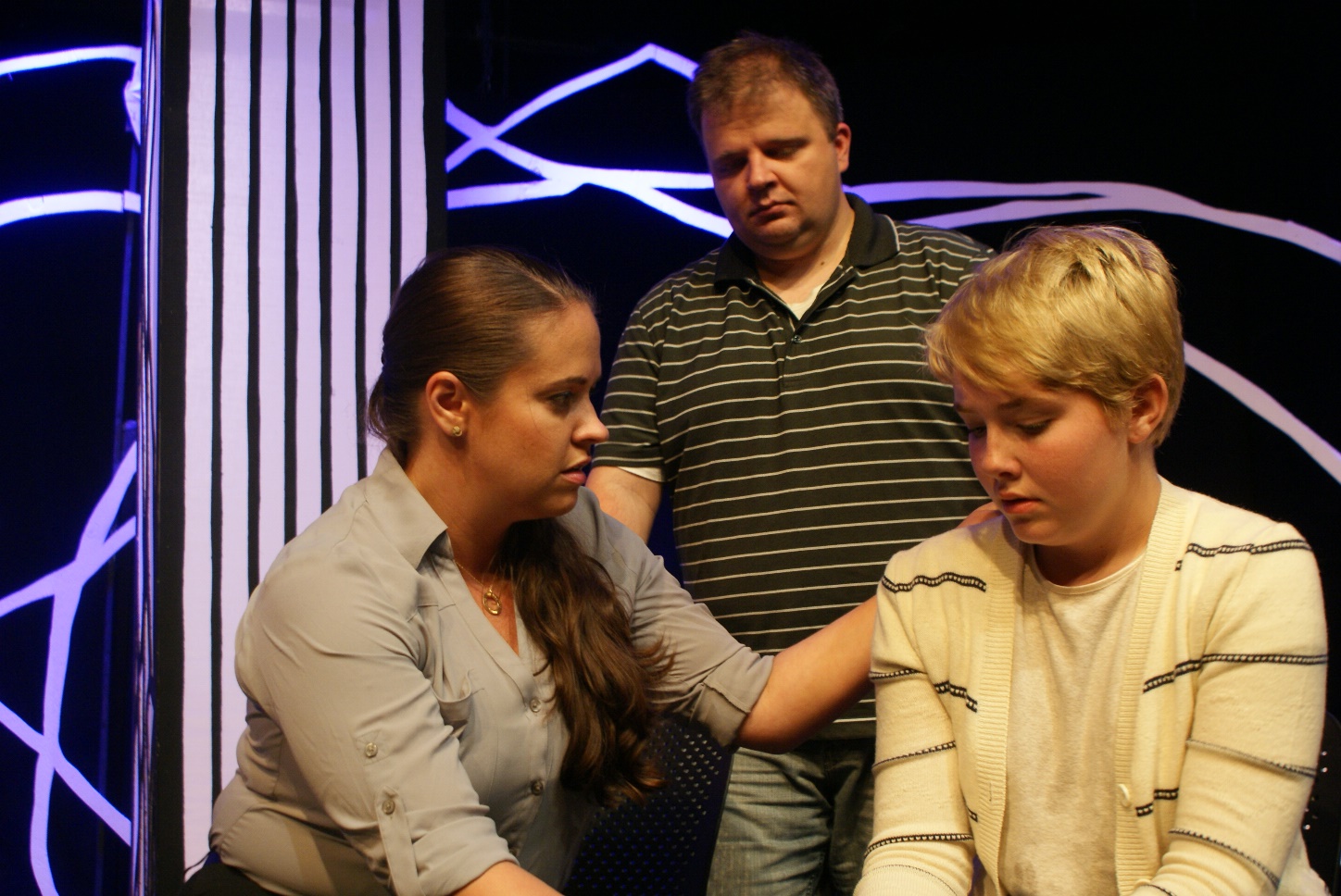
After suffering through a particularly slow day, owner Mushnik (an extravagantly accented Kyle Hansen) threatens to fire both Seymour and fellow employee Audrey (a glamorously attired but flighty Madison Tinder). But then Seymour reveals that he’s discovered a strange plant—some kind of flytrap, he thinks—and has named it “Audrey II” in honor of the woman for whom he secretly lusts. Once word of the exotic plant gets out, the customers start flocking in.

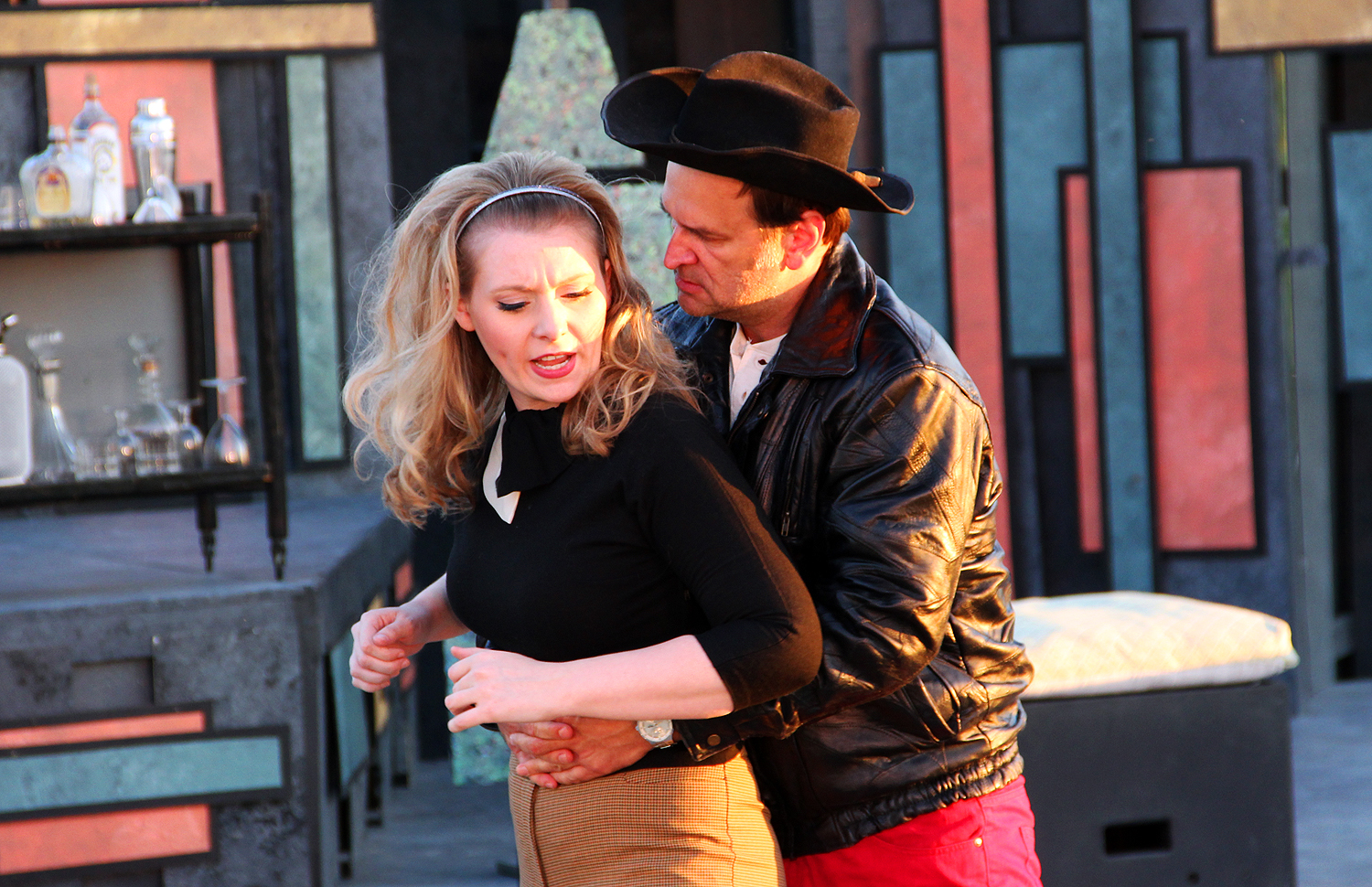
Just a slight problem: Seymour learns that Audrey II thrives on one thing and one thing only: human blood. Is he willing to become a murderer in order to keep his new meal ticket alive? Pounds imbues Seymour with just enough humanity to clarify the struggle between his basic decency and his desire for success, which he hopes will finally impress the beautiful Audrey. Audrey, meanwhile, suffers from such low self-esteem that she seems incapable of escaping the abusive clutches of her sadistic boyfriend, Orin (Harry Sanderson).

Obviously, Little Shop of Horrors deals with dark subjects, but the overall atmosphere is as goofy and gleefully malevolent as Audrey II herself (a puppet voiced by John Henry Carter). Helping to set the mood is a slyly sexy trio of “Urchins” (Monica Brown, Haley Jones and Marina Pires) who serve as a sort of Greek chorus.

But what really keeps things lively is the score, a collection of songs by Alan Menken (music) and Ashman (lyrics) that capture the flavor of early rock, blues and folk. Hummable favorites include the Prologue (sung by the Urchins) and Suddenly, Seymour (sung by Seymour and Audrey). Both the solos and the harmonized numbers are nicely handled by the cast and the offstage band led by Dennis Davenport.

Rob Johnson’s clever and realistic set, Andy Baker’s mock-scary lighting and Julia Ferreri’s playful costumes add to the entertainment value of this drolly bloodthirsty musical comedy.

Otterbein Summer Theatre will present Little Shop of Horrors through July 27 at Cowen Hall, 30 S. Grove St., Westerville. Performances are at 8 p.m. Friday-Saturday and 2 p.m. Sunday (July 14 only), plus 8 p.m. July 18 and 2 p.m. July 19. Running time: 1 hour, 55 minutes (including intermission). Tickets are $25. 614-823-1109 or www.otterbein.edu/drama.

All Shakespearean updates are not created equal

Susan Wismar (Maria), Andy Falter (Sir Toby), Jesse Massaro (Malvolio) and Adam Poe (Sir Andrew) in a scene from Twelfth Night (photo by Dale Bush)
Appearing in a scene from Twelfth Night are (from left) Susan Wismar (Maria), Andy Falter (Sir Toby), Jesse Massaro (Malvolio) and Adam Poe (Sir Andrew) (photo by Dale Bush)

By Richard Ades

There’s more than one way to update Shakespeare.

One approach, perfected by Josh Whedon’s modern-dress film version of Much Ado About Nothing, is to ignore the time period and concentrate on the story. The effect is to emphasize the timelessness of the characters and their predicaments, even if their language is a particularly flowery form of Elizabethan English.

Another approach is to use the time period and setting to add another layer of meaning to the play—for instance, by relocating Macbeth to a politically unstable part of the world.

Yet a third approach is to use the time period as a way to make the play more accessible to the average theatergoer. That’s the tack Actors’ Theatre has taken with its 1980s version of Twelfth Night.

To tell the truth, I tend to see this approach as a form of surrender. It’s like the thespians have decided it’s too hard to persuade viewers to appreciate Shakespeare for his own sake, so they add a veneer of recognizable references. It’s particularly puzzling when they apply this method to Twelfth Night, which may be the most likable of all the Bard’s comedies.

That said, it must be stated that much works just fine in the production director Mandy Fox has put together on the nifty pastel-colored set Trent Bean has designed for the Schiller Park stage.

Most importantly, Kayla Jackmon is appealing as Viola, the young woman who washes ashore in an unfamiliar land following a shipwreck. We automatically root for her as she responds to her dire situation by disguising herself as a male eunuch and going to work for the love-struck Duke Orsino (Andrew Blasenak).

Also working just fine are the comical figures we meet at the house of the noblewoman Orsino is love-struck for, Olivia (Ashley Frisch). Andy Falter is a Miami Vice-attired hoot as her drunken uncle, Toby Belch, while Adam Poe puts his short stature to humorous use as Olivia’s would-be suitor, Sir Anthony Aguecheek. In addition, Liz Light sings nicely as Olivia’s fool, Feste, and Susan Wismar earns laughs with a Valley Girl interpretation of Olivia’s conniving servant, Maria.

From a comedy standpoint, all this sounds pretty good. But the problem is that director Fox seems to have decided that everything in this updated Twelfth Night has to be played for laughs. Not only does this approach rob the tale of some charming moments, but it forces the actors to find humor in characters that aren’t meant to be funny.

In the first scene, while Viola worries that she lost twin brother Sebastian (Cornelius Hubbard Jr.) in the shipwreck, Ben Sostrom depicts the sea captain who rescued her as a fey stereotype. Needless to say, this undercuts the sadness of the moment.

Viola (Kayla Jackmon, left) unwittingly wins the love of Olivia (Ashley Frisch) while masquerading as a man in Twelfth Night (photo by Dale Bush)

Later, we’re introduced to Orsino and his ongoing attempt to woo Olivia despite her pledge to spend the next seven years mourning her late brother. In most productions, Orsino is depicted as a soulful romantic, making him a fitting target for the adoration the disguised Viola comes to feel for him. Here, though, Orsino comes across as a love-struck buffoon, making Viola’s crush seem shallow and inconsequential.

The worst part of all this is that, having played the comedy’s gentler moments for laughs, the actors are forced to up the ante by playing the more-boisterous moments for even bigger laughs. As the show goes on, some cast members over-emote in a style that seems more appropriate for the vaudeville era than the 1980s.

When Olivia falls for the young “man” Viola is impersonating, Frisch turns her into a caricature of a woman in heat. When Olivia’s dictatorial steward, Malvolio (Jesse Massaro), is fooled into thinking he’s the object of his lady’s desires, he shouts his protestations of love so loudly that you’d think he was courting someone in the next county. Then, just in case the odd audience member is still unaware that something funny is supposed to be going on, Toby and his friends take the stage decked out in Ghost Busters paraphernalia.

All this overwhelms the alternately clever and tenderly romantic tale that is Twelfth Night, which could have absorbed the 1980s pop references but can’t survive all the bombast.

“Prithee read i’ thy right wits,” Olivia pleads at one point as Feste is reading a letter out loud and making a mockery of it in the process. You can’t help wishing the director and her cast had taken her words to heart.

Actors’ Theatre will present Twelfth Night through July 28 at the amphitheater in Schiller Park, 1069 Jaeger St. Show times are 8 p.m. Thursday-Sunday. Running time: 2 hours, 10 minutes (including intermission). Admission is free; bring a blanket or lawn chair. 614-444-6888 or theactorstheatre.org.

The souse who would be king

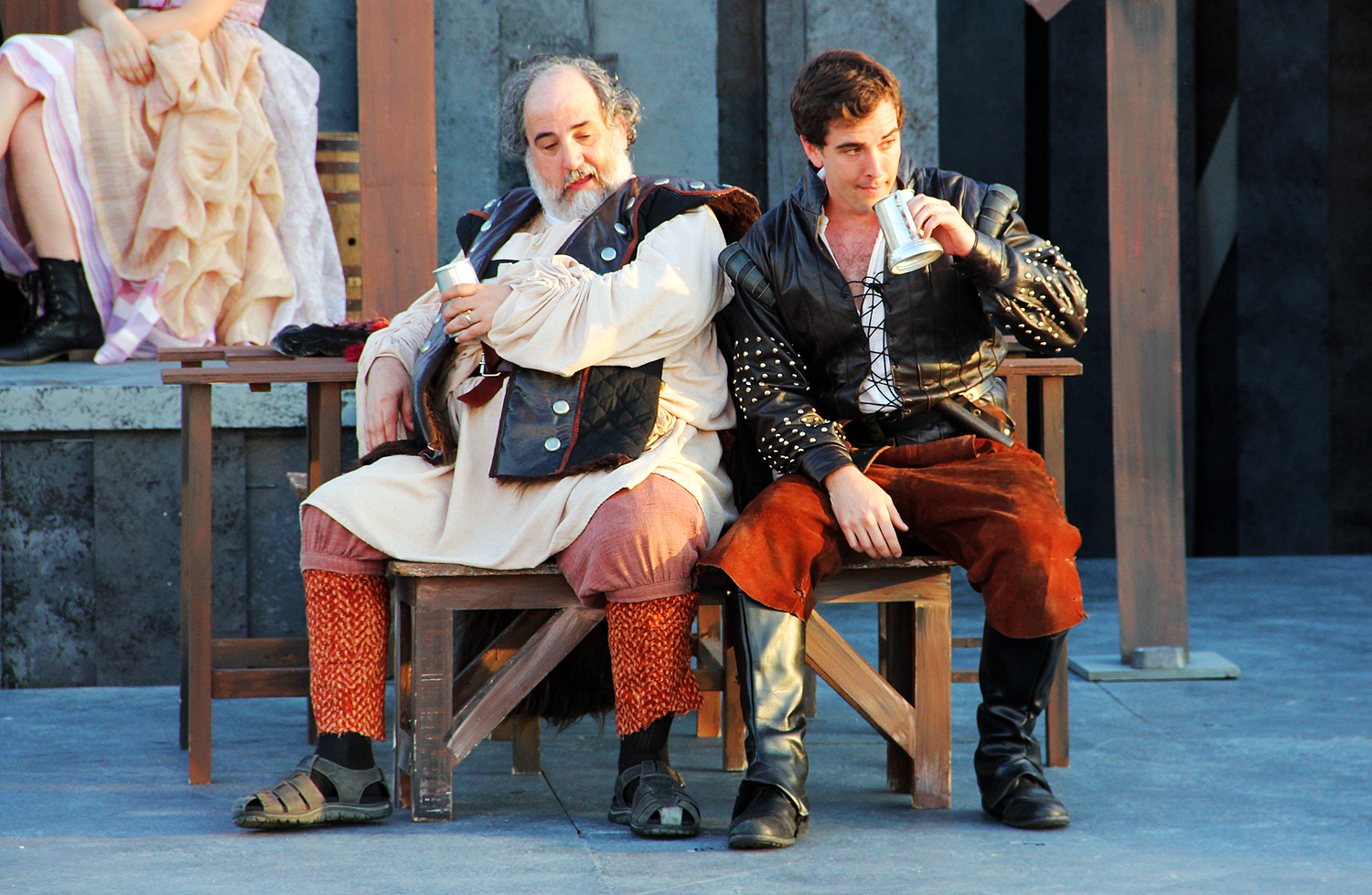
John Tener (left) as Falstaff and David Tull as Prince Hal in Henry IV, Part One (photo by Matt Hermes)

By Richard Ades

Central Ohio Shakespeare fans currently have an embarrassment of riches. Besides Josh Whedon’s wonderful film adaptation of Much Ado About Nothing, they have three outdoor theater productions to choose from.

If you’re serious about the Bard, your best bet may be the work you’re probably the least familiar with: Henry IV, Part One. Yes, it’s a history play, but you don’t have to know your Tudors from your Plantagenets to enjoy it. That’s because the central character is a timeless archetype: a son who’s torn between his father’s expectations and his own fun-loving inclinations.

The son is Prince Hal, who likes nothing better than to spend his days drinking and getting into mischief with his tavern buddies, especially the disreputable but somehow lovable Sir John Falstaff. Hal’s lifestyle is extremely troubling to his father, King Henry IV, especially after sundry noblemen begin plotting against the crown.

Will Hal step up to his princely duties in time to help his father survive the threat to his reign? You could cheat by looking it all up on Wikipedia, but it’s more fun to watch the tale unfold on the New Players stage.

Directed by the Bard-literate Robert Behrens, the production benefits from a trio of great performances.

John Tener is a delight as Falstaff, an oversized and comical character who proved so popular that Shakespeare brought him back in two subsequent adventures. As Hal, David Tull is a nice blend of youthful indiscretion and innate decency.

In the scenes revolving around the developing revolt, Rick Clark’s Henry has a rather uncommanding presence, but Chris Austin gives a charismatic and powerful performance as the hot-tempered rebel known as Hotspur. Also making a strong impression, though he ventures right to the edge of a Scottish stereotype in the process, is Scott Willis as the Earl of Douglas.

The talk of rebellion eventually explodes into actual combat, and Behrens makes the most of it with well-staged action scenes involving swords, quarterstaffs and fisticuffs.

It’s noteworthy that, of the three local Shakespeare productions, Henry IV is the only one that isn’t updated. However, that doesn’t mean costume designer Natalie Cagle is a stickler for historical correctness. The men look vaguely 15th-century, but some of the women flit about in short skirts or dresses. One gets the impression that Cagle had to pull out all the creative stops in order to clothe the cast on a limited budget.

Scenic designer Peter Pauze also had to make do with more creativity than cash, it appears. Sometimes the scene changes involve such minor alterations that they hardly seem worth the effort. Still, the choreographed changes are performed with so much spirit that they’re fun to watch.

Anyway, the costumes and scenery are almost beside the point. What makes the production fun is the joy and devotion that Tener, Tull and the rest of the cast bring to this seldom-seen gem from the Shakespeare canon.

Note: New Players Theater is presenting Henry IV, Party One in repertory with The Taming of the Shrew (see previous review). The third local Shakespeare production is Actors’ Theatre’s production of Twelfth Night (review to come).

New Players Theatre will present Henry IV, Part One through July 28 at the Mill Run Amphitheater (behind Church at Mill Run), 3500 Mill Run Drive, Hilliard. Show times are 8 p.m. July 5, 13-14, 18 and 25-28. Running time: 2 hours, 40 minutes (including intermission). Offered on alternate evenings is The Taming of the Shrew, which will be presented at 8 p.m. June 30, July 6-7, 11-12 and 19-21. Tickets: Pay what you will (bring a blanket or lawn chair); “premium reserved seats” also available with reservations. 614-874-6783 or newplayers.org.

Daring to spoof Broadway

By Richard Ades

Appearing in Forbidden Broadway’s Greatest Hits, Vol. 1 are (from left) Dionysia Williams, Joe Bishara (front), Christopher Storer and Dionysia Williams (Red Generation Photography)
Appearing in Forbidden Broadway’s Greatest Hits, Vol. 1 are (from left) Dionysia Williams, Joe Bishara (front), Christopher Storer and Liz Wheeler (Red Generation Photography)

Lighthearted summer musicals have become a staple with CATCO, and the troupe’s patrons seem to approve. They’ve bought so many tickets that both Evil Dead: The Musical (2011) and Avenue Q (2012) were extended and/or revived.

This year’s offering, Forbidden Broadway’s Greatest Hits, Vol. 1, appears to be continuing that tradition. The satirical revue opened just last week, and it’s already been extended by four performances.

It couldn’t have happened to a nicer cast—or one that’s harder-working. Joe Bishara (who also directs), Christopher Storer, Liz Wheeler and Dionysia Williams reveal impressive singing and improvisational skills as they storm their way through an evening filled with take-no-prisoners lyrics and blink-of-an-eye costume changes. Their purpose: to spoof a slew of well-known Broadway shows and stars.

Created and written by Gerard Alessandrini, Forbidden Broadway has been updated numerous times since it opened off-Broadway in 1982. The latest New York version included takeoffs on current Broadway blockbuster The Book of Mormon and on Hugh Jackman, star of last year’s cinematic production of Les Miserables.

Not surprisingly, the Greatest Hits show is less up to date. Some of its satirical targets, in fact, are more than a bit dusty.

Williams does a nifty impersonation of Liza Minnelli in Liza One Note, for example, but when was the last time the star of the silver screen’s Cabaret has grabbed the spotlight? And the show’s version of America, featuring Wheeler as Chita Rivera and Williams as Rita Moreno, really tests the audience’s long-term memory—since it jokes about a presumed rivalry between the performers who played Anita in the Broadway and Hollywood versions, respectively, of West Side Story.

Some of the targeted shows are equally ancient. Cats? Yes, it ran longer than any other Broadway show except The Phantom of the Opera, but the New York production used up the last of its nine lives 13 years ago.

Still, even when the subject matter seems past its prime, the cast members are always admirable. And when their talent combines with one of Alessandrini’s particularly clever conceits, the results are sublime.

Yes, Ethel Merman is long gone, but Wheeler brings her back in all of her full-throated glory in a piece that takes aim at modern singers’ tendency to let the amplification do the heavy lifting. Among the male impersonations, the funniest is Bishara’s take on “male chanteuse” Mandy Patinkin in an Over the Rainbow spoof that’s understatedly named Somewhat Overindulgent.

Of course, satire wouldn’t be satire if it didn’t rub some people the wrong way.

If you worship at the altar of Stephen Sondheim, you may be put off by a segment that rips into the composer/lyricist’s tendency to pack a whole lot of words and ideas into small amounts of time and melody. Even the audience gets into the act on this one, courtesy of a sing-along that eventually accelerates to breakneck speed.

And what will fans of Les Miz think of Forbidden Broadway’s eight-song attack on the mega-musical? Well, they’ll probably be won over multiple times. The best part comes when Jackman’s version of Jean Valjean (Storer) sings the words that probably have been on the mind of every man who’s ever attempted the plaintive Bring Him Home: “It’s too high.”

Adding to the show’s fun is the fact that it’s performed in an intimate cabaret setting on a tiny stage the performers share with music director and accomplished pianist Matt Clemens. The glitzy set, lighting and costumes—designed by Michael S. Brewer, Curtis “Nitz” Brown and Marcia Hain, respectively—are further pluses.

Satire is said to be something that closes on Saturday night, but CATCO’s latest summer musical is proving to be an exception to the rule.

CATCO will present Forbidden Broadway’s Greatest Hits, Vol. 1 through July 14 in Studio Three, Riffe Center, 77 S. High St. Show times are 8 p.m. Thursday-Saturday (no show July 4) and 2 p.m. Sunday. Running time: 1 hour, 30 minutes (including intermission). Tickets are $35. 614-469-0939 or catco.org.

Making patriarchy palatable

Amanda Cawthorne as Kate and Tim Browning as Petruchio in The Taming of the Shrew (photo by Matt Hermes)

By Richard Ades

There are two Shakespeare plays that are hard sells because they’re based on outmoded mores. Of these, the more difficult is The Merchant of Venice, not so much because it has a Jewish villain but because its punishment for his villainy is to force him to convert to Christianity.

If Shakespeare were alive today, I’d sure he’d long since have had an Exodus International-style change of heart and issued an apology.

The other tough sell is The Taming of the Shrew, but after seeing the play twice in the past year, I suspect it may be due for a partial reprieve. The comedy is as patriarchal and sexist as ever, but if it’s done with heart and sensitivity, viewers might be able to overlook its dated viewpoint.

Admittedly, I first came to this conclusion after seeing it performed at London’s Globe Theatre, where I joined the other “groundlings” standing at the foot of the stage. Not only was the production a witty delight, garnering the biggest laughs of any Shakespearean outing I’d ever seen, but the theater’s 16th-century design might have made it easier to dip one’s mental toes into the mindset of the Bard’s era.

Still, you don’t have to go to the Globe to appreciate Shrew. If it’s been reprieved, the probable reason is simply that women’s place in the world has changed.

When a character declares that wives owe their husbands obedience because the men are the ones who go out and earn a living, we know she’s talking about a time that’s safely in the past. For most of us living in 21st-century America, the play’s sexism is too anachronistic to be threatening.

As I said, the comedy still must be performed with heart and sensitivity in order to work. New Players Theater’s current production, directed by Jocelyn Wiebe, is not perfect. But it does get the all-important relationship between Katherina (the “shrew”) and Petruchio (her would-be “tamer”) exactly right.

The situation: Baptista (Scott Willis), a rich resident of Padua, Italy, has two daughters of marriageable age. The gentle Bianca (Erin Mellon) has several suitors, but Baptista insists that her older sister, Kate (Amanda Cawthorne), must be married first. Trouble is, Kate’s mercurial temper scares off all prospective husbands.

Enter Petruchio (Tim Browning), who’s in search of a rich wife and insists that he can mold Kate into a devoted spouse. With help from his long-suffering servant, Grumio (Todd Covert), he sets out to do just that by adopting a plan of action that convinces her and everyone else that he’s outlandishly eccentric and possibly insane.

What makes all this palatable is that Browning portrays Petruchio as manipulative but never disrespectful toward Kate, while Cawthorne portrays Kate as ill-tempered but never undignified. Besides, we can’t help suspecting that these two fiery spirits are well-suited to each other.

A subplot involving Bianca’s suitors is marked by the typical Shakespearean disguises. Both Lucentio (Austin Andres) and Hortensio (Matthew Moore) pretend to be tutors in order to gain alone time with her (a goal that will resonate with fans of The Bachelorette), while Lucentio’s servant Tranio (Clifton Holznagel) masquerades as his master. The ruses are good for a few laughs, but the funniest suitor of all, thanks to Miles Drake’s crusty portrayal, is the doddering Gremio.

Mellon’s Bianca seems a tad too shallow to justify all the attention she receives, but the acting in the subplot is mostly on-target. Unfortunately, this part of the play is weakened by hackneyed bits of slapstick accompanied by overbearing sound effects (“Boing!”) and musical flourishes (“Whah, whah, whah, whah”). To be sure, slapstick has a place in Shakespeare, but it should serve the plot rather than acting as an over-the-top distraction.

Director Wiebe seems to set the tale somewhere in the mid-20th century, judging from the recorded musical accompaniment and Natalie Cagle’s costume designs. Again, the music is sometimes overbearing, but the costumes are distinctive and attractive. Alas, none is as daring as the ass-less outfit Petruchio wore to his wedding at the Globe, but that approach probably would have gotten the troupe thrown out of Hilliard.

And that would have been a shame. Despite its outdated attitudes, The Taming of the Shrew remains a clever and entertaining take on the war between the sexes.

New Players Theater will present The Taming of the Shrew through July 21 at the Mill Run Amphitheater (behind the Church at Mill Run), 3500 Mill Run Drive, Hilliard. Show times are 8 p.m. June 20-23 and 30, and July 6-7, 11-12 and 19-21. (Henry IV, Part One will be presented at 8 p.m. June 27-29, July 5, 13-14, 18 and 25-28.) Running time: 2 hours, 30 minutes (including intermission). Tickets: Pay what you will. “Premium reserved seats” are available with paid reservations; otherwise, bring a blanket or lawn chair. 614-874-6783 or newplayers.org.

Obscure production has impeccable timing

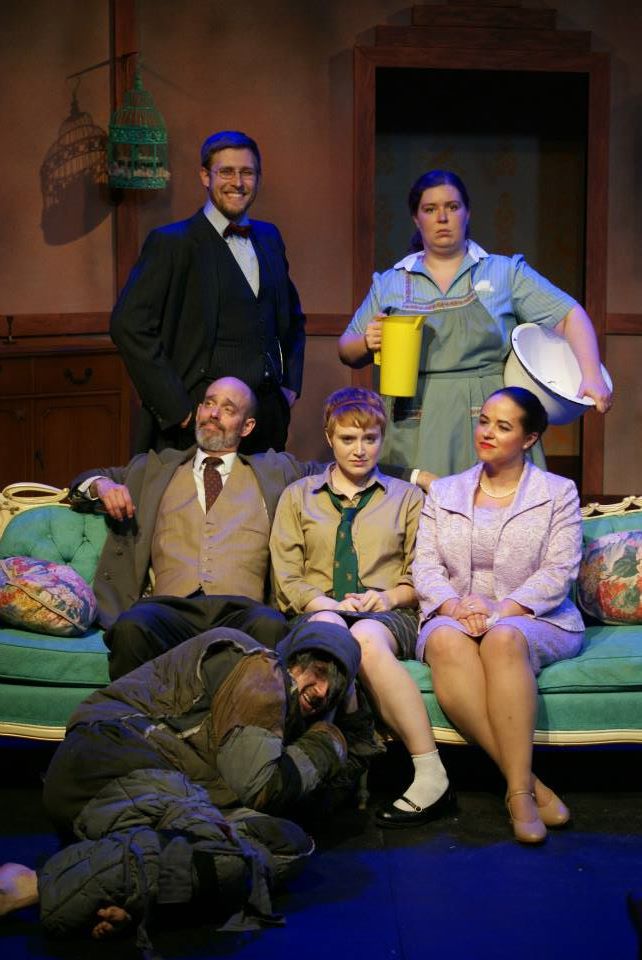
Appearing in The Empire Builders are (from left): standing—Travis Horseman (Neighbor), Audrey Rush (Mug, the maid); seated—Jim Azelvandre (Father), Mary Beth Griffith (Zenobia), Mary-Aileen St. Cyr (Mother); on floor—Stefan Langer (the Schurz) (photo courtesy of MadLab/Shepherd Productions)
Appearing in The Empire Builders are (from left): standing—Travis Horseman (Neighbor), Audrey Rush (Mug, the maid); seated—Jim Azelvandre (Father), Mary Beth Griffith (Zenobia), Mary-Aileen St. Cyr (Mother); on floor—Stefan Langer (the Schmurz) (photo by Michelle Batt)

By Richard Ades

MadLab and Shepherd Productions’ staging of The Empire Builders serendipitously arrives on the heels of an event that raised similar issues: Namely, how much should one be willing to give up in the name of safety, and how does one distinguish between justifiable concern and rampant paranoia?

Well, actually, there were two such events, if you count the revelations of government spying on private phone and Internet usage. But I was speaking mainly of something more local: The Night of the Derecho.

On Wednesday (June 12), Central Ohio TV stations devoted the entire evening to endless reports of tornado warnings, tornado watches and, most frighteningly, of a straight-line storm approaching from the west. We learned that weather patterns over northern Indiana were conspiring to create a threat even more dangerous than the folks E. Gordon Gee referred to as “those damn Catholics” at Notre Dame.

Perhaps sensing that viewers were having trouble worrying about all this while the skies over Columbus remained calm and clear, weathercasters trotted out maps showing developing tornados up north and that treacherous storm system out west. And lightning! Lots and lots of lightning!

And the worst was yet to come, they warned, as the derecho was due to hit Columbus sometime after 1 a.m. The folks at Channel 6 went so far as to advise us to take refuge in our basements in case the fierce winds sent trees crashing into our homes.

I remained skeptical, but I couldn’t dismiss the warnings entirely, especially since a mature ash tree stood right outside my bedroom window. Though I didn’t hide in the basement, neither did I escape into dreamland. Instead, I lay awake and watchful until the storm arrived, right on time, left a few drops of rain and departed. The total damage: an overturned mat on the back porch. Except in parts of Hilliard and Canal Winchester, it seemed, the derecho was a nonevent.

It’s in the aftermath of this harrowing experience—and of the NSA/Verizon revelations—that The Empire Builders arrived at MadLab last week. It was pretty neat timing, considering that French playwright Boris Vian’s 1957 work is about a family that goes to great lengths to protect itself from a vague threat.

Each time they hear a mysterious and ominous noise, Father (Jim Azelvandre) and Mother (Mary-Aileen St. Cyr) drag their daughter (Mary Beth Griffith) and maid (Audrey Rush) upstairs one flight. And each time they move, they end up in a smaller apartment than the one they had before, though only daughter Zenobia seems to realize this. She points out, in vain, that they started out with six rooms and now have only two.

She also points out that it wasn’t until they’d moved the first time that their living space was shared by a silent beast known as the Schmurz (Stefan Langer). But again, the parents are oblivious. They refuse to even acknowledge the creature’s existence, though they periodically pause to attack it with their hands, feet, belt or whatever else is handy.

This is obviously an extremely odd work, and it only gets odder as it goes along—odder and harder to interpret. But many viewers will see that as a challenge.

Inspired by recent events, they may compare the Schmurz to the NSA, or maybe to the terrorist threats that spur it on. They may compare the family’s increasingly smaller apartments to our loss of privacy, or perhaps to our loss of regular TV programming on Wednesday night.

And what does the mysterious noise represent? Edward Snowden? Chris Bradley?

The play’s obscure theme is actually less of a problem than the fact that it’s about as repetitious as Wednesday’s weather reports. For example, it’s fun to watch Father and Mother beat the tar out of the Schmurz two or three times, but by the sixth or seventh time, the slapstick routine has grown stale.

It definitely helps that director Andy Batt has gathered a good cast, which includes Travis Horseman as the Neighbor and the estimable Azelvandre as the Father, who becomes the prime protagonist. But there’s only so much the actors can do to maintain interest in characters who don’t develop or behave in a rational manner.

Griffith has an advantage over the others, playing someone who actually appears to have a working brain, and she makes the most of it with an appealing performance. Weirdly, though, the only character who evolves in the course of the play is the Schmurz, who grows increasingly menacing. Langer does a commendable job of giving the specter a personality without saying a word.

Behind the scenes, Anthony Pellecchia’s lighting, Dave Wallingford’s sound design and Deb Dyer’s bizarre set combine to give the show an eerie personality.

The Empire Builders is a gutsy choice for Shepherd’s third annual production, being relatively unknown compared to Shakespeare’s Titus Andronicus (2011) or Samuel Beckett’s Waiting for Godot (2012). Having recently carped about another local troupe’s unadventurous programming, I can’t fault Shepherd for taking a risk.

But it’s also good to remember that when a vintage play has sunk into obscurity, there’s often a reason.

MadLab and Shepherd Productions will present The Empire Builders through June 22 at MadLab Theatre and Gallery, 227 N. Third St. Show times are 8 p.m. Thursday-Saturday. Running time: 2 hours (including intermission). Tickets are $15, $12 for students and seniors, $10 for members. 614-221-5418 or madlab.net.

Duck-centered talk is both funny and philosophical

Poster for the debut production of Geoff Nelson's new troupe, A Portable Theatre
Poster for The Duck Variations, starring Jonathan Putnam (seated) and Geoffrey Nelson (photo courtesy of A Portable Theatre)

By Richard Ades

After watching a local 2012 production of November, David Mamet’s clunky attempt at political satire, it was hard to get enthused over the prospect of seeing another Mamet comedy.

On the other hand, it was easy to get enthused over the prospect of seeing the debut of Geoffrey Nelson’s new touring troupe, A Portable Theatre. Especially since the production starred both Nelson and longtime cohort Jonathan Putnam.

The two CATCO alums have been doing theater together for more than 30 years, as Nelson noted on opening night, and it shows in the easy way they play off each other. Working under Nelson’s direction, they mine every bit of humor from Mamet’s two-person one-act, The Duck Variations.

The surprising bonus, for those who suffered through November, is that the one-act has quite of bit of humor to mine. Written in 1972, when Mamet was just closing in on the quarter-century mark, it’s basically a wide-ranging conversation between two strangers who meet in a park.

Politics, economics, friendship, pollution—these and more topics come up. But the conversation starts with and often returns to ducks, with which each of the men seems to identify in various ways. Being at an age when they’re aware of their own mortality, they particularly sympathize with the males who attain leadership roles only to be replaced by younger males when they’re felled by death.

It’s all a bit profound, and just a little sad. Mostly, though, it’s funny, thanks to the personality clashes that arise.

Emil (Nelson) is frankly lonely and is happy to find someone to talk to, but he can’t help being annoyed by his companion’s tendency to bloviate on subjects he obviously knows little about. George (Putnam), for his part, becomes both annoyed and defensive when his misstatements are questioned.

At one point, George goes so far as to insist that birds are the only animals capable of flight. Only later, after Emil drops the subject, is he willing to admit that insects also have been known to take wing.

In a talkback session after the opening-night performance, Nelson explained that the characters are meant to be in their 60s. That probably seemed ancient to the then-20-something playwright, who imbued them with several familiar characteristics of old age.

Being in his 60s himself, Nelson said, he actually thinks of the men as being in their 80s. However, neither actor makes an obvious effort to age his character. This subtle approach allows Emil and George to come across, not as stereotypical oldsters, but as individuals who are touchingly vulnerable and recognizably—and hilariously—human.

A Portable Theatre will present The Duck Variations through June 23. Show times are 8 p.m. Saturday and 2 p.m. Sunday at the BalletMet Performance Space, 322 Mount Vernon Ave.; and 8 p.m. Wednesday and 11 a.m. Thursday at Abbey Theater of Dublin, 5600 Post Road. Running time: 50 minutes. Tickets are $20, $10 students ($15/$10 students at Thursday matinee). Aportabletheatre.com.

Singing the post-operative blues

Hedwig (JJ Parkey, left) and Yitzhak (Ruthie Stephens) trade notes in Hedwig and the Angry Inch (photo by Heather Wack)

By Richard Ades

I was a little concerned when I learned JJ Parkey was going to play the title role in Short North Stage’s production of Hedwig and the Angry Inch.

When Parkey played the Emcee in Cabaret at the same venue last year, he depicted the entertainer as pure evil. Since no one is pure anything, that approach made the iconic character less interesting than he might have been.

Still, Parkey seemed talented, and I consoled myself with the thought that actors don’t always have final say over their performances. Sometimes directors dictate a certain approach in order to support their vision of the work. I have personal experience with this because, way back in my college/community-theater days, a director forced me to play a soft-spoken and intuitive character as a loudmouthed jerk in order to support his misguided interpretation of the play.

Maybe that’s what was going on with Cabaret, I thought. Or maybe not. It’s a moot point, really, because Parkey plays the transgendered Hedwig with all the verve and sensitivity that the role demands. It’s a bravura performance.

In case you’re one of the few people who are encountering John Cameron Mitchell’s cult musical for the first time (Short North’s production is my fourth, counting the 2001 movie), it’s about an East German lad who undergoes gender-reassignment surgery in order to marry his way to American citizenship. Unfortunately, the surgery is botched, leaving the former Hansel with a vestige—an “angry inch,” as it were—of his former genitalia where a brand-new vagina was supposed to be.

We actually meet Hedwig, as she’s now known, when she takes the stage along with her rock band, the Angry Inch. In the course of the concert, we hear her sad story, including her unhappy affair with a now-popular musician who’s simultaneously performing up the street. We also meet Yitzhak (a cross-dressing Ruthie Stephens), a sullen band member who clearly has his own rocky history with Hedwig.

Written with both wit and attitude by Mitchell, the melodrama unfolds in the midst of enjoyable ballads and punk-rock tunes by Stephen Trask. Parkey and the golden-throated Stephens do them all justice, as does the onstage band led by P. Tim Valentine.

Director/choreographer Edward Carignan wraps it all up in a production that knows when to let loose and when to stop and smell the rancor. Carignan likewise designed the wigs and gaudy costumes that help to define the title character, as do the clever video images that appear at opportune moments on two backdrop screens.

Technical director Robert Kuhn and lighting designer Amanda Ackers also deserve mention for their contributions to a show that, along with the recent Passing Strange, bolsters Short North Stage’s reputation as a purveyor of first-rate musical entertainment.

Short North Stage will present Hedwig and the Angry Inch through June 22 at the Garden Theater, 1187 N. High St. Show times are 9 p.m. Thursday-Saturday. Running time: 2 hours (including intermission). Tickets are $20. 614-725-4042 or shortnorthstage.org.

Romance is the Maine event

Appearing in Almost, Maine are (from left) Sean Murphy, Harry Sanderson, Emily Vanni and Marina Pires (photo by Ed Syguda)

By Richard Ades

The Pine Tree State must be a magical place, judging from Almost, Maine.

Whether or not that’s a good thing is a matter of taste.

John Cariani’s collection of vignettes is all about relationships—relationships beginning, relationships ending, relationships in flux. Most writers would be content to tackle the subject by throwing a couple of people together and letting human nature take its course, but Cariani prefers to add an element of unreality. His thesis seems to be that the ordinary rules of existence are skewed in the remote town where he sets his tales.

Take the first story, Her Heart. A woman (Emily Vanni) shows up unannounced on the lawn of a local man (Harry Sanderson), sets up a tent and prepares to wait for the Northern Lights to appear. Why? The woman has an explanation that’s both sad and ingenious, but it’s overshadowed by her odd announcement that she’s carrying her heart in a bag. It seems that the organ was broken—literally broken, into so many pieces—by her husband and had to be replaced.

As if this weren’t enough of a jarring distraction, Cariani also gives the man a name that is more or less the opposite of the husband’s. Coincidence, or is this his way of telling us that these two people have been brought together for a reason?

Don’t bother guessing—it’s the latter. You figure this out after subsequent vignettes arrive with their own meaningfully named characters.

I suppose you could label Cariani’s approach “magic realism,” but it strikes me as an unnecessarily heavy-handed example of the genre. Luckily, the acting is not heavy-handed but is subtle and appealing, allowing the tales’ innate charm to survive their author’s occasional excesses.

Working under Christina Kirk’s direction and in the midst of scenic designer Rob Johnson’s spare depiction of a wintry, nighttime landscape, the four actors create a multitude of relatable personalities.

If there’s a standout, it’s Vanni, whose characters range from the aforementioned trespasser to Rhonda, a grownup tomboy being courted by a longtime friend in Seeing the Thing. The other female cast member, Marina Pires, is solid in lower-key roles such as Marci, a woman struggling to reconnect with her husband in Where It Went.

Sanderson is at his best playing men who are a bit confused by their circumstances, such as Marci’s husband, Phil. Final cast member Sean Murphy shines the brightest as Steve, a boy-man who’s oddly impervious to pain in This Hurts.

Whether or not you share my crankiness over Cariani’s take on the subject of romance, you can’t help loving what Otterbein’s versatile cast does with it.

Note: Don’t be surprised if you arrive at Otterbein’s Cowan Hall and find the auditorium empty. The audience section has been set up on the massive stage, which is the new home of Otterbein Summer Theatre. Personally, I always liked the intimate Campus Center Theatre, but apparently it’s no longer available. That being the case, the Cowan stage is a workable alternative.

Otterbein Summer Theatre will present Almost, Maine at 8 p.m. Thursday through Saturday (June 6-8) at Cowan Hall, 30 S. Grove St., Westerville. Running time: 2 hours (including intermission). Tickets are $22. 614-823-1109 or Otterbein.edu/theatre.

Broadway sightings: singing Mormons and a memorabilia-hawking OSU grad

The Eugene O’Neill Theatre is the Broadway home of The Book of Mormon (photos by Richard Ades)
Actor and OSU grad Paul Moon sells Book of Mormon memorabilia while waiting for his own show, My Big Gay Italian Wedding, to return to the stage

By Richard Ades

Are you dying to see The Book of Mormon? If so, you’re probably wondering whether it’s worth catching the show in New York considering the fact that it’s due to arrive in Columbus about a year from now.

Seeing a show on Broadway is certainly more expensive, even without the added cost of getting there and back. But then, Broadway shows have definite advantages over touring shows.

First, the cast is tried and true. Touring casts can be great, but only if the director can find actors as perfectly suited to their roles as their Great White Way counterparts.

Second, even the largest Broadway theaters are far more intimate than the Ohio or the Palace, where big touring shows usually end up in Columbus. Generally speaking, that means there are no bad seats in the house.

Unless, that is, you get stuck behind a tall individual with an extremely large noggin. That’s what happened when I saw The Book of Mormon last weekend at New York’s Eugene O’Neill Theatre. Since even a $169 ticket doesn’t give you the right to ask a neighbor to remove his head, I had to stretch and twist my neck in an attempt to see this Tony-winning song-joke-and-dance fest. As a result, it took me a while to warm up to the show.

However, I soon joined the rest of the crowd in laughing at what Trey Parker, Robert Lopez and Matt Stone had wrought.

If you’ve seen the signature song I Believe performed on TV, you know the musical finds plenty of humor at the expense of what comedian Bill Maher has called the world’s silliest religion. At its heart, though, is the relationship between two young men who are assigned to be partners throughout their two years of compulsory missionary work.

Elder Kevin Price is highly thought of by his teachers—and even more highly thought of by himself. Elder Arnold Cunningham is his exact opposite, a friendless screw-up who readily admits his shortcomings.

“I lie a lot,” he tells Kevin at their first meeting.

But as chagrined as Kevin is by his assigned partner, he soon finds an even greater source of disappointment. Though he has visions of being sent to Disney-perfect Orlando, he and Arnold end up in a Ugandan village where the problems include poverty, ignorance, AIDS and a warlord who threatens to “circumcise” the women.

On Broadway, Matt Doyle struts and sings competently as the self-obsessed Kevin, but the real star is Jon Bass as the needy, truth-challenged Arnold. A delightfully child-like Nikki M. James eventually grabs a big share of the spotlight as Nabulungi, daughter of the village leader. Like Doyle, Bass and the rest of the cast, she sings beautifully, especially on the Act 1 solo Sal Tlay Ka Siti.

Given co-creators Parker and Stone’s connections to South Park, it’s not surprising that much of the humor is derived from extreme crassness—one villager repeatedly complains that he has maggots in his scrotum, and cussing is rampant. Indeed, the chief villain goes by the descriptive name General Butt-Fucking Naked. What’s surprising is how much sweetness and heart are mixed in with the gross-outs.

Parker co-directs the show with choreographer Casey Nicholaw, whose witty dance routines constitute a big part of its appeal. Scott Pask’s scenery and Brian MacDevitt’s lighting design combine to great effect in several delirious production numbers, including one set in a Mormon vision of hell.

If you need an excuse to go to New York, seeing The Book of Mormon is a pretty good one. Or you can head to Chicago, which also has a production.

Otherwise, just hold tight. The touring show will arrive at the Ohio Theatre next May.

The Book of Mormon is being presented at the Eugene O’Neill Theatre, 230 W. 49th St., New York City. Running time: 2 hours, 25 minutes (including intermission). For reservations, call 1-800-432-7250 or visit telecharge.com.

Postscript: Why did that guy selling Book of Mormon memorabilia at Sunday’s performance seem so familiar? Because he was Paul Moon, a Colorado native and Ohio State grad who appeared in Columbus shows such as Short North Stage’s production of The Irish Curse (my choice for the best local comedy of 2012). Now carving out a career in New York, Moon has a role in My Big Gay Italian Wedding, an off-Broadway musical comedy that’s temporarily on hiatus. If you want to see the Columbus ex-pat onstage, performances begin again June 22 at St. Luke’s Theatre, 308 W. 46th St. For ticket information, visit bigitalianwedding.com or telecharge.com.