How the GOP keeps its White voters faithful—and scared

Republican strategist Steve Bannon talks politics in the documentary White With Fear.

By Richard Ades

When Donald Trump talked about immigrants eating people’s pets during a 2024 presidential debate, he was carrying on a longtime Republican campaign tactic: Win the votes of White Americans by scaring the hell out of them.

According to Andrew Goldberg’s documentary White With Fear, this strategy can be traced back at least as far as the 1968 presidential campaign. Even though the controversial Vietnam War was still raging, we learn, the campaign of Republican Richard Nixon focused mainly on race.

Among the film’s many interviewees is author Rick Perlstein (Nixonland), who explains that the GOP worked to recapture the White House by tapping into many White Americans’ hatred of Blacks. This was done largely through innuendo and dog whistles.

When Nixon pledged to support “law and order” and fight crime, for example, it was understood that he was talking specifically about Black crime. The candidate’s subtext was hard to miss when he made statements such as referring to Black-majority Washington, D.C. as “the crime capital of the world.”

 The fearmongering tactic apparently worked, as Nixon captured the presidency. And it obviously continues to work, the documentary points out, as the GOP has won the majority of White votes in every presidential election ever since.

Not that the targets of GOP fearmongering have always remained the same.

When Al-Qaeda-backed terrorists attacked the World Trade Center on Sept. 11, 2001, brown-skinned Muslim extremists became the new source of fear. Republican Vice President Dick Cheney fed the paranoia with warnings about sneak attacks involving “chemical agents,” and the fledgling Fox News catapulted to prominence by offering its own nonstop appeals to prejudice and mistrust.

Later, the advent of Barack Obama as a national figure allowed the GOP to launch a two-pronged attack that combined White Americans’ fear of Blacks with their fear of Muslims. Obama actually wasn’t Muslim, but the persistent rumor that he was ran hand in hand with the Trump-fed suspicion that he wasn’t even born in this country.

Then 2020 arrived along with the worldwide COVID pandemic, allowing Republicans to target yet another race: Asians. Falling back on his love for nicknames, Trump led the attack by persistently referring to the scourge as the “Chinese virus” or “kung flu.”   

Hillary Clinton is one of many voices from both the left and the right who are interviewed in White With Fear.

Several years earlier, according to White With Fear, the Grand Old Party had actually considered changing its racially divisive ways. This happened after Obama was elected to a second term in 2012, and Republicans realized it might be a good idea to win over some of the non-White Americans who would one day become the majority.

Their solution: Work to pass immigration reform. But when that proved unpopular with their most conservative representatives, Republicans instead went back to their old ways by launching an attack on immigrants.

Strategists such Steve Bannon came up with the tactic, and then-candidate Trump adopted it with a vengeance. Thus was born his endless attack on immigrants as rapists, murderers and drug dealers; as stealers of American jobs; as replacements for American voters; and, most surreally, as eaters of American pets. It all culminated in the expensive and court-defying effort to expel immigrants that has become a cornerstone of Trump’s second term in office.

One of the most interesting aspects of Goldberg’s documentary is that it tackles its provocative topic with the help of experts from both the left and the right.

There are the expected liberal voices such as Hillary Clinton, who has several incisive things to say about her 2016 presidential opponent. But there are also conservative voices, including some former Trump supporters who have since repented, and others—including Bannon himself—who remain among the MAGA faithful.

This diversity of viewpoints gives us not only a critique of the GOP’s race-baiting approach to politics but a behind-the-scenes look at how it came to be.

Rating: 4 stars (out of 5)

White With Fear will be available through VOD outlets beginning June 3.
He photographed folks the mainstream media ignored

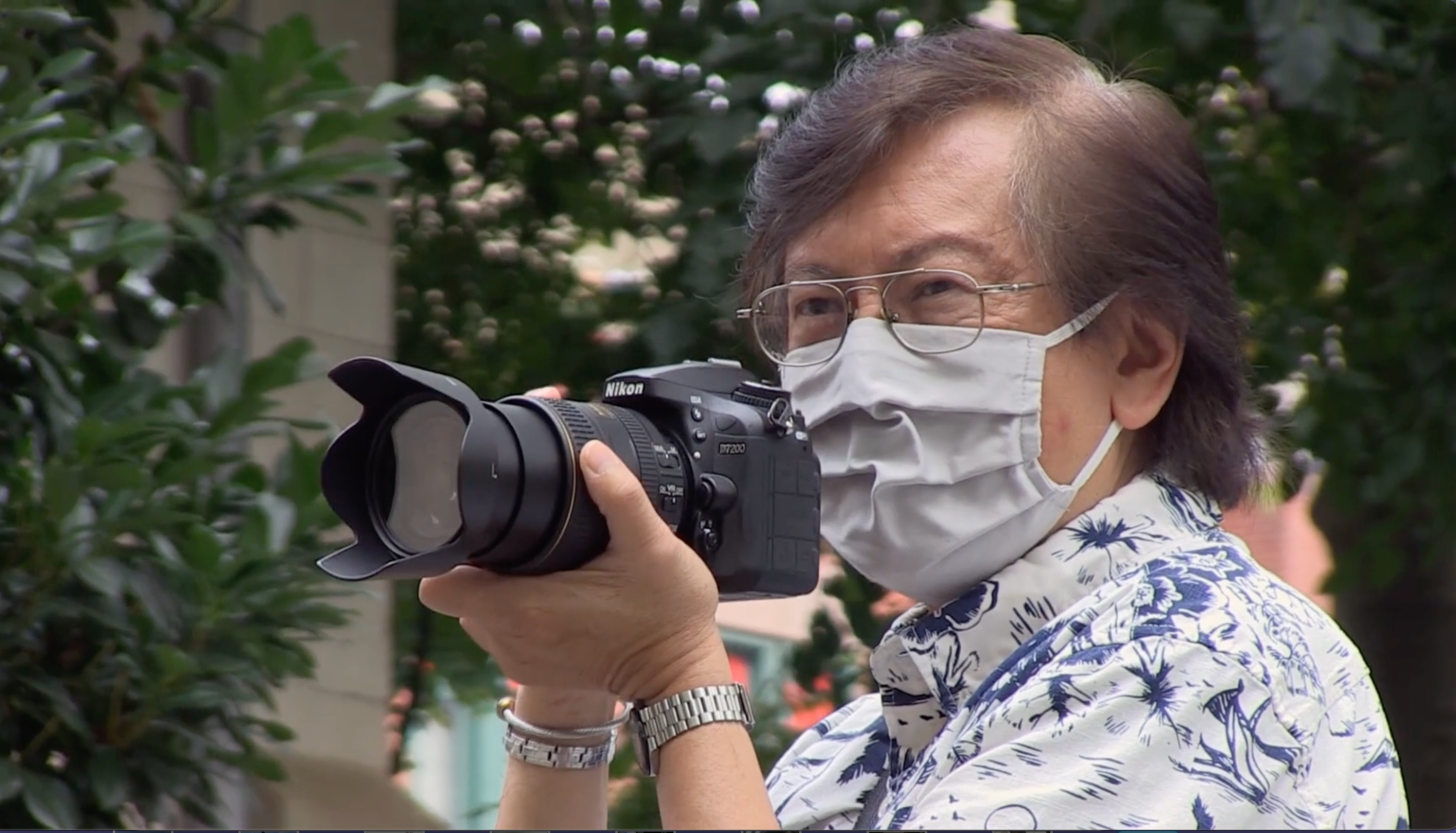
Wearing a mask during the COVID pandemic, Corky Lee gets ready to take his next photo. (Photos courtesy of All Is Well Pictures)

By Richard Ades

As a child, Corky Lee enjoyed comic books about superheroes, which he later credited with giving him a “moral compass.” As a Chinese American, however, he never saw any superheroes who looked like him.

Despite this fact (or maybe because of it), Lee grew up to be a kind of superhero himself—one whose “superpower” was simply taking the kind of pictures no one else was taking. Walking around New York City with a camera bag over his shoulder, he spent five decades chronicling the lives of Asian Americans and Pacific Islanders, people whose struggles and celebrations were often ignored by the mainstream media.

Lee and his lifelong crusade of inclusion are the subject of Photographic Justice: The Corky Lee Story, a documentary being shown on PBS in observance of Asian American and Pacific Islander Month.

Directed by Jennifer Takaki and featuring a combination of contemporary interviews and vintage footage, the film is a low-key but loving portrait of the man who became a fixture in New York’s Asian community. Whenever members of its many varied cultures and nationalities threw a parade, held a party or joined a picket line, Lee could be counted on to be there.

Love of country and love of New York are obvious in this photo Corky Lee took of a 2006 parade celebrating Budha’s birthday.

After decades of such coverage, the documentary tells us, Lee amassed so much knowledge about local AAPI-related events that kids jokingly referred to him as “Corkypedia.”

Besides showing up for Asian holidays such as the lunar new year and Budha’s birthday, Lee also covered national holidays, when he concentrated on providing an Asian American viewpoint. On Veterans Day, for example, he focused his lens on AAPI vets to show that Asians are as much a part of U.S. society as their European American counterparts.

According to the documentary, Lee felt this lesson became especially important when the country was hit with the 9/11 attacks in 2001 and with COVID in 2020. Muslim Americans and Chinese Americans, respectively, were scapegoated for these national and international tragedies, and he did what he could to counteract the resulting prejudice.

Sadly, the latter effort turned out to be his last. After viewing Takaki’s documentary, you’ll realize just how much of a loss that was.

Rating: 4 stars (out of 5)

Photographic Justice: The Corky Lee Story can be seen in select theaters and will air on PBS stations beginning May 13. Its Central Ohio airtime is 4 p.m. Sunday, May 19 on WOSU.

COVID-19 drives the plot in Indian-American romcom

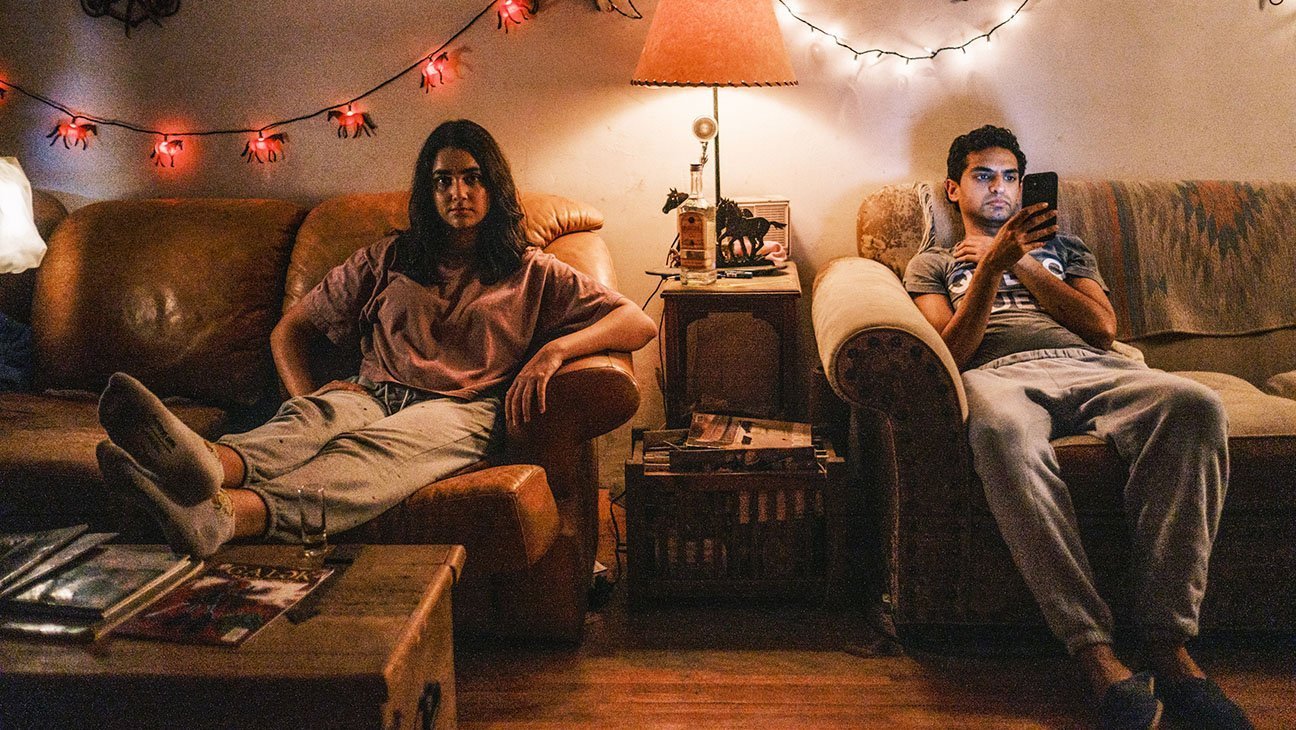
The COVID pandemic turns Rita (Geraldine Viswanathan, left) and Ravi (Karan Soni) into unwilling housemates in 7 Days.

By Richard Ades

“Meeting cute” is a time-honored romcom tradition. Set in the early days of the pandemic, 7 Days offers a new variation in the form of “meeting COVID.”

When Indian-Americans Ravi and Rita (Karan Soni and Geraldine Viswanathan) hold their first date, we’re informed that it takes place in March 2020. Viewers will instantly know why that’s significant: March 2020 was the month that Everything Stopped.

Actually, their date takes place about five minutes before Everything Stopped. The two are taking precautions such as wearing masks (a historical inaccuracy, as the average person didn’t have access to masks until months later), but they’re still able to travel and meet other people. However, that soon changes.

By the time the date comes to its awkward end and they return to Rita’s nearby home, they learn that Ravi is stuck there because the agency that was to supply his rental car has shut down. Reluctantly, Rita offers to let him spend the night on her couch. As you might surmise from the flick’s title, that night stretches into a week’s worth of sheltering in place.

The first directorial effort of Roshan Sethi, who co-wrote the script with Soni, 7 Days is set firmly in the world of Indian-American courtship. Like many stories involving the children of immigrants, it involves a clash between the traditional and the modern.

Ravi belongs to the traditional camp, eschewing meat, alcohol and premarital fooling around, and he assumes Rita is the same. After all, he met her through a traditional dating website. Soon after becoming her houseguest, though, he learns she was only putting on an act to satisfy her mother, who pays her rent. In fact, Rita is the exact opposite of the kind of wife he’s looking for.

At times, 7 Days is like a romcom version of The Odd Couple, pitting the neat mama’s boy Ravi against the sloppy, rebellious Rita. (When he first sees Rita’s messy home, Ravi assumes she has roommates, only to learn she lives alone.) But as the story progresses and the two are forced to face an unexpected challenge, such easy humor is replaced by something deeper and more subtle. At the same time, the two leads—particularly Suni—add nuance to their comedic portrayals.

Do opposites attract? That happens a lot in run-of-the-mill romcoms, but 7 Days may have something else in mind. With the help of brief interviews of actual married couples that are shown in the early moments, it examines the possibility that love is something that’s built with the help of empathy and familiarity rather than being a magical force that appears out of thin air.

If that’s true, then just maybe the conservative Ravi and the free-thinking Rita have a chance to become a couple in spite of themselves.

Rating: 4 stars (out of 5)

7 Days (no MPAA rating) is available through VOD outlets beginning April 26.

Eclectic shorts share quarantine protocols

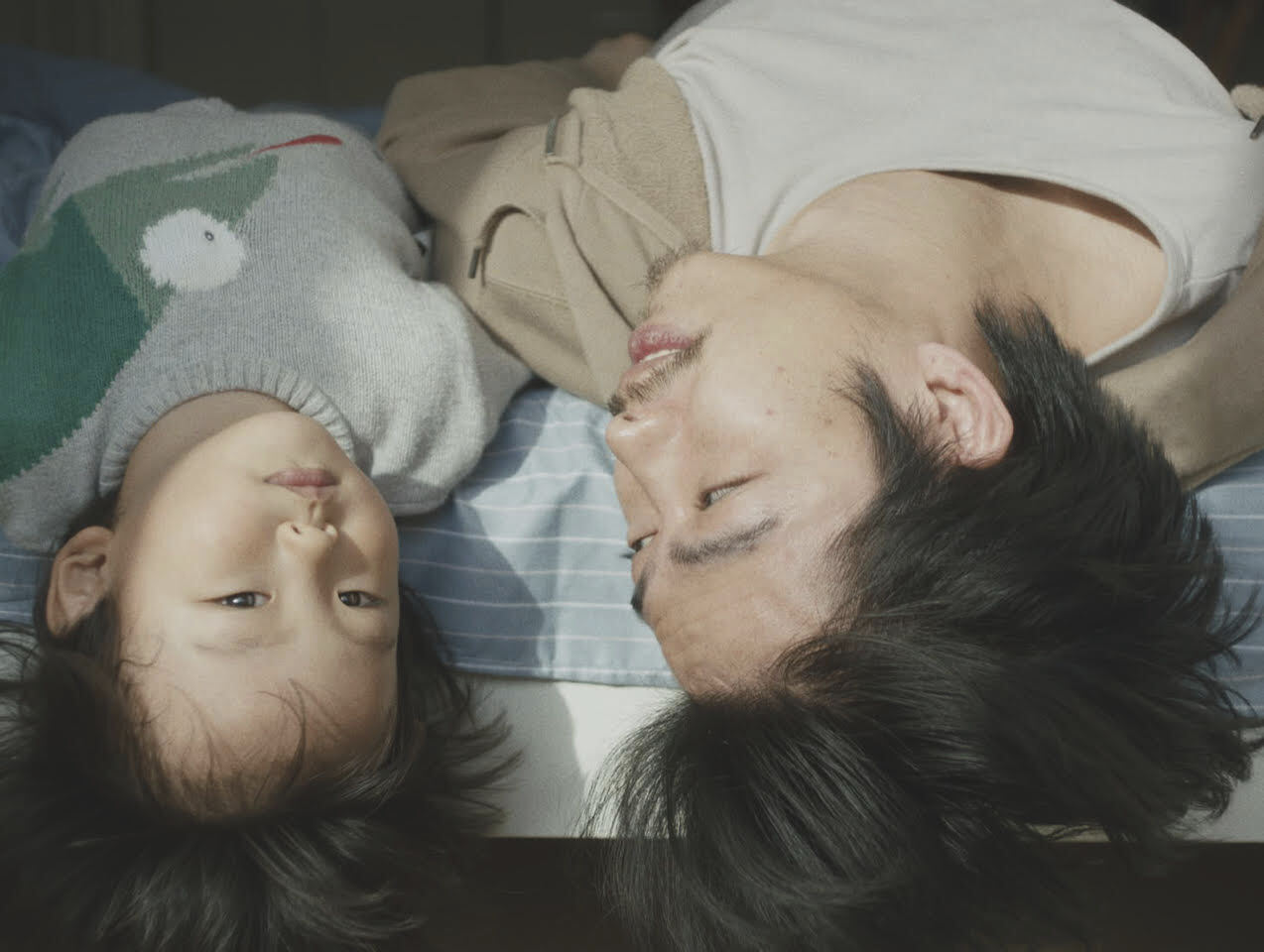
A young Chinese man (Zhang Yu, right) and his son (Zhang Yanbo) struggle to cope with quarantine restrictions in “The Break Away,” part of the anthology The Year of the Everlasting Storm. (Photo courtesy of Neon)

By Richard Ades

The Year of the Everlasting Storm is a collection of seven shorts that are united not so much by theme as by process. Since the titular year is 2020, the seven directors (from five different countries) were instructed to create works without violating COVID-19 quarantine restrictions. The apparent purpose was to show it was still possible to make films during a pandemic.

The result: a group of flicks that are mostly made in cramped quarters, though a couple also branch out into the virtual world. Other than that, they have little in common, which means each one stands alone rather than contributing to a cohesive whole.

Well, with one caveat: A few of the films focus on what life was like during the early days of the pandemic, which allows us to compare them to each other and to our own real-life experiences.

Leading off the collection is a work by Jafar Panahi, the Iranian director who actually inspired the entire project by making previous films under similar restrictions—though they were imposed by his country’s censorship rather than a pandemic. “Life” features the filmmaker and members of his family, including his beloved pet iguana, Iggy. Little happens except that his mother violates a stay-at-home mandate in order to pay a visit, though only after armoring herself with a hazmat suit and a spray bottle of disinfectant. The gently comic vignette is a reminder of the fears and deprivations much of the world experienced while first coming to terms with a once-in-a-century plague.

Even more deprivations are suffered by the young Chinese couple featured in the second film, “The Break Away,” directed by Singapore-born Anthony Chen. Stuck in their apartment and worried about money because the pandemic has sapped much of their income, the frazzled wife (Zhou Dongyu) gradually loses patience with her laid-back husband (Zhang Yu). Meanwhile, their young son is irritable because he can’t understand why he isn’t allowed to go outside. Like “Life,” the mini-drama contains reminders of the early misconceptions we all had about COVID-19 and how it’s spread.

The COVID theme shows up only briefly in the next short, Malik Vitthal’s “Little Measures,” which is the first of the collection’s three U.S. offerings. It focuses on Bobby Yay Yay Jones, whose attempt to regain custody of his three children has been delayed by the pandemic. Meanwhile, he keeps in touch with them electronically, their conversations being shown via small Facetime-style images. The piece is punctuated by Jonathan Djob Nkondo’s animation, which comes off as a superfluous addition.

COVID disappears almost entirely in “Terror Contagion,” directed by American filmmaker/journalist Laura Poitras (Citizenfour). Consisting largely of computer images taken from virtual meetings, it follows Poitras as she joins the group Forensic Architecture’s investigation into the Israeli spyware manufacturer NSO. Accompanied by Brian Eno’s creepy music, it evokes a feeling of paranoia as it talks of global surveillance and its potential dangers to individual freedoms. Both an impressive addition and a distraction from the rest of the collection since it’s such a change in tone, “Terror Contagion” probably would benefit from being expanded into a stand-alone documentary.  

Next, the anthology returns to COVID concerns with Dominga Sotomayor’s “Sin Titulo,” which is about a Chilean woman (Francisca Castillo) who’s affected by the pandemic in two ways: Her vocal ensemble isn’t allowed to sing together in person, forcing her to record her part over the phone so that it can be joined with the others electronically. And, more painfully, she’s unable to see her newborn grandchild except at a distance. A difficult relationship with a rebellious daughter adds a bit more tension to this modest but beautifully filmed flick.

“Dig Up My Darling,” the show’s penultimate and spookiest piece, also deals with a pandemic—though it’s not clear just which one. David Lowery (Pete’s Dragon) directs a silent Catherine Machovsky in the tale of a woman who hits the highway to take care of some long-unfinished business. It’s a mystery that’s more interested in creating an eerie atmosphere than in answering questions, several of which are deliberately left hanging at the end.

In fact, viewers may still be trying to answer those questions when new ones pop up during the final short, “Night Colonies.” Directed by Thailand’s Apichatpong Weerasethakul, it focuses on three things: a mattress, fluorescent lights and lots and lots of bugs that are buzzing around said lights. Viewers might wonder whether all this is an oblique reference to the pandemic or its aftermath, especially when faded photos of people make a brief appearance. Generally, though, the film just comes off as an exercise in carefully composed sights and sounds, which will leave some mesmerized while others may wish Iggy the iguana would reappear and treat himself to a few flying treats.  

It’s a polarizing finale to a collection of inventive films that would work better as a whole if they were connected by more than just as set of production rules.

Rating: 3½ stars (out of 5)

The Year of the Everlasting Storm opens Sept. 3 at select theaters.