Painful memories of an eradicated past

An animated sequence depicts Pelagia Radecka, a young resident of Gniewoszów, Poland, searching for survivors of antisemitic violence in 1945.

By Richard Ades

My community is getting ready for the annual Columbus Jewish Film Festival, but a local theater is beating it to the punch with one of the most powerful Holocaust-related documentaries you’re likely to see this year.

Among Neighbors, directed by Yoav Potash (Crime After Crime), is about the tragic and lasting effects World War II had on the town of Gniewoszów, Poland. The film is at once a history lesson, a tale of survival and a portrait of humanity at its best and its absolute worst.

It’s also a mystery, one whose solution isn’t provided until the film’s final moments.

Because the documentary does so much, and because Potash waits so long to connect seemingly disparate parts, it sometimes comes off as disjointed. But the dramatic end justifies the director’s suspense-building means, and the film is never less than compelling along the way.  

Using a combination of contemporary interviews, archival footage and eloquent hand-drawn animation, Potash introduces us to Gniewoszów both past and present.
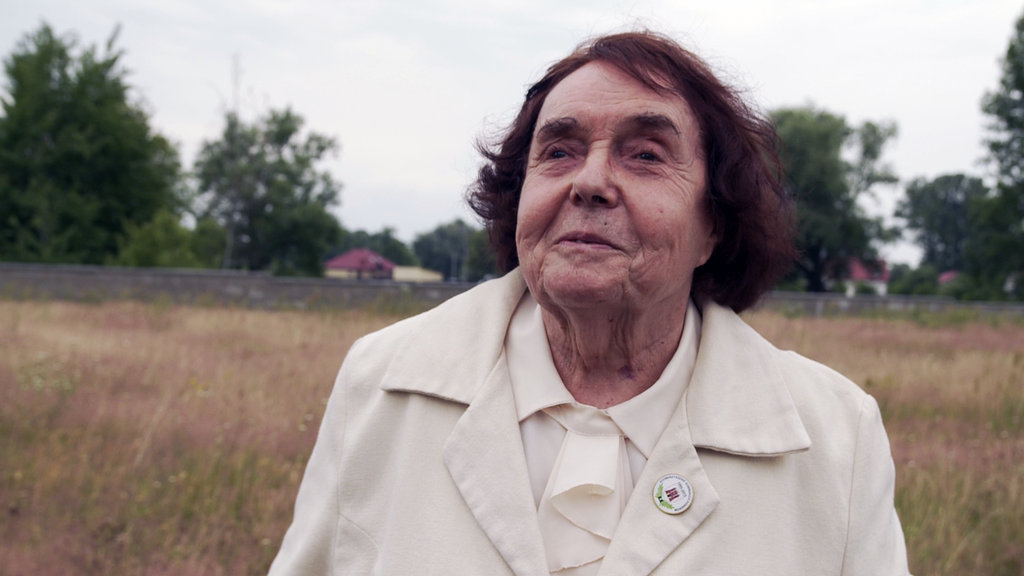
Pelagia Radecka, a Catholic resident of Gniewoszów, witnessed an act of antisemitic violence after the Nazis left her town.

In the past, Jews and Catholics lived together as neighbors and sometimes as friends, just as they had for centuries. But that all changed when Nazi Germany invaded Poland at the beginning of World War II and began instituting antisemitic restrictions that eventually evolved into roundups and death camps.

In response, a few Poles came to their Jewish neighbors’ defense, but more went along with the restrictions and even benefited from them. And some adopted the Nazis’ antisemitic and violent ways, even after the Germans had been driven out.  

As a result, Gniewoszów became a town whose Jewish residents have disappeared along with all traces of their former presence in the community. And most of its current residents are reluctant to talk about what happened to them, particularly since a 2018 law makes it illegal to suggest that Poles were in any way complicit in the Holocaust.
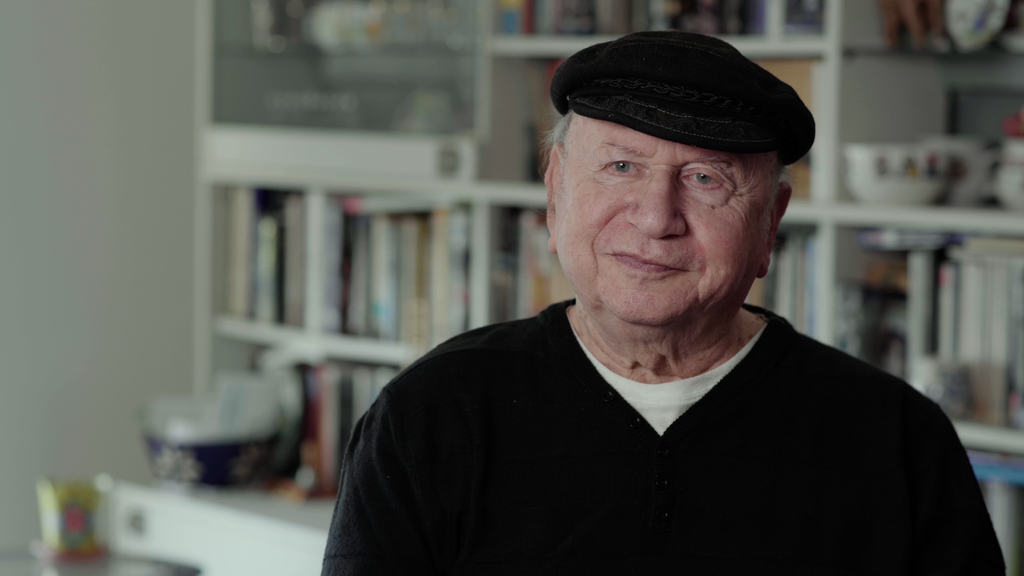
Yaacov Goldstein, a Jewish resident of Gniewoszów, survived the Holocaust and later moved to Israel.

Luckily for Potash, he’s able to find a few elderly residents who were alive during World War II and can be coaxed into telling what they remember. Two of them stand out:

˖ Yaacov Goldstein, a Jew who was a boy during World War II and later moved to Israel, tells the harrowing story of his parents’ efforts to survive and to protect him and his younger brother from the Nazis.

˖ Pelagia Radecka, a Catholic resident who was a teenager during the war, recalls being friends with the Jewish shopkeepers and their son who lived across the street. She also recalls witnessing a shocking act of antisemitic violence that occurred after the Germans had been driven out.

Bravely, Radecka is eager to talk about this act, even though she’s kept it to herself ever since, and even though talking about it amounts to a violation of Polish law.

Besides being a portrait of the highs and lows humans are capable of, Among Neighbors is a critique of societies that attempt to erase their sordid pasts. For Americans, living at a time when our own government is attempting to do the same, it could not be more timely.

Rating: 4½ stars (out of 5)  

Among Neighbors can be seen in select theaters, including Columbus’s Gateway Film Center, with screenings scheduled at 1:30 p.m. Oct. 25 and 26. For a list of other upcoming screenings, visit amongneighbors.com/screenings.

Estranged cousins reunite for Holocaust-related tour

Benji Kaplan (Kieran Culkin, left) and his cousin David (Jesse Eisenberg) get reacquainted while touring Polish Holocaust sites in A Real Pain. (Photos courtesy of Searchlight Pictures)

By Richard Ades

When Jesse Eisenberg made his debut as a writer/director with 2022’s When You Finish Saving the World, some found its depiction of familial squabbles heavy-handed and its characters insufferable.

Now Eisenberg is back with another comedy-drama about family relations, and he seems to have taken the criticisms to heart. A Real Pain’s two leading characters are flawed but likable, and its depiction of their squabbles is hardly heavy-handed. To the contrary, Eisenberg makes us work to figure out just what is behind them.

David Kaplan (played by Eisenberg himself) is a successful New Yorker with a wife and young son. His cousin Benji (Kieran Culkin) is single, jobless and lives in his mother’s upstate home.

Though the two were close boyhood friends, they’ve grown increasingly distant as adults, separated by their lifestyles and personalities as much as by geography. Now, however, they have a chance to reconnect thanks to their late grandmother, a Holocaust survivor who left them money specifically set aside for a visit to her native Poland.

So the cousins fly to Warsaw to join a multi-day tour of Holocaust-related sites led by a Brit named James (Will Sharpe). Also on the tour are a recently divorced American (Jennifer Grey) and a Rwandan-born Jewish convert (Kurt Egyiawan), among others. Each is briefly introduced, but Eisenberg keeps his main focus on the two cousins and their increasing discomfort with each other.

David, uptight and buttoned-down, watches with simmering resentment as the unrepressed Benji easily connects with other members of the group. For his part, Benji complains that David has made little attempt to see him recently, and he pushes him to smoke pot and otherwise reclaim some of the wildness that made them inseparable childhood companions.

Benji (Kieran Culkin) gives his cousin David (Jesse Eisenberg) a hug while following other members of their tour group.

As the tour goes on, the tension between the two grows due to Benji’s increasingly angry and erratic behavior. Whether it’s caused by the loss of his beloved grandmother or other, unidentified problems, it leaves David profoundly uncomfortable. The fact that it’s happening while the group is touring sites intimately connected to the last century’s worst atrocity only adds to the stress.

As an actor, Eisenberg doesn’t stretch himself, playing David much like he’s portrayed other socially awkward characters. As a director, on the other hand, he generously allows Culkin to imbue Benji with passion, unexpected quirks and unexplored depths.

What does it all mean? Eisenberg relies on the viewers to come up with their own explanations for the cousins’ difficult relationship and their disparate responses to the tragic history they’re revisiting. His approach is unobtrusive to a fault—with one exception.

An almost constant companion to the proceedings is a score consisting of works by 19th century piano virtuoso Frederic Chopin. Other than the fact that the composer was Polish, the music seems to have little to do what’s happening onscreen. What’s worse, the dramatic and often familiar passages sometimes upstage what’s going on.

For viewers struggling to find meaning in Eisenberg’s interesting but understated story, it’s an unwelcome distraction.

Rating: 3½ stars (out of 5)

A Real Pain (rated R) opens Nov. 15 in theaters nationwide.

Holocaust escapee finds a home in pornography

Chelly Wilson does business out of her apartment in an old snapshot provided by the Wilson family. (Photos courtesy of Kory Miller/Obscured Pictures)

By Richard Ades

There have been many documentaries about Holocaust survivors. Queen of the Deuce is likely the only one about a survivor who went on to make her fortune in the porn industry.

Born into a family of Greek Jews in 1908, Chelly Wilson was quicker than most to recognize the rising threat Nazi Germany posed in the late 1930s. Temporarily leaving her son with her ex-husband and her daughter with a non-Jewish acquaintance, she hastily emigrated to New York, where she was soon making money selling hot dogs.

But Wilson’s real success came years later, when she began acquiring neighborhood movie theaters and devoting them to the increasingly popular genre of pornography. By the time soft porn began giving way to the hard variety, she was honchoing a business that ran a slew of theaters and even made its own features.

Directed and co-written by Valerie Kontakos, Queen of the Deuce tells Wilson’s story through interviews with her grown children and grandchildren, as well as people who worked with her over the years. Though she died in 1994, Wilson even makes an appearance herself thanks to home movies and interviews recorded by her family. In addition, an animated version of Wilson at various ages makes brief appearances to help us understand who she was and how she got that way.

An animated version of Chelly Wilson poses with some of her regular poker buddies in an image provided by Exile Films.

It all adds up to a portrait of an individual whose life was full of contradictions. For example:

⸱ She was a Jew who celebrated Christmas (which was also her birthday).

⸱ She was a lesbian but was married twice, including to a man she met in America.

⸱ She was a mother and grandmother who valued her family but sometimes kept them in the dark about her past.

A final contradiction is that, while many would label her a feminist thanks to her fierce independence, she made her living off a film genre that feminists of her era often considered misogynous.

In general, Wilson comes across as someone who proudly and unapologetically lived her life and was unafraid to thumb her nose at social norms. Director Kontakos does a good job of capturing her personality with major help from collaborators such as editor Rob Ruzic, composer Ken Myhr and lead animator Abhilasha Dewan.

As a bonus, Kontakos also captures the personality of New York in the 1960s and ’70s, before politicians such as Rudy Giuliani began working to reform its sex-, dirt- and crime-ridden image. Back then, the Big Apple might not have been as nice a place to visit as today’s cleaned-up version, but it obviously was the perfect home for a risk-taking entrepreneur named Chelly Wilson.

Rating: 4 stars (out of 5)

Queen of the Deuce previously made the rounds of several festivals, including the 2023 Columbus Jewish Film Festival. The film opens May 24 in select theaters and online through Amazon Prime Video and Apple TV.

She forged a new way to look at racism

Aunjanue Ellis-Taylor stars as author Isabel Wilkerson in Origin. (Photos by Atsushi Nishijima/courtesy of Neon)

By Richard Ades

Isabel Wilkerson’s 2020 book Caste: The Origins of Our Discontents was praised for its incisive comparison between racial repression in the U.S. and repressive systems in other countries. In particular, it looked at India’s caste system and Nazi Germany’s genocidal antisemitism.

Now writer-director Ava DuVernay has transformed that best-selling book into a semibiographical movie called Origin, which explains the challenges Wilkerson faced as she was formulating her provocative ideas. Besides facing pushback from African Americans and others who questioned her thesis, we learn, she lost several beloved members of her family.

DuVernay, who wrote the script with Wilkerson herself, apparently hopes these personal tragedies will inject enough drama into the film to prevent it from coming off as a mere lecture.

Wilkerson (Aunjanue Ellis-Taylor, right) is comforted by her husband, Brett (Jon Bernthal).

First, the bad news: It still comes off largely as a lecture despite solid acting by Aunjanue Ellis-Taylor (as Wilkerson) and the rest of the cast. But the good news is that the lecture imparts enough details about Wilkerson’s revolutionary thesis to be worthwhile. Those who haven’t read the book will find it enlightening, while those who have read it may see it as a useful recap.

In a nutshell, Wilkerson contends that our country’s history of repression toward Blacks—from slavery and racist laws to the recent murders of innocent African Americans such as Trayvon Martin—has much in common with other societies’ attempts to devalue certain groups and depict their members as less than human.

In India, that group is the Dalits (formerly known as the Untouchables), who often are denied educational opportunities and relegated to the most menial of jobs. In Nazi Germany, of course, that group was the Jews.

Throughout the film, historical incidents are recreated to give the victims and perpetrators of repression a human face. Among others, we meet a Black couple and a White couple who worked undercover to understand racism in the Jim Crow South. We also meet a Gentile man and a Jewish woman who fell in love in Germany during the rise of Naziism.

Nazis hold a public book burning in a scene from Origin.

Dramatically, perhaps the most effective of these recreations involves a young Black baseball player who wasn’t allowed to swim when his White teammates dropped by the local pool. Historically, the most shocking scene (for those unfamiliar with Wilkerson’s book) shows Nazi officials patterning Germany’s antisemitic laws after American laws that relegated Blacks to second-class citizenship.

In the more contemporary scenes involving Ellis-Taylor’s Wilkerson, the other major cast members include Jon Bernthal as her husband, Brett; Emily Yancy as her mother, Ruby; and Niecy Nash as her cousin, Marion.   

DuVernay’s 2014 film Selma was a fascinating look at Martin Luther King and the pivotal role he played in the Civil Rights movement. The director’s new film may not be as dramatically effective, but it is every bit as illuminating.

Rating: 3 stars (out of 5)

Origin (PG-13) can be seen in theaters nationwide.

Future mime’s battle to thwart the Nazis

Resistance
Jesse Eisenberg as Marcel Marceau in Resistance (Pantaleon Films)

By Richard Ades

There may be no performing artist who’s despised and ridiculed more than the mime. But maybe after seeing Resistance, people will start to give these silent storytellers the benefit of the doubt.

The World War II thriller focuses on that most famous mime of all time, Marcel Marceau, and reveals that he definitely had a story to tell, though he mostly kept to himself. It turns out that back when he was coming of age in occupied France, Marceau joined the Resistance and was instrumental in helping hundreds of Jewish children escape the Holocaust.

It’s a fascinating and unique story, despite the fact that writer/director Jonathan Jacubowicz fails to tell it in a manner that’s fascinating or unique—or even very believable.

True, we’re used to reality-based tales taking liberties with the facts in order to ramp up the drama (the bullet-riddled escape from Iran in Argo comes to mind). But Resistance is filled with so many clichés and cliffhangers that we start to doubt virtually everything we see. Just to take one: Did Marceau’s father, a butcher, really oppose his son’s desire to be an actor, or is that simply Jacubowicz’s attempt to add the kind of parent-child tension that invariably leads to a moving reconciliation?

Further feeding our doubts, the movie casts 36-year-old Jesse Eisenberg as Marceau, even though he was actually a teenager at the time. You may or may not feel Eisenberg is able to shed his usual persona and do a convincing job here (I’m not impressed), but it doesn’t help that the movie depicts Marceau as years older than he really was. You have to wonder what else is made up.

Another weakness: Despite focusing on someone who came to personify mime—a craft that calls on viewers to use their imagination—Resistance seems determined to spoon-feed us information.

Just in case we don’t know what the Holocaust was, the first scene shows a soon-to-be-orphaned Jewish girl (Bella Ramsey) asking her parents, “Why do they hate us?” And just in case we don’t know that the Nazis were evil, the film periodically cuts away from Marceau to show vicious Gestapo agent Klaus Barbie (Matthias Schweighofer) methodically shooting, beating or torturing people. For the record, Barbie was a real-life monster, but Schweighofer’s version comes off as the kind of psychopathic sadist who could just as easily double as the villain in a run-of-the-mill melodrama.

Despite all these problems, the film does succeed on some levels. The cast—including Clemence Poesy as Marceau’s love interest and fellow Resistance fighter, Emma—is good enough to make us care about the people trying to survive and oppose the Nazis’ reign of terror. As a result, viewers who are able to overlook the film’s excesses will watch many scenes in a heightened state of tension.

But the film’s real value lies in its revelation of the heroism displayed by a well-known figure and many others in response to the 20th century’s greatest evil. It provides the kind of inspiration that’s welcome now that we need all the heroes we can find.

Rating: 3 stars (out of 5)

Resistance (rated R for bloodless but troubling violence) opens March 27 at VOD outlets.