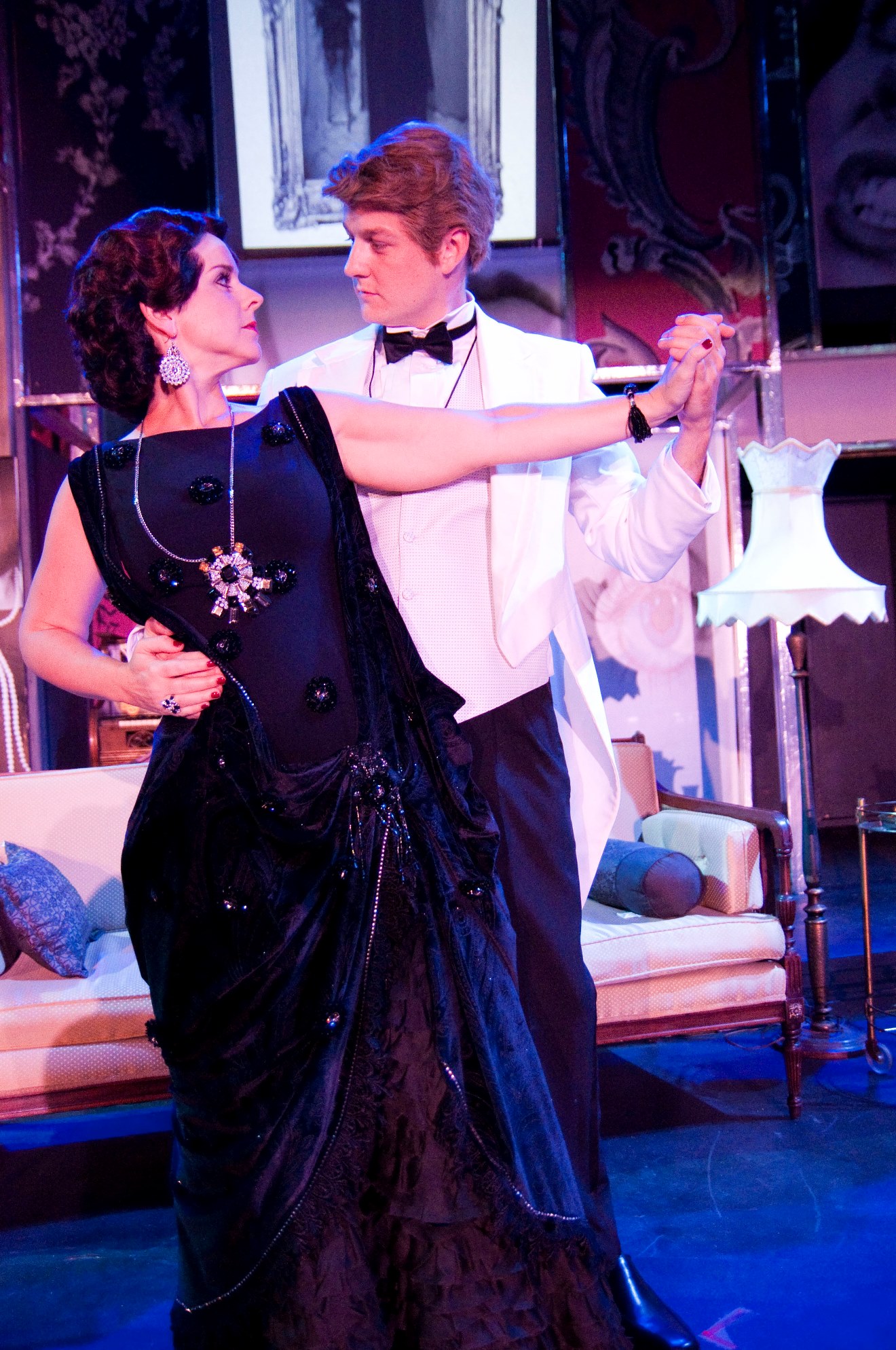
WWII musical is traditional in every way but one

The cast of Yank! The Musical (photo by Jerri Shafer)

By Richard Ades

Wartime romance is complicated. When it’s depicted on the stage, it’s also, often, tuneful.

Think South Pacific. Or The Sound of Music. Or Yank! The Musical.

The last may be less well-known than the other two, but it focuses on a type of romance that’s seldom addressed in mainstream entertainment: the same-sex kind.

With a book and lyrics by David Zellnik and music by Joseph Zellnik, it follows the adventures of Stu, a young man who joins the Army during World War II. Stu tries his best to fit in with the ragtag group of guys he trains with, but he can’t help noticing that he stands out. One clue is that he doesn’t share the others’ lascivious fascination with pinup photos of Betty Grable.

The other soldiers seem to sense Stu’s nonconforming nature and kid him mercilessly—or they would if a nice guy named Mitch didn’t stop them. Stu is grateful, but it turns out his feelings for Mitch go far beyond that. One night, when the squad is finally on its way to the war, he acts on those feelings, setting off on a dangerous sequence of events.

Beyond its gay theme, Yank! The Musical is pretty traditional. Stu and Mitch’s squad is geographically and ethnically diverse, just like squads always are in wartime fiction. The songs are pleasant but unmemorable, sounding much like any number of vintage romantic ballads.

Somehow, though, none of this matters. To the contrary, it seems fitting that a gay love story is treated much like its “straight” predecessors. It underscores the fact that gay Americans were fighting for their country right along with the heterosexuals usually depicted in wartime musicals.

Evolution Theatre’s production tells Stu’s story well, thanks to Jimmy Bohr’s beautiful direction and cast of actors who act and sing with equal skill.

Nick Hardin is conflicted but courageous as Stu; William Macke is kind but even more conflicted as Mitch. Other major players include choreographer Brent Fabian as Artie Goldberg and Jesika Siler Lehner as a bevy of show-biz crooners and assorted other women.

Though the musical tackles the serious issue of discrimination against gay soldiers, it doesn’t always do it in a serious way. Particularly funny is the trio of steno-pool workers (Jeb Bigelow, Doug Joseph and Scott Clay) who express their otherness by taking on the characters of Southern belles from Gone With the Wind. Add the lighthearted songs and dance numbers, and you have a show that’s far more pleasant than you’d expect.

Shane Cinal’s scenic design is simple, leaning heavily on patriotic colors, and is bolstered by Nitz (Curtis) Brown’s dramatic lighting. Jason Guthrie’s costumes are similarly simple but place the action in the proper era.

Led by Michael L. Medvidik, the onstage band plays with spirit, even if it hits the occasional sour note. The vocal harmonizing also has its pitchy moments, though the singers do fine when they’re on their own.

A final caveat is that the musical goes on longer that it really needs to, thanks to extraneous numbers like the silly Your Squad Is Your Squad. But the story is so overdue, and it’s told in such a good-natured manner, that you probably won’t mind at all.

Evolution Theatre Company will present Yank! The Musical through June 6 at the Columbus Performing Arts Center, 549 Franklin Ave., Columbus. Show times are 8 p.m. Thursday-Saturday. Running time: 2 hours, 30 minutes (including intermission). Tickets are $25, $20 students/seniors. 1-800-838-3006 or evolutiontheatre.org.

Heartfelt performances, fine vocals mark revival of ‘Les Miserables’

Jean Valjean (Bill Hafner, left) risks being recognized by Javert (Scott Green, center) when he intercedes on behalf of Fantine (Melissa Muguruza), who’s being detained by two local constables (Derryck Menard and Emerson Elias) in this scene from Les Miserables (photo by Jerri Shafer)

By Richard Ades

As the familiar opening strains of Les Miserables filled the air, I held my breath. Having seen the blockbuster musical at least four times (including the 2012 movie), I knew how much depended on the actor playing Jean Valjean.

Would he have a voice powerful enough to carry off the demanding part? Would he have enough acting chops to make us care about the put-upon French fugitive?

But as soon as Bill Hafner sang Valjean’s first few notes, I began to relax. Hafner not only has an exceptional voice, but he’s able to project the combination of nobility and humility that makes Valjean such an appealing hero.

And Hafner is far from the only talent who’s up to the Les Miz challenge. Director David R. Bahgat and his cast and crew have created something remarkable on the JCC stage. Every performance, every lighting effect, every costume contributes to an experience that builds to one emotional climax after another.

Set in the early 19th century, the Claude Michel Schonberg/Alain Boublil/Jeffrey Hatcher musical focuses on Valjean’s attempt to remake and redeem himself after serving years at hard labor for the petty crime of stealing a loaf of bread. When he unknowingly contributes to the downfall of a single mother named Fantine, he takes on a new responsibility as the guardian of her young daughter, Cosette.

Meanwhile, he’s constantly forced to be on the lookout for Javert, a police officer who’s determined to bring him to justice for violating his parole. But that doesn’t stop him from becoming entangled with young idealists who are determined to launch a revolution.

Besides Hafner, many cast members give affecting performances in this sung-through musical. They include:

• Melissa Muguruza as Fantine
• Violet Hicks (alternating with Sigal Judd) as her young daughter, Cosette
• Amy Rittberger as the grown Cosette
• Madeline Bolzenius as the lovelorn Eponine

Eponine’s disreputable parents, the Thenardiers, are deliciously played by Mark Schuliger and Mary Sink. Their appearances, especially the rousing number Master of the House, give the tragedy-prone musical a few welcome moments of comic relief.

Moments of romantic relief arise after the grown Cosette falls for young revolutionary Marius (Elisha Beachy), leading to such beautiful ballads as A Heart Full of Love. But this subplot, too, has a tragic element, as it dooms Eponine’s own feelings for Marius, as expressed in her heart-rending lament On My Own.

Marius’s fellow revolutionaries include leader Enjolras (Jay Rittberger) and a plucky street urchin named Gavroche (Yaakov Newman). Their anthems, including Do You Hear the People Sing?, are as glorious as ever, but they take on a touching note of pathos in this production. That’s because the performances and even director Bahgat’s costume designs suggest that Enjolras and his followers are really just idealistic “schoolboys,” as Javert derisively calls them.

As for Javert, Scott Green plays him with the ramrod posture of a man who’s unable to see beyond his narrow interpretation of right and wrong. Green mostly meets the role’s vocal needs, but his voice occasionally showed signs of strain at the matinee I attended.

Les Miz fans know that Javert’s final exit is a challenge for a semiprofessional troupe like Gallery Players. Fortunately, Bahgat handles it with creativity and dramatic flair—qualities that mark the entire production.

As I said in the beginning, much rides on Jean Valjean’s broad shoulders, and actor Hafner never disappoints. His rendition of the difficult Act 2 solo Bring Him Home is simply the highpoint of a triumphant lead performance.

But there is so much else that contributes to the show’s success, including Jon Baggs’s scenery and Jarod Wilson’s light and sound design.

Yes, there are minor problems: the odd sour note from the band, a few voices that are under-amplified. None of these detract from the show’s ability to pull us into a musical that retains its ability to move us even after multiple viewings.

At its best, Les Miserables is a mesmerizing experience. In case you haven’t figured it out by now, this is Les Miserables at its best.

Gallery Players will present Les Miserables through March 29 at the Jewish Community Center, 1125 College Ave., Columbus. Show times are 7:30 p.m. Thursday, 8 p.m. Saturday and 2:30 p.m. Sunday. Running time: 3 hours (including intermission). Tickets are $25 ($20 JCC members), $20 ages 60-plus ($18 JCC members), $15 students and children. 614-231-2731 or www.jccgalleryplayers.org.

Depression-era musical is far from depressing

Emma Stratton (center, lower deck) shows off her dance moves with other members of the company of Anything Goes (photo by Jeremy Daniel)

By Richard Ades

Watching Anything Goes is like taking a trans-Atlantic voyage while simultaneously time-traveling back to the 1930s.

The seagoing musical has been tweaked since it opened on Broadway in 1934, but the basic show remains intact. As a result, you feel like you’re enjoying the same kind of entertainment that helped to take our ancestors’ minds off the Great Depression.

What does the show tell us about our forebears? That they laughed at silly and sometimes naughty humor. And, mostly, that they had great taste in music.

The musical’s main claim to immortality is its collection of classic Cole Porter tunes such as You’re the Top and the title song, among many others. In the current touring show, all are wonderfully delivered by the cast and a brassy, jazz-savvy band conducted by Robbie Cowan.

Complementing the songs are some truly awesome dance numbers choreographed by director Kathleen Marshall. For tap-dancing fans, the highlight is the Act 1 capper set to the title tune. For those with a taste for something a little more provocative, Act 2’s Blow, Gabriel, Blow is equally fun.

The story centers on a young stockbroker named Billy Crocker (Brian Krinsky) and his attempt to woo engaged-to-be-married heiress Hope Harcourt (Rachelle Rose Clark). However, the show’s real star is neither Krinsky nor Clark.

Instead, it’s Emma Stratton, who plays nightclub performer Reno Sweeney. In the first scene, Reno declares her affection for Billy (I Get a Kick Out of You), only to learn that he’s fallen for Hope. A trooper if there ever was one, Reno then joins Billy’s campaign to win Hope away from her stuffy British fiancé, Lord Evelyn Oakleigh (Richard Lindenfelzer).

Reno is such an engaging character that you may root for Billy to choose her over the mousey Hope, even though you realize it’s a long shot. Meanwhile, you get to enjoy Stratton showing off her pipes and her equally impressive dance prowess in a bevy of tunes and production numbers.

Several other notable characters also figure in the plot. They include Billy’s alcoholic boss, Elisha Whitney (Michael R. Douglass); small-time gangster Moonface Martin (Dennis Setteducati); and Moonface’s free-loving girlfriend, Erma (Mychal Phillips). All have tuneful and reasonably funny moments.

Strangely, though, the funniest moment of all comes from an unlikely source. Lindenfelzer’s Lord Evelyn spends much of his time trying to master American slang, which produces chuckles at best, but the real comic gem is his attempt to locate The Gypsy in Me in an Act 2 dance duet with Reno.

The set, originally designed by Derek McLane and coordinated by James Kronzer, is clever depiction of ocean-liner interiors and exteriors.

Anything Goes is best known for its amazing collection of Porter tunes. Besides those already mentioned, the familiar solos and duets include Easy to Love (Billy), It’s De-Lovely (Billy and Hope) and Friendship (Moonface and Reno).

But thanks to the efforts of director/choreographer Marshall and her talented cast, crew and band, the show is much more than a few excerpts from the American Songbook. It’s a silly, sexy and footloose return trip to 1930s Broadway.

Broadway in Columbus and CAPA will present Anything Goes through Sunday (Feb. 8) at the Ohio Theatre, 39 E. State St. Show times are 7:30 p.m. through Thursday, 8 p.m. Friday, 2 and 8 p.m. Saturday, and 1 and 6:30 p.m. Sunday. Running time: 2 hours, 40 minutes (including intermission). Tickets are $28-$98. 614-469-0939, 1-800-745-3000 or ticketmaster.com.

Newspaper vendors go on strike in fleet-footed musical

Stephanie Styles and Dan DeLuca play Katherine and Jack in the touring production of Newsies (photo by Deen van Meer)

By Richard Ades

It was kind of odd watching Newsies Tuesday night at the Ohio Theatre.

The history-based Disney musical is basically a salute to the power of unions. As a result, it was hard to see it without remembering that a blatantly anti-union law had been passed about four years ago right across the street at the Statehouse—or that the governor who signed the law was re-inaugurated on Monday night.

All of that might have made it hard to enjoy the musical except that the anti-union law was overwhelmingly repealed thanks to a 2011 referendum. Yes, the little guys do occasionally win out in real life, as they do in Disney musicals.

Based on a 1992 movie, which was based on the Newsboys Strike of 1899, Newsies is about what happens when New York City newspapers put the screws to the young lads who eke out a living by selling their products on the street.

Joseph Pulitzer (Steve Blanchard), owner of the New York World, is the first to raise the wholesale price his “newsies” must pay, thinking that’s the easiest way to offset recent losses. He doesn’t count on the tenacity of Jack Kelly (Dan DeLuca), the paper pushers’ unofficial leader.

Jack persuades Manhattan-based newsies to go on strike, then begins seeking support from their counterparts in other New York boroughs. Backing him up are his best friend, Crutchie (Zachary Sayle), along with newcomer Davey (Jacob Kemp) and his little brother, Les (played at alternate performances by Vincent Crocella and Anthony Rosenthal).

Fighting the newspapers is a nearly impossible task, but unexpected help comes in the form of Katherine (Stephanie Styles), a society reporter who wants to write about the labor struggle to prove she’s ready to graduate to hard news.

Newsies gained several Tony nominations after opening on Broadway in 2012, but it won only for its musical score and choreography. The touring version makes it clear that these remain the show’s prime strengths.

With music by Alan Menken and lyrics by Jack Feldman, the score has several enjoyable numbers. They include The World Will Know, a defiant anthem that captures the spirit (if not the power) of Les Miz’s Do You Hear the People Sing?, and Watch What Happens, an amusing expression of Katherine’s determination in the face of self-doubt.

True, a few of the other numbers are either less memorable or less relevant, coming off as mere filler. But a worse problem on opening night was a sound system that often failed to elevate the generally fine voices above the large band conducted by James Dodgson. It sometimes was hard to pick out the lyrics, particularly in the group numbers.

Working under Jeff Calhoun’s direction, DeLuca makes Jack such a caricature of New York swagger that he’s not as compelling a hero as he might be. (Also, he seemed to suffer from subpar amplification at Tuesday’s performance.) But Styles turns Katherine into a lovable heroine, while Blanchard’s Pulitzer is such an effectively loathsome villain that you can almost imagine him twirling his mustache.

The real stars, though, are choreographer Christopher Gattelli and his spinning, leaping and somersaulting dancers. Several numbers fill Tobin Ost’s set with amazing moments of motion.

The dancing makes this musical history lesson as impressive as it is inspiring.

Broadway in Columbus and CAPA will present Newsies through Sunday (Jan. 18) at the Ohio Theatre, 39 E. State St. Show times are 7:30 p.m. through Thursday, 8 p.m. Friday, 2 and 8 p.m. Saturday, and 1 and 6:30 p.m. Sunday. Tickets are $28-$98. 614-469-0939, 1-800-745-3000 or ticketmaster.com.

Struggling to grow up in the Reagan era

Newsies demonstrates that 1890s young adults could accomplish quite a lot when they put their minds to it. Kenneth Lonergan’s This Is Our Youth, in contrast, shows that 1980s young adults could accomplish next to nothing, especially when their minds were clouded by drugs and immaturity.

It’s a savvy, clever portrait of an era and an age group that is entertaining until it gets bogged down in talkiness and redundancy, as it does during the second act.

In Warehouse Theatre Company’s production, the three actors give fully committed performances under Kristofer Green’s direction: John Connor as the self-absorbed Dennis, Jesse Massaro as the self-doubting Warren and Erin Mellon as the emotionally cautious Jessica.

Will Warren find a way to recover the $15,000 he stole from his hated father? And will he ever connect with Jessica, the oblivious object of his romantic obsession?

Such questions hold the viewers’ interest for a while, but Lonergan eventually overplays his dramatic cards. It’s a shame, because the actors do everything they can to keep us involved.

It’s a valiant effort, to say the least.

Warehouse Theatre Company will present This Is Our Youth at 8 p.m. Thursday-Saturday (Jan. 15-17) at MadLab Theatre and Gallery, 227 N. Third St. Running time: 2 hours, 20 minutes (including intermission). Tickets are $22, $15 student rush. 614-371-5940 or warehousetheatre.org.

Hollywood has-been seeks comeback in Webber musical

Norma Desmond (Gina Handy) tangoes with Joe Gillis (Chris Shea) in Short North Stage’s production of Sunset Boulevard (photo by Heather Wack)

By Richard Ades

One of Sunset Boulevard’s two most famous lines comes early on. When a struggling writer stumbles into Norma Desmond’s Hollywood mansion and tells her she “used to be big,” the former silent-film star replies: “I’m still big. It’s the movies that got small.”

Movies may or may not be smaller nowadays, but movie-based stage musicals are often extravaganzas. Andrew Lloyd Webber’s adaptation of Billy Wilder’s 1950 film certainly was. In fact, the 1994 Broadway production was so expensive that it ran for more than two years and still managed to lose millions.

Short North Stage’s production isn’t quite that big, but it’s still huge by Columbus standards. Michael Brewer’s two-story set effectively stands in for Norma’s grandiose mansion and other locations, with help from video segments projected on two large screens. Moreover, music director P. Tim Valentine’s offstage band is sizable enough to handle Webber’s soaring score.

If director Scott Hunt’s staging fails to consistently match the power of Wilder’s classic, it’s partly because the nourish film is tricky source material for a stage musical. Just the right touch is needed to carry off its blend of cynicism, desperation and passion.

One problem is that leading lady Gina Handy only occasionally projects the brittle mixture of grandiosity and insecurity that marks Norma Desmond, an ex-celeb who clings to the belief that the world is eager for her return. At Thursday’s preview performance, Handy also was decidedly pitchy on her first big solo (Surrender), though her voice was better on later, quieter numbers.

Jarod Wilson’s bland lighting design is another disappointment. This tale of a woman lost in the caverns of her ego-driven delusions cries out for uber-dramatic lighting effects, and it seldom gets them.

Most of the cast does strike the right chords, beginning with Chris Shea as Joe Gillis, the struggling screenwriter who wanders into Norma’s abode and ends up falling under her dangerous spell. Perhaps Shea could project a bit more world-weariness as Joe, who has become tired of the ass-kissing it takes to prosper in Hollywood, but he has no trouble earning our attention and concern.

As Max, Norma’s mysterious butler, Christopher Moore Griffin is appropriately reserved and sings with the show’s deepest, richest voice. The only drawback is that Max’s lyrics sometimes get buried under a droning German accent, so a little more enunciation would be helpful.

The fourth major character, script editor Betty Schaeffer, is played by Cassie Rae. The perky blonde proved in Short North Stage’s early-2014 production of A Grand Night for Singing that she’s a charismatic performer with an irresistible voice. She proves it again here, to the extent that Betty’s growing affection for Joe becomes one of the show’s strongest threads.

Smaller parts are divided among a group of worthy actors who each play multiple roles. Doug Joseph, for example, portrays “Finance Man #1” in addition to legendary director Cecil B. DeMille.

Of the nearly sung-through musical’s two acts, Act 2 is stronger, as it contains several dramatic payoffs. They include the show’s other famous line, Norma’s surreal announcement that she’s ready for her close-up.

Surprisingly, this is the first time we see clearly just how many years separate Norma from the glamorous, youthful image she carries around in her head. Up until then, she’s appeared to be little older than the writer who’s joined her household.

If only she’d posed for that close-up a couple of hours earlier, the depths of her delusion would have been easier to understand.

Short North Stage will present Sunset Boulevard through Oct. 19 at the Garden Theater, 1187 N. High St. Show times are 8 p.m. Thursday-Saturday and 3 p.m. Sunday. Running time: 2 hours, 35 minutes (including intermission). Tickets are $25-$40. 614-725-4042 or shortnorthstage.org.

Revised musical drops its pedantic personality

Stacie Boord as the Ringmaster in Evo (Shadowbox Live photo)
Stacie Boord as the Ringleader in Evo (Shadowbox Live photo)

By Richard Ades

Over the past 25 years, Shadowbox Live has settled into a comfortable role as the troupe that plies viewers with skits, food, booze and rock tunes.

It wasn’t always this way. Back in the early days, Shadowbox head honcho Stev Guyer was determined to create big, important works about big, important topics. The result was a series of original musicals such as 1995’s Evolution.

Like the others, Evolution was loud, flashy and ambitious. Sometimes, particularly in the dance sequences, it was impressive.

More often, though, it came across as a lecture set to music. How could it seem otherwise, when it methodically introduced each topic before discussing it with billboard-style dialogue and lyrics?

Now, apparently, Guyer wants to take another crack at creating important art. With help from Shadowbox head writer Jimmy Mak and musical director Matthew Hahn, he’s revisited Evolution and renamed it Evo.

Thankfully, the new version has lost more than a portion of its name. It’s also lost the pedantic attitude that made viewers of Evolution feel like they deserved college credit just for sitting through it.

Guyer and his fellow Shadowboxers have learned a lot about showmanship in the past quarter-century, and they’ve funneled it all into Evo.

The new show still addresses some of the same questions about human beings and our relationships with ourselves, each other and society: Why are we so prone to violence? Is “justice” just another word for “revenge”? And, most basically, what is the point of our existence?

Sex, love, parenting and old age also are taken up.

The most obvious change from the previous version is that all of these topics are introduced by the Ringleader, a flawed character energetically portrayed by Stacie Boord. Her presence helps to put a recognizably human face on the proceedings.

Another difference is that the show often makes effective use of humor to get its points across.

Often the humor is of the darker variety, as it is in a segment on parenting and the complications it creates in romantic relationships. When “Mr. Know It All” (Billy DePetro) and “Mrs. Don’t Tell Me What to Think” (Katy Psenicka) are asked which part each wants to play in a knife-throwing act, the latter eagerly grabs a handful of blades. It seems she has a wealth of pointed comments that she’s been dying to aim at her hubby.

As in the original Evolution, music and dance are at the center of the action.

From the first notes of Risking It All, with its ever-changing time signatures, the music is an interesting combination of melodies and intricate rhythms. The heavy percussion often carries echoes of traditional African drumming, reminding us of the continent where human evolution likely has its roots.

The dancing, choreographed by Psenicka, is as varied as the show’s many moods. Though it can be frenetic and exciting, it also can be sensitive and graceful. In a particularly lovely segment, Guyer and Boord sing a song about aging desire while JT Walker III and Nikki Fagin act it out through dance.

Throughout the show, Scott Aldridge’s dramatic lighting is a key component. So are the colorful and flowing costumes (designed by Linda Mullin, Myah Shaffer and Lyn Walker), which help to establish the circus-like atmosphere.

Occasionally, the show still carries a whiff of the classroom. One example is a section that delves into the ancient practice of taking aged tribe members out into the wilderness to die. It seems like a needless digression since society now treats its oldsters a bit more humanely.

But most of the show is entertaining and engrossing, and it’s consistently so after intermission. Even when Evo preaches, as it does in the section titled Revenge, it drains the self-righteousness from the sermon by delivering it with a comedic touch.

Shadowbox clearly has evolved for the better through the years by learning from its past mistakes. If only we could say the same for the rest of humankind.

Evo will be presented at 2 and 7 p.m. Sundays through Nov. 2. Running time: 1 hour, 50 minutes (including intermission). Tickets are $25, $20 for students and seniors. 614-416-7625 or shadowboxlive.org.

Love triangle turns deadly in offbeat rock musical

By Richard Ades

Chances are you’ve never seen a musical quite like Murder Ballad. On the other hand, chances are the show’s characters will seem very familiar.

In the first act, young New Yorkers Sara (Kaitlin Descutner) and Tom (Jason Carl Crase) begin a wild affair that appears to be based solely on physical attraction. (Well, maybe alcohol plays a supporting role.)

When they break up two years later, a drunk and lonely Sara bumps into Michael (Nick Cirillo), who is kind, decent, sensitive and, in general, everything Tom is not. They hook up and begin planning a future together.

It’s not hard to predict what will happen next. We know that Sara is attracted to “bad boys.” We know that Michael doesn’t fit that description. We know that Tom is still around—and easy to find, since he tends bar on the Lower East Side. It’s only a matter of time, it would seem, before Sara and Tom reunite.

About the only thing we don’t know is how Murder Ballad will live up to its name. Who gets murdered, and who does the murdering?

The one character who doesn’t seem familiar in Julia Jordan and Juliana Nash’s rock musical is the Narrator (Corinne Davis). Narrators generally are neutral reporters of the action, and that’s the way this Narrator starts out. As time goes on, however, she seems to be increasingly troubled by what she sees—so troubled that at one point she picks up a bottle from Tom’s bar and begins taking deep swigs between songs.

The emotionally involved Narrator is one thing that sets Murder Ballad apart, despite its familiar plot and characters. The staging is another.

Director/production designer Edward Carignan has transformed Short North Stage’s Green Room by installing a high, rectangular “bar top” in the center, with the audience seated around the periphery. The characters often climb onto this elevated platform or other precarious perches, underlining the dangerousness of their situation. Occasionally, they wander among the viewers, making them feel like they’re in the midst of the action.

Since this is a sung-through musical (no spoken dialogue), the songs are designed to tell the story rather than stand alone. Even so, a few have catchy tunes, and all are powerfully delivered by the cast and the four-piece band led by keyboardist Matthew Ebright. The only disappointment is that the lyrics are sometimes hard to pick out on the louder numbers.

Murder Ballad premiered at Manhattan Theatre Club’s Studio at Stage II in late 2012 and reopened in 2013 at an off-Broadway venue. Though the original production reportedly sold out, the off-Broadway version closed after only two months. After seeing Short North Stage’s revival, it’s not hard to guess why. The offbeat production design is striking, but you can’t help wishing the characters were a bit less generic.

Still, it’s fun to see what caught the attention of New York theatergoers a couple of years back. Bravo to Short North Stage for bringing this still-fresh slice of the Big Apple to Columbus.

Short North Stage will present Murder Ballad through Aug. 16 at the Garden Theater, 1187 N. High St. Show times are 8 p.m. Thursday-Saturday. Running time: 1 hour, 30 minutes (including intermission). Tickets are $30. 614-725-4042 or shortnorthstage.org.

Keeler-like lass sets out to conquer Broadway

Ruby (Haley Jones, on floor) shows off her flexibility in Dames at Sea, which also stars (from left) Ian Taylor, Erin Ulman, Jordan Donica, Courtney Dahl and Sam Parker (photo by Andrew Beers)

By Richard Ades

Otterbein is presenting its summer series on the stage of Cowan Hall. That is, both the audience and the actors share the stage, making for an intimate experience.

At first, it seems like an odd setup for Dames at Sea, a takeoff on 1930s movie musicals. You may find yourself wondering why they didn’t use the entire auditorium, as they do with their spring musical productions.

But it turns out the cozy surroundings work just fine for this George Haimsohn/Robin Miller/Jim Wise comedy, which is far more modest in size than the movies it spoofs. Originally opening off-Broadway in 1966, it features only seven major roles—and two of them are played by the same actor.

In Otterbein’s production, Haley Jones stars as Ruby, who’s determined to make her mark on Broadway even though she’s fresh off the bus from Utah. She’s clearly modeled after the kind of talented lass Ruby Keeler played on Depression-era movie screens, and Jones imbues her with the same kind of fresh-faced innocence and spunk. Almost as appealing is Sam Parker’s portrayal of Dick, the sailor who falls in love with Ruby after learning they both hail from the same small town.

The same town? Gee, what are the chances of that? Well, pretty good in this show, which takes none-too-subtle jabs at the amazing coincidences and strokes of luck that propelled Keeler’s heroines to instant fame and romance.

Also playing important roles are Jordan Donica as flop-prone director Hennesey, Erin Ulman as spoiled diva Mona Kent, Courtney Dahl as sarcastic hoofer Joan and Ian Taylor as Joan’s sailor-boyfriend, Lucky. In Act 2, Donica does double duty as the Captain, whose battleship is commandeered by Hennesey and his cast after their theater becomes unavailable.

Supporting roles are played by Anthony Cason, Emily Vanni, Jeff Gise and—upstaging all the rest—Tux. This pooch, who plays Mona’s lapdog, is the biggest, calmest Pomeranian you’ve ever seen.

In a show this campy, it’s a good idea not to camp up the performances, which amounts to overkill. Working under Doreen Dunn’s spirited direction, most of the cast members manage to avoid this most of the time. The biggest exception is Ulman, who makes Mona a caricature of diva-hood.

On the other hand, Ulman sings and tap-dances well, as she proves in the first musical number, Wall Street. Other cast members also get ample opportunities to show off their fine pipes and moves, with strong help from Molly Sullivan’s choreography and Dennis Davenport and Lori Kay Harvey’s keyboard accompaniment. Fittingly, no one gets more opportunities than Jones, who is especially impressive on her two ballads, The Sailor of My Dreams and Raining in My Heart.

Rob Johnson’s scenery is nearly nonexistent in Act 1, set on a largely bare stage, but the Captain’s Navy ship is amusingly depicted in Act 2.

Plot-wise, Dames at Sea is little more than a string of self-consciously absurd developments. Music-wise, it’s marked by tunes that are pleasant but mostly unmemorable. It’s a slight pleasure, but a pleasure nonetheless.

Otterbein Summer Theatre will present Dames at Sea at 8 p.m. Wednesday-Saturday (July 23-26), plus 2 p.m. Friday, in Cowan Hall, 30 S. Grove St., Westerville. Running time: 2 hours, 5 minutes (including intermission). Tickets are $25. 614-823-1109 or www.otterbein.edu/drama.

‘Jersey Boys’ fails to recapture stage show’s magic

Playing the Four Seasons in a scene from Jersey Boys are (from left): John Lloyd Young (Frankie Valli), Erich Bergen (Bob Guadio), Vincent Piazza (Tommy DeVito) and Michael Lomenda (Nick Massi) (Warner Bros. Entertainment Inc.)

By Richard Ades

Chicago was a great movie. So were Cabaret, West Side Story and The Sound of Music.

But for every stage musical that made a successful transition to the multiplex, you can probably think of four or five that didn’t. So it’s not really surprising that the movie version of Jersey Boys isn’t half as much fun as its live predecessor.

Director Clint Eastwood made some good choices and some bad choices when he went about adapting Marshall Brickman and Rick Elice’s biographical tribute to the Four Seasons. One of the good choices was casting people who’d already proved themselves in the stage version, rather than following the usual practice of hiring film stars. That guaranteed that the actors playing the 1960s rock group could actually sing (unlike, say, Russell Crowe in the big-screen version of Les Miz).

One of Eastwood’s questionable choices was hiring Brickman and Elice to adapt their own hit musical. You’d think that would be a plus, as it would encourage the movie to stay true to the original, but staying true to the original isn’t necessarily a good thing.

Not to belabor the obvious, but a movie and a stage musical are two entirely different animals. On the stage, we can put up with dramatic developments being delivered in a kind of shorthand, as their main purpose is to propel us toward the next tune. In a movie, we generally need more realism.

We don’t get that in Eastwood’s Jersey Boys. Not only do many of the characters come off as Italian-American stereotypes, but the dramatic developments often hit us without warning, depriving them of their potential power. That’s especially true of lead singer Frankie Valli (John Lloyd Young), who’s faced with one emotional setback after another involving the women in his life—none of whom we’ve really gotten to know.

Compounding the problem, Young gives a rather unemotional performance in the role he originated on Broadway, though he makes up for it every time he launches into his dead-on impersonation of Valli’s falsetto warbling.

The actors playing the other members of the group—Vincent Piazza as unscrupulous control freak Tommy DiVito, Erich Bergen as songwriter Bob Guadio and Michael Lomenda as bass-voiced Nick Massi—are all fine. Even so, the movie seldom gives us a feel for what drives them other than their egos. And economic necessity: In an early voice-over, Tommy says the only ways to escape from their blue-collar New Jersey neighborhood are the Army, the mob and fame.

Speaking of the mob, it’s well represented by Christopher Walken as “Gyp” DeCarlo, a paternal gangster with a soft spot for the group’s music.

The film does manage to open the story up a bit in the first act, as when Frankie is roped into an attempt to rob a jewelry store. The heist goes humorously wrong when the would-be crooks attempt to load a huge safe into the trunk of an old Studebaker, with disastrous results.

Mostly, though, Eastwood sticks to the stage musical’s arc, which allows the members of the group to take turns narrating the Four Seasons’ rise from obscurity to Top 40 success, even as the quartet is wracked by jealousies and financial problems.

Like the original, the movie is at its best when it re-creates the band’s big hits, like Sherry, Walk Like a Man and, best of all, the Valli solo Can’t Take My Eyes Off You. Unfortunately, there aren’t nearly enough moments when the musicians are allowed to set aside their problems and just rock out.

As if to make up for this dearth, the closing credits are projected over a Bollywood-style song-and-dance number involving the whole cast, belatedly capturing the kind of energy that made the stage production a Broadway hit.

Rating: 3 stars (out of 5)

Musical takes young lovers on ‘fantastick’ voyage

Appearing in The Fantasticks are (clockwise from top): Ian Taylor (the Mute), Alex Huffman (Hucklebee), Preston Pounds (Matt), Natalie Szczerba (Luisa) and Kyle Hansen (Bellomy) (photo by Andrew Beers)

By Richard Ades

The Fantasticks is a subtle, tricky work that deals in mood and feeling rather than plot. When you think about it, it’s kind of amazing that the original off-Broadway production made it the world’s longest-running musical.

How did it happen? The biggest factor is likely Tom Jones and Harvey Schmidt’s gorgeous music, beginning with the show-opening Try to Remember. It establishes a sad, wistful tone that colors everything that follows—that is, unless the actors break the spell by mishandling the subsequent forays into silliness and cynicism.

At Otterbein, director David Caldwell leads a production that gets just about everything right.

Sam Parker speaks simply and sings beautifully as El Gallo, the narrator who comes to play a pivotal role in the lives of the young central characters, Matt and Luisa.

Growing up next to each other but separated by a wall erected by their fathers, the two have fallen in love. Or have they simply fallen in love with the idea of falling in love? Truthfully, Matt and Luisa are so filled with youthful optimism and romantic notions that they have little understanding of how the world really works.

Before El Gallo is done with them, that will all change.

Natalie Szczerba imbues the teenaged Luisa with an exalted sense of her own specialness and an operatically soaring voice. As Matt, Preston Pounds is slightly more limited vocally, but he sells us on the young man’s passionate approach to Luisa and everything else.

Alex Huffman and Kyle Hansen give lightly comic turns as the pair’s fathers, who are not as opposed to the developing romance as they’ve let on. In fact, they conspire with El Gallo and itinerant actors Henry and Mortimer to concoct a way to push them together.

As Henry, Jeff Gise at first struggles to give a believable impersonation of old age, but he grows more effective as the show goes on. As Mortimer, a faux Native American who specializes in death scenes, Anthony Cason gives the show’s funniest performance.

Oddly, one of the production’s most expressive performances is delivered by Ian Taylor as the aptly named Mute, who silently portrays the wall and otherwise makes himself useful throughout.

Rob Johnson’s scenery is minimal, as is traditional. Andy Baker’s lighting design is handsome and dramatic.

Accompanying the singers from positions on opposite sides of the stage are music director/pianist Dennis Davenport and harpist James Predovich. Predovich’s playing is lovely, while Davenport’s keyboard work is extraordinary.

How did The Fantasticks attain its legendary popularity? Now that I’ve seen Otterbein’s production, the feat is a bit easier to understand.

Otterbein Summer Theatre will present The Fantasticks through June 21 in the Fritsche Theatre, Cowan Hall, 30 S. Grove St., Westerville. Show times are 8 p.m. Thursday-Saturday, plus 2 p.m. this Friday (June 13). Running time: 2 hours, 5 minutes (including intermission). Tickets are $25. 614-823-1109 or www.otterbein.edu/drama.