
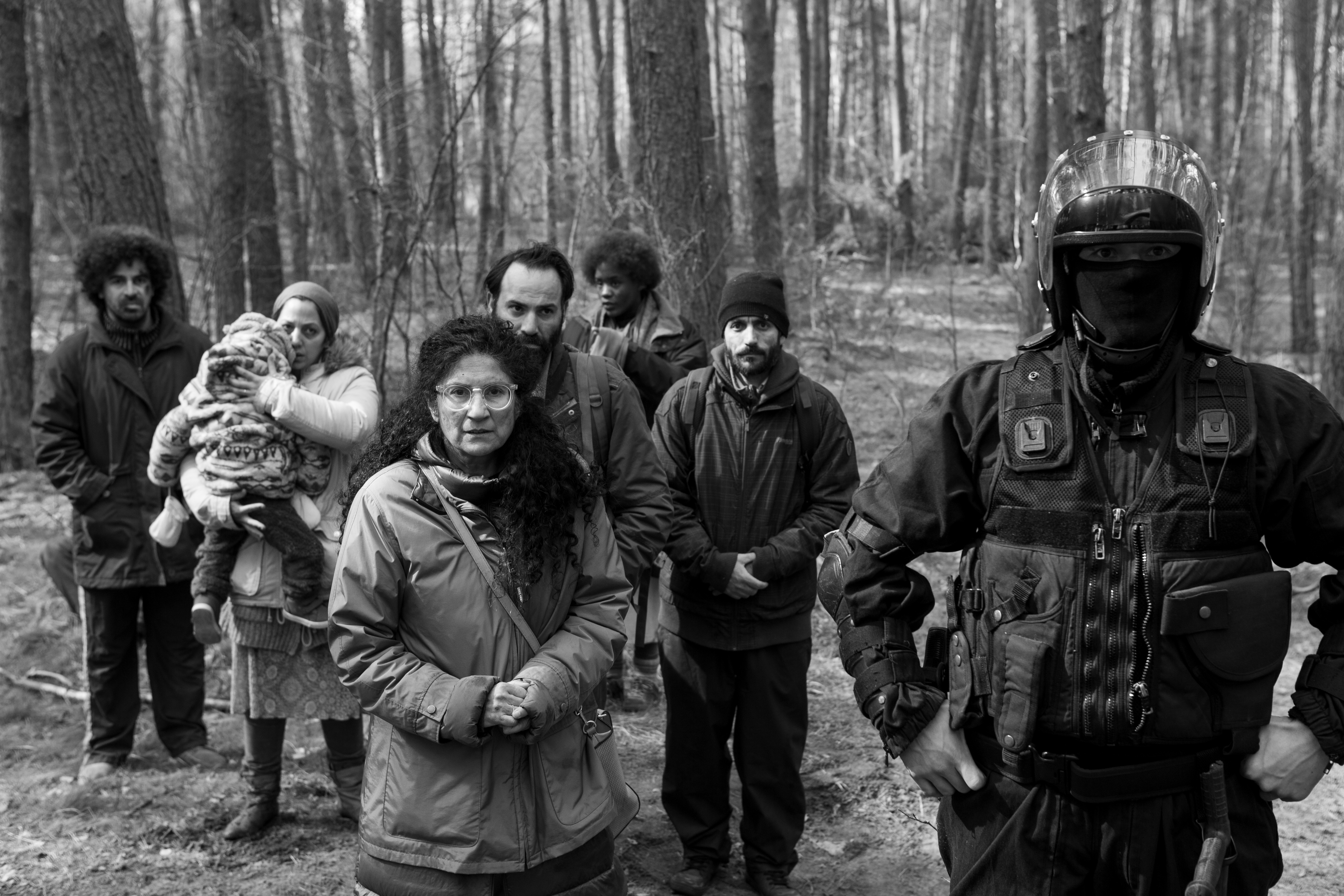
Leila (Behi Djanati Atai, glasses) and other migrants find themselves at the mercy of hostile border guards. (Photos courtesy of Kino Lorber)
By Richard Ades
The life of a migrant is an unending battle for survival.
That was the message delivered by 2023’s Io Capitano, the story of two Senegalese teens’ perilous attempt to reach Europe. And it’s a message that comes across even more terrifyingly in Agnieszka Holland’s Green Border.
The acclaimed director sets her tale in a specific time and place: the border between Poland and Belarus in 2021. The year is significant because that’s when Belarusian dictator Alexander Lukashenko encouraged desperate people from around the world to travel to his communist country, where they supposedly would be guaranteed safe passage to Poland and the rest of the European Union.
As the film opens, we meet several people who’ve taken advantage of Lukashenko’s offer by catching a flight to Belarus. Among them are Bashir and Amina (Jalal Altawil and Dalia Naous), a Syrian couple who are traveling with an older relative and three young children. There’s also Leila (Behi Djanati Atai), an Afghan teacher fleeing Taliban persecution.
Upon landing in Belarus, the Syrians allow Leila to share their prearranged ride to the Polish border. Once there, however, they realize that Lukashenko’s promise of safe passage was a hoax. After being forced to pay a bribe, they’re shoved through an opening in the barbed wire that separates the two hostile countries and left alone in a thick Polish forest with night coming on.
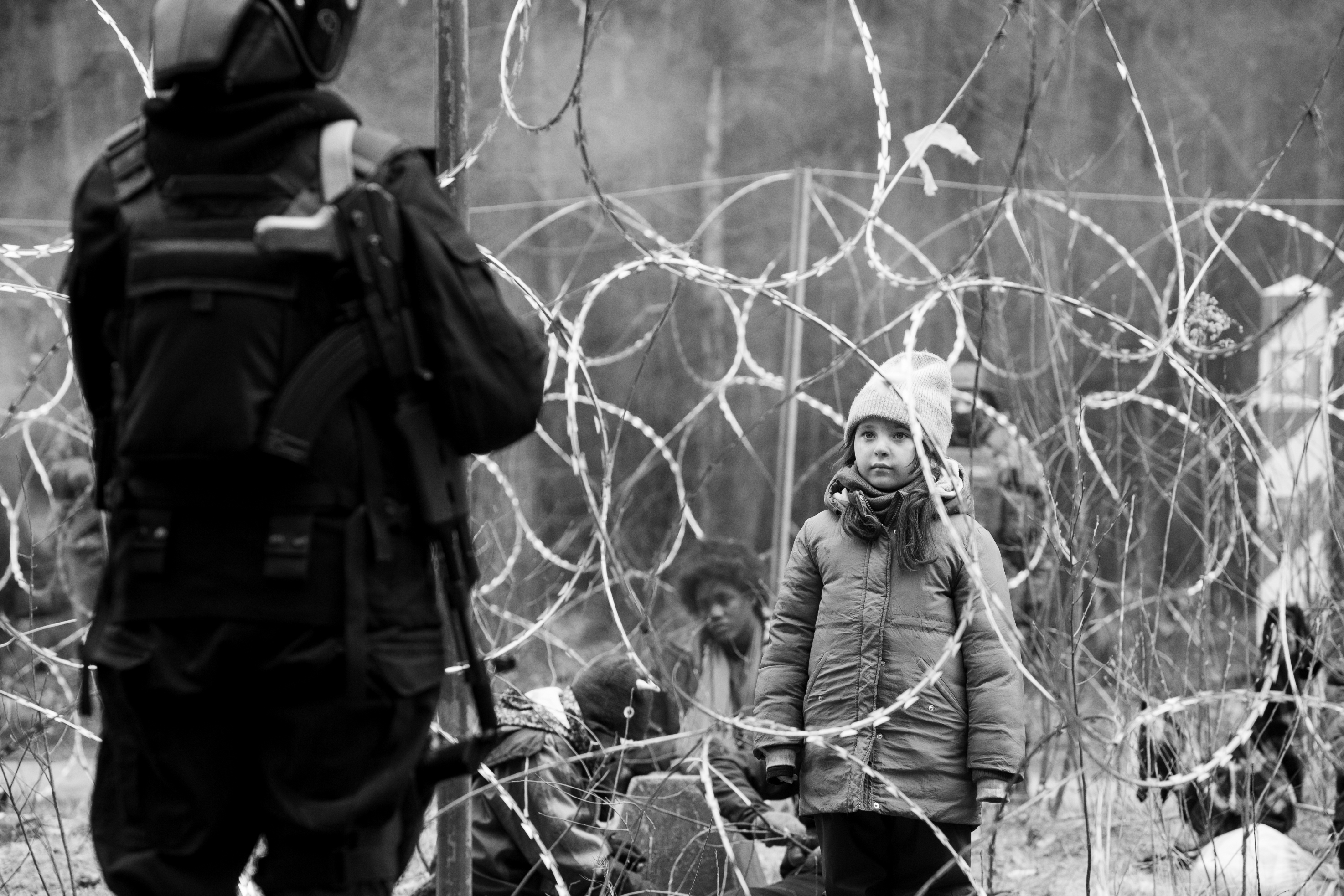
A young migrant girl peers through the barbed wire that separates Poland from Belarus.
But the real shock comes the next day, when they’re discovered by border guards who load them onto a truck and send them back to Belarus.
It soon becomes clear that neither country wants them and that they’re stuck in a kind of limbo, repeatedly being forced back and forth across the barbed-wire frontier. All the while, they’re cheated, derided and even brutalized by the guards and others they encounter.
Basically, this is a horror film, but one that replaces jump scares and gore with an unflinching look at the cruelty ordinary people can inflict on others whom they’ve dismissed as enemies and less than human. In such cases, not even children, elders or pregnant women are deemed worthy of compassion.
Working from a script she co-wrote with Maciej Pisuk and Gabriela Lazarkiewicz, Holland also looks at the migrants’ nightmarish situation from two additional viewpoints. One is through the eyes of Jan (Tomasz Wlosok), a young border guard who’s soon to be a father.
While attending a lecture given by his gung-ho superior, Jan is told that many of the migrants are pedophiles and other deviants, and that all amount to “live bullets” aimed at Poland by the dictator Lukashenko and his Russian buddy, Vladimir Putin. Despite this appeal to prejudice and patriotism, Jan is obviously torn as he goes about a job that frequently offends his sense of decency.
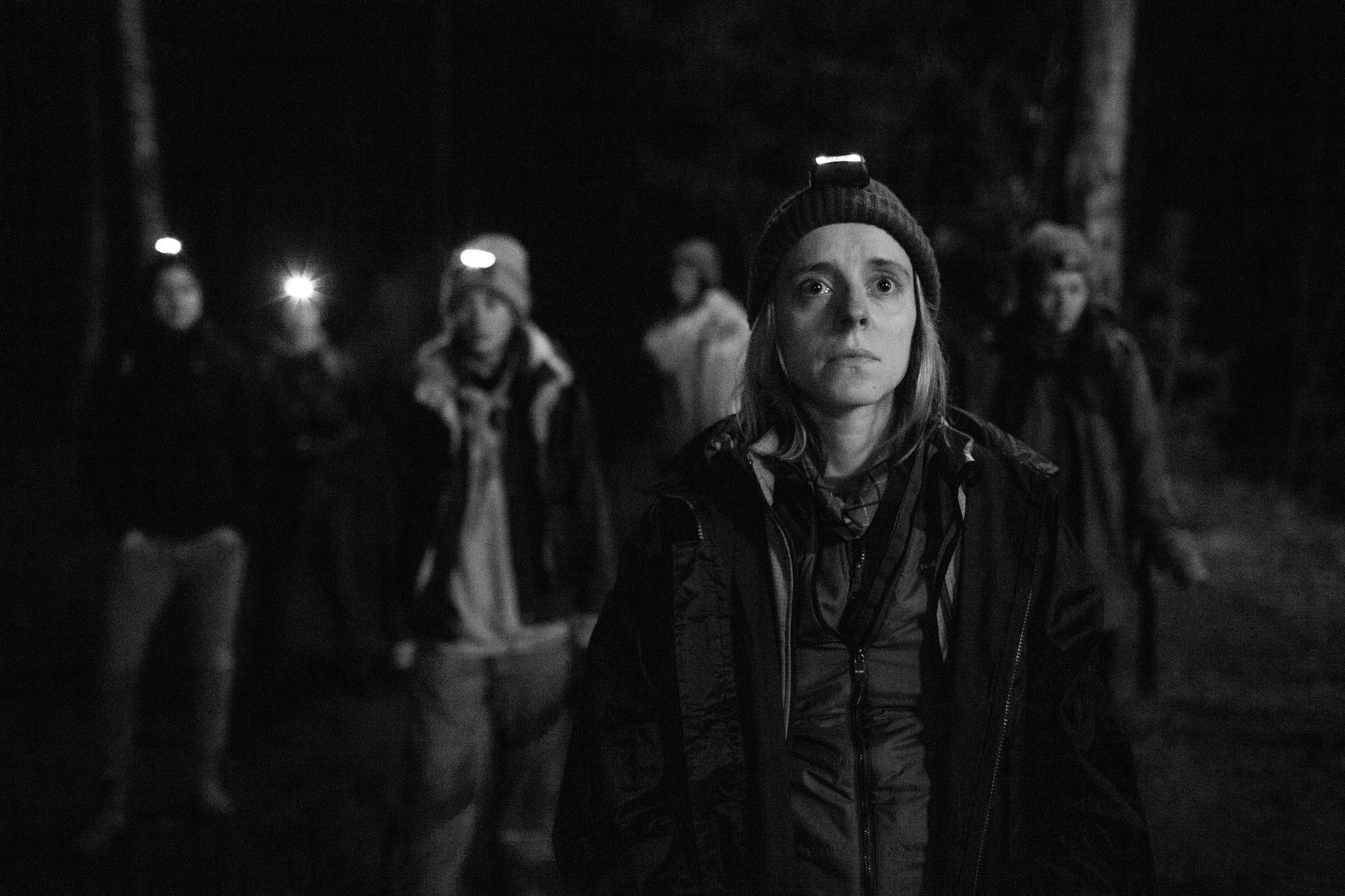
A group of Polish activists search for migrants caught in the no-man’s land between their country and Belarus.
The final viewpoint belongs to a group of activists who work undercover to aid the migrants. A widowed psychotherapist named Julia (Maja Ostaszewska) soon joins them, but she’s dismayed by their ineffectiveness and ultimately decides to take matters into her own hands.
All of the characters are portrayed with discipline and conviction by the cast, whose efforts are complemented by Tomasz Naumiuk’s black-and-white cinematography and Frederic Vercheval’s subtly expressive score.
Eventually, the stories of the migrants and others coalesce in ways that inject slivers of hope into the 2½-hour film. Otherwise, director/co-writer Holland offers few reasons for optimism about the plight of migrants in Europe or anywhere else.
Instead, she suggests that as long as governments can score political points by categorizing these desperate people as a subhuman threat, their suffering will continue.
Rating: 4½ stars (out of 5)
Green Border can be seen at select theaters, with more openings scheduled in the coming weeks. Columbus screenings are scheduled at 7 p.m. Friday, June 28 and 1 p.m. Saturday, June 29 at the Wexner Center for the Arts, and beginning July 5 at the Gateway Film Center. VOD screenings begin Aug. 20.


 Reel Time With Richard Ades