Painful memories of an eradicated past

An animated sequence depicts Pelagia Radecka, a young resident of Gniewoszów, Poland, searching for survivors of antisemitic violence in 1945.

By Richard Ades

My community is getting ready for the annual Columbus Jewish Film Festival, but a local theater is beating it to the punch with one of the most powerful Holocaust-related documentaries you’re likely to see this year.

Among Neighbors, directed by Yoav Potash (Crime After Crime), is about the tragic and lasting effects World War II had on the town of Gniewoszów, Poland. The film is at once a history lesson, a tale of survival and a portrait of humanity at its best and its absolute worst.

It’s also a mystery, one whose solution isn’t provided until the film’s final moments.

Because the documentary does so much, and because Potash waits so long to connect seemingly disparate parts, it sometimes comes off as disjointed. But the dramatic end justifies the director’s suspense-building means, and the film is never less than compelling along the way.  

Using a combination of contemporary interviews, archival footage and eloquent hand-drawn animation, Potash introduces us to Gniewoszów both past and present.
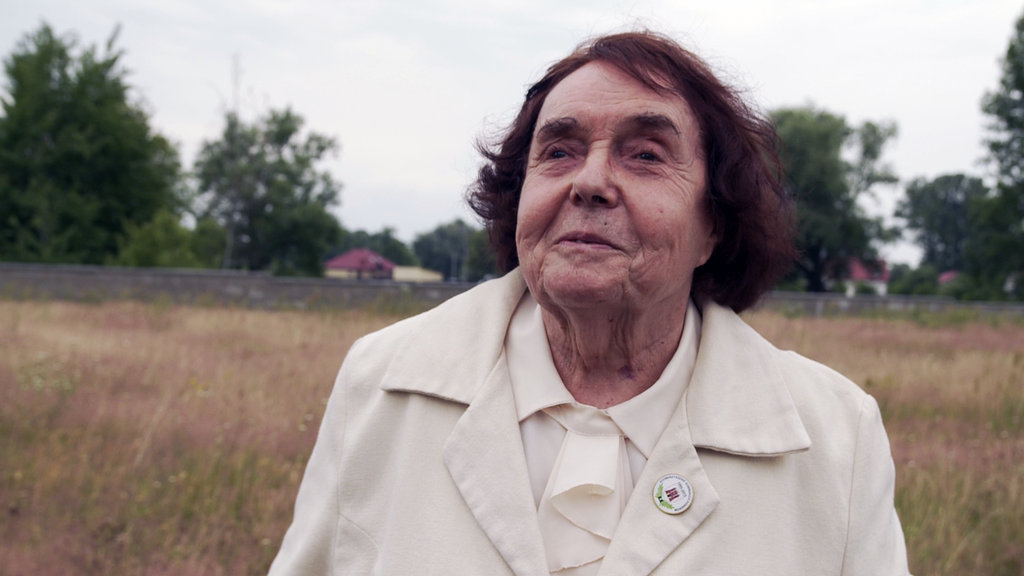
Pelagia Radecka, a Catholic resident of Gniewoszów, witnessed an act of antisemitic violence after the Nazis left her town.

In the past, Jews and Catholics lived together as neighbors and sometimes as friends, just as they had for centuries. But that all changed when Nazi Germany invaded Poland at the beginning of World War II and began instituting antisemitic restrictions that eventually evolved into roundups and death camps.

In response, a few Poles came to their Jewish neighbors’ defense, but more went along with the restrictions and even benefited from them. And some adopted the Nazis’ antisemitic and violent ways, even after the Germans had been driven out.  

As a result, Gniewoszów became a town whose Jewish residents have disappeared along with all traces of their former presence in the community. And most of its current residents are reluctant to talk about what happened to them, particularly since a 2018 law makes it illegal to suggest that Poles were in any way complicit in the Holocaust.

Yaacov Goldstein, a Jewish resident of Gniewoszów, survived the Holocaust and later moved to Israel.

Luckily for Potash, he’s able to find a few elderly residents who were alive during World War II and can be coaxed into telling what they remember. Two of them stand out:

˖ Yaacov Goldstein, a Jew who was a boy during World War II and later moved to Israel, tells the harrowing story of his parents’ efforts to survive and to protect him and his younger brother from the Nazis.

˖ Pelagia Radecka, a Catholic resident who was a teenager during the war, recalls being friends with the Jewish shopkeepers and their son who lived across the street. She also recalls witnessing a shocking act of antisemitic violence that occurred after the Germans had been driven out.

Bravely, Radecka is eager to talk about this act, even though she’s kept it to herself ever since, and even though talking about it amounts to a violation of Polish law.

Besides being a portrait of the highs and lows humans are capable of, Among Neighbors is a critique of societies that attempt to erase their sordid pasts. For Americans, living at a time when our own government is attempting to do the same, it could not be more timely.

Rating: 4½ stars (out of 5)  

Among Neighbors can be seen in select theaters, including Columbus’s Gateway Film Center, with screenings scheduled at 1:30 p.m. Oct. 25 and 26. For a list of other upcoming screenings, visit amongneighbors.com/screenings.

Love, loss and friendship in the shadow of war

Summerland Alice
Gemma Arterton as reclusive writer Alice Lamb in Summerland (Photo by Michael Wharley/Flying Castles Ltd.)

By Richard Ades

Alice Lamb doesn’t care much for people, and she especially has it in for children. So when she’s asked to take in an adolescent boy who’s fled German bombing raids, she agrees only because she’s given no other choice.

That’s the setup of Summerland, a drama set on the cliff-strewn coast of England during World War II. Written and directed by Jessica Swale, it spins its tale of friendship and lost love in a way that’s pleasant and beautiful but a bit too contrived to ring true.

Partial spoiler alert! Viewers may find some of the film’s contrivances easier to accept after a last-minute revelation places them in context. But until then, our sense of reality is challenged.

For starters, we simply don’t believe that Alice (Gemma Arterton) is as misanthropic as she seems. True, the writer lives alone in a seaside home and rails against anyone who dares to interrupt her work, but her angry words seem like mere affectations when spoken by this young woman with the pretty, unlined face. Thus, when a London evacuee named Frank (Lucas Bond) finds refuge under her roof, we have no doubt she’ll eventually warm up to him. The only question is when and how.

A series of flashbacks explain Alice’s lonely and bitter existence. At some time in the past, she found a soulmate in the form of warmhearted Vera (Gugu Mbatha-Raw), but their relationship apparently hit a snag. Back in the “present,” she eventually confides this loss to the inquisitive Frank, who reacts in a way that’s surprisingly mature for both his age and his era. She’s moved, while we’re given one more reason to doubt the tale’s authenticity.

More convincing than the friendship between Alice and Frank is the one Frank develops with his stubbornly individualistic classmate, Edie. That’s partly because Edie is wonderfully portrayed by Dixie Egerickx (star of an upcoming remake of The Secret Garden), but mostly because the two aren’t forced to mold their characters to suit the movie’s plot points.

Speaking of which, Alice and Frank soon begin discussing bits of the folklore that Alice studies and writes about, including “floating islands” and “Summerland,” a kind of pagan paradise. These inevitably make their way into the story, as do developments that are rather too convenient to be believed. (Second spoiler alert! But then, maybe they shouldn’t be, according to the aforementioned revelation.)

With a soaring score by Volker Bertelman and gorgeous seaside cinematography by Laurie Rose, Summerland is a lovely way to spend an hour and 40 minutes. Just don’t expect to see anything that bears much resemblance to real life.

Rating: 3 stars (out of 5)

Summertime (PG) is available from VOD outlets beginning July 31.


Future mime’s battle to thwart the Nazis

Resistance
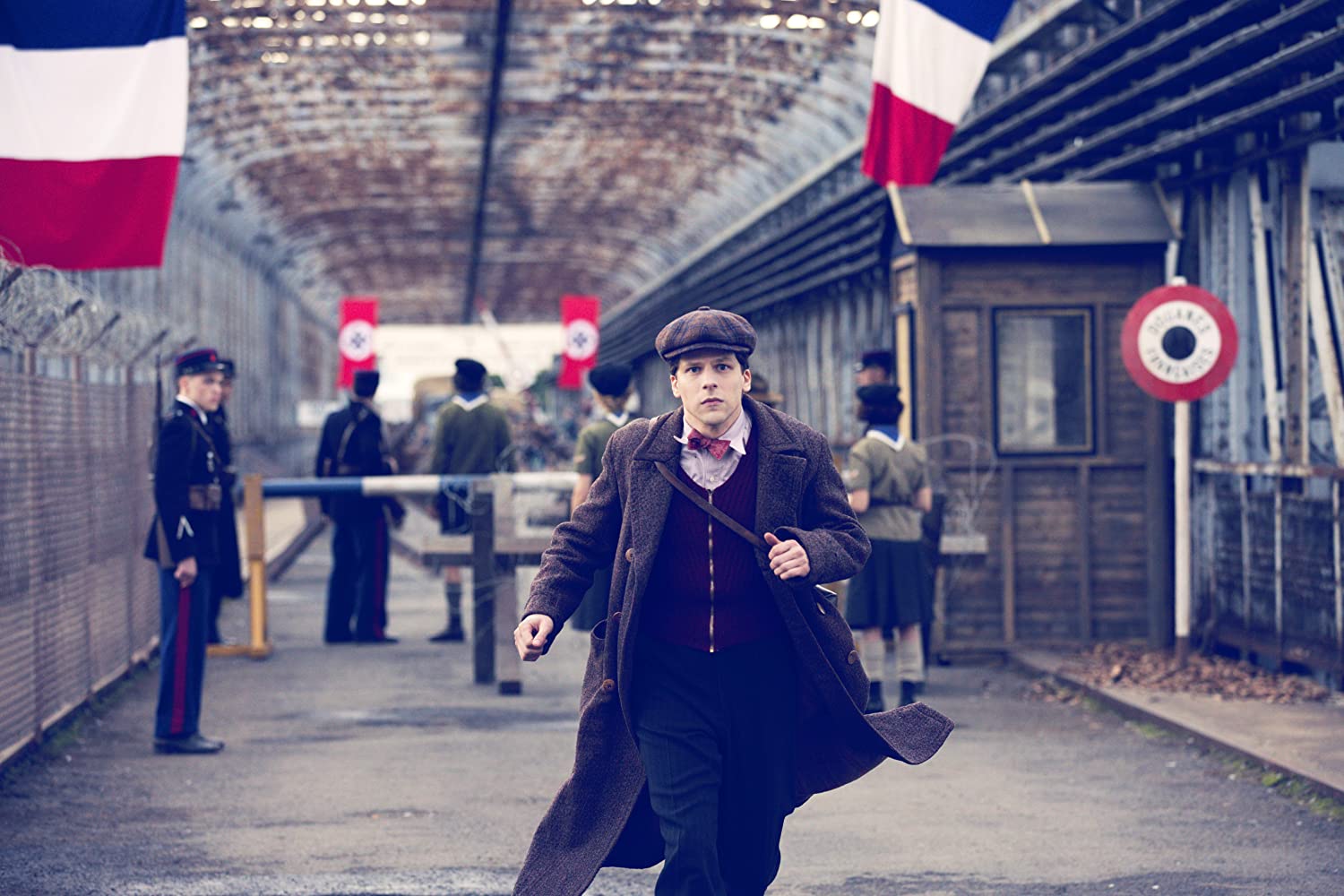
Jesse Eisenberg as Marcel Marceau in Resistance (Pantaleon Films)

By Richard Ades

There may be no performing artist who’s despised and ridiculed more than the mime. But maybe after seeing Resistance, people will start to give these silent storytellers the benefit of the doubt.

The World War II thriller focuses on that most famous mime of all time, Marcel Marceau, and reveals that he definitely had a story to tell, though he mostly kept to himself. It turns out that back when he was coming of age in occupied France, Marceau joined the Resistance and was instrumental in helping hundreds of Jewish children escape the Holocaust.

It’s a fascinating and unique story, despite the fact that writer/director Jonathan Jacubowicz fails to tell it in a manner that’s fascinating or unique—or even very believable.

True, we’re used to reality-based tales taking liberties with the facts in order to ramp up the drama (the bullet-riddled escape from Iran in Argo comes to mind). But Resistance is filled with so many clichés and cliffhangers that we start to doubt virtually everything we see. Just to take one: Did Marceau’s father, a butcher, really oppose his son’s desire to be an actor, or is that simply Jacubowicz’s attempt to add the kind of parent-child tension that invariably leads to a moving reconciliation?

Further feeding our doubts, the movie casts 36-year-old Jesse Eisenberg as Marceau, even though he was actually a teenager at the time. You may or may not feel Eisenberg is able to shed his usual persona and do a convincing job here (I’m not impressed), but it doesn’t help that the movie depicts Marceau as years older than he really was. You have to wonder what else is made up.

Another weakness: Despite focusing on someone who came to personify mime—a craft that calls on viewers to use their imagination—Resistance seems determined to spoon-feed us information.

Just in case we don’t know what the Holocaust was, the first scene shows a soon-to-be-orphaned Jewish girl (Bella Ramsey) asking her parents, “Why do they hate us?” And just in case we don’t know that the Nazis were evil, the film periodically cuts away from Marceau to show vicious Gestapo agent Klaus Barbie (Matthias Schweighofer) methodically shooting, beating or torturing people. For the record, Barbie was a real-life monster, but Schweighofer’s version comes off as the kind of psychopathic sadist who could just as easily double as the villain in a run-of-the-mill melodrama.

Despite all these problems, the film does succeed on some levels. The cast—including Clemence Poesy as Marceau’s love interest and fellow Resistance fighter, Emma—is good enough to make us care about the people trying to survive and oppose the Nazis’ reign of terror. As a result, viewers who are able to overlook the film’s excesses will watch many scenes in a heightened state of tension.

But the film’s real value lies in its revelation of the heroism displayed by a well-known figure and many others in response to the 20th century’s greatest evil. It provides the kind of inspiration that’s welcome now that we need all the heroes we can find.

Rating: 3 stars (out of 5)

Resistance (rated R for bloodless but troubling violence) opens March 27 at VOD outlets.


Quirky tale of a boy and his führer

Jojo Rabbit
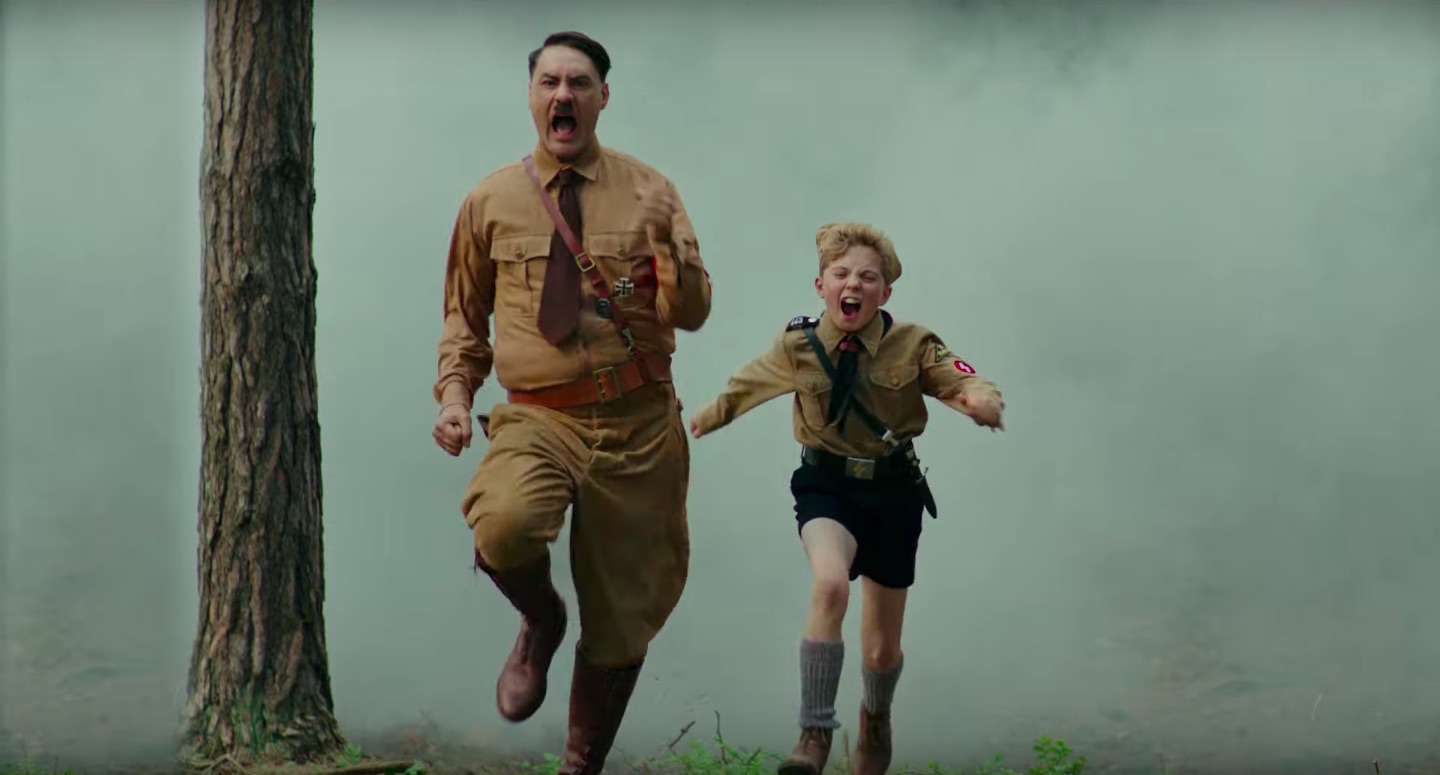
Jojo (Roman Griffin Davis, right) shares a run with his friend Adolf (Taika Waititi) in Jojo Rabbit. (20th Century Fox Film Corp.)

By Richard Ades

Those who hate war, prejudice and mass murder rightly view Adolf Hitler as one of history’s foremost villains. So it comes as a shock when a seemingly kind-hearted version of the dictator serves as a German boy’s imaginary friend in Jojo Rabbit.

Set in the chaotic final months of World War II, the dark comedy centers on the struggles of Jojo (Roman Griffin Davis), who lives with his mother (Scarlett Johansson) following the disappearance of his soldier/father under mysterious circumstances.

Jojo is a true believer in the Nazi cause and is looking forward to attending a government-run training camp for youths as the story opens. Once there, however, the 10-year-old balks at a demand that he prove his combat readiness by killing a defenseless rabbit. His refusal turns him into an object of ridicule by the instructors and everyone else.

Everyone that is, except the supportive friend that only he can see. Hitler (Taika Waititi) assures Jojo that he did the right thing and says he will be a better soldier than all the others if he learns to emulate rabbits’ survival instincts. “Be the rabbit,” he counsels the boy.

Directed by Waititi (Thor: Ragnarok), who adapted the story from Christine Leunens’s novel, Jojo Rabbit often functions as a satirical reflection on authoritarianism and prejudice. When the imagined Hitler isn’t soothing Jojo’s spirits, he’s parroting the party line on the supposedly horned and subhuman creatures known as Jews. It’s something Jojo and his real-life friend Yorki (Archie Yates) have long heard and mostly accept, even though it doesn’t always jibe with what they’ve witnessed for themselves.

Then Jojo happens to venture into an upstairs room while his mother is out and is horrified to learn she’s been hiding a Jewish teenager named Elsa (Thomasin McKenzie). As a loyal Nazi, he feels obligated to turn her in, but Elsa warns him that doing so will land his mother in trouble with the authorities. Elsa also thwarts his attempt to overpower her by deftly snatching away his party-issued knife. She’s like a “female, Jewish Jesse Owens,” Hitler later comments, sharing the boy’s indecision over how to handle the situation.

The resulting stalemate between Jojo and Elsa gradually becomes the central core of the story, taking it in new and emotionally charged directions thanks to sincere portrayals by actors Davis and McKenzie. Most of the other cast members also give carefully gauged performances, including Sam Rockwell as an eccentric German officer and Rebel Wilson as the gung-ho Fraulein Rahm. The one exception is Johansson, who never quite comes to life as Jojo’s secretive mother.

As for Waititi, he does fine in the on-screen portion of his triple contribution, making the imaginary Hitler humorously boyish without ignoring the danger he represents. As the screenwriter and director, he allows occasional sections of the film to fall flat, but he’s on target more often than not.

Given that its subject is the prime evil of the 20th century, it’s likely that not everyone will be comfortable with this quirky tale. But for those who can get into the spirit, it’s a subversive experience with an unexpectedly effective payoff.

Rating: 4 stars (out of 5)

Jojo Rabbit (PG-13) opens Oct. 31 in Columbus at the Drexel Theatre, Gateway Film Center, AMC Lennox Town Center 24 and Crosswoods Cinema.