Reviews

Democracy comes to Bhutan. Hilarity ensues.

An elderly Buddhist lama (Kelsang Choejey, who is a lama in real life) has a mysterious need for a firearm in The Monk and the Gun. (Photos courtesy of Roadside Attractions)

By Richard Ades

It was less than 20 years ago that the Himalayan country of Bhutan modernized and transformed itself from a kingdom into a democracy. The resulting repercussions are at the center of a warmly funny and slyly satirical film called The Monk and the Gun.

Written and directed by Pawo Choyning Dorji (2019’s Lunana: A Yak in the Classroom), the film introduces us to seemingly unrelated characters whose paths ultimately converge in a momentous and meaningful way.

There’s Tshering (Pema Zangmo Sherpa), an official charged with preparing remote villagers for the “mock election” that’s meant to serve as democracy’s dry run. There’s Choephel (Choeying Jatsho), who’s earned the wrath of his mother-in-law and neighbors by backing an unpopular candidate.

There’s also Benji (Tandin Sonam), a city dweller who hopes to make some quick cash by serving as a guide for a treasure-seeking American improbably named Ronald Coleman (Harry Einhorn).

Finally, giving the flick its name, there’s Tashi (Tandin Wangchuk), a Buddhist monk who’s ordered by his “lama” to find two guns by the time the full moon arrives in four days. Why, asks Tashi, who’s never even seen a gun. “To make things right,” the lama (Kelsang Choejey) replies cryptically.

Tashi (Tandin Wangchuk, right) barters over the ownership of a vintage rifle with American gun collector Ronald Coleman (Harry Einhorn, left) and his guide, Benji (Tandin Sonam).  

Because guns are a rarity in Bhutan, and because the treasure the American seeks is a rare Civil War rifle that somehow made its way into a local man’s home, it’s inevitable that Coleman and Tashi end up looking for the same weapon. That sets up a dilemma that eventually sends Coleman and his guide off on a risky and illegal mission, but not until it’s exposed the visitor to one of the many cultural shocks he encounters.

After finding the prized gun and offering to buy it for a small fortune, Coleman learns from his guide that the owner is reluctant to sell because he considers the amount too high. “Wait, what?” the American says, astounded that anyone would choose scruples over a life-changing infusion of money.

Meanwhile, elections official Tshering encounters cultural shocks of another kind as she tries to sell democracy to the local villagers. As Buddhists who’ve always devoted themselves to living in harmony, they can’t understand why they’re suddenly being asked to divide themselves into mutually hostile political factions.

Many of the flick’s satirical jabs are aimed at the U.S.: at our materialism, at the ever-growing viciousness of our political process, and especially at our love affair with guns. But Dorji also aims much of the humor at his own countrymen, especially those who think adopting Western-style ways will automatically guarantee them a better life.  

Driven by Dorji’s clever script, Jigme Tenzing’s serene choreography and convincing performances by the mostly amateur cast, The Monk and the Gun is a delight from beginning to its surprisingly uplifting ending.

Rating: 5 stars (out of 5)

The Monk and the Gun opens Feb. 9 in theaters nationwide, including Columbus’s Gateway Film Center.

She forged a new way to look at racism

Aunjanue Ellis-Taylor stars as author Isabel Wilkerson in Origin. (Photos by Atsushi Nishijima/courtesy of Neon)

By Richard Ades

Isabel Wilkerson’s 2020 book Caste: The Origins of Our Discontents was praised for its incisive comparison between racial repression in the U.S. and repressive systems in other countries. In particular, it looked at India’s caste system and Nazi Germany’s genocidal antisemitism.

Now writer-director Ava DuVernay has transformed that best-selling book into a semibiographical movie called Origin, which explains the challenges Wilkerson faced as she was formulating her provocative ideas. Besides facing pushback from African Americans and others who questioned her thesis, we learn, she lost several beloved members of her family.

DuVernay, who wrote the script with Wilkerson herself, apparently hopes these personal tragedies will inject enough drama into the film to prevent it from coming off as a mere lecture.

Wilkerson (Aunjanue Ellis-Taylor, right) is comforted by her husband, Brett (Jon Bernthal).

First, the bad news: It still comes off largely as a lecture despite solid acting by Aunjanue Ellis-Taylor (as Wilkerson) and the rest of the cast. But the good news is that the lecture imparts enough details about Wilkerson’s revolutionary thesis to be worthwhile. Those who haven’t read the book will find it enlightening, while those who have read it may see it as a useful recap.

In a nutshell, Wilkerson contends that our country’s history of repression toward Blacks—from slavery and racist laws to the recent murders of innocent African Americans such as Trayvon Martin—has much in common with other societies’ attempts to devalue certain groups and depict their members as less than human.

In India, that group is the Dalits (formerly known as the Untouchables), who often are denied educational opportunities and relegated to the most menial of jobs. In Nazi Germany, of course, that group was the Jews.

Throughout the film, historical incidents are recreated to give the victims and perpetrators of repression a human face. Among others, we meet a Black couple and a White couple who worked undercover to understand racism in the Jim Crow South. We also meet a Gentile man and a Jewish woman who fell in love in Germany during the rise of Naziism.

Nazis hold a public book burning in a scene from Origin.

Dramatically, perhaps the most effective of these recreations involves a young Black baseball player who wasn’t allowed to swim when his White teammates dropped by the local pool. Historically, the most shocking scene (for those unfamiliar with Wilkerson’s book) shows Nazi officials patterning Germany’s antisemitic laws after American laws that relegated Blacks to second-class citizenship.

In the more contemporary scenes involving Ellis-Taylor’s Wilkerson, the other major cast members include Jon Bernthal as her husband, Brett; Emily Yancy as her mother, Ruby; and Niecy Nash as her cousin, Marion.   

DuVernay’s 2014 film Selma was a fascinating look at Martin Luther King and the pivotal role he played in the Civil Rights movement. The director’s new film may not be as dramatically effective, but it is every bit as illuminating.

Rating: 3 stars (out of 5)

Origin (PG-13) can be seen in theaters nationwide.

Black writer rebels against tired stereotypes

Thelonius “Monk” Ellison (Jeffrey Wright) resents fellow writers who trade in racial stereotypes. (Photo by Claire Folger/Orion Pictures Inc.)

By Richard Ades

American Fiction’s opening credits are accompanied by funky music reminiscent of ’70s “blaxploitation” cinema. That efficiently sets us up for the flick’s satire of entertainment that trades in Black stereotypes.

If only the satire itself were delivered as efficiently. Instead, director/co-writer Cord Jefferson mixes it in with a series of family and personal tragedies and challenges that delay and dilute its message.

It’s all pleasantly entertaining, thanks largely to a fine cast led by Jeffrey Wright. It’s just not as pointed as it might be.

Wright plays Thelonius “Monk” Ellison, an L.A.-based writer of brainy books that struggle to find an audience. While attending a book festival in Boston, his hometown, Monk is frustrated to find that most of the attention is being grabbed by up-and-coming author Sintara Golden (Issa Rae) and her best-selling tale of inner-city life, We’s Lives in da Ghetto.

Author Sintara Golden (Issa Rae, left) and a fawning interviewer (Nicole Kempskie) discuss Sintara’s acclaimed novel, We’s Lives in da Ghetto. (Photo courtesy of Orion Pictures Inc.)

Sintara’s success, combined with Monk’s failure to find a publisher for his latest ultra-intellectual effort, confirms his view that African American writers can’t sell books unless they fill them with stereotypical representations of Black existence. In other words, they have to be immersed in crime, poverty, anger, drugs and violence.

In an effort to dramatize the absurdity of the situation, Monk dashes off an exaggerated version of such a book and instructs his agent (John Ortiz) to market it under the pen name Stagg R. Leigh. Anyone who’s seen The Producers will probably guess what happens next: Much to Monk’s chagrin, this supposed loser is snapped up by eager publishers who see it as a surefire hit.

This forces Monk to play the part of the fictitious author, who’s supposedly a street-wise escaped felon, while interacting with various bigwigs who not only want to publish the book but to turn it into a Hollywood blockbuster. The result is comedic and satirical gold.

Monk’s brother, Clifford (Sterling K. Brown), makes an unexpected appearance in the family pool. (Photo courtesy of Orion Pictures Inc.

Before we get to that point, however, Monk’s life is hit with several complications, including an unexpected death, a mother (Leslie Uggams) who’s stricken with Alzheimer’s, an estranged brother (Sterling K. Brown) who recently came out as gay and an amorous neighbor (Erika Alexander).

These and other developments are generally handled well, but they do nothing to advance the flick’s frontal attack on an entertainment industry that too often deals in racial stereotypes.

The film reclaims its satirical edge with an unconventional finale that debates just what kind of story it meant to tell. That’s a clever and all-too-appropriate way to wrap things up, since it’s apparent that first-time filmmaker Jefferson, as talented as he is, never quite made up his mind.

Rating: 3½ stars (out of 5)

American Fiction (rated R) opens Dec. 11-12 in theaters nationwide.

Critics name the best of 2023

The 22nd annual Columbus Film Critics Association Awards, honoring the best in film for 2023, were announced on Jan. 4. The winners are listed below.

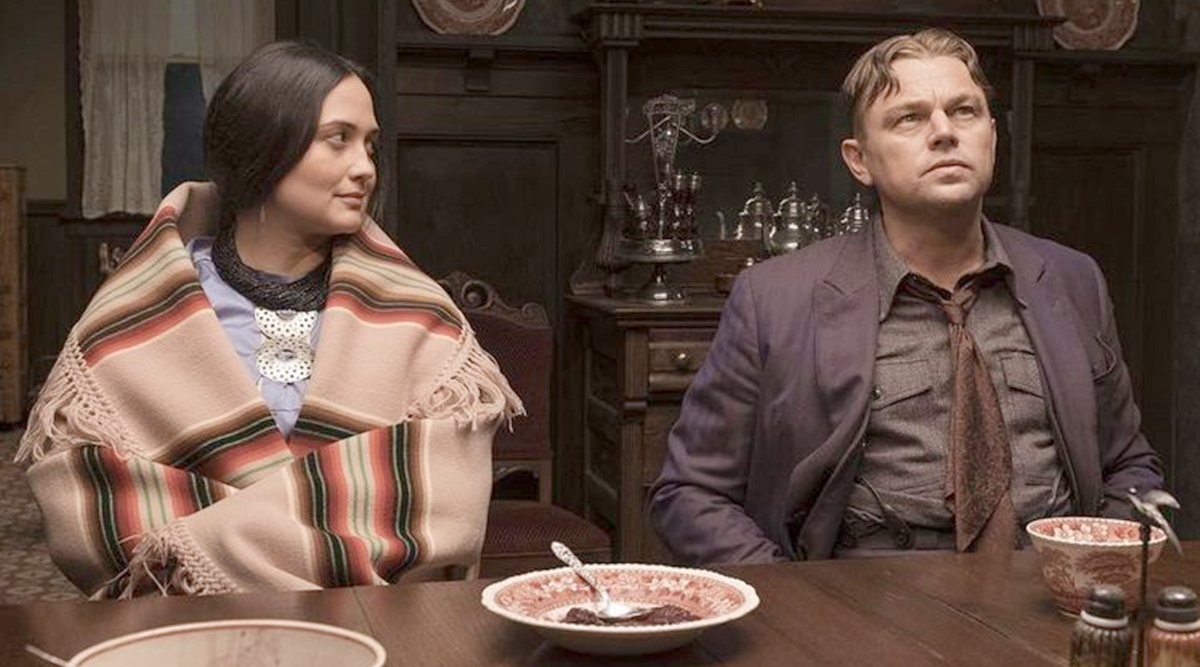
Lily Gladstone (left) and Leonardo DiCaprio in Killers of the Flower Moon, winner of several honors in the Columbus film critics’ annual poll

Best Film

  1. Killers of the Flower Moon
  2. The Holdovers
  3. Poor Things
  4. Past Lives
  5. Oppenheimer
  6. Barbie
  7. American Fiction
  8. The Zone of Interest
  9. Spider-Man: Across the Spider-Verse
  10. The Iron Claw

Best Director

  • Martin Scorsese, Killers of the Flower Moon
  • Runner-up: Greta Gerwig, Barbie

Best Lead Performance

  • Emma Stone, Poor Things
  • Runner-up: Lily Gladstone, Killers of the Flower Moon

Best Supporting Performance

  • Jodie Foster, Nyad
  • Runner-up: Da’Vine Joy Randolph, The Holdovers

Best Ensemble

  • Killers of the Flower Moon
  • Runner-up: Poor Things

Actor of the Year (for an exemplary body of work)

  • Sandra Hüller, Anatomy of a Fall (Anatomie d’une chute) and The Zone of Interest
  • Runner-up: Jeffrey Wright, American FictionAsteroid City and Rustin

Breakthrough Film Artist

  • Lily Gladstone, Killers of the Flower Moon – (for acting)
  • Runner-up: Celine Song, Past Lives – (for directing and screenwriting)

Best Cinematography

  • Robbie Ryan, Poor Things
  • Runner-up: Rodrigo Prieto, Killers of the Flower Moon

Best Film Editing

  • Thelma Schoonmaker, Killers of the Flower Moon
  • Runner-up: Jennifer Lame, Oppenheimer

Best Adapted Screenplay

  • Kelly Fremon Craig, Are You There God? It’s Me, Margaret.
  • Runner-up: Eric Roth and Martin Scorsese, Killers of the Flower Moon

Best Original Screenplay

  • David Hemingson, The Holdovers
  • Runner-up: Justine Triet and Arthur Harari, Anatomy of a Fall (Anatomie d’une chute)

Best Score

  • Robbie Robertson, Killers of the Flower Moon
  • Runner-up: Ludwig Göransson, Oppenheimer

Best Documentary

  • (Tie): Anselm (Anselm – Das Rauschen der Zeit) and Kokomo City
  • Runners-up (tie): 20 Days in Mariupol and Still: A Michael J. Fox Movie

Best Foreign Language Film

  • Afire (Rotter Himmel)
  • Runner-up: Anatomy of a Fall (Anatomie d’une chute)

Best Animated Film

  • Nimona
  • Runner-up: Spider-Man: Across the Spider-Verse

Frank Gabrenya Award for Best Comedy

  • The Holdovers
  • Runner-up: American Fiction

Best Overlooked Film

  • Are You There God? It’s Me, Margaret.
  • Runner-up: Showing Up

Wrestling family on the road to tragedy

The wrestling Von Erich brothers are (from left): David (Harris Dickinson), Kevin (Zac Efron), Mike (Stanley Simons) and Kerry (Jeremy Allen White). (Photo by Eric Chakeen)

By Richard Ades

When wrestler Kevin Von Erich (Zac Efron) tells his future wife how much he cares about his younger brothers, she says he must have “oldest son syndrome.” She’s right, it turns out, as every time one of his sibs succumbs to what Kevin calls the family curse, the pain and concern are etched all over his face.

Curses are imaginary, of course, but it’s hard not to believe in them after watching The Iron Claw. The tale eventually racks up so much tragedy that writer/director Sean Durkin might be accused of melodramatic overkill if he hadn’t based his script on the Von Erichs, a real-life family of wrestlers that won notoriety in the 1980s.

A black-and-white prologue explains the Texas-based dynasty’s origins. Fritz Adkisson (Holt McCallany), who competes under the stage name Von Erich, believes he can make his fortune in the ring if only he commits himself to the task. He’s so convinced of his future success that he surprises wife Doris (Maura Tierney) with a Cadillac that she knows they can’t afford.

Kerry (Jeremy Allen White, left) and David (Harris Dickinson) share a triumphant moment in the ring. (Photo by Brian Roedel)

The film then fast-forwards a couple of decades to find Fritz equally committed to turning his now-grown sons into successful wrestlers. At first, that means only Kevin and second-oldest David (Harris Dickinson), but eventually Fritz wheedles younger brothers Kerry (Jeremy Allen White) and would-be musician Mike (Stanley Simons) into joining the family business.

How? Apparently Fritz relies on parental authority and none-too-subtle appeals to sibling rivalry. In an early scene, he goes so far as to rank his sons in order of preference, telling them their rankings are subject to change depending on their actions. In other words, he’s not exactly in the running for Father of the Year.

Just as future wife Pam (Lily James) predicted, Kevin ends up feeling protective toward his younger brothers when he thinks his dad is treating them like pawns. For the most part, though, he says nothing, either on their behalf or his own, even after Fritz begins granting the others opportunities that had been promised to him.

Pam (Lily James) and her husband, Kevin (Zac Efron) (Photo by Brian Roedel)

In fact, no one says anything, allowing Fritz to push his offspring into situations that prove increasingly dangerous for them and the family as a whole. The result is a slow-motion disaster that would be painful to watch if it weren’t so beautifully acted.

Leading the cast, a bulked-up Efron aces the part of the self-effacing, self-doubting Kevin, while McCallany makes Fritz an understated portrait of modern Machiavellianism. Equally effective are Dickinson, White and Simons as the younger brothers, Tierney as the emotionally distant mother and James as the warm-hearted Pam.

The moral of the story seems to be that wrestling may be a make-believe sport, but the dangers it presents can be all too real—especially when you’re pushed into it by someone guided solely by his own self-interest.

Rating: 4 stars (out of 5)

The Iron Claw (rated R) opens Dec. 22 in theaters nationwide.

The Irish town where music is a way of life

By Richard Ades

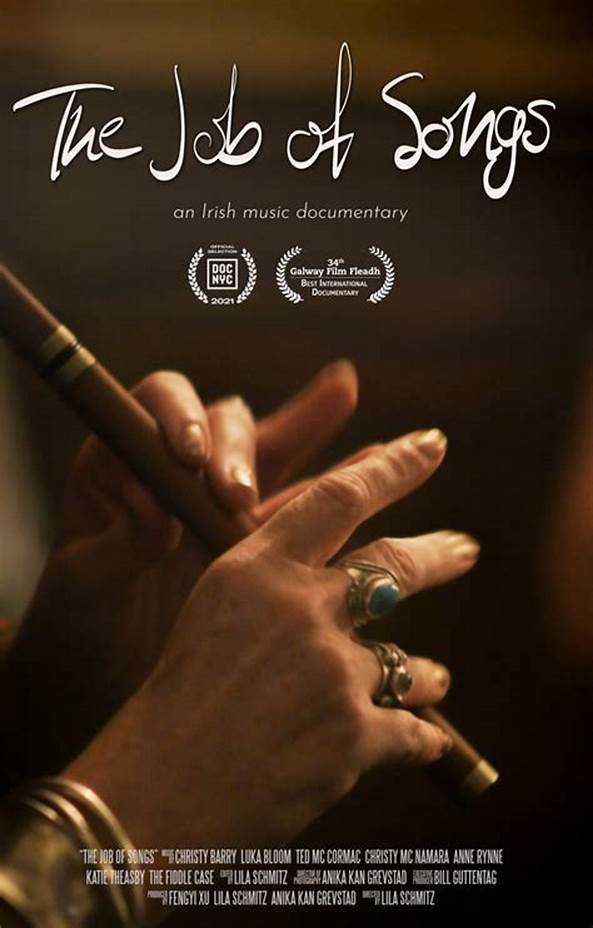
It’s a pity I couldn’t have seen The Job of Songs before taking a trip to Ireland a few years back.

My partner and I were eager to hear authentic Irish music in authentic Irish pubs, but we had little idea where to look. We didn’t know that close to the popular tourist destination known as the Cliffs of Moher is a village steeped in Irish musical traditions.

The tune-filled documentary—directed, edited and co-written by Lila Schmitz—introduces us to Doolin, located in County Clare on the west coast of Ireland. A musician who performs under the stage name Luka Bloom says he moved to the town decades ago after discovering that its entire population was into music just as much as he was.

Apparently, Doolin’s musical fame has spread across the pond and beyond. Local radio deejay Eoln O’Neil is shown spinning Irish tunes on a show that attracts listeners from around the world.

The town is also popular with tourists, who have begun dropping by for a quick fix of music on their way to or from the Cliffs of Moher. It’s a trend that some locals look down on, one complaining that the visitors ought to stick around long enough to meet some actual Irish people.

Speaking of which, the film introduces to several Doolin residents of all ages who devote their lives to playing music. The oldest is Ted McCormic, who has only one leg but doesn’t let either his disability or his 80-plus years stop him from sharing his still-strong voice at local jams.  

Other featured musicians include Anne Rynne, who begin playing and writing songs in her 60s after receiving a guitar from her brother, Bloom.

Radio host O’Neil points out the inescapable fact that beautiful but mournful airs make up much of the traditional Irish repertoire. “It’s in our DNA,” he says.

Unfortunately, the sad tunes are more than simply a musical taste, as depression, alcoholism and even suicide are described as widespread problems in the area.

Red-haired Katy Theasby talks about her own struggles with depression and overindulgence, but she says music was her salvation. After obtaining a new tin whistle, she says, she found that for the first time she was able to play without drinking.

Whether for their mental health, personal fulfillment or other reasons, all of the Doolin musicians clearly feel that playing is as necessary as breathing. According to one, listening to music is also important for non-musicians, explaining that the “job of songs” is to allow these folks to feel even though they don’t have songs of their own.

In much the same way, the job of Schmitz’s documentary is to allow viewers to “visit” the musical mecca known as Doolin even though they’ve never actually been there.

Rating: 4 stars (out of 5)

The Job of Songs (no MPAA rating) is available from various digital platforms. For information, visit thejobofsongs.com.

Bernstein biopic plagued by hamminess on both sides of the camera

Maestro stars Bradley Cooper and Carey Mulligan as conductor/composer Leonard Bernstein and his wife, Felicia Montealegre.

By Richard Ades

While waiting to see Maestro—Bradley Cooper’s take on the life of Leonard Berstein and his wife, Felicia Montealegre—I had a scary thought: What if it turned out to be another Being the Ricardos?

In that 2021 film, writer/director Aaron Sorkin focused so much on the marital woes of Lucille Ball and her husband, Desi Arnaz, that he all but ignored the comedic joy she brought to the world. So I worried: Would Cooper pull a Sorkin by focusing so much on Bernstein’s marital challenges that he’d ignore all the musical joy the composer/conductor created?

The good news is that Cooper, as the biopic’s director and co-writer (with Josh Singer), does leave ample room for Bernstein’s beautiful music. The bad news is that he leaves little room for the joy that should have accompanied the music. Instead, the musical interludes appear like oases amid a chilly atmosphere of marital tension and discord.

Perhaps even worse, even though Leonard is played by Cooper himself and Felicia by the great Carey Mulligan (Promising Young Woman), we only sporadically feel like we understand them as either individuals or marital partners.

A big problem is Cooper’s portrayal of Leonard as a nasal-voiced caricature who seems to be consumed by frantic energy. Mulligan’s Felicia is more restrained, but it’s not really clear why the Costa Rican-born thespian decided to spend her life with this flighty musical genius.

As the movie’s first scene points out, Leonard is attracted to men and eager to act on that attraction. Felicia is apparently aware of this and seems OK with it, but you don’t have to be clairvoyant to suspect it eventually will cause tension in the marriage.

Felicia Montealegre and Leonard Bernstein (Carey Mulligan and Bradley Cooper) enjoy one of their first outings. The couple’s early years are depicted in black and white.

Another reason we have trouble understanding the characters is the self-consciously artsy way in which director Cooper and cinematographer Matthew Libbatique tell their story.

The black-and-white photography of the early scenes, the transitions that allow characters to magically walk through a doorway into another location altogether, the heated conversations that are seen from a fixed viewpoint on the other side of the room: All may be impressive in and of themselves, but they cumulatively have a “look at me” quality that detracts attention from the central characters.

Maybe it would have helped us get to know the two if the film had spent less time on their challenging marriage and more on their respective careers. But we see little of Felicia’s acting or of Leonard’s musical collaborations. Even his best-known work, the great Broadway musical West Side Story, gets only a brief mention as an adaptation of Romeo and Juliet.

The film eventually does allow Leonard and Felicia and their relationship to come warmly alive, but only after a serious health problem threatens to separate them forever. The change is welcome, but it comes very late in the two-plus-hour running time.

As a conductor, Bernstein said his goal was, in effect, to become the composer so that he and the orchestra could do justice to the artist’s work. As a writer, director and actor, Cooper no doubt wanted to do equal justice to Bernstein and Montealegre, but he was too busy showing off to accomplish the task.

Rating: 2½ stars (out of 5)

Maestro (rated R) opens Nov. 22 in select theaters and Dec. 8 at Columbus’s Drexel Theatre and Gateway Film Center. It will be available through Netflix beginning Dec. 20.

‘Doubtfire’ actor reprises Tony-nominated star turn

Daniel (Rob McClure) effects a Scottish accent to convince ex-wife Miranda (Maggie Lakis) to hire the fictitious Mrs. Doubtfire as their children’s nanny. (Photos courtesy of Broadway in Columbus)

By Richard Ades

Mrs. Doubtfire’s brief 2021-22 Broadway run was most acclaimed for Rob McClure’s Tony-nominated performance in the starring role. So it’s fortunate that McClure is re-donning the title nanny’s wig, mask and padding for the North American tour.

As unemployed actor Daniel Hillard, McClure trots out a cornucopia of voices and impersonations, all delivered with manic energy almost worthy of the late Robin Williams, who originated the role in the 1993 film.

Fueling the plot is the fact that Daniel is a devoted father but a so-so husband, leading wife Miranda (Maggie Lakis) to seek a divorce. When a judge threatens to award Miranda sole custody of their kids unless Daniel can get his financial act together, the distraught dad concocts a plan to keep on seeing them.

With makeup and hairstyling help from brother Frank (Aaron Kaburick) and his husband, Andre (Nik Alexander), Daniel invents an aging Scotswoman named Mrs. Doubtfire. In this disguise, he lands the job of taking care of his offspring while Miranda is busy launching her own clothing line.

Daniel (Rob McClure) shares dance steps with a group of chefs in one of the show’s production numbers.

Emotion would seem to be built into the story, dealing as it does with Daniel’s attempt to hold onto his family. But the musical’s writers (Kary Kirkpatrick and John O’Farrell) and director (Jerry Zaks) put more of the focus on comedy and spectacle.

The comedy largely revolves around Daniel’s attempts to bamboozle a court liaison (Romelda Teron Benjamin) charged with checking up on him. As for the spectacle, it involves dance numbers that are sometimes shoehorned in on the thinnest of excuses. For example, when Daniel tells Frank and Andre he needs a female alter ego, they conjure up dancing celebrities ranging from Donna Summer to Eleanor Roosevelt and Janet Reno before he can explain what he has in mind.

All of this is fun when it works, as it often does. There are many amusing moments, and the dance numbers are spirited thanks to Lorin Latarro’s choreography and Wayne Kirkpatrick and Kary Kirkpatrick’s tunes.

It’s just that the show would be more satisfying if it provided more feels.

Giselle Gutierrez as Lydia, Daniel and Miranda’s older daughter

One emotional high point comes midway through Act 1 with “What the Hell,” a heartfelt song that expresses how Daniel and Miranda’s divorce is affecting their children. Teenage daughter Lydia (a wonderful Giselle Gutierrez) is angry, while younger siblings Chris and Natalie feel they are somehow to blame for the breakup. (Chris is played at alternate performances by Cody Braverman and Axel Bernard Rimmele, Natalie by Emerson Mae Chan and Kennedy Pitney.)  

By the end, the musical does manage to supply another heartwarming moment or two. Otherwise, the focus is on laughs, leaps and Rob McClure’s amazing capacity for comedic schtick.   

Broadway in Columbus will present Mrs. Doubtfire through Nov. 5 at the Ohio Theatre, 39 E. State St., Columbus. Showtimes are 7:30 p.m. through Thursday, 8 p.m. Friday, 2 and 8 p.m. Saturday, and 1 and 6:30 p.m. Sunday. Running time: 2 hours, 35 minutes (including intermission). For tickets or more information, visit columbus.broadway.com. For information on future tour stops, visit mrsdoubtfirebroadway.com/tour.

The hills are alive with the sound of sexual revolution

Novice nun Elisabeth (Lilith Grasmug) is forced to return home to her family following the mysterious death of her older sister. (Photos courtesy of Dekanalog)

By Richard Ades

Switzerland’s nominee for 2023’s international Oscar is Thunder, the quietly striking debut feature of writer-director Carmen Jaquier.

Critics have compared the French-language film to various acclaimed predecessors, and Jaquier herself has said its style was inspired by Pier Paolo Pasolini’s The Gospel According to St. Matthew and Carlos Reygadas’s Silent Light.

Given that its heroine is a novice nun who’s forced to leave an Alpine nunnery and rejoin secular life, the most obvious comparison is to The Sound of Music, but the similarities are only on the surface. While that blockbuster musical’s Maria discovers love, family and marriage, Thunder’s Elisabeth (Lilith Grasmug) discovers something decidedly earthier.

Set in a conservative village around the turn of the last century, the tale begins with a series of images showing the difficult lives of its inhabitants, particularly its girls and women. The montage ends with a disturbing shot of a young woman chained to the kitchen where she’s working.

The scene then switches to a distant nunnery, where 17-year-old Elisabeth is told she must return to her family because Innocente, her older sister and best friend, has died. The girl has to be carried out forcefully, apparently because she has no desire to leave the safety of religious life. Even as she trudges through mountainous terrain toward home, Elisabeth asks God to hide the secrets of the world from her because she wants no part of it.

Yet as soon as she returns to the family she hasn’t seen in years, Elisabeth begins trying to uncover the secret that’s been haunting her: What happened to Innocente? Her curiosity only grows when her mother (Sabine Timoteo) refuses to discuss the matter, and when a passing villager charges that her late sibling was a deviate who would have sex with anyone, including the devil.

Answers finally begin to appear when Elisabeth finds a diary in which Innocente describes in graphic detail her discovery of a part of life that is repressed in their rigidly religious society—sex. Intriguingly for the spiritually minded Elisabeth, Innocente writes that the discovery makes her feel closer, not farther, from God.

Will Elisabeth follow in her late sister’s dangerous path? Her parents fear that she will, especially after she befriends three young men who fell under the sexually adventurous Innocente’s influence.

Despite dealing with physical passion and such serious subjects as repression and misogyny, Thunder’s style is quiet and meditative. Cinematographer Marine Atlan’s images of the Alpine landscape and composer Nicolas Rabacus’s score complement each other in their calm beauty.

Leading the cast, Grasmug projects understated strength and determination as Elisabeth. Behind her, the supporting cast is uniformly convincing.

Despite the film’s strengths, some viewers may have reservations, feeling that writer-director Jaquier stacks the deck in her depiction of a mini-sexual rebellion in turn-of-the-century Switzerland.

Would teenagers really be able to handle the type of shared intimacy being shown without jealousy or hurt ever arising? And while the adults’ disapproval seems to be motivated solely by their religion, wouldn’t any modern parent be just as concerned, if for different reasons?

But Jaquier doesn’t address such questions, being focused solely on the age-old battle between repression and freedom, particularly as it relates to girls and women. And she depicts that struggle beautifully in a film whose subdued style in no way diminishes the strength of its convictions.

Rating: 3½ stars (out of 5)

Thunder (no MPAA rating) opened Oct. 25 in New York City, with a national rollout set to follow.

A Scottish woman’s struggle to survive

Kirsty (Hermione Corfield, in white dress) attends a village celebration in The Road Dance. (Photos courtesy of Music Box Films)

By Richard Ades

In 1904, on a beach in Scotland’s Outer Hebrides, a man and his young daughter have just finished a swimming lesson. When the father asks the girl what she’s learned, she names the three most important lessons: paddle with your arms, kick with your feet and, perhaps most importantly, breathe.

Thus begins The Road Dance, setting the stage for the survival struggle that faces Kirsty (Hermione Corfield), the grownup version of the girl, 12 years later. Her problems stem from a farewell celebration held for her beau, Murdo (Will Fletcher), and other local men who’ve been called up to fight in World War I.

Despite the circumstances—and despite the obvious jealousy of Kirsty’s rejected suitor (Tom Byrne)—it’s a joyous occasion. But then Kirsty goes off by herself to answer the call of nature and is subjected to an attack that leaves her dazed and irrevocably changed. The encounter sends her on a dark journey that she attempts to hide even from her loving mother and sister (Morven Christie and Ali Fumiko Whitney).

Directed and written by Richie Adams, who based his script on a novel by John Mackay, The Road Movie is steeped in atmosphere.

Petra Korner’s cinematography immerses us in the rustic island community, with its stone fences and houses, windswept hills and lonely beaches. Composer Carlos Jose Alvarez’s mournful score is as distinctly Scottish as the inhabitants’ dialects.

Further clarifying the time and place are bits of dialogue that define the community’s religious core—for example, when a minister sermonizes about a village girl’s fateful surrender to temptation, or when an old woman demands to know if Kirsty is carrying her Bible. (She is.)

Murdo and Kirsty (Will Fletcher and Hermione Corfield) take a walk.

One result of the focus on atmosphere is that following Kisty’s attack, we assume what happens next will be as predictable as the sunset over the Atlantic. How could it be otherwise, given who she is and when and where she lives? And for a long section of the story, that appears to be the case.

Eventually, though, things change. Rather than being predictable, The Road Dance proves to be full of unexpected developments. Some of them, truthfully, are a bit contrived, but fine, naturalistic acting by Corfield and the rest of the cast help to keep the tale centered.  

Though not perfect, The Road Dance is worthwhile not only for the tragic story it tells but for the beautiful and richly atmospheric way in which it tells it.

Rating: 4 stars (out of 5)

The Road Dance (no MPAA rating) will be available through select theaters and VOD outlets beginning Oct. 13. It will be screened at Columbus’s Gateway Film Center beginning Nov. 3.