Girl meets rodeo veteran in tale of teenage desperation

BULL_press4
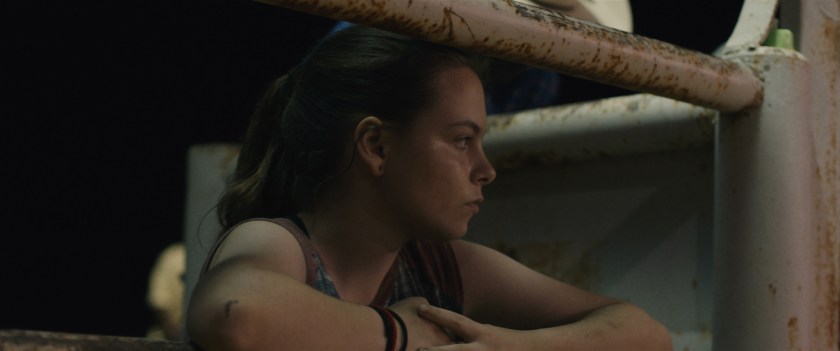
Amber Havard plays Kris, a troubled Texas teen with hopes of becoming a bull rider. (Photos courtesy of Samuel Goldwin Films)

By Richard Ades

Tough but touching, Bull is the story of a girl’s coming of age amid the direst of conditions. It’s also the story of her unlikely relationship with an aging rodeo performer, as well as a window into a subculture most of us know nothing about.

Kris (Amber Havard) is a 14-year-old living on the outskirts of Houston with her grandmother and younger sister while she waits for her mother to serve out a prison term. Mostly left on her own, she has a tendency to get into the kind of trouble that suggests she’ll eventually follow in her mom’s self-destructive footsteps.

One such incident lands Kris on the bad side of neighbor Abe (Rob Morgan), a former rodeo bull rider who lives next door. Hobbled by years’ worth of injuries, Abe can no longer ride, but he stubbornly clings to his old life by serving as one of the daredevils who race into the ring to divert bulls’ attention away from fallen contestants.

Despite being mad at Abe for forcing her to make amends by doing chores, Kris quickly becomes fascinated by his former occupation. When she sees him training teenage boys how to ride bulls, she begs him to let her try and soon seizes on bull riding as her ticket to a better life.

That sounds like the making of a happy, not to mention sappy, ending, but director/co-writer Annie Silverstein has no intention of giving her characters easy solutions. Abe and Kris are too complicated for that, as are their problems.

BULL_press3
Despite his injuries, Abe (Rob Morgan) still clings to the rodeo, where he was once a successful competitor.

Abe is too bitter over life’s setbacks to willingly serve as Kris’s surrogate father, and she’s not looking for one anyway. She clearly craves male companionship, but—perhaps taking after her mother—she appears to be drawn to “bad boys.”

She first gloms onto a mischief-making teen named Daryl (Reece McClure), but she soon transfers her attention to Billy (Steven Boyd), an adult who turns out to be just as unscrupulous as he seems. Savvy performances by leads Morgan and Havard, sensitively captured by director Silverstein, make the consequences both harrowing and moving.

Though they’re very different films, it’s hard not to compare Bull with Chloe Zhao’s The Rider (2017). Each exposes us to a part of Western culture that’s often overlooked—Native American cowboys in the earlier film, black cowboys in this one. And each deals with a man whose health challenges keep him from plying his chosen career.

Both films are great, but Bull gets the edge due to its absorbing tale of two lonely people who need each other far more than they’re willing to admit.

Rating: 4 stars (out of 5)

Bull opens May 1 through VOD outlets. The film is not rated but contains rough language and brief instances of sexual content, nudity and drug use.


Future mime’s battle to thwart the Nazis

Resistance
Jesse Eisenberg as Marcel Marceau in Resistance (Pantaleon Films)

By Richard Ades

There may be no performing artist who’s despised and ridiculed more than the mime. But maybe after seeing Resistance, people will start to give these silent storytellers the benefit of the doubt.

The World War II thriller focuses on that most famous mime of all time, Marcel Marceau, and reveals that he definitely had a story to tell, though he mostly kept to himself. It turns out that back when he was coming of age in occupied France, Marceau joined the Resistance and was instrumental in helping hundreds of Jewish children escape the Holocaust.

It’s a fascinating and unique story, despite the fact that writer/director Jonathan Jacubowicz fails to tell it in a manner that’s fascinating or unique—or even very believable.

True, we’re used to reality-based tales taking liberties with the facts in order to ramp up the drama (the bullet-riddled escape from Iran in Argo comes to mind). But Resistance is filled with so many clichés and cliffhangers that we start to doubt virtually everything we see. Just to take one: Did Marceau’s father, a butcher, really oppose his son’s desire to be an actor, or is that simply Jacubowicz’s attempt to add the kind of parent-child tension that invariably leads to a moving reconciliation?

Further feeding our doubts, the movie casts 36-year-old Jesse Eisenberg as Marceau, even though he was actually a teenager at the time. You may or may not feel Eisenberg is able to shed his usual persona and do a convincing job here (I’m not impressed), but it doesn’t help that the movie depicts Marceau as years older than he really was. You have to wonder what else is made up.

Another weakness: Despite focusing on someone who came to personify mime—a craft that calls on viewers to use their imagination—Resistance seems determined to spoon-feed us information.

Just in case we don’t know what the Holocaust was, the first scene shows a soon-to-be-orphaned Jewish girl (Bella Ramsey) asking her parents, “Why do they hate us?” And just in case we don’t know that the Nazis were evil, the film periodically cuts away from Marceau to show vicious Gestapo agent Klaus Barbie (Matthias Schweighofer) methodically shooting, beating or torturing people. For the record, Barbie was a real-life monster, but Schweighofer’s version comes off as the kind of psychopathic sadist who could just as easily double as the villain in a run-of-the-mill melodrama.

Despite all these problems, the film does succeed on some levels. The cast—including Clemence Poesy as Marceau’s love interest and fellow Resistance fighter, Emma—is good enough to make us care about the people trying to survive and oppose the Nazis’ reign of terror. As a result, viewers who are able to overlook the film’s excesses will watch many scenes in a heightened state of tension.

But the film’s real value lies in its revelation of the heroism displayed by a well-known figure and many others in response to the 20th century’s greatest evil. It provides the kind of inspiration that’s welcome now that we need all the heroes we can find.

Rating: 3 stars (out of 5)

Resistance (rated R for bloodless but troubling violence) opens March 27 at VOD outlets.


Small moments define Oscar-nominated documentary

Honeyland 2-7-20
Beekeeper Hatidze Muratova tends to one of her hives while a young neighbor watches in a scene from Honeyland.

By Marilyn Fais and Richard Ades

Note: Guest critic Marilyn Fais helps review Honeyland, a film from North Macedonia that has been nominated for Academy Awards in two categories: Documentary and International Feature. Directed by Tamara Kotevska and Ljubomir Stefanov, the film originally was meant to be a short documentary about the land surrounding a river in the country’s central region. Then the filmmakers met Hatidze Muratova, a 50-something woman eking out a living as a beekeeper, and they ultimately decided to focus their lens on her unusual life.

If you decide to see Honeyland, don’t expect any big moments, but expect to be captivated by many small moments. Taking place in a remote area of North Macedonia, the film follows one woman, Hatidze Muratova, as she goes about her subsistence life as a beekeeper.

She’s in her mid-50s and lives with her ailing mother. They have no neighbors, and it appears they’re the only people around for miles.

Then they get neighbors—a large nomadic family led by Hussein and Ljutve Sam—and the interactions that follow add new complications to Hatidze’s difficult existence. Between her reactions to these newcomers and her brief but poignant talks with her mother, viewers gain new insights into Hatidze’s life and philosophy.

In the process, they also gain insights into the challenges faced by anyone attempting to live in harmony with the natural world. These make this unusual film both intensely personal and sadly universal.

Rating: 4 stars (out of 5)

Honeyland opens Feb. 7 at the Gateway Film Center in Columbus.

Russia as seen through the eyes of a Putin-hating oligarch

Citizen K
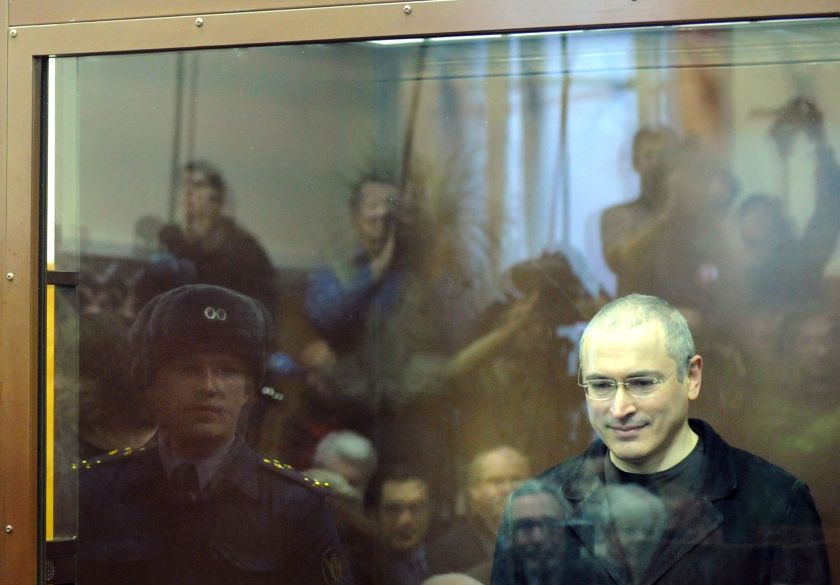
Mikhail Khodorkovsky (right) faces the consequences of being on the wrong side of Vladimir Putin in Citizen K. (Zachary Martin/Greenwich)

By Richard Ades

Early in the documentary Citizen K, Mikhail Khodorkovsky recalls Russia’s own “Wild West” era. It occurred during a roughly seven-year period following the 1991 fall of the Soviet Union and the subsequent decline of communist authoritarianism.

The resulting legal vacuum allowed Khodorkovsky and other enterprising individuals to make their fortunes through often-shady means. It also allowed many of these so-called “gangster capitalists” to be killed for their money while Moscow turned into the “murder capital” of Europe.

Fortunately for Khodorkovsky, he managed to avoid the assassins, though he soon made an enemy who was equally ruthless: Vladimir Putin.

Written and directed by Alex Gibney, Citizen K is a history of modern Russia as seen through the eyes of Khodorkovsky, who amassed billions through his ownership of a major oil company. It describes the ways he and other self-created capitalists attempted to remake Russia for their own benefit. It also describes how Putin, once an out-of-work KGB agent, rose to power by appealing to people’s nostalgia for Soviet power and influence.

Finally, it explains how Khodorkovsky and others found themselves working at cross-purposes with Putin, putting a target on their backs. Some are alleged to have paid for this with their lives. In Khodorkovsky’s case, he was put on trial for financial crimes and ended up spending 10 years in a remote prison.

Majestically photographed by cinematographers Mark Garrett and Denis Sinyakov, with an equally grand score by Robert Logan and Ivor Guest, Citizen K is an impressive piece of filmmaking. It’s also an invaluable history lesson for any who want to understand how Russia became the dangerous adversary it is today—and why President Trump’s apparent failure to recognize that fact is so concerning.

If there’s one thing the documentary lacks, it’s someone to root for.

The thousands of stories based on America’s lawless Wild West generally gave us a hero who showed up to save the day. In this tale of Russia’s “Wild West” and its aftermath, it’s hard to decide whether our protagonist deserves that label.

In an archival interview, a young Khodorkovsky proudly admits that greed is his chief motivator. Other historic footage makes it clear that he was willing to lay off thousands to achieve his financial goals. It’s even suggested that he may have resorted to tactics such as bombings or murder.

Only later, after being released from prison, does Khodorkovsky take on a task that doesn’t seem entirely self-serving: From his new home in the UK, he funds efforts to promote democracy in his homeland. That does seem heroic.

By this point in the film, however, we’ve learned enough about the way “politics” work in Putin’s Russia to suspect that it’s also a quixotic exercise in futility.

Rating: 3½ stars (out of 5)

Citizen K opens Feb. 7 at the Gateway Film Center in Columbus.

Different century, same misery

Les Miserables 2
Three plain-clothes cops (Damien Bonnard, Alexis Manenti and Djibril Zonga, from left) patrol a poor Parisian neighborhood in Les Misérables. (SRAB Films/Rectangle Productions/Lyly Films)

By Richard Ades

As Les Misérables opens, a group of dark-skinned youths joyfully celebrate France’s 2018 World Cup championship by taking part in a public event that includes a mass rendition of “La Marseillaise.” Director Ladj Ly’s apparent message: Despite being immigrants or the children of immigrants, the boys consider themselves just as French as those around them.

As Ly’s camera follows them back to their segregated Parisian neighborhood, however, we realize they don’t enjoy the same opportunities as their countrymen. This isn’t Victor Hugo’s Les Misérables—there’s no Jean Valjean, no Javert, no idealistic revolutionaries. But there’s more than enough injustice to light the fuse of revolt, just as it did in Hugo’s tale.

The question is: Will it? Leading up to the answer is a harrowing dive into the lives of modern-day immigrants.

The Malian-born Ly, directing and co-writing his first full-length film, doesn’t create a one-sided portrait of discrimination. Those who take advantage of the local residents include a racist white cop named Chris (Alexis Manenti), but they also include the neighborhood’s black “Mayor” (Steve Tientchev), who uses his power to line his own pockets. There’s also a group of thugs who consort with the police to further their illegal activities.

We’re introduced to the resulting cauldron of resentment through the eyes of newcomer Stephane (Damien Bonnard), a divorced cop who’s moved to Paris to be closer to his young son. He’s assigned to ride along with Chris and his Malian-French partner, Gwada (Djibril Zonga), and soon becomes appalled by the liberties Chris takes with residents—for example, finding excuses to body-search teenage girls.

But before he can decide how to respond, Stephane and the others are thrown into the middle of potentially explosive situation brought on by a seemingly small crime: the theft of a lion cub from a traveling circus. This brings them into contact with two local boys—the trouble-prone Issa (Issa Perica) and the drone-flying Buzz (Al-Hassan Ly)—as well as a devout Muslim restaurateur named Salah (Almamy Kanoute). Thus begins a chain of events that results in unforeseen consequences for all concerned.

Why name this contemporary tale Les Misérables? That’s spelled out when the film ends with a quote from Hugo: “There are no such things as bad plants or bad men. There are only bad cultivators.”

Viewers may quibble about whether Ly has proved the maxim, just as they may differ on whether it should win the “International Feature Film” Oscar for which it’s been nominated. (Probably not, as South Korea’s Parasite seems a worthy shoo-in.) But they’re likely to agree that Ly has created an exciting cautionary tale and an impressive full-length debut.

Rating: 4 stars (out of 5)

Les Misérables (rated R) opens Jan. 24 at the Drexel Theatre and Gateway Film Center.

‘Dolittle’ does too much, and none of it well

null
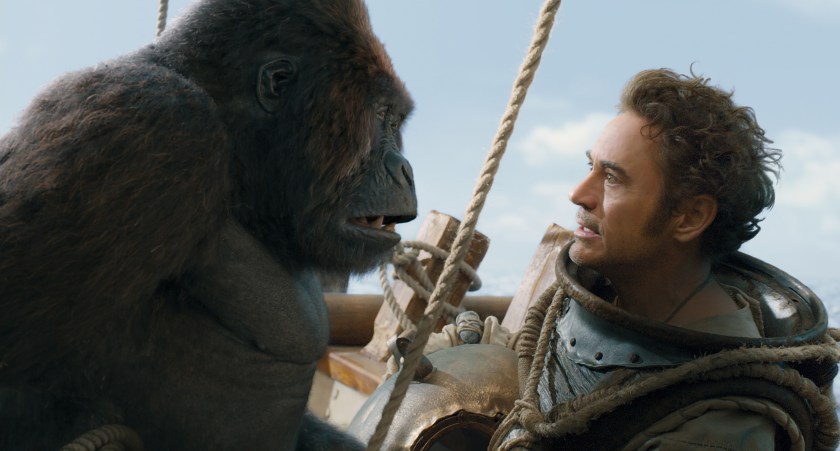
The title physician (Robert Downey Jr., right) sets sail with a timid gorilla (Rami Malek) and other animal friends in Dolittle.

By Richard Ades

Talking animals are fun. Robert Downey Jr. is fun. When they’re combined in Dolittle, though, they seem to cancel each other out.

Maybe it’s because the CGI critters steal the spotlight from Downey’s title character. Or maybe it’s because Downey is so preoccupied managing a melodic Welsh accent that he has trouble bringing his character to life.

Then again, maybe it’s because director Stephen Gaghan (Syriana) and his committee of co-writers try to do too much. After beginning to tell the touching tale of a doctor who’s avoided human contact since losing his beloved wife, they bury it under a busy plot involving royal intrigue, an aspiring apprentice, a vengeful father and even a dragon with dyspepsia.

Along the way, the doctor gets upstaged by a host of animals with assorted quirks and phobias: among others, a gorilla who’s always afraid (Rami Malek), a polar bear who’s always cold (John Cena), an ostrich who hides from reality (Kumail Nanjiani) and a squirrel who carries a grudge (Craig Robinson). All of these psychological challenges are played for laughs that seldom come.

Example: While discussing absent fathers with an animal friend, the polar bear recalls that one night his own dad went out for a “pack of seals” and never returned. At the screening I attended, the joke failed to elicit so much as a chuckle, even from those old enough to understand it.

null
Tommy Stubbins (Harry Collett) becomes an admirer of Dr. Dolittle (Robert Downey Jr.) after asking him to heal a wounded squirrel.

The busy plot is set in motion when two young people coincidentally arrive at Dolittle’s British animal hospital/preserve at the same time. Tommy Stubbins (Harry Collett) wants the doctor to heal the aforementioned squirrel, whom he accidentally shot; and Lady Rose (Carmel Laniado) wants him to travel to Buckingham Palace to treat Queen Victoria (Jessie Buckley), who has come down with a mysterious illness.

Urged on by his maternalistic parrot pal (Emma Thompson), Dolittle reluctantly agrees to both requests. The latter ultimately sends him and his friends across the ocean and into a series of perils involving the dastardly Lord Thomas Badgley (Jim Broadbent), the vicious King Rassouli (Antonio Bandaras) and a really pissed-off tiger (Ralph Fiennes). Unfortunately, the resulting action scenes are filmed so haphazardly that they’re likely to leave viewers as unmoved as the film’s feeble attempts at comedy.

Under any circumstances, Dolittle would be a disappointment. Considering it boasts a huge cast of top-tier actors and an even bigger budget (reportedly $175 million), it’s a disappointment of monumental proportions.

Rating: 2 stars (out of 5)

Dolittle (PG) opens Jan. 16 or 17 at theaters nationwide.

‘Parasite’ occupies top spot at 18th annual Columbus Film Critics Association awards

Columbus Film Critics Association logo

Director/co-writer Bong Joon-ho’s Parasite (Gisaengchung) has been named Best Film in the Columbus Film Critics Association’s 18th annual awards, which recognize excellence in the film industry for 2019. The thrilling film about a struggling family that schemes to obtain lucrative jobs in a wealthy household also claimed three other awards. Parasite was named Best Foreign Language Film, and Bong was honored as Best Director and for Best Original Screenplay with his co-writer Han Jin-won.

Two other individuals won multiple awards. Adam Driver was named Best Actor for Marriage Story and Actor of the Year, which recognizes his exemplary 2019 body of work that also consists of The Dead Don’t Die, The Report and Star Wars: Episode IX – The Rise of Skywalker. Florence Pugh was tabbed as Best Supporting Actress for Little Women and Breakthrough Film Artist for her performance in that film as well as in Fighting With My Family and Midsommar.

Columbus-area critics lauded Best Film runner-up Knives Out with Best Ensemble and Bob Ducsay for Best Film Editing. Us also won two awards with Lupita Nyong’o selected as Best Actress and Michael Abels honored for Best Score. In addition to Pugh’s Best Supporting Actress win, Little Women’s other prize went to Greta Gerwig for Best Adapted Screenplay. Other individuals commended for their achievements include Best Supporting Actor Willem Dafoe (The Lighthouse) and Roger Deakins (1917) for Best Cinematography.

Other winners were: Best Documentary Apollo 11; Best Animated Film Toy Story 4; and Best Overlooked Film The Last Black Man in San Francisco.

Founded in 2002, the Columbus Film Critics Association, formerly the Central Ohio Film Critics Association, comprises film critics based in Columbus, Ohio, and its surrounding areas. Its membership consists of 28 print, radio, television and online critics. COFCA’s official website at www.cofca.org contains links to member reviews and past award winners.

Winners were announced at a private party on Jan. 2.

Complete list of awards:

Best Film
1. Parasite (Gisaengchung)
2. Knives Out
3. 1917
4. Little Women
5. Marriage Story
6. The Farewell
7. Once Upon a Time… in Hollywood
8. The Irishman
9. Uncut Gems
10. Jojo Rabbit

Best Director
-Bong Joon-ho, Parasite (Gisaengchung)
-Runner-up: Sam Mendes, 1917

Best Actor
-Adam Driver, Marriage Story
-Runner-up: Adam Sandler, Uncut Gems

Best Actress
-Lupita Nyong’o, Us
-Runner-up: Florence Pugh, Midsommar

Best Supporting Actor
-Willem Dafoe, The Lighthouse
-Runner-up: Joe Pesci, The Irishman

Best Supporting Actress
-Florence Pugh, Little Women
-Runner-up: Scarlett Johansson, Jojo Rabbit

Best Ensemble
Knives Out
-Runner-up: Parasite (Gisaengchung)

Actor of the Year (for an exemplary body of work)
-Adam Driver (The Dead Don’t Die, Marriage Story, The Report and Star Wars: Episode IX – The Rise of Skywalker)
-Runner-up: Florence Pugh (Fighting with My Family, Little Women and Midsommar)

Breakthrough Film Artist
-Florence Pugh (Fighting with My Family, Little Women and Midsommar) – (for acting)
-Runner-up: Joe Talbot, The Last Black Man in San Francisco – (for directing, producing and screenwriting)

Best Cinematography
-Roger Deakins, 1917
-Runner-up: Jarin Blaschke, The Lighthouse

Best Film Editing
-Bob Ducsay, Knives Out
-Runner-up: Lee Smith, 1917

Best Adapted Screenplay
-Greta Gerwig, Little Women
-Runner-up: Taika Waititi, Jojo Rabbit

Best Original Screenplay
-Bong Joon-ho and Han Jin-won, Parasite (Gisaengchung)
-Runner-up: Rian Johnson, Knives Out

Best Score
-Michael Abels, Us
-Runner-up: Thomas Newman, 1917

Best Documentary
Apollo 11
-Runner-up: American Factory

Best Foreign Language Film
Parasite (Gisaengchung)
-Runner-up: Portrait of a Lady on Fire (Portrait de la jeune fille en feu)

Best Animated Film
Toy Story 4
-Runner-up: I Lost My Body (J’ai perdu mon corps)

Best Overlooked Film
The Last Black Man in San Francisco
-Runner-up: Ready or Not

COFCA offers its congratulations to the winners.

Previous Best Film winners:

2002: Punch-Drunk Love
2003: Lost in Translation
2004: Million Dollar Baby
2005: A History of Violence
2006: Children of Men
2007: No Country for Old Men
2008: WALL·E
2009: Up in the Air
2010: Inception
2011: Drive
2012: Moonrise Kingdom
2013: Gravity
2014: Selma
2015: Spotlight
2016: La La Land
2017: Lady Bird
2018: If Beale Street Could Talk

For more information about the Columbus Film Critics Association, please visit www.cofca.orgor e-mail info@cofca.org.

Dramatization of real-life scandal could be better

BombshellTrio
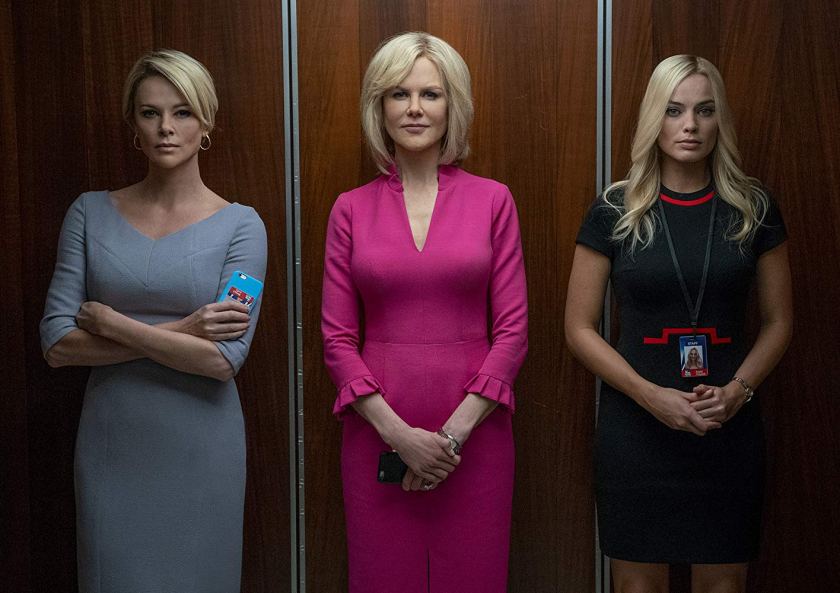
Megyn Kelly, Gretchen Carlson and Kayla Pospisil (Charlize Theron, Nicole Kidman and Margot Robbie, from left) share an elevator ride in Bombshell. (Lionsgate)

By Richard Ades

Bombshell isn’t a complete dud, but neither is it as effective as it could be. Perhaps that’s because it spreads too little explosive power over too wide an area.

The flick is designed as an expose of Fox News and particularly of the sexual-harassment charges that in 2016 brought down chairman and CEO Roger Ailes. On the way there, however, it stops to explain such things as how Fox and President Donald J. Trump became joined at the hip, and why the network’s women journalists tend to be pretty blondes in short skirts.

It also attempts to tell a tale of feminist empowerment, but its ability to inspire is stymied by the fact that most of the female characters display more loyalty to their careers than to each other. Further weakening the message is the film’s tone, which wanders haphazardly between drama and spoofery.

Maybe director Jay Roach (Meet the Parents, Meet the Fockers) was not the right person to helm this ambitious take on a real-life scandal. Or maybe Charles Randolph was not the right person to write it, even though he co-wrote a much better historical expose, 2015’s The Big Short.

But the cast, at least, is perfect.

Particularly laudable is Charlize Theron’s impersonation of Megyn Kelly, whose questioning of Trump’s misogynistic tendencies during a 2015 presidential debate made her the target of his unquenchable fury. Kelly serves as the story’s main narrator, which is a mixed blessing.

As a prominent Fox talent, she is well-suited to explaining the company’s power structure, including the fact that Ailes ultimately answers to owner Rupert Murdoch and his sons. But, like her real-life counterpart, Theron’s Kelly is difficult to like. When the scandal begins unfolding, she reacts as the lawyer she is, refusing to get involved until she’s had a chance to weigh the evidence—and the risk to herself.

BombshellTheronLithgow
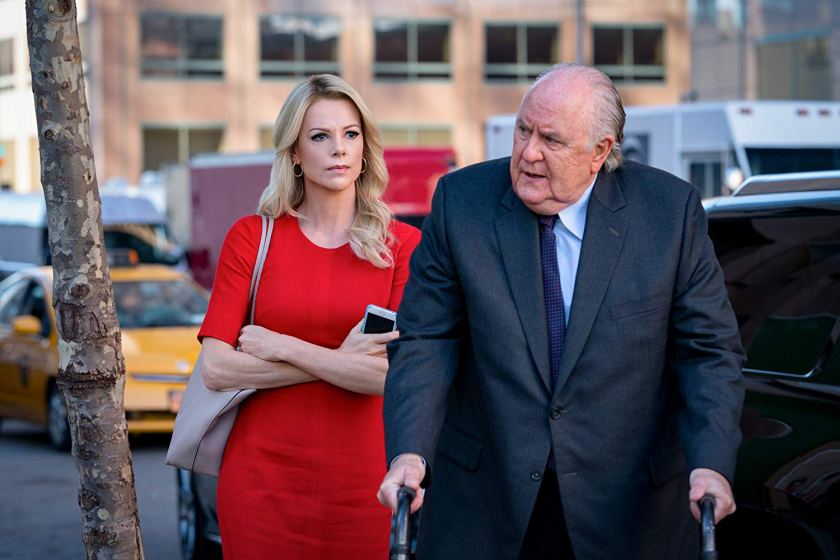
Megyn Kelly (Charlize Theron) takes a walk with her boss, Roger Ailes (John Lithgow). (Photo by Hilary B Gayle)

More relatable is fellow newswoman Gretchen Carlson (Nicole Kidman), who is fired after doing such un-Fox-like things as appearing on air without makeup and calling for assault weapons to be banned. She subsequently sues Ailes for sexual harassment and surprised to find that none of his other victims is eager to follow her lead.

Those other victims include Kayla Pospisil (Margot Robbie), an ambitious producer and self-described “evangelical millennial” who receives a first-hand lesson in Ailes’s tendency to hide sexual innuendo under a demand that she prove her “loyalty.” (Kayla, one of the story’s few fictional characters, is said to be based on several former Fox employees.)

The decrepit Ailes himself is played by a barely recognizable John Lithgow as an executive who has been manipulating women for so long that he seems genuinely surprised when his behavior becomes a legal matter.

Bombshell reveals several interesting historical tidbits, including the antipathy that Fox’s bigwigs originally held for the upstart Trump. It also includes a few laughs, though they don’t always work to the film’s benefit.

When Kayla falls into bed with co-worker Jess Carr (SNL’s Kate McKinnon), their relationship is defined by light banter that makes no attempt to explain why the evangelical Kayla has so little trouble squaring lesbian sex with her religious beliefs.

Other laughs are engendered by the appearance of stand-ins for rascally celebrities such as Rudy Giuliani (Richard Kind) and Geraldo Rivera (Tony Plana). In such cases, the movie’s uncanny impersonations undermine the story by shoving it unceremoniously into spoof territory.

Bombshell benefits from a strong cast and a subject that is both timely and fascinating. If it hadn’t been weakened by so-so execution, it might have lived up to its name.

Rating: 3 stars (out of 5)

Bombshell (rated R) opens Dec. 20 at theaters nationwide.

Tale of hero’s ordeal marred by stereotypical depiction of woman journalist

Richard Jewell crowd control
The title character (Paul Walter Hauser) tries to keep bystanders safe from an imminent bombing in Richard Jewell. (Photos by Claire Folger/Warner Bros. Pictures)

By Richard Ades

Richard Jewell is the fact-based story of a hero who was turned into a pariah by the media and the FBI. Clint Eastwood’s dramatization of the scandal would be rather effective if it weren’t guilty of the same kind of injustice.

The real-life Jewell was working as a security guard during the 1996 Olympics in Atlanta when he happened upon a suspicious-looking backpack that had been abandoned at a public concert. He alerted the police, who reluctantly investigated and found three pipe bombs inside. Jewell then helped police clear the area, so that when the bombs went off, many members of the public were injured, but only one was killed.

Jewell was at first celebrated for saving lives, but he soon became the FBI’s prime suspect because he fit the profile of a ne’er-do-well who would create such a disaster in order to cast himself as the hero. When the media got hold of this theory, Jewell was effectively tried in the press even though he hadn’t been officially charged.

Eastwood’s account of the injustice, scripted by Billy Ray, begins slowly and effectively. Jewell (a pitch-perfect Paul Walter Hauser) is depicted as an individual whose lifelong dream of becoming a police officer is undercut by his gung-ho attitude. At one point, he loses a job as a college security guard because he insists on barging into dorm rooms and even stopping cars on the highway in order to enforce campus rules.

Stymied in his career and perpetually ridiculed because of his weight and because he lives with his mother (Kathy Bates), Jewell considers himself a loser. In other words, the FBI’s suspicions following the bombing are not completely out of left field.

What is out of left field is Eastwood’s depiction of Kathy Scruggs, the Atlanta Journal-Constitution reporter who broke the story. From the moment she appears, Scruggs (Olivia Wilde in full balls-out mode) comes off as the kind of anything-for-a-story journalist who is more prevalent in movies than in real life.

So single-minded is Scruggs that when the bombs go off in Atlanta’s Centennial Park, her first response is not to express concern for the victims but to pray for a scoop: “Dear God, whoever did this, please let us find him before anyone else does.” (I’m not kidding. Eastwood and Ray actually have her saying this.) Later, apparently not content to rely on divine intervention, she literally trades sex for an FBI agent’s tip on the bureau’s suspicions.

Richard Jewell layer
Jewell (Paul Walter Hauser, right) is comforted by his attorney, Watson Bryant (Sam Rockwell).

Obviously, the FBI doesn’t come off too well here, as the agent (played by Jon Hamm as an extension of the corruptible Don Draper) allows himself to be manipulated into sharing investigative secrets. And it comes off even worse when the bureau ignores evidence that it has the wrong suspect.

But it’s Scruggs who comes off the worst, especially in the movie’s fabricated claim that she was willing to prostitute herself for a story. This ludicrously exaggerated portrayal is a slap not only at the late reporter but at every woman journalist who dares to take her job seriously.

This being 2019, and Eastwood being the conservative who once pretended a chair was Barack Obama at the Republican National Convention, it’s also tempting to interpret the movie’s denigration of the media and the FBI as a reflection of the current president’s continuous attacks on the Fourth Estate and the so-called “deep state.” Fairly or not, many will see the film as a product of its times and its director’s biases.

If one is able to divorce Richard Jewell from politics and from its outdated depiction of a woman journalist, it has much to recommend it. Besides Hauser’s portrayal of the title character, it boasts relatable performances by Bates as Jewell’s supportive mom; Sam Rockwell as Watson Bryant, the friend who reluctantly becomes his defense attorney; and Nina Arianda as the lawyer’s immigrant/secretary.

Bryant’s attempt to help a good man reclaim his reputation adds up to absorbing drama. It’s just a shame that it’s weakened by the movie’s own dive into character assassination.

Rating: 2½ stars (out of 5)

Richard Jewell (rated R) opens Dec. 13 at theaters nationwide.

Sly script and unlikely casting fuel delightful whodunit

Knives Out detectives
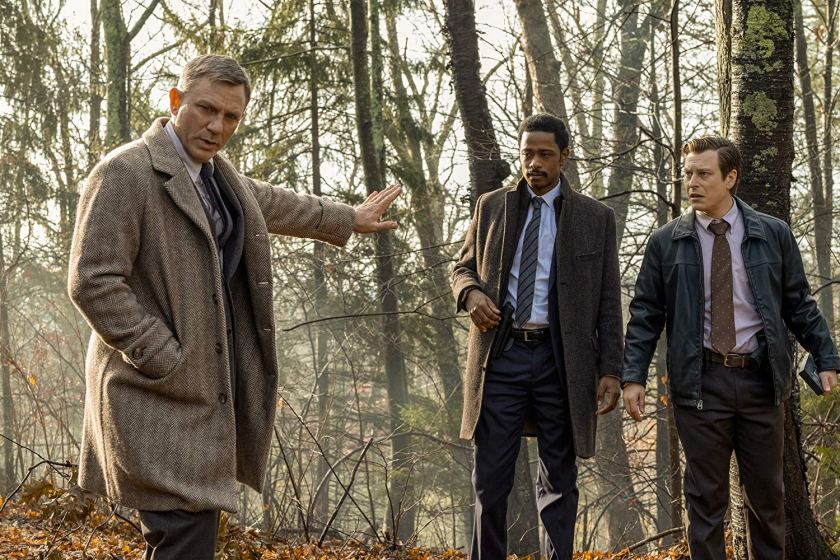
Private eye Benoit Blanc (Daniel Craig, left) searches for clues with the help of police Lt. Elliott (LaKeith Stanfield, center) and Trooper Wagner (Noah Segan). (Photo by Claire Folger/MRC II Distribution Co.)

By Richard Ades

Unfolding like a typical murder mystery, Knives Out dares viewers to answer the all-important question: Who cast Daniel Craig as a Southern private eye?

No, actually, the question is: Who killed Harlan Thrombey? As for Craig, it eventually becomes apparent that the erstwhile James Bond was cast as Virginia gumshoe Benoit Blanc simply for the hell of it, or perhaps as a sign that writer/director Rian Johnson (Star Wars: The Last Jedi) plans to have a little fun with the genre film.

And with the help of Craig and additional big-name stars, that’s just what he does.

The tale starts out conventionally enough. After a housekeeper finds successful mystery writer Harlan (Christopher Plummer) with his throat slit on the morning after his 86th birthday, police Lt. Elliott (LaKeith Stanfield) and Trooper Wagner (Noah Segan) begin investigating. Forensic evidence points to a suicide, but there are reasons to suspect foul play.

Not the least of them is the presence of Blanc, who is helping with the investigation after being hired by someone whose identity even he doesn’t know. Why would an anonymous benefactor pay the “gentleman detective” big bucks to investigate a suicide?

With Blanc’s help, the police also discover that several members of Harlan’s extended family—all of whom were present for his birthday party the night before—had motives for wishing him harm. Flashbacks show that Harlan had last-minute confrontations with others over misdeeds ranging from larceny to an extramarital affair. In some cases, he simply decided they were no longer worthy of his financial support.

Those caught up in the web of suspicion include:
• Linda (Jamie Lee Curtis), a real estate mogul and Harlan’s daughter
• Richard (Don Johnson), Linda’s husband
• Ransom (Chris Evans), their playboy son
• Walt (Michael Shannon), Harlan’s son, who runs his publishing house
• Donna (Riki Lindhome, Walt’s wife
• Jacob (Jaeden Martell), Walt and Donna’s internet-trolling son
• Joni (Toni Collette), a lifestyle guru and widow of Harlan’s older son
• Meg (Katherine Langford), Joni’s daughter

Knives Out Marta in middle
Embroiled in Harlan Thrombey’s murder investigation are (from left): Trooper Wagner and Lt. Elliott (Noah Segan and LaKeith Stanfield); Harlan’s caretaker, Marta Cabrera (Ana de Armas); his grandson, Hugh “Ransom” Drysdale (Chris Evans); and detective Benoit Blanc (Daniel Craig).

Also around, but considered beyond suspicion, are Fran (Edi Patterson), Harlan’s housekeeper; Marta Cabrera (Ana de Armas), his loving nurse; and “Great Nana” Wanetta Thrombey, Harlan’s ancient and mostly silent mother.

As the investigation proceeds, Marta becomes an increasingly important resource to Blanc and the police. A young immigrant with an undocumented mother at home, she earns Blanc’s trust because (1) she clearly was Harlan’s closest friend and (2) she has an odd, if disgusting, disorder that renders her incapable of lying without vomiting.

With its plethora of suspects and red herrings, Knives Out at first resembles a typical murder mystery. Surely, we think, it’s only a matter of time before Blanc arrives at the truth. But then writer/director Johnson confounds our expectations by allowing us to learn what happened while the investigators are still in the dark—except that he doesn’t really, because there’s still a last-minute reveal that will take pretty much everyone by surprise.

Further differentiating the flick from the average whodunit is its class-consciousness. Marta, as portrayed by de Armas, comes off as a kind-hearted caretaker who’s been treated shabbily by Harlan’s entitlement-blinded relatives. Not only do they fail to invite her to her beloved patient’s funeral, but they can’t even remember what country she’s from.

In short, Knives Out amounts to sly, quirky fun brought to life by a great, committed cast. Leading it all, Craig revels in the role of the drawling, cigar-smoking Blanc, who may or may not live up to his reputation as a brilliant detective. As with everything else in the flick, we just have to wait and see.

Rating: 4 stars (out of 5)

Knives Out (PG-13) opens Nov. 27 at theaters nationwide.