Reviews

Blues-centered drama could use more tonal modulation

Ma Rainey (Wilma Hatton) sings the blues with Toledo (Will Williams, in front) and the rest of her band (from left): Levee (Bryant Bentley), Cutler (Chuck Timbers) and Slow Drag (Ron Jenkins) (photo by Mark Clayton Southers)

By Richard Ades

As near as I can tell, I’ve reviewed exactly one August Wilson play during all the decades I’ve been covering Columbus theater. That suggests there’s a real need for Short North Stage’s yearlong August Wilson Festival, which allows viewers to get acquainted with a prominent African-American playwright whose works are seldom seen locally.

However, it’s an open question whether the festival’s current production is the best way to get acquainted with Wilson. As seen in the Garden Theater’s intimate Green Room, Ma Rainey’s Black Bottom comes off as talky and occasionally preachy.

Though that’s partly because the script itself is talky and occasionally preachy, I suspect it might be partly due to the way it’s presented by director Mark Clayton Southers and his cast. It’s not that the players aren’t strong. In a way, they’re too strong.

At last Thursday’s performance, nearly every scene was filled with so much heat and passion that there was little room for dramatic ebbs and flows.

One big caveat: This was a preview performance, so it’s possible Southers and his cast hadn’t finished honing the production. The director has done wonderful past work at Short North Stage (I’m thinking of 2013’s Passing Strange), so there’s no reason to believe he can’t get equally fine results out of the talented cast he’s assembled for Ma Rainey’s Black Bottom.

Set in the 1920s at a white-owned recording studio in Chicago, the play’s loose plot revolves around a recording session with real-life blues singer Ma Rainey (Wilma Hatton).

Arriving first are backup musicians Cutler (Chuck Timbers), Toledo (Will Williams), Slow Drag (R. Lawrence Jenkins) and Levee (Bryant Bentley). As the four squabble about matters both large and small, tensions develop among band leader Cutler, the philosophical Toledo and the ambitious Levee, who dreams of starting his own band. A major disagreement arises over Levee’s insistence that they perform his updated arrangement of the title song, which he claims is more in line with current tastes.

Meanwhile, studio owner Sturdyvant (Geoffrey C. Nelson) becomes nervous when Rainey doesn’t appear at the promised time and takes out his frustrations on her long-suffering manager, Irvin (Jonathan Putnam). It only makes matters worse when Rainey finally arrives with an angry cop (Ryan Kopycinski) in tow following a minor traffic accident. Adding to the confusion is her entourage: Dussie Mae (Rachel Bentley), her glammed-up girlfriend, and Sylvester (Taylor Martin Moss), her shy and stuttering nephew.

It’s a sign of the production’s problems that the character who generates the most sympathy in this black-centered drama is Rainey’s white manager, played by Putnam with a permanent hangdog expression. The character who generates the least sympathy is Rainey herself, who insists on getting her way no matter how unreasonable her demands. Hatton would make the character more likable—or, at least, more relatable—if she added a touch of vulnerability, making it clear that Rainey’s diva-like ways are a reaction to the white racism she’s had to fight throughout her career.

Bentley earns a little more of our sympathy as Levee, whose ambitions run into their own racist roadblock. But he and some of the other “musicians” need to moderate their portrayals to give a sense of progression as the play moves forward. On Thursday, their arguments tended to be equally fierce throughout, adding up to a fatiguing viewing experience.

Not surprisingly for a play set in a recording studio, the characters sometimes break into song. Hatton, Bentley and Jenkins all excel at bluesy vocals, while the other “musicians” do a good job of miming in time to the recorded accompaniment.

Rob Kuhn’s set design is full-featured despite having to depict two separate rooms in the cramped space. Cheryl M. El-Walker’s costume designs are colorful and era-appropriate.

First staged in 1984, Ma Rainey’s Black Bottom is part of Wilson’s 10-play Pittsburgh Cycle, which depicts African-American life in each decade of the 20th century. As such, it’s an important political and cultural document. With a little more honing, Short North Stage’s production could also become a rewarding dramatic experience.

NOTE: This production is historic for reasons beyond the play itself, as it’s an opportunity to see local theater stalwart Geoffrey Nelson one more time before his upcoming move to Louisville. It’s an added treat that he shares the stage with frequent collaborator Jonathan Putnam. Thanks to Short North Stage for arranging this nostalgia-filled reunion.

Short North Stage will present Ma Rainey’s Black Bottom through June 19 at the Garden Theater, 1187 N. High St., Columbus. Show times are 8 p.m. Thursday-Saturday and 2 p.m. Saturday-Sunday. Running time: 2 hours, 45 minutes (including intermission). Tickets are $25-$30. 614-725-4042 or shortnorthstage.org.

Tale of jealous Moor presented with passion and power

Othello (Christopher C. Austin III) consults with his trusted lieutenant, Iago (Matthew Michael Moore), in Actors’ Theatre’s production of Othello (photo by Richard Ades)
Othello (Christopher C. Austin III, left) consults with “honest Iago” (Matthew Michael Moore) in Actors’ Theatre’s production of Othello (photos by Richard Ades)


By Richard Ades

A stirring production of Othello offers evidence that Central Ohio’s Shakespeare-in-the-park troupe remains in good hands.

This is the first season Actors’ Theatre has put together under the leadership of Philip J. Hickman, who was elevated to artistic director following the untimely death of John S. Kuhn early last year. The lineup is promising and challenging, with an Oscar Wilde comedy and a new adaptation of an Alexandre Dumas potboiler in addition to two of the Bard’s strongest works. And if the first production is any guide, that lineup will be brought to the stage with consummate skill.

Directed by Matt Hermes, the troupe’s production of Othello is brisk and passionate. At a key moment, it’s also horrifying—to the extent that parents might want to leave their most impressionable children at home.

Unusually for a Shakespearean tragedy, Othello keeps its focus almost exclusively on its three central characters: Othello, a Moorish military hero who has recently fallen in love and married; Desdemona, the young Venetian woman who has become his wife; and Iago, an ensign who is determined to get revenge after Othello passed him over for promotion. All three are given compelling portrayals in the Schiller Park production.

Desdemona (Lindsey Fisher) finds her new husband (Christopher C. Austin III) is becoming increasingly suspicious

As Othello, Christopher C. Austin III is the image of militaristic dignity when he’s functioning as a commanding officer, but he’s so smitten by his new love that he can’t help showing his feelings whenever his bride is around. As Desdemona, Lindsey Fisher is guileless and genteel but just as smitten. The result is that PDAs abound whenever the newlyweds are in the same room.

As Iago, the play’s true protagonist, Matthew Michael Moore comes across as an evil puppeteer. He clearly looks down on those around him and coolly uses their loves, desires and prejudices to his advantage. Iago is one of Shakespeare’s most devious villains, and Moore plays him with subtlety and dark humor.

Updated here to the 1820s—a change that affects the costumes and weapons but otherwise has little impact—the tragedy centers on Iago’s campaign to awaken in Othello the “green-eyed monster” of jealousy. To do this, he invents reasons to suspect Desdemona has been unfaithful with Cassio (David Tull), the lieutenant who was promoted in Iago’s place.

Two people play willing or unwilling roles in the campaign: Roderigo, who lusts after Desdemona; and Emilia, Iago’s wife and Desdemona’s maid. David Widder-Varhegyi plays the former as a scamp and a gullible fool, while Susan Wismar plays the latter as a decent woman who is cowed into obeying her husband but is appalled when she realizes what he’s up to.

Andrew Weibel’s set seems more elaborate than usual for the outdoor troupe, even including a small fountain. Emily Jeu’s colorful costumes help to define the time and place.

The sound, designed by William Bragg (with Fia Friend operating the sound board), is as clear as I’ve ever heard it at the Schiller amphitheater. At last Friday’s performance, the only distortion occurred when Austin’s Othello shouted his most dramatic lines, overwhelming the amplification. A little restraint may be needed to avoid that problem in the future.

As one would expect in a Shakespearean tragedy, there are deaths. Two of them happen so quickly, and on such a crowded stage, that many viewers will miss them. On the other hand, one murder is the most protracted and horrific act of violence I can remember seeing at the Schiller amphitheater.

Is it excessive? Not at all. It’s merely the final evidence that Actors’ Theatre takes its role as Columbus’s Shakespeare-in-the-park troupe very seriously.

Actors’ Theatre will present Othello through June 19 at the Schiller Park amphitheater, 1069 Jaeger St., Columbus. Show times are 8 p.m. Thursday-Sunday. Running time: 2 hours, 40 minutes (including intermission). Tickets: pay what you will (bring a blanket or lawn chair); reserved seats or blankets are available for $20. 614-444-6888 or theactorstheatre.org.

Ear pod plays starring role in ‘Best of Shadowbox 2016’

Amy Lay holds forth in Ex’s and Oh’s, one of the cover songs featured in Best of Shadowbox 2016 (photo by Jeffery Crisafulli)

By Richard Ades

When I head to Indiana for my high school reunion in a few weeks, I can only hope it will be half as much fun as another reunion of sorts I attended recently: the annual Best of Shadowbox show.

Just as reunions give you the chance to get reacquainted with old friends, Best of Shadowbox gives you the chance to get reacquainted with skits you’ve seen over the past year. In most cases, it’s a pleasure to see them again, especially since the writers and cast members often find ways to improve them in reaction to audience response.

One skit that didn’t need much improving is The Ear Pod, featuring Tom Cardinal as a husband who hates to miss a big football game to attend a counseling session with his wife (Julie Klein). Trying to have it both ways, he secretly listens to the game via an ear pod while his wife vents about all that’s wrong with their relationship. The misunderstandings multiply hilariously as Cardinal’s enthusiastic reactions to the game are misinterpreted by his angry spouse and the diplomatic counselor (Michelle Daniels).

At least a couple of skits seem more entertaining this time around.

Sexy Nurse imagines what would happen if hospital employees really dressed the way they do in our pornographic fantasies. It centers on a patient (Robbie Nance) who’s excited when his nurse (Amy Lay) shows up in a barely there uniform. It’s still not a laugh riot, but it’s good, raunchy fun.

Also slightly improved—though it was pretty funny to begin with—is Job App. It’s about what happens when a job applicant (Nance) has a social-media history that contradicts everything he says about himself. Klein is admirably restrained as the dubious interviewer, allowing the momentum to build toward the show’s strongest punchline.

Romeo (Robbie Nance) and Juliet (Amy Lay) discover they share singular tastes in 50 Shades of Romeo (photo by Jeffery Crisafulli)

On the other hand, 50 Shades of Romeo seems less amusing on second viewing. Merging Shakespeare’s Romeo and Juliet with E.L. James’s kinky best-seller is a clever idea, but much of the humor consists of adding “-eth” to sundry words (including F-bombs) to make them sound Elizabethan. As if to make up for the labored jokes, Lay slaps on an extra layer of ditsiness as the S&M-prone Juliet, but it doesn’t help.

Among the skits I missed the first time around, the funniest is Happy Haunting, in which two fey ghosts (Jimmy Mak and Brandon Anderson) try to protect their unaware roommate (Leah Haviland) from her boorish date (Nance). The weakest is Camping Without a Net, in which a group of millennials are terrified to learn they’ve lost their Internet connection. The skit itself seems lost, generating more than one “huh?” moment as it meanders toward an unsatisfying ending.

But there’s nothing unsatisfying about the show’s musical numbers, which mix great singing with great musicianship on the part of the house band. The highlights (and their lead singers) include Life in the Fast Lane (Klein), Walk on the Ocean (Cardinal) and Sexual Healing (Noelle Grandison and Guillermo Jemmott).

Even more fun is the number that ends Act 1, Elle King’s Ex’s and Oh’s, sung by a deliciously attired Lay, Haviland, Ashley Pearce, Chyna Cheaney and Katy Psenicka. And most fun of all is the final song, Meat Loaf’s Paradise by the Dashboard Light, featuring a back-and-forth duet by Klein and Lukas Tomasacci. Amusing interplay among the backup singers is an added bonus in a number that I wouldn’t mind getting reacquainted with a few more times.

Best of Shadowbox 2016 continues through Sept. 3 at Shadowbox Live, 503 S. Front St., Columbus. Show times are 7:30 and 10:30 p.m. Friday-Saturday (no 10:30 performances July 22 or 29). Running time: 2 hours (including intermission). Tickets are $20-$40. 614-416-7625 or shadowboxlive.org.

Staged ‘Dirty Dancing’ best seen through nostalgia-tinted glasses

Baby (Rachel Boone) and Johnny (Christopher) share a few steps in the national tour of Dirty Dancing, presented by Broadway in Columbus (photo by Matthew Murphy)
Baby (Rachel Boone) and Johnny (Christopher Tierney) practice their moves in the national tour of Dirty Dancing, presented by Broadway in Columbus (photo by Matthew Murphy)

By Richard Ades

If you’re a fan of Dirty Dancing, you may not have the time of your life watching the stage show, but it’ll probably do until the next time you catch the 1987 flick.

Adapted by original screenwriter Eleanor Bergstein, the theatrical version tries to recapture the magic of the Jennifer Grey-Patrick Swayze romance but starts out with several strikes against it.

The first strike, of course, is that it features neither Jennifer Grey nor the late Patrick Swayze. In their place, the current touring show has Rachel Boone as Frances “Baby” Houseman, who’s vacationing with her family at a Catskills resort in 1963; and Christopher Tierney as Johnny Castle, the working-class dance instructor who attracts her attention.

Boone earns our sympathy and sometimes our laughs as the high-minded Baby, but Tierney’s Johnny is rather stiff except when he’s strutting his stuff on the dance floor. The two generate so little chemistry that when Baby finally announces her feelings for Johnny, it comes as a surprise even though we know that’s what the whole show is about.

It’s not entirely the actors’ fault. The second strike against the show is its episodic structure, especially in the hectic first act. Scenes fly by so fast that there’s no time for any emotional depth to develop.

Strike three is the quirky nature of the show, which can’t be called a real musical because it denies its stars the chance to express themselves in song. Most of the vocal numbers are delivered by minor characters such as Elizabeth (Adrienne Walker) and Billy Kostecki (Doug Carpenter). Both sing beautifully, but in the process they effectively put both Johnny and Baby in the corner.

All of this would have been enough to strike out the average show, but it hasn’t seemed to hurt Dirty Dancing, which has become a worldwide hit. The only explanation is that the show effectively, if imperfectly, rekindles viewers’ affection for the film.

The vintage pop tunes are back, along with several more that couldn’t be obtained for the film. They include Do You Love Me?, If You Were the Only Girl and the beloved finale, (I’ve Had) The Time of My Life. All are accompanied by a boisterous and brassy onstage (but usually hidden) band led by Alan J. Plado.

Also back are the early 1960s idealism and conflicts, including references to the Peace Corps and the civil rights struggle. It’s in this unstable atmosphere that Baby steps forward to help Penny (Jenny Winton), a friend of Johnny who has been impregnated by her well-to-do boyfriend. That sets up a misunderstanding that drives a wedge between Baby and her previously doting father (Mark Elliot Wilson).

Best of all, the dancing is back, courtesy of Michelle Lynch’s high-kicking and high-lifting choreography.

James Powell’s direction makes the most of the flashier moments, particularly when special effects are used to “show” Baby and Johnny practicing their dance moves in the middle of a forest, a field and even a lake. Stephen Brimson Lewis’s set designs and Jon Driscoll’s video and projection designs are the real stars here.

The supporting cast is all strong, with some of the funniest moments provided by Alex Scolari as Baby’s bratty and vocally challenged sister, Lisa.

The stage version of Dirty Dancing is hardly a classic, but it does have the advantage of reviving viewers’ memories of a classic. For many, that will be enough.

Broadway in Columbus and CAPA will present Dirty Dancing through May 22 at the Ohio Theatre, 39 E. State St., Columbus. Show times are 7:30 p.m. through Thursday, 8 p.m. Friday, 2 and 8 p.m. Saturday, and 1 and 6:30 p.m. Sunday. Running time: 2 hours, 25 minutes (including intermission). Tickets are $58-$153. 614-469-0939, 1-800-745-3000, broadway.columbus.com, capa.com or ticketmaster.com.

Theatre Roulette offers snappy mix of shocks and guffaws

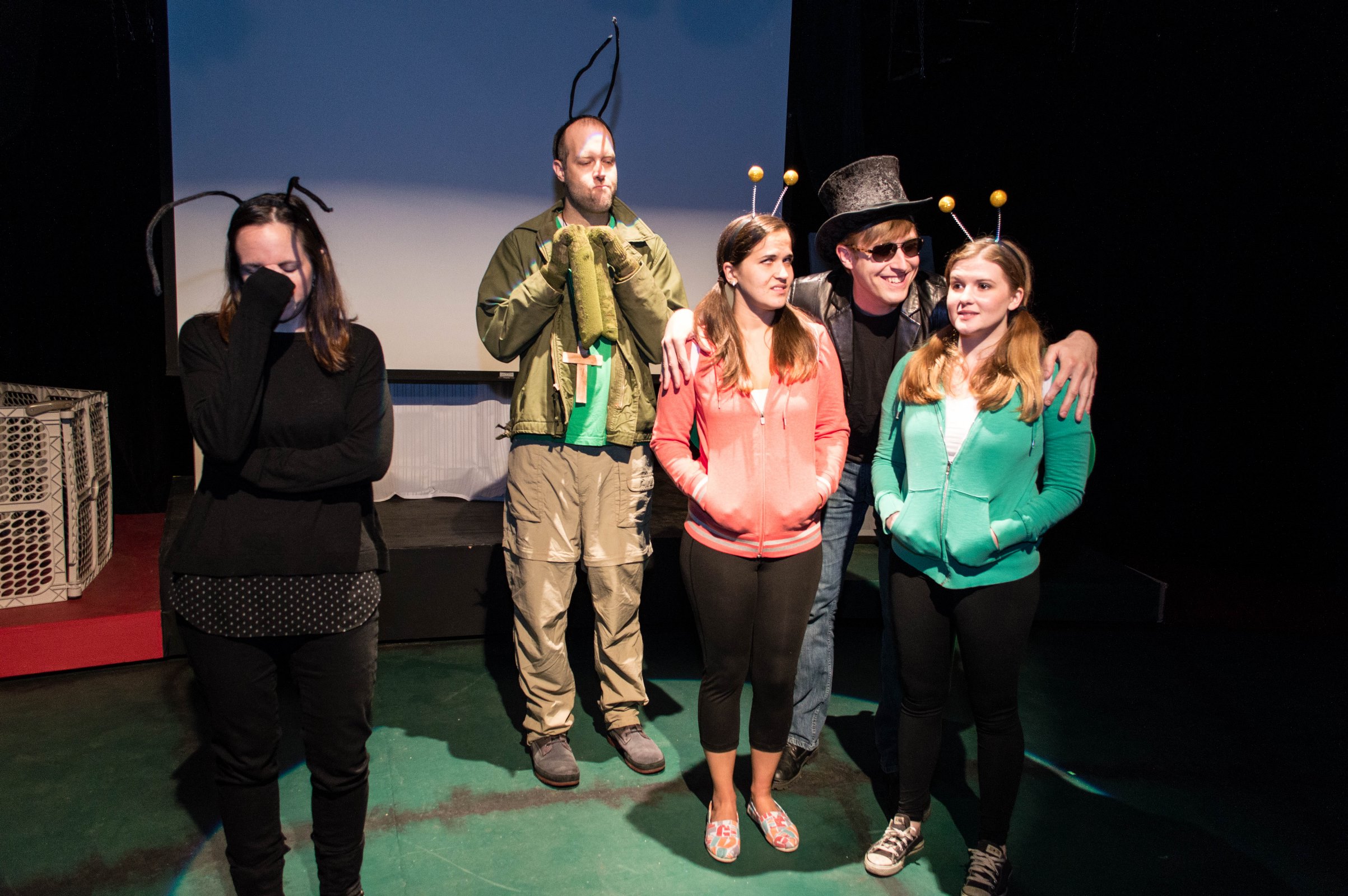
Appearing in The Jar are (from left) Nikki Smith as Cricket, Greg Payne as Praying Mantis, Laura Spires as Julie, Travis Horseman as Daddy Longlegs and Kim Martin as Karen (photo by Michelle Diceglio)
Appearing as insects caught in The Jar are (from left) Nikki Smith as Cricket, Greg Payne as Praying Mantis, Laura Spires as Julie, Travis Horseman as Daddy Longlegs and Kim Martin as Karen (photo by Michelle DiCeglio)

By Richard Ades

Seven plays in less than an hour? It must be some kind of record.

Director Amanda Bauer wastes no time with Black Night, one of the three collections of playlets in MadLab’s Theatre Roulette 2016. On opening night, she didn’t even bother introducing the evening, let alone individual works.

At the end of each play, the stage lights are simply turned off, the scenery is rearranged and the lights come back on, all in the space of a few seconds. The efficiently is dazzling.

What goes on between the scene changes is equally impressive, at least as far as the production is concerned. The acting and pacing are spot on, and many of the costumes are ingenious.

And the writing? Not everything works equally well, but most of the plays earn extra points for originality.

Let’s take them in order.

MooMaid by Rick Park: Josh Kessler plays Mitchell, a dad who can’t stop boasting about his unseen daughter. But something seems off. He drops a lot of F-bombs, and he starts stripping off clothes to prepare for an activity that isn’t revealed until the end. The piece expertly builds a sense of dread that turns out to be justified.

The Prodigal Cow by Mark Harvey Levine: A calf (Laura Spires) is thrilled to be the only farm animal invited to her owner’s dinner party. If you know the New Testament at all, you’ll probably guess where this one is going. It’s also weighed down with weak puns. And how come the calf actually looks something like a cow, but her best friend, the kid (Nikki Smith), looks nothing like a goat?

Absolutely Unbelievable by Bella Poynton: Larry (Greg Payne) goes on a radio show claiming to be a time traveler from five years in the future. The piece has some amusing moments as hosts Sam and Anna (Alex Green and Kyle Jepson) beg for news of technological advancements beyond Larry’s iPhone 8. Disappointingly, though, they never bring up the one question the average American would have asked first: Who’s the next president?

The Lovers by Kirsten Easton: A man and a woman (Chad Hewitt and Kim Martin) try to recall the details of their first meeting while two shrouded figures (Travis Horseman and Colleen Dunne) act out the event. Though nicely performed, the piece gives us little reason to care whether the two have a future together.

Date #3 by Alex Dremann: Will they or won’t they? Ethan and Lynne (Jason Sudy and Spires) deal with that question at the end of the all-important third date. Laughs are provided by various passers-by played by Jepson and Kessler—especially Kessler’s Frenchman, whose accent is as amusingly stereotypical as his philosophical wisdom about the ways of the heart.

A Couple of Inappropriate Jokes and a Story (or Two) by Kelly Lusk: Hewitt plays a man who alternately tells jokes and shares personal tragedies. The incongruous mix makes this the evening’s most unconventional work, but it also means the piece never develops enough gravitas to pull off its would-be shocking ending.

In the Jar by Levine: The evening’s funniest play is about various bugs who get caught by a young boy and imprisoned in a jar—a jar that, they’re terrified to learn, has no air holes. Payne’s unctuous praying mantis gets the most laughs, but all of the insects sport personalities that are as entertaining as their costumes.

Other collections in Theatre Roulette 2016 are Red Night (featuring works by various playwrights) and Green Night (featuring six plays by Erik Sternberger). See below for specific dates and times.

Theatre Roulette 2016 continues through May 28 at MadLab Theatre and Gallery, 227 N. Third St., Columbus. Show times are 8 p.m. Thursday-Saturday, plus 2 and 4 p.m. May 28. Running time for Black Night: 55 minutes. Remaining dates: Green Night: 8 p.m. May 19 and 27, plus 4 p.m. May 28; Black Night: 8 p.m. May 20 and 28; and Red Night: 8 p.m. May 21 and 26, plus 2 p.m. May 28. Tickets are $15, $13 students/seniors, $10 members. 614-221-5418 or madlab.net.

Troupe marks new beginning by depicting world’s end

Endgame

By Richard Ades

There’s something ironic about seeing Endgame while celebrating the opening of a new theater. Samuel Beckett’s dark comedy, after all, is not about beginnings. It’s about the end of the world.

Hamm and Clov (Michael Garrett Herring and Alex Foor) spend their days in a decrepit dwelling perched between the land and the sea. Outside their tiny windows, the planet seems to be dead or dying from some unnamed catastrophe.

Hamm cannot see or walk. Clov, conversely, cannot sit. The two have a quarrelsome relationship thanks to Hamm’s constant demands that he be humored or served. These spring not only from his helplessness but from the pleasure he seems to take in making Clov’s life even more miserable than it would otherwise be.

The only other characters are Nagg and Nell (Roger Masten and Rebecca Zelanin), Hamm’s aged parents, who live in side-by-side trash cans. Though the two regard each other with tired affection, Hamm makes no secret of his hatred of them for bringing him into the world.

Despite the depressing situation and the central character’s rampant misanthropy, Endgame can be an enjoyable experience if a production makes the most of its rich, philosophical language and dour, sometimes self-referential humor. Red Herring’s production, directed by Verne Hendrick and Keely Heyl, generally hits the proper notes.

Foor’s Clov is slow, deliberate and resentful of Hamm’s bossiness. His growing despair and anger are subtly revealed in Foor’s shuffling gait and passive-aggressive tone of voice.

Masten’s Nagg is solicitous toward his wife but barely tolerates his son, boredom emanating from his face as he listens to Hamm’s long-winded storytelling in exchange for a promised treat. Masten’s brittle characterization makes the character both funny and pitiable. (Co-director Hendrick will play Nagg at the May 24 performance.)

In the smaller role of Nell, Zelanin is convincingly distracted and feeble, though she occasionally starts to fall into a Katharine Hepburn impersonation. (Linda Browning will take over the role May 19-29.)

Herring, one of the troupe’s executive producers, carries the bulk of the load as Hamm. He mostly carries it with distinction, though on opening night some of his later speeches could have been delivered more expressively.

Designed by Herring, the set is a combination of roughhewn boards and ancient tools and utensils. Topher Dick’s lighting and Dayton Willison’s grimy, threadbare costumes add to the post-apocalyptic atmosphere.

Red Herring's new home, the Franklinton Playhouse, 566 W. Rich St. Free parking is available at a lot across the street. (photo by Richard Ades)
Red Herring’s new home, the Franklinton Playhouse, 566 W. Rich St. Free parking is available at a lot across the street. (photo by Richard Ades)

The opening-night performance was not perfect, with a line dropped here and there or delivered indifferently, but it communicated the sad and mysterious essence of Beckett’s play well enough to be rewarding. But even if it hadn’t, the chance to get a first look at Red Herring’s new Franklinton home would have made the trip worthwhile.

Though the warehouse-like building is not yet finished, it’s roomy and comfortable enough to reveal its potential. Red Herring plans to share it with other groups in between its own shows, which should make the venue a valuable addition to a part of the city that’s increasingly becoming a hub of creativity.

Red Herring Productions will present Endgame through May 29 at the Franklinton Playhouse, 566 W. Rich St., Columbus. Show times are 8 p.m. Thursday-Saturday, plus 2 p.m. May 15 and 29. Running time: 1 hour, 25 minutes. Tickets are $20 in advance, pay what you want at the door. 614-723-9116 or redherring.info.

Sweet music, jarring language and a timeless morality tale

Big River

By Richard Ades

Standing Room Only nearly lived up to its name Friday, as its evening performance of Big River filled most of the seats in CPAC’s Van Fleet Theatre. Hopefully, that means there’s a market for the ambitious programming the troupe has been tackling of late.

Or maybe it simply means people have an undying love for the tale whose source material is often considered the Great American Novel: Mark Twain’s The Adventures of Huckleberry Finn. Adapted by William Hauptman (book) and Roger Miller (music and lyrics), the Tony-winning musical again sends its scruffy title character and a runaway slave named Jim down the Mississippi on their respective quests for adventure and freedom.

One of the gutsiest things about SRO’s production is also the reason parents might want to prepare their youngest children for the experience. Like Twain’s novel, but unlike an expurgated version I saw many years ago, it allows characters to spout the most racist term in the American vocabulary. The word can sound jarring to modern ears, but it’s probably necessary. That’s because the story depends on a frank portrait of 19th century attitudes to underscore its central lesson.

Huck begins the tale as a rebellious lad who nonetheless accepts the morality of his pre-Civil War era when it comes to the subjugation of black Americans. Indeed, he’s so convinced slavery is a holy institution that he worries he’ll go to hell if he helps Jim escape. Both the novel and the musical are most moving when they show the boy reassessing his position after getting to know Jim as a human being.

Miller’s songs are sometimes stirring but mostly laid-back and pleasant, especially when accompanied by SRO’s old-timey quintet. Performing under music director Chipper Snow, it’s dominated by Ted Reich’s wistful harmonica and Jordan Shear’s lively fiddle.

As for the vocals, there are a few pitchy moments, but most cast members are up to the challenge. That’s especially true of the two male leads. Caleb Baker (as Huck) and Brandon Buchanan (as Jim) harmonize beautifully on duets such as Muddy Water and Worlds Apart.

Acting-wise, their styles are a bit less harmonious. Though Buchanan’s Jim reflects the tension and fears of a man determined to float his way to freedom, Baker’s Huck is unrelentingly calm. He seems unruffled whether he’s fighting off a knife attack or trying to avoid being tarred and feathered by angry townsfolk.

Baker’s physical appearance—he’s taller and huskier than most of the “adults” around him—also undercuts his portrayal of the youth. But that would be less of a problem if he acted more like a frightened teen rather than a laconic good ol’ boy.

Several of the supporting players make indelible impressions under Dee Shepherd’s easy-going direction.

John Feather is dignified and decent as Judge Thatcher, then abandons both dignity and decency to play the self-described King, a con artist who hitches a ride on Huck and Jim’s raft. Greg Zunkewicz is equally conniving as the King’s companion, the Duke, but he sometimes needed to project more at the performance I attended.

Funniest of all is Thor Collard as Huck’s drunken Pap, especially when he’s railing musically against the Gov’ment. Sweetest of all is Ashton Brammer as Mary Jane, who wins Huck’s heart when she becomes the victim of a scheme hatched by the King and the Duke.

As Huck’s friend Tom Sawyer, Anthony Guerrini gets across the lad’s addiction to romantic adventures. It’s not his fault that Tom becomes a distraction late in the story. His 11th-hour reappearance is the only instance in which Twain’s Great American Novel becomes a little less than great.

Even more than SRO’s recently staged Sweeney Todd, Big River is presented in a bare-bones manner. Designed by Angela Barch, some of the costumes are only vaguely 1840-ish, while the “scenery” consists mainly of a footlocker and a large box.

But none of that matters when the production is at its best, doling out sweet music along with a morality tale that retains its power 131 years after it first pricked the conscience of America.

Standing Room Only Theatre will present Big River through May 7 at the Columbus Performing Arts Center, 549 Franklin Ave., Columbus. Show times are 8 p.m. Friday and 2 and 8 p.m. Saturday. Running time: 2 hours, 50 minutes (including intermission). Tickets are $21, $18 seniors (55-plus), $16 members, $12 students. 614-258-9495 or srotheatre.org.

Singing and dancing overshadow emotion in latest ‘Fiddler’

Appearing in Otterbein University Theatre’s production of Fiddler on the Roof are (front) Lauren Kent (Tzeitel), (rear, from left) Aubree Tally (Golde), Natalie Szczerba (Hodel), John Stefano (Tevye) and Abigail Isom (Chava) (photo by Evan Moore-Coll)

By Richard Ades

Otterbein University Theatre apparently is giving Fiddler on the Roof to John Stefano as a going-away present. The professor, who’s retiring after 24 years in the theater and dance department, had long dreamed of playing the iconic dairyman, Tevye.

It’s a wonderful gesture on Otterbein’s part, but it wouldn’t have been surprising if the result had been a production that fell far short of the Tony-winning musical’s potential. After all, you can’t build a show this massive around a single actor.

Thankfully, Otterbein’s theater program is sufficiently rich in talent that its production has several stirring moments.

One of them comes shortly after Tevye introduces us to his Russian hometown, a Jewish community that, in the pre-revolutionary political climate of 1905, is finding life increasingly precarious. Gathering together with their families for the Friday night meal, Tevye and other villagers sing the beautiful Sabbath Prayer.

It’s a heartfelt scene that underscores the message of Tradition, the anthem that opens the show: These humble folks cling to their beliefs and rituals to give meaning to lives mired in poverty, pain and struggle.

Also stirring is the wedding scene in which Tevye and wife Golde (Aubree Talley) marry off the first of their five daughters. Its highlight comes when four dancers perform difficult moves while carefully balancing bottles on their flat-topped hats. Bravo!

In general, director Lenny Leibowitz’s production is at its best in large numbers involving singing and dancing. Otterbein has enough fine vocalists and dancers to carry off Jerry Bock and Sheldon Harnick’s glorious anthems and Stella Hiatt Kane’s acrobatic choreography, and rousing accompaniment is supplied by the ample-sized orchestra performing under Lori Kay Harvey’s baton.

Many of the individual actors also sing beautifully, including Lauren Kent, Natalie Szczerba and Abigail Isom as Tevye’s daughters Tzeitel, Hodel and Chava. Their early trio, Matchmaker, is an engaging exploration of their mixed feelings toward the ancient tradition of arranged marriage.

As for Stefano, he’s not the strongest vocalist who ever hauled around Tevye’s milk cart, but neither is he the weakest. Yes, his voice sometimes falters, but it does so in a way that makes the character all the more endearing.

Stefano also shines during the humorous moments in which Tevye complains to God about his sad lot in life—or to the audience about his loving but fear-inducing wife, Golde. The actor’s comic timing is spot-on.

It’s in the more dramatic moments that the Otterbein production sometimes lacks finesse and timing. One example is the aforementioned wedding scene, which peters out long before it’s interrupted by an attack that foreshadows new problems for the local Jewish community.

Another example: Connor Cook is appealing as Motel, the shy tailor who’s afraid to ask Tevye for the hand of his oldest daughter, but the moment in which he finally works up the nerve is rushed through before it has a chance to sink in.

Other problems can be traced to overacting (Dana Cullinane as the over-the-top Matchmaker) or underacting (Andre Spathelf-Sanders, who barely registers as Chava’s non-Jewish suitor). And though Tally strikes the right balance between scariness and warmth as Golde, neither she nor her makeup artist make a serious attempt to disguise the age difference between her and the actor who plays her husband. As a result, it’s hard to believe Golde and Tevye’s marriage really has endured for 25 years.

The production has many strengths beyond those I’ve already mentioned. They include supporting players Connor Allston as Perchik, the radical student who woos Hodel, and Jack Labrecque as Lazar Wolf, the lonely butcher who sets his sights on Tzeitel. Rob Johnson’s nonrealistic scenery and T.J. Gerckens’s lighting also are striking.

Overall, though, this staging of the musical tragicomedy is more effective as a musical and a comedy than it is as a tragedy. Most productions of Fiddler on the Roof are three-hankie affairs, but one should be enough this time around.

Otterbein University Theatre will present Fiddler on the Roof through April 16 at Cowan Hall, 30 S. Grove St., Westerville. Show times are 8 p.m. Thursday-Saturday. Running time: 2 hours, 55 minutes (including intermission). Tickets are $25. 614-823-1109 or www.otterbein.edu/drama.

Show offers stripped-down, bloodied-up Sondheim

Susan Bunsold Wilson and Bill Hafner in Standing Room Only's production of Sweeney Todd (photo by Dale Bush)
Susan Bunsold Wilson and Bill Hafner in Standing Room Only’s production of Sweeney Todd (photo by Dale Bush)

By Richard Ades

If Columbus barbers have noticed a drop in business recently, it could be because the local theater scene is offering not one, but two productions of the bloodthirsty musical Sweeney Todd: The Demon Barber of Fleet Street.

Those whose taste tends toward the grandiose might want to check out the Ohio State version being presented this weekend at Mershon Auditorium. Those who favor more intimate productions might prefer the Standing Room Only production whose two-week run ends Sunday.

I’ve seen the latter, and I can recommend it with one caveat: The unamplified lyrics are sometimes hard to pick out over the accompaniment. That annoyance aside, the production does right by this darkest of musicals, which features a book by Hugh Wheeler and music and lyrics by Stephen Sondheim.

In fact, it does brilliantly by the musical, thanks to a well-chosen cast and Patrick McGregor II’s ingenious direction.

This is a “black box” production twice over. Not only is the scenery limited to a black backdrop and little more, but the main prop is a black, coffin-shaped box that is continually being moved and upended to serve a multitude of functions. This minimalistic approach might be distracting if McGregor’s cast weren’t so mesmerizing.

Following his starring role in Gallery Players’ 2015 production of Les Miserables, Bill Hafner again excels playing a 19th century man who’s suffered years of unjust imprisonment. But don’t expect to find much in common between the two portrayals.

Unlike the noble Jean Valjean, Sweeney Todd has vengeance on his mind—vengeance against the judge who sent him away in order to pursue his wife. The former barber’s fury intensifies when he returns to London only to learn that his wife is dead and his daughter has been adopted by that same judge. As portrayed by Hafner, Todd is so overcome by grief and anger that he stumbles around in a state of near catatonia.

In effective contrast, Susan Bunsold Wilson radiates manic energy as Mrs. Lovett, the widowed baker who ultimately becomes Todd’s partner in crime. As amoral as she is personable, Mrs. Lovett quickly finds a way to benefit when the deranged barber’s “shaves” start turning into homicides. It’s no coincidence that her meat pies soon become the talk of the neighborhood.

Both Hafner and Wilson display strong voices on numbers such as their duets By the Sea and the darkly humorous A Little Priest, in which Todd and Mrs. Lovett discuss the optimum ingredients for a tasty pie.

As the dastardly Judge Turpin, Todd Lemmon offers an understated version of villainy that disguises itself under a cloak of piety. Turpin and Hafner join their voices to great effect on Pretty Women, a beautiful song that incongruously arises during a moment of impending murder. A more blatant depiction of evil is offered by Colton Weiss as Turpin’s henchman, the nasal-voiced Beadle.

The musical’s second-most beautiful song, Not While I’m Around, is given a dramatic delivery by Layne Roate as the limping, dimwitted Tobias Ragg. Appearing in other important secondary roles are Ethan White as goodhearted seaman Anthony Hope; Taryn Huffman as Todd’s grown daughter, Johanna; and Laura Crone as a beggar woman and a rival barber.

An impressively large orchestra provides the accompaniment, though music director Josh Cutting ably replaced it with his keyboard at the matinee I attended. Curtis Brown’s lighting not only establishes mood but is used to shift viewers’ focus from one side of the room to the other during quick scene changes.

Filled with dark themes and bloody violence, Sweeney Todd is unsuitable for young children. But SRO’s inventive production makes it a treat for those who appreciate Sondheim’s lovely tunes and graceful lyrics even when they’re sung in the midst of a murder spree.

Standing Room Only Theatre will present Sweeney Todd through Sunday (April 10) at the Columbus Performing Arts Center, 549 Franklin Ave., Columbus. Remaining show times are 8 p.m. Saturday and 2 p.m. Sunday. Running time: 2 hours, 45 minutes (including intermission). Tickets are $12-$21 Saturday, $12-$16 Sunday. 614-258-9495 or srotheatre.org.

The Ohio State School of Music, Opera and Lyric Theatre will present Sweeney Todd through Sunday (April 10) at Mershon Auditorium, 1879 N. High St., Columbus. Remaining show times are 7:30 p.m. Saturday and 3 p.m. Sunday. Tickets are $20, $10 for senior citizens, students, children and OSU faculty, staff and alumni association members. Show isn’t suitable for ages 12 and under. 614-292-3535 or music.osu.edu.

Chekhovian angst mined for Durang-ian mirth

Vanya and Sonia and Masha and SpikeBy Richard Ades

There’s nothing quite as fun as watching Christopher Durang take on the Catholic Church, as he proved in his classic satire Sister Mary Ignatius Explains It All for You. But seeing him take on Anton Chekhov is also good for laughs.

He does so in Vanya and Sonia and Masha and Spike, a 2013 Tony Award winner that borrows names and themes from the dour Russian, along with a general air of depressed malaise. That is, the characters suffer from depression; the audience is in hysterics.

CATCO’s current production benefits from a director with a flair for comedy—David Hemsley Caldwell—and two lead players who are equally adept. Jonathan Putnam and Danielle Mann are quietly masterful as Vanya and Sonia, the 50-something siblings who share a miserable existence in the home once owned by their deceased parents.

The first scene establishes their flinty relationship. Sonia brings Vanya his morning coffee, only to learn he’s already poured himself a cup. She complains that he’s deprived her of one of her few daily pleasures, leading to an argument that eventually ends in broken china.

Sonia, we learn, was adopted. We also learn that she’s attracted to Vanya despite his protestations that he marches to a “different drummer”—i.e., he’s gay. Putnam and Mann inhabit the unhappy pair so thoroughly that their personalities come through even when they’re just sitting and glumly observing the world.

Meanwhile, Chekhov is referenced in multiple ways, including Sonia’s insistence that a nearby stand of 10 or 11 trees constitutes a “cherry orchard.” But don’t worry if you’re rusty on the playwright’s works—Durang throws in enough explanations to keep everyone in the loop.

In a nod to Greek mythology, he also makes sure we know why a character named Cassandra is doomed to making dire predictions that no one believes. Shanessa Sweeney is a live wire as the housekeeper, whose ability to see the future comes in handy following the sudden appearance of Sonia and Vania’s successful sister, Masha (Lori Cannon).

The movie star barges in with her younger lover, Spike (William Darby), and begins talking about a change that will upset her siblings’ boring but stable existence. Narcissistic and overbearing, Masha proved a difficult character to enjoy at Wednesday’s preview matinee, especially since Cannon at first had trouble playing her with more than one note. Cannon fared better after intermission, when Masha’s insecurities bubbled to the surface and made her recognizably—and hilariously—human.

As Spike, Darby has some nice comic moments but is mostly limited to stripping off his clothes and showing off his physique. In a more nuanced role, Kristen Krak is lovable as Nina, an aspiring actress who quickly forms a bond with the man she insists on calling “Uncle Vanya.”

Completing the near-perfect production, Eric Barker’s painterly set is expressively lit by Jarod Wilson to suggest the passage of time as the action wends its way from morning to night and back to morning. It’s an entertaining and surprisingly warm-hearted trip, and one that’s well worth taking.

CATCO will present Vanya and Sonia and Masha and Spike through April 24 in Studio One, Riffe Center, 77 S. High St., Columbus. A preview will be presented at 7:30 p.m. Thursday (April 7). Regular show times are 11 a.m. Wednesday, 8 p.m. Thursday-Saturday and 2 p.m. Sunday. Running time: 2 hours, 35 minutes (including intermission). Tickets are $17 Wednesday, $30 Thursday, $40 Friday-Saturday and $35 Sunday. 614-469-0939 or catco.org.