Reviews

Play, movie depict challenges of being female in a male-dominated society

Waad Mohammed as a Saudi girl in search of a bicycle in Wadjda

By Richard Ades

Patriarchy is in the crosshairs at two Bexley area venues. A groundbreaking Saudi Arabian film is launching a sneak attack at the Drexel Theatre while, a few blocks to the south, a familiar tale is walking the boards at the Jewish Community Center.

The play is Yentl, best known as the source material of a 1983 movie musical starring Barbra Streisand. Written by Leah Napolin and Isaac Bashevis Singer, the stage version differs significantly from the Streisand vehicle but still focuses on a young Jewish Pole who changes her identity in order to study scripture.

Yentl (Adelaide Feibel) learns the joys of scholarship thanks to her rabbi-father (Frederick M. Luper), who teaches her the Torah in secret because such knowledge is meant only for boys. After his death, she disguises herself as a young man named Anshel and joins a yeshiva to continue her studies.

From this point, the play largely sets aside the underlying issue of gender inequality and focuses on gender identity. Yentl/Anshel becomes study partners with Avigdor (Daniel Shtivelberg) and stumbles into a relationship with his ex-fiancée, Hadass (Rachel Gaunce). This sets up complicated questions whose answers are hard to sort out in the current Gallery Players production.

One problem is that talented high-schooler Feibel seems overwhelmed by the challenging title role. Not only is she onstage almost constantly, but she has to play a girl who masquerades as a boy and is faced with conflicting and confusing emotions. Though Feibel gives a gutsy performance, it’s hard to read her character’s true feelings, as the portrayal mainly comes off as angry and defensive.

In general, director Steve Black’s production suffers from a lack of coherence. There are good performances in both large and small roles—Shtivelberg and Gaunce are both admirable—but there are also scenes in which actors stumble over lines or chew the scenery.

At the performance I attended, the audience unwittingly added to the problem by applauding every scene, no matter how short. Though the applause was meant to be supportive, it added to the feeling that the play was a collection of disparate parts rather than a coherent whole.

Meanwhile, at the Drexel, an unusual film is taking aim at the patriarchal elements of another religion. Set in Saudi Arabia, where a conservative interpretation of Islam prevents women from even obtaining driver’s licenses, Wadjda focuses on another girl who masquerades as someone she’s not.

Wadjda (an irresistible Waad Mohammed) is easy to spot in her all-girl school—she’s the one wearing worn sneakers under her ankle-length uniform. Though she would be a typical preteen in most parts of the world, Wadjda’s love of pop music and her tomboyish adventures with boy pal Abdullah (Abdullrahman Al Gohani) mark her as a rebel in the school’s repressive atmosphere.

Then two things happen that change her life: (1) She spots a beautiful bicycle that she decides she must have, even though cycling is considered hazardous to a girl’s virtue. And (2) the school announces a Quran competition whose prize money is almost identical to the bike’s cost. The enterprising girl immediately undertakes a study of Islam’s holy book, fooling the school’s staff into thinking she’s suddenly found religion.

Directed by Haifaa Al Mansour, the film also focuses on Wadjda’s mother (Reem Abdullah), a woman with her own set of problems. She attempts to live by her society’s strict rules, which mean covering up from head to toe and hiring a foreign-born driver when she wants to venture outside the home. But she’s increasingly feeling the sting of patriarchy, particularly because her loving but largely absent husband (Sultan Al Asaaf) is planning to take a second wife who can give him the son he needs to carry on his bloodline.

The mother’s emotional conflicts are shown in subtle ways, as in the primping she engages in before putting on a garment that hides her handiwork from the public. Similarly, Wadjda’s feelings toward her situation—her father’s imminent remarriage and the increasing strictures she’s expected to follow—must be gleaned from her expressive eyes.

Wadjda carries two distinctions: It’s the first full-length film made entirely in Saudi Arabia, and it’s the first feature directed by a Saudi woman. But its most important distinction is the disarming and subtly powerful way in which it depicts the ordeal of growing up female in a patriarchal society.

Gallery Players (in conjunction with Fort Hayes Black Box Theatre Company) will present Yentl through Nov. 3 at the Jewish Community Center, 1125 College Ave. Show times are 7:30 p.m. Thursday, 8 p.m. Saturday and 2:30 p.m. Sunday. Running time: 2 hours, 20 minutes (including intermission). Tickets are $20 ($15 JCC members), $18 seniors ($13 JCC members), $10 students and children. 614-231-2731 or http://columbusjcc.org/programs/cultural-arts/gallery-players/.

Wadjda will be screened through Oct. 31 at the Drexel Theatre, 2254 E. Main St. Show times: 4:30, 7:30 and 9:45 p.m., plus 11 a.m. and 1:45 p.m. Wednesday. Running time: 1 hour, 37 minutes. Tickets: $5-$9. Rating: 5 stars (out of 5). Drexel.net.

Tale of New Jersey songsters improves with age

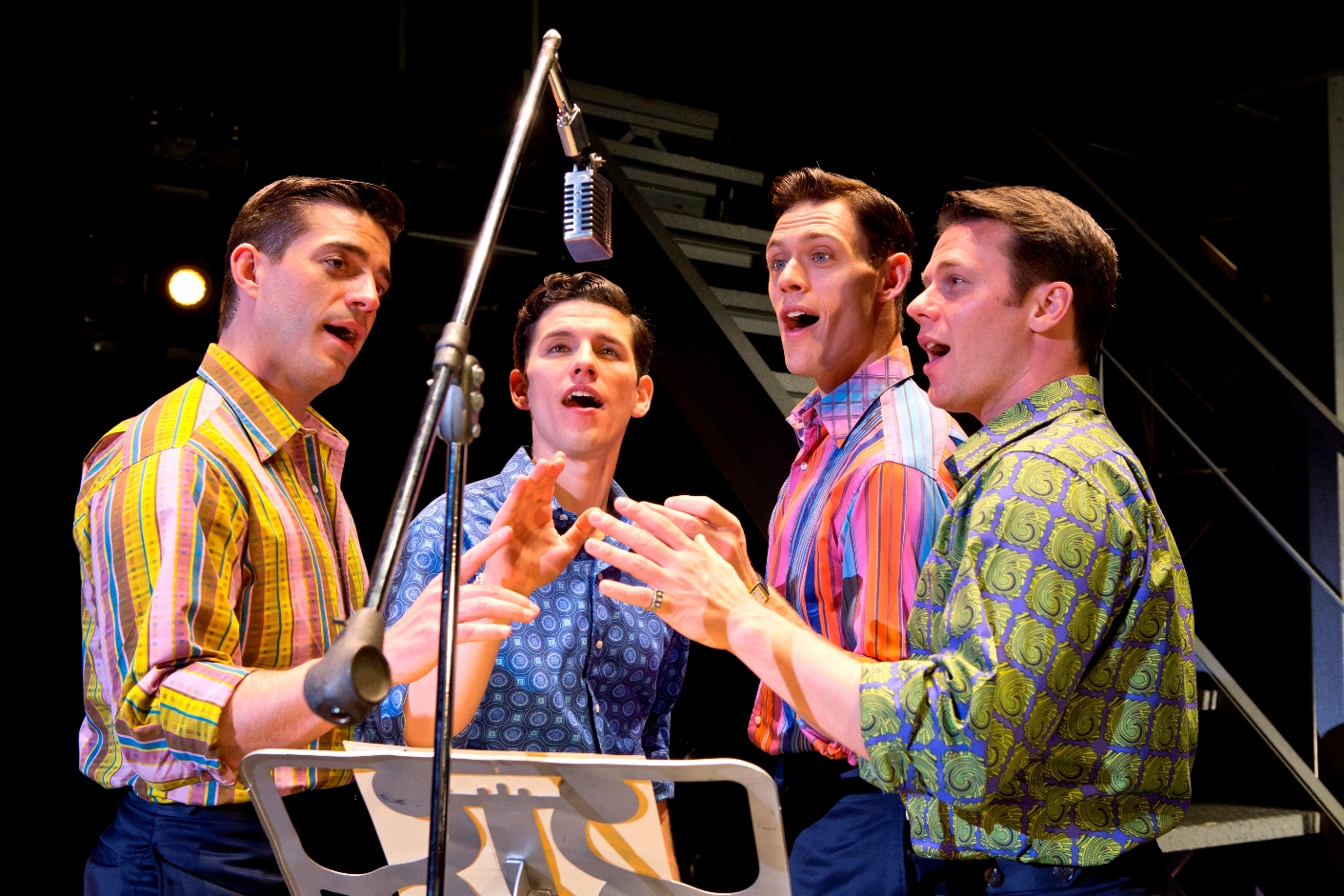
Brandon Andrus, Nick Cosgrove, Jason Kappus and Nicolas Dromard (from left) play the Four Seasons in Jersey Boys (photo by Jeremy Daniel)

By Richard Ades

Why is Jersey Boys so much more fun the second time around?

Part of it may be due to lowered expectations. Prior to the touring show’s Columbus debut in 2011, the press attended a preview during which we were told to expect a spectacle that would put every other musical to shame. We also were informed that male viewers, in particular, would be reduced to manly tears by this trip down the Four Seasons’ Memory Lane.

Well, it didn’t happen. Not to me, at least. The show’s historically correct harmonizing was great, but the dramatic portions left my eyes dry.

Fast forward to earlier this week, when the latest version of the touring show returned to the Ohio Theatre. I went, expecting little, and got a lot. In fact, I had a ball.

But the difference can’t be attributed entirely to my new lack of optimism. I think the production is noticeably better this time around.

That’s particularly true in regards to the key role of lead singer Frankie Valli. Two years ago, the featured actor hit the falsetto notes with aplomb, but he couldn’t carry off some of the tale’s most touching moments. Now, though, Nick Cosgrove does it all without a hitch—singing, acting and even a few athletic dance moves.

Actors playing the rest of the New Jersey-bred quartet are equally fine: Nicolas Dromard as the out-for-himself Tommy DeVito, Jason Kappus as songwriter Bob Gaudio and a comically laconic Brandon Andrus as Nick Massi.

With a book by Marshall Brickman and Rick Elice, this 2006 Tony Award winner relates the history of the Four Seasons by allowing each member of the 1960s rock group to tell his side of the tale in turn. It’s a clever tack and probably a necessary one, given that three of the four original members are still alive and don’t necessarily agree on the details.

A bevy of talented supporting cast members play the many people who wander in and out of the musicians’ lives. Key actors include Barry Anderson as record producer Bob Crewe, Marlana Dunn as Mary Delgado and Thomas Fiscella as sentimental gangster Gyp DeCarlo.

Under Des McAnuff’s direction, the cast and crew work as a unit while the action flows fluidly from one scene to the next, sometimes even in the midst of song. Meanwhile, Klara Zieglerova’s set design and Howell Binkley’s lighting design fill the stage with images that are subtly handsome and perfectly complementary. As a piece of stagecraft, Jersey Boys is a wonder.

But the show’s real highlight is the music—the just-right re-creations of hits such as Big Girls Don’t Cry, Walk Like a Man and Can’t Take My Eyes Off You. And that’s due not only to the actors’ vocal prowess but to conductor Ben Hartman and his onstage band. Special kudos to Mark Papazian, without whose emphatic drumming the night would be far less joyful.

Were my eyes still dry when I left the show this time around? Yes, but I didn’t care. The rest of my face was smiling.

Broadway in Columbus and CAPA will present Jersey Boys through Sept. 29 at the Ohio Theatre, 39 E. State St. Show times are 7:30 p.m. Tuesday-Thursday, 8 p.m. Friday, 2 and 8 p.m. Saturday and 1 and 6:30 p.m. Sunday. Running time: 2 hours, 35 minutes (including intermission). Tickets are $28-$128. 614-469-0939, 1-800-745-3000 or ticketmaster.com.

King Arthur and friends hit the road in ‘Spamalot’

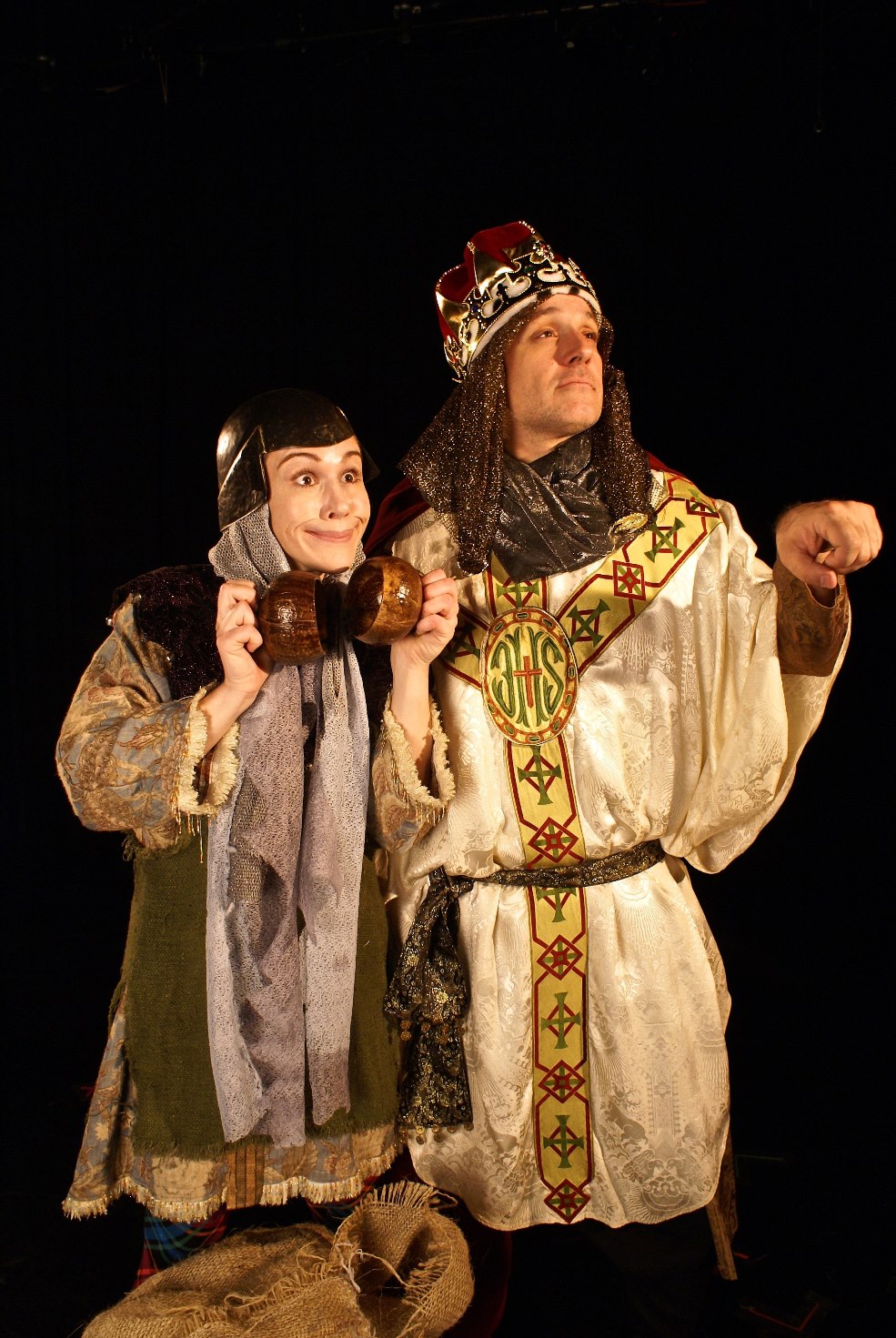
Tom Cardinal (right) as King Arthur and Amy Lay as his aide, Patsy, in Spamalot (photo courtesy of Shadowbox Live)

By Richard Ades

Shadowbox Live’s “metaperformers” are Monty Python fans. That’s obvious throughout their production of Spamalot, the musical inspired by the 1975 film Monty Python and the Holy Grail.

You can see the love in the working-class British accents and the squeaky voices of the suspiciously mannish women. You can see it in the perfect timing with which the “Knights Who Say Ni” squawk out their signature word.

You can see it in director Stev Guyer’s patient willingness to allow each scene to expand to its maximum level of hilarity.

For the unaware, Monty Python was a BBC-bred comedy troupe that combined brainy humor with rampant silliness and an anarchic disregard for societal norms. Spamalot, with book and lyrics by Python alum Eric Idle, simultaneously spoofs the King Arthur legend and Broadway-style musicals. The latter comes out in numbers such as The Song That Goes Like This, a dead ringer for the kind of show-stopping tune that’s become an Andrew Lloyd Webber hallmark.

At Shadowbox, Idle’s Tony-winning musical allows numerous performers to put their acting and singing strengths to optimal use.

Tom Cardinal is heroic but not foolhardy as Arthur, the mythical king whose search for the Holy Grail sends his ragtag group of knights off on a series of dangerous adventures. Amy Lay is delightfully dutiful as Patsy, his aide, who stands in for his “horse” by clapping together two halves of a coconut. (The presence of this tropical fruit, by the way, foments one of the first daffy exchanges as dubious guards question just what kind of bird would be big enough to carry it to medieval England.)

After spoofing operatic divas in previous Shadowbox theme shows, Stephanie Shull brings the same kind of energy to the Lady of the Lake, a role that also makes the most of her powerhouse voice. Michelle Daniels narrates Arthur’s adventures as the Historian, while Billy DiPetro supplies comical menace as the disapproving father of a son who fancies himself a maiden in distress.

Also along for the virtual ride are JT Walker III as Galahad, David Whitehouse as Lancelot, Jim Andes as Bedevere and Robbie Nance as Robin, as well as a host of others playing the threatening soldiers, trash-talking “Frenchies,” lascivious ladies and sundry monsters the knights encounter during their quest.

Katy Psenicka’s alternately medieval-rough and Broadway-glitzy choreography adds to the fun, as does Matthew Hahn’s musical direction and a band that’s often dominated by Kevin Patrick Sweeny’s keyboard work.

Due to acoustics and accents, a few lyrics and bits of dialogue may be difficult to catch. But that probably won’t be a problem for true Python fans, who know the show by heart anyway.

Speaking of which, if you are such a fan, don’t give in to the temptation to call out punch lines in advance, as at least one audience member did on opening night. Otherwise, an unpleasant French person may unplug his nose in your general direction.

Spamalot will be presented at 2 and 7 p.m. Sundays through Nov. 17 at Shadowbox Live, 503 S. Front St. Running time: 2 hours, 20 minutes (including intermission). Tickets are $30, $20 for students and seniors. 614-416-7625 or shadowboxlive.org.

You might want to brush up on your Kierkegaard first

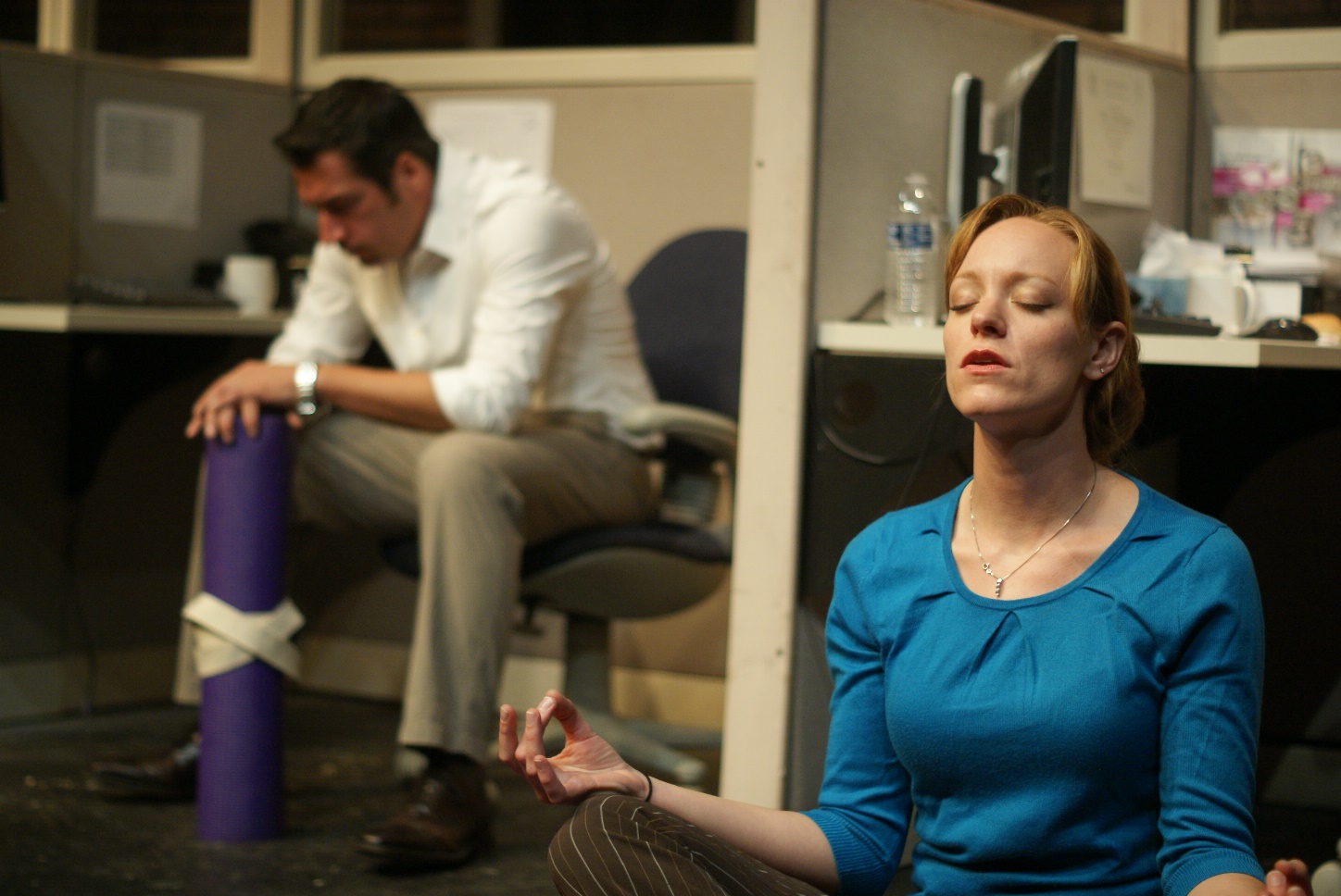
Colin (Erik Sternberger, left) strikes a typically dejected pose while Fran (Katharine Pilcher) practices “existential yoga” in The :nv:s:ble Play (photo by Andy Batt)
Colin (Erik Sternberger, left) strikes a dejected pose while Fran (Katharine Pilcher) practices “existential yoga” in The :nv:s:ble Play (photo by Andy Batt)

By Richard Ades

It’s ironic that Alex Dremann’s The :nv:s:ble Play is about a group of book editors. The two-act, two-hour work offers interesting food for thought, but it would benefit from a little editing.

While philosophy majors may be amused by its subtle existential humor, most folks would find it far more palatable if a few minutes—60, say—were cut from its running time.

Set in a New York publishing house that specializes in existential literature, The :nv:s:ble Play is about employees who are so shy and retiring that they gradually disappear from sight. At the center of the action is Colin (Erik Sternberger), who is trying to finish editing a romance novel when he discovers that neither his co-workers nor the book’s author (an unusually hammy Courtney Deuser) can see or hear him.

Actually, saying Colin is at the center of the action is misleading. It would be more accurate to say he’s in the center of the inaction, as he spends scene after scene hunched over his desk in a state of dejection while his oblivious co-workers go about their lives.

Since those lives consist mainly of gossiping about who’s romancing whom and which employees are destined to be laid off, Dremann seems to be suggesting that people like Colin are doomed to be the unappreciated backbones of their companies while their shallow but flashier colleagues gain all the glory.

There’s also a romantic element to the story, but its point is a bit murky. Colin may be in love with Fran (Katharine Pilcher), the Yale-educated woman in the next cubicle, but he also may not be, as he’s not even sure he believes in the emotion. So why should we care? Because a fellow invisible worker comes up with a theory—presumably after watching Beauty and the Beast—that one way to break the spell of invisibility is to make another person fall in love with you.

This sets Colin on a quest to get Fran to fall for him, which means he first must get her to notice him. His bumbling efforts result in several frustratingly slow scenes, including one cribbed from the 1989 rom com Say Anything.

One bright spot in all this is that MadLab’s cast, like most recent MadLab casts, is uniformly good. Director Andy Batt pulls generally well-crafted performances out of his actors.

Besides Sternberger and Pilcher, the leading players include Chad Hewitt as the sleazily ambitious Tim, Shana Kramer as the pregnant Carmen and Megan Corbin as their scary supervisor, Nancy. Most lovable of all is Michelle Batt as Ramona, a self-described asexual arborist who, like Colin, has become invisible to her co-workers.

Rounding out the cast are Joe Liles as Lawrence, an IT guy who has become invisible even to Colin and Ramona, and Deuser as Cass, an aging editor who is unseen because her desk is on the far side of the room.

Speaking of the room, Brendan Michna’s set design is a series of cubicles that will remind many office workers of their place of employment. It certainly reminded me of my former office, except that I don’t remember my days there being quite so uneventful.

The :nv:s:ble Play will be presented at 8 p.m. Fridays and Saturdays through Sept. 14 at MadLab Theatre and Gallery, 227 N. Third St. Running time: 2 hours (including intermission). Tickets are $12, $10 for students and seniors, $8 for members. 614-221-5418 or madlab.net.

On his way to writing ‘Rent’…

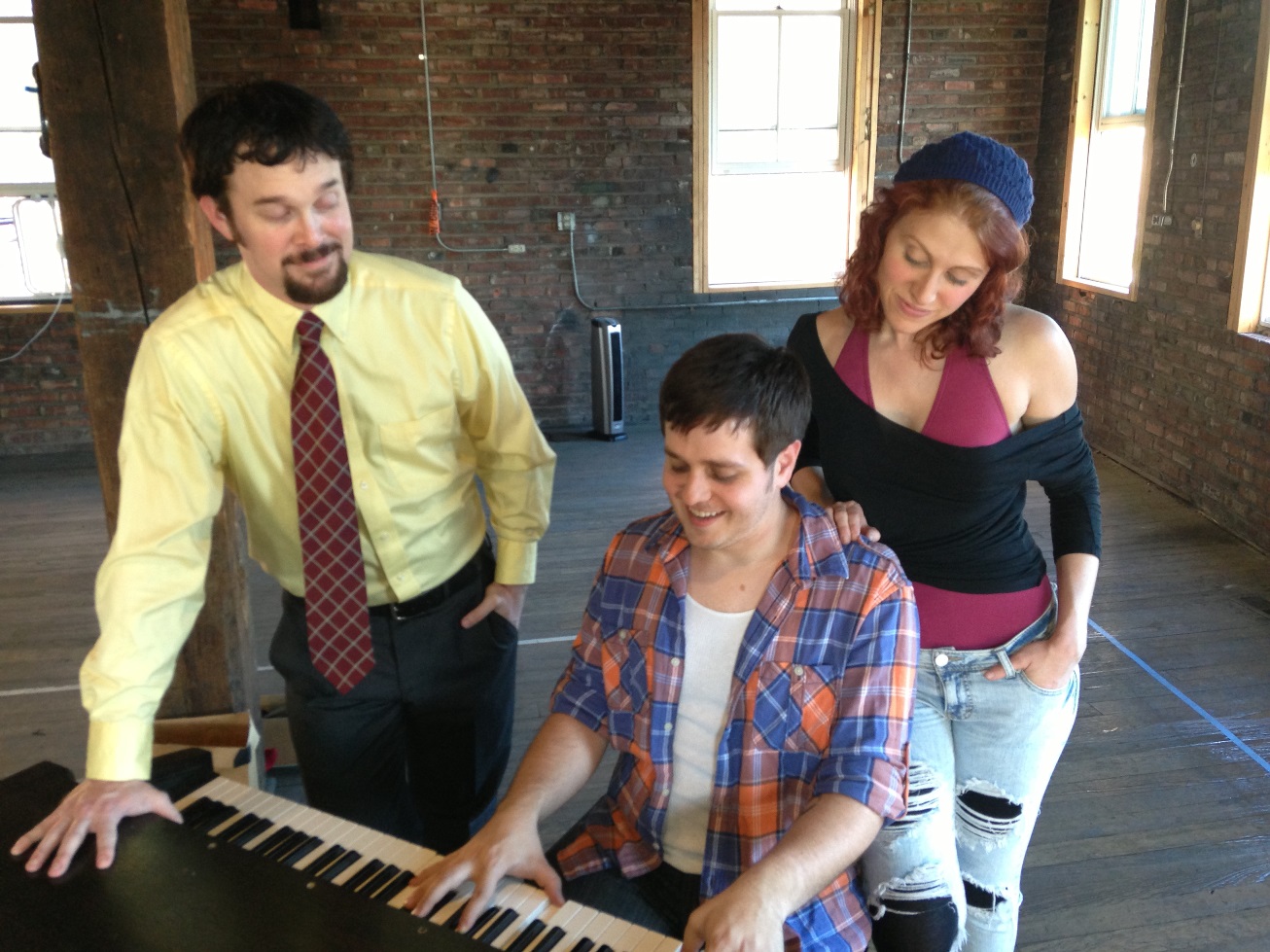
Appearing in tick, tick…Boom! are (from left) Christopher Storer as Michael, Jonathan Collura as Jon and Kaitlin Descutner as Susan (photo by Zach Hartley)

By Richard Ades

If you’re a fan of Rent or of rock-based musical theater in general, you’ll want to see tick, tick…Boom! The 1990 work is Jonathan Larson’s semi-autobiographical take on his struggle to establish himself as a composer and lyricist.

If you’re not a fan of either Rent or rock-based musical theater, the show is less of a must-see, but it remains tuneful and pleasant enough to be worthwhile.

Of course, the $64,000 question with any locally produced musical is: Does the cast have enough vocal chops to carry it off? Because, let’s face it, that’s not something you can take for granted.

Happily, though, the answer is a resounding yes. Director Zach Hartley has found three performers who sing like pitch-perfect larks. They also have acting chops, though that’s less of a consideration in a show whose appeal is more historical than dramatic.

Jonathan Collura is personable as Jon, a New York composer who’s sweating his way toward both his 30th birthday and a workshop performance of his latest musical. Kaitlin Descutner is equally appealing as his dancer/girlfriend, Susan, who supplies comfort and support when she’s not kvetching about her desire to live in a less-urban environment.

It would nice if Christopher Storer provided a more grounded portrayal of Michael, Jon’s Bimmer-driving roommate. That might make a last-minute revelation about the character seem less gratuitous. But Storer excels—as does Descutner—in colorful secondary roles.

As for the songs, they range from the lightweight Green Dress to the clever Sunday, a trio that reflects Jon’s (and Larson’s) reverence for Stephen Sondheim. Also Sondheim-like is the flashy Come to Your Senses, which gives Descutner a chance to show off her vocal power.

For the most part, the tunes come in flavors of rock, which Larson helped to introduce to musical theater. Whatever their genre, an onstage band led by musical director Hillary Billups provides stalwart support.

Truthfully, as a piece of theater, tick, tick…Boom! is less than overwhelming. But as a piece of theatrical history, it’s a gem.

Evolution Theatre Company will present tick, tick…Boom! through Aug. 17 at the Columbus Performing Arts Center, 549 Franklin Ave. Show times are 8 p.m. Thursday-Saturday. Running time: 95 minutes. Tickets are $20-$25, $15 for students and seniors. 614-223-1124, 1-800-838-3006 or evolutiontheatre.org.

Hoping to spell their way to happiness

Japheal Bondurant as competitor William Barfee in The 25th Annual Putnam County Spelling Bee (Red Generation Photography)

By Richard Ades

A confession: I was disappointed when I heard CATCO had booked The 25th Annual Putnam County Spelling Bee for its new season.

That was partly because I’d rather see Columbus’s premier troupe tackle works that aren’t quite so familiar. Mostly, though, it was because I’d seen a touring production come through town several years back and hadn’t fallen in love with it.

But you know what they say about love being better the second time around? Maybe that also applies to this quirky musical. Thanks to CATCO’s personable production, I now love both it and its nerdy characters.

With a book by Rachel Sheinkin and music and lyrics by William Finn (Falsettos), Spelling Bee is like a comedic and tuneful version of the 2002 documentary Spellbound. Like the film, it delves into the personalities of the young contestants in an attempt to explain how they became spelling whizzes and why parlaying their skills into victory is so important to them.

It could be that director Steven Anderson’s long submergence in children’s theater has served him well here, because his production’s greatest strength is its ability to turn each of the competitors into a recognizably and lovably eccentric individual.

Early laughs are won by Leaf Coneybear (Patrick Walters), whose behavior is even odder than his helmeted and caped attire. Also attracting our attention is the Korean-American Marcy Park (Nicolette Montana), who only later reveals why she seems annoyed by the whole event.

The richest portrayals are provided by Japheal Bondurant as the plus-sized William Barfee—whose haughtiness could well be both a reflection of his brilliance and a defense against an often-hostile world—and Elisabeth Zimmerman as the lonely Olive Ostrovsky. Played by Zimmerman with a deer-in-the-headlights expression and a lovely voice, Olive reveals the direness of her situation in the show’s most touching number, The I Love You Song.

Also taking part in the competition are Chip Tolentino (James Sargent), whose struggle to repeat last year’s victory is complicated by his dictatorial libido, and Logainne Schwarzandgrubenierre (Emily Turner), whose gay fathers encourage her to win at any cost.

Four pre-selected audience members play additional competitors and frequently come in for witty and personalized jibes from the spelling bee’s hosts, Rona Lisa Peretti (Krista Lively-Stauffer) and Vice Principal Douglas Panch (Ralph E. Scott). Panch, by the way, has many of the show’s funniest lines—which usually follow the question “Can you use it in a sentence?”—and Scott delivers them with deadpan perfection.

The cherry on the show’s comical sundae is Mitch Mahoney (Geoffrey Martin), a scruffy ex-con who was sentenced to perform community service by acting as the competition’s “comfort counselor.”

Michael S. Brewer’s set design captures the look of a school auditorium right down to the cinder-block walls and the “Putnam Piranhas” wall signs. A band led by Matt Clemens is a spirited presence despite being hidden backstage.

With tuneful tunes, heartfelt performances and more laugh-out-loud moments than you can shake a dictionary at, The 25th Annual Putnam County Spelling Bee is simply irresistible.

CATCO will present The Twentieth Annual Putnam County Spelling Bee through Aug. 18 in Studio One, Riffe Center, 77 S. High St. Show times are 11 a.m. Wednesday, 8 p.m. Thursday-Saturday and 2 p.m. Sunday. Running time: 2 hours, 20 minutes (including intermission). Tickets are $41 for Thursday and Sunday performances, $45 for Fridays and Saturdays, $11.50 for Wednesday matinees. Student tickets are available for $15 two hours before non-sold-out performances. 614-469-0939 or catco.org.

Young playwrights aim high

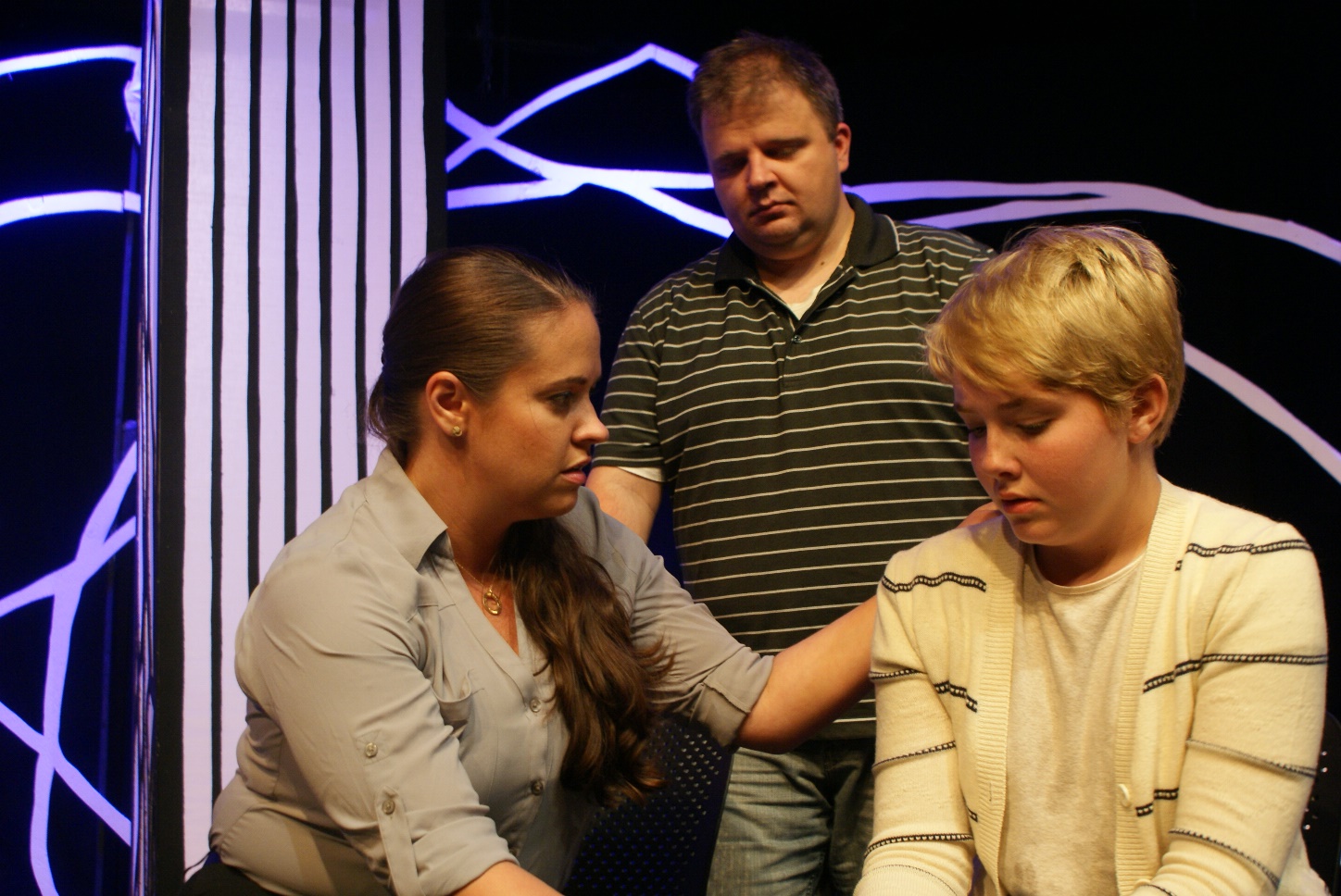
The spirit of George (Sean Reid) watches as his wife (Mary-Aileen St. Cyr, left) and daughter (Lexy Weixel) deal with his loss in Neither Here Nor There (photo by Michelle Batt)

By Richard Ades

When MadLab launched its Young Writers Short Play Festival last year, I was pleasantly surprised to find the high school playwrights taking on mature topics and storylines. Though they spent their days in the classroom, they demonstrated that their imaginations were fully capable of roaming the world at large.

This year—in the first of the festival’s two collections, at any rate—the writers seem to have graduated from mature topics to “big” topics. Friday night’s plays deal with, in order, death, religion, nuclear war and gay identity. Kudos to the kids for their social consciousness.

But, of course, good intentions don’t guarantee good results. No matter how big its topic is, a play rises and falls on such details as characters, situations and dialogue, not to mention the strength of the acting and directing.

Due to all of these factors, the first play of the evening does nothing but rise. Emily Cipriani’s Neither Here Nor There takes on a potentially manipulative and hackneyed situation and creates an inventive combination of laughs and tears.

Working under Becky Horseman’s sensitive direction, Sean Reid stars as George, a man who suddenly finds himself in a hospital room looking down at an unconscious accident victim. Thanks to the appearance of a doughnut-downing Grim Reaper (Peter Graybeal), he learns that the victim is a brain-dead version of himself. Being an invisible spirit, George is then forced to watch helplessly as his wife (Mary-Aileen St. Cyr) and daughter (Lexy Weixel) attempt to deal with a loss that is all the more difficult because it’s not yet final.

Actor Weixel, by the way, is also a featured playwright in the festival (her Dead End being included in the Saturday collection). In the first of her two Friday appearances, her unfussy portrayal of the daughter is one of the production’s many strengths.

None of the Friday collection’s remaining plays are as fully realized as Neither Here Nor There, but all are worth seeing—if for no other reason than because they offer a rare glimpse into the minds of thoughtful high-schoolers. The other works:

Priestly, by Kinsey Cantrell, dramatizes the clash between an up-and-coming filmmaker (Stephen Woosley) and his religion-fixated mother (Randi Morgan). The play benefits from funny lines, but Cantrell and Morgan are less successful in their attempts to humanize the largely stereotypical mom. On opening night, the production’s timing was also a bit sluggish.

In Love and War, by Amelia Koontz, throws a teenage girl and boy (Weixel and Joe Liles) together on the brink of nuclear annihilation. The resulting romance-in-the-face-of-destruction is reminiscent (probably unconsciously so) of the 2012 flick Seeking a Friend for the End of the World, but Koontz’s tale is less cloying than that oddball rom-com.

The playwright and director Woosley and his two actors actually do a good job of portraying the lonely teens’ attempts to understand and support each other. However, as in the movie, the characters’ interactions can’t help being overshadowed by the end-of-days setting.

Closing Closet Doors, by Hannah Russell, centers on Lydia (Brigid Ogden), a young lesbian who has come out to her family and now has to suffer the embarrassing consequences. It’s a brave effort, but the work has so many characters offering so few revelations that it almost seems like an outline for a play rather than the play itself.

Despite its spareness, Closing Closet Doors did win loads of laughs on opening night. That’s partly because the script gives director Woosley and his cast abundant opportunities to throw in comic business.

Truthfully, it also didn’t hurt that friends of the playwright and cast had turned out for the show and were eager to show their support. But just think of that: high-schoolers being celebrated, not for shooting baskets or making touchdowns, but for creating theater.

One more reason to cheer the Young Writers Short Play Festival.

The Young Writers Short Play Festival continues through Aug. 10 at MadLab Theatre and Gallery, 227 N. Third St. Show times are 8 p.m. Friday (featuring plays by Emily Cipriani, Kinsey Cantrell, Amelia Koontz and Hannah Russell) and 8 p.m. Saturday (featuring plays by Em Hammett, Anna Mulhall, Sarah Fornshell, Lexy Weixel and Abigail Goodhart). Tickets are $12, $10 for students and seniors, $8 for members. 614-221-5418 or madlab.net.

Second helping of ‘Burlesque’ outshines the first

Amy Lay, Morgan Mosley, Nikki Fagin, Stacie Boord and Edelyn Parker (from left) in Burlesque Behind the Curtain (Shadowbox Live photo)

By Richard Ades

One of the most surprising letters I ever got during my time at The Other Paper was from a theater troupe seeking more publicity. What surprised me was the letter’s explanation that troupes need as much ink as they can get because, according to statistics, more people are into sado-masochism than are into live theater.

After getting over my shock at the unlikely comparison, it occurred to me that it’s probably possible to remedy the situation by mounting shows that would appeal to these non-theater-going S&M-ers. Shadowbox Live’s original Burlesque de Voyage, for example, offered a satisfying release, in the form of laughs and sexual energy, but only after forcing viewers to sit through a rather tedious first act. Punishment and reward: Surely that would have attracted members of the whips-and-chains crowd if only they’d known about it.

Unfortunately, this demographic is less likely to be attracted to the follow-up show, Burlesque Behind the Curtain, which stubbornly insists on being entertaining all the way through. The sequel is again centered on a traveling burlesque troupe, but writer Jimmy Mak wisely altered the format in a couple of key ways.

Stacie Boord as Della Clayton (Shadowbox Live photo)

While 2012’s Burlesque devoted its entire first act to backstage dramas that were uninvolving because we hadn’t been properly introduced to the characters, 2013’s sequel alternates such scenes with songs and skits from the fictitious troupe’s stage show. Moreover, it adds interest to the backstage scenes by giving them a focus: the arrival of new cast member Della Clayton (Stacie Boord), a grownup child star with a talent for rubbing people the wrong way.

Act 1 still isn’t perfect—the backstage dramas are fairly shallow (and were sometimes sluggishly performed on opening night), and the comedy skits are so-so. But the song-and-dance numbers are both tuneful and provocative.

The show’s first infusion of lust is Maintenant, sung in French by emcee Busty (Julie Klein) and accompanied by classy/sexy dancers who soon strip down to their bras. (Pasties and thongs make an appearance before the show is over.) Continuing in the same mood, Robbie Nance sings the Coasters’ Little Red Riding Hood while the Big Bad Wolf (Jim Andes) “eats” Grandma (Boord) in a way that was never intended in the original fairy tale.

Finishing up the act, Jeff Simpson sings You Look Like Rain with tones just as beautiful as the notes band member Nicole Rachelle coaxes out of her saxophone solo.

But if Act 1 sounds good, just wait. Act 2 is five times better. Especially improved are the comedy sketches, which consist of vaudeville-type routines performed in the vaudeville style.

The evening’s first huge laugh comes courtesy of Monkey Business, delightfully delivered by Mak as a police detective and Amy Lay as a semi-clothed secretary whose boss has just jumped out of a 20th-story window. Even more laughs come courtesy of the double entendres in The Court of Last Retort, starring Brandon Anderson as the D.A., Mak as the lascivious judge and a cigarette-holder-toting Lay as the witness.

Yet even those laughs are topped by the guffaws Klein and others drag out of a naughty audience-participation bit set to the tune of I Wanna Be Loved by You.

Speaking of which, there’s still plenty of sexual content in Act 2, including a number that might even appeal to S&M types: Director Stev Guyer sings John Legend’s Who Did That to You while scantily clad “Avengers” beat a woman-abusing man (Andes) within an inch of his life.

Laughs, music, dance, nubile bodies and a feminist revenge tale: Really, what more could you ask from a show?

Burlesque Behind the Curtain will be presented at 7:30 p.m. Wednesdays and Thursdays through Oct. 10 at Shadowbox Live, 503 S. Front St. (No performances Aug. 28; Sept. 4, 11, 12, 25, 26; Oct. 3, 9.) Running time: 2 hours, 10 minutes (including intermission). Tickets are $30, $20 students and seniors. 614-416-7625 or shadowboxlive.org.

If Miracle-Gro doesn’t work, try blood

Seymour (Preston Pounds) and Audrey II are surrounded by “Urchins” Monica Brown, Marina Pires and Haley Jones (from left) in Little Shop of Horrors (photo by Ed Syguda)

By Richard Ades

One of my favorite musical experiences of all time was Otterbein’s 2011 production of The Drowsy Chaperone, whose many perks included Preston Pounds’s portrayal of the agoraphobic central character.

Now Pounds is back as Seymour, the unfortunate plant-shop employee in Little Shop of Horrors. His presence guarantees that the movie-based musical will have a core of likable vulnerability that keeps it from drowning in silliness.

The presence of director David Hemsley Caldwell, an old hand at Otterbein musicals (including Chaperone), is another harbinger of good things to come. Caldwell keeps things fun and quirky while only occasionally allowing the proceedings to descend into self-conscious campiness.

With a book by Howard Ashman and based on Roger Corman’s 1960 cult flick, Little Shop is set in a Skid Row plant shop that’s seen better times. (Or maybe it hasn’t—it is located on Skid Row.)

After suffering through a particularly slow day, owner Mushnik (an extravagantly accented Kyle Hansen) threatens to fire both Seymour and fellow employee Audrey (a glamorously attired but flighty Madison Tinder). But then Seymour reveals that he’s discovered a strange plant—some kind of flytrap, he thinks—and has named it “Audrey II” in honor of the woman for whom he secretly lusts. Once word of the exotic plant gets out, the customers start flocking in.

Just a slight problem: Seymour learns that Audrey II thrives on one thing and one thing only: human blood. Is he willing to become a murderer in order to keep his new meal ticket alive? Pounds imbues Seymour with just enough humanity to clarify the struggle between his basic decency and his desire for success, which he hopes will finally impress the beautiful Audrey. Audrey, meanwhile, suffers from such low self-esteem that she seems incapable of escaping the abusive clutches of her sadistic boyfriend, Orin (Harry Sanderson).

Obviously, Little Shop of Horrors deals with dark subjects, but the overall atmosphere is as goofy and gleefully malevolent as Audrey II herself (a puppet voiced by John Henry Carter). Helping to set the mood is a slyly sexy trio of “Urchins” (Monica Brown, Haley Jones and Marina Pires) who serve as a sort of Greek chorus.

But what really keeps things lively is the score, a collection of songs by Alan Menken (music) and Ashman (lyrics) that capture the flavor of early rock, blues and folk. Hummable favorites include the Prologue (sung by the Urchins) and Suddenly, Seymour (sung by Seymour and Audrey). Both the solos and the harmonized numbers are nicely handled by the cast and the offstage band led by Dennis Davenport.

Rob Johnson’s clever and realistic set, Andy Baker’s mock-scary lighting and Julia Ferreri’s playful costumes add to the entertainment value of this drolly bloodthirsty musical comedy.

Otterbein Summer Theatre will present Little Shop of Horrors through July 27 at Cowen Hall, 30 S. Grove St., Westerville. Performances are at 8 p.m. Friday-Saturday and 2 p.m. Sunday (July 14 only), plus 8 p.m. July 18 and 2 p.m. July 19. Running time: 1 hour, 55 minutes (including intermission). Tickets are $25. 614-823-1109 or www.otterbein.edu/drama.

All Shakespearean updates are not created equal

Susan Wismar (Maria), Andy Falter (Sir Toby), Jesse Massaro (Malvolio) and Adam Poe (Sir Andrew) in a scene from Twelfth Night (photo by Dale Bush)
Appearing in a scene from Twelfth Night are (from left) Susan Wismar (Maria), Andy Falter (Sir Toby), Jesse Massaro (Malvolio) and Adam Poe (Sir Andrew) (photo by Dale Bush)

By Richard Ades

There’s more than one way to update Shakespeare.

One approach, perfected by Josh Whedon’s modern-dress film version of Much Ado About Nothing, is to ignore the time period and concentrate on the story. The effect is to emphasize the timelessness of the characters and their predicaments, even if their language is a particularly flowery form of Elizabethan English.

Another approach is to use the time period and setting to add another layer of meaning to the play—for instance, by relocating Macbeth to a politically unstable part of the world.

Yet a third approach is to use the time period as a way to make the play more accessible to the average theatergoer. That’s the tack Actors’ Theatre has taken with its 1980s version of Twelfth Night.

To tell the truth, I tend to see this approach as a form of surrender. It’s like the thespians have decided it’s too hard to persuade viewers to appreciate Shakespeare for his own sake, so they add a veneer of recognizable references. It’s particularly puzzling when they apply this method to Twelfth Night, which may be the most likable of all the Bard’s comedies.

That said, it must be stated that much works just fine in the production director Mandy Fox has put together on the nifty pastel-colored set Trent Bean has designed for the Schiller Park stage.

Most importantly, Kayla Jackmon is appealing as Viola, the young woman who washes ashore in an unfamiliar land following a shipwreck. We automatically root for her as she responds to her dire situation by disguising herself as a male eunuch and going to work for the love-struck Duke Orsino (Andrew Blasenak).

Also working just fine are the comical figures we meet at the house of the noblewoman Orsino is love-struck for, Olivia (Ashley Frisch). Andy Falter is a Miami Vice-attired hoot as her drunken uncle, Toby Belch, while Adam Poe puts his short stature to humorous use as Olivia’s would-be suitor, Sir Anthony Aguecheek. In addition, Liz Light sings nicely as Olivia’s fool, Feste, and Susan Wismar earns laughs with a Valley Girl interpretation of Olivia’s conniving servant, Maria.

From a comedy standpoint, all this sounds pretty good. But the problem is that director Fox seems to have decided that everything in this updated Twelfth Night has to be played for laughs. Not only does this approach rob the tale of some charming moments, but it forces the actors to find humor in characters that aren’t meant to be funny.

In the first scene, while Viola worries that she lost twin brother Sebastian (Cornelius Hubbard Jr.) in the shipwreck, Ben Sostrom depicts the sea captain who rescued her as a fey stereotype. Needless to say, this undercuts the sadness of the moment.

Viola (Kayla Jackmon, left) unwittingly wins the love of Olivia (Ashley Frisch) while masquerading as a man in Twelfth Night (photo by Dale Bush)

Later, we’re introduced to Orsino and his ongoing attempt to woo Olivia despite her pledge to spend the next seven years mourning her late brother. In most productions, Orsino is depicted as a soulful romantic, making him a fitting target for the adoration the disguised Viola comes to feel for him. Here, though, Orsino comes across as a love-struck buffoon, making Viola’s crush seem shallow and inconsequential.

The worst part of all this is that, having played the comedy’s gentler moments for laughs, the actors are forced to up the ante by playing the more-boisterous moments for even bigger laughs. As the show goes on, some cast members over-emote in a style that seems more appropriate for the vaudeville era than the 1980s.

When Olivia falls for the young “man” Viola is impersonating, Frisch turns her into a caricature of a woman in heat. When Olivia’s dictatorial steward, Malvolio (Jesse Massaro), is fooled into thinking he’s the object of his lady’s desires, he shouts his protestations of love so loudly that you’d think he was courting someone in the next county. Then, just in case the odd audience member is still unaware that something funny is supposed to be going on, Toby and his friends take the stage decked out in Ghost Busters paraphernalia.

All this overwhelms the alternately clever and tenderly romantic tale that is Twelfth Night, which could have absorbed the 1980s pop references but can’t survive all the bombast.

“Prithee read i’ thy right wits,” Olivia pleads at one point as Feste is reading a letter out loud and making a mockery of it in the process. You can’t help wishing the director and her cast had taken her words to heart.

Actors’ Theatre will present Twelfth Night through July 28 at the amphitheater in Schiller Park, 1069 Jaeger St. Show times are 8 p.m. Thursday-Sunday. Running time: 2 hours, 10 minutes (including intermission). Admission is free; bring a blanket or lawn chair. 614-444-6888 or theactorstheatre.org.