Reviews

Motherless girl shocked by dad’s sudden reappearance

Georgie (Lola Campbell) turns to petty crime with the help of her friend, Ali (Alin Uzun). (Photos courtesy of Kino Lorber)

By Richard Ades

Scrapper’s title is the perfect description of Georgie (Lola Campbell), a 12-year-old struggling to survive in a working-class suburb of London.

Having recently lost her mother and with no father in sight, the girl scrounges for money by stealing bikes with the help of her friend, Ali (Alin Uzun). She then tries to fence them to a local shop owner by arguing that soon everyone will want one because the Tour de France is imminent.

Even when Georgie and Ali are caught stealing by a bike’s owner, she manages to talk her way out of trouble by pretending they were just making sure it was mechanically sound. She also succeeds in keeping concerned social workers at bay by convincing them she’s living with an uncle rather than on her own.

As depicted by first-time actor Campbell and first-time writer-director Charlotte Regan, Georgie seems unfazed by anything that comes her way. That is, until a man named Jason (Harris Dickinson) shows up and claims to be her long-lost father. That sets off a wave of paranoid suspicions (Is he a vampire? Is he a gangster?), along with recriminations toward the parent she accuses of deserting her.

“At least he’s here now,” Ali argues, leading to a fallout with his mercurial friend.  

Jason (Harris Dickinson) tries to mend fences with Georgie (Lola Campbell), the daughter he never knew.

Will Jason stay around long enough to accept the parenting role he abandoned as a young man? Will the resentful and independent Georgie let her guard down long enough to let him try?

A situation like this seems guaranteed to generate pathos and sentimentality, but filmmaker Regan relies on quirky humor to avoid the former and to head off the latter as long as possible. Reportedly, she also relied heavily on improvisation, which explains why some scenes have a freewheeling quality.

Though the resulting film is a bit uneven, a winning cast keeps the story interesting. Uzun and Dickinson are fine as Georgie’s faithful friend and belatedly concerned father, while Campbell is irresistible as the girl who falls back on her ample wits to survive one of the worst losses a child can face.

Rating: 3½ stars (out of 5)

Scrapper (no MPAA rating) can be seen in select theaters and is scheduled to run Sept. 8-14 at Columbus’s Gateway Film Center.

Staged ‘Frozen’ is icily beautiful and warmly poignant

Carolyn Bowman plays Elsa, a princess with a dangerous magical gift, in the North American tour of Frozen. (Photo by Deen van Meer)

By Richard Ades

Disney’s 2013 flick Frozen was met by universal acclaim and won the Oscars for best animated film and best song. The stage adaptation, which opened on Broadway to mixed reviews in 2018, was nominated for three Tonys but won none.

Apparently, the stage musical is not as perfect as its cinematic forebear. But after seeing the touring version Thursday at the Ohio Theatre, it’s obvious that it remains pretty entertaining.

Not that it couldn’t be better. To pad out the running time, book writer Jennifer Lee added extra scenes that often seem superfluous, while composer/lyricists Kristen Anderson-Lopez and Robert Lopez added extra songs that aren’t as catchy as the original eight.

That the show delivers as much entertainment as it does despite the filler is due to the sterling work of director Michael Grandage and his talented cast, as well as the beautiful stage vistas created by scenic/costume designer Christopher Oram and lighting designer Natasha Katz.

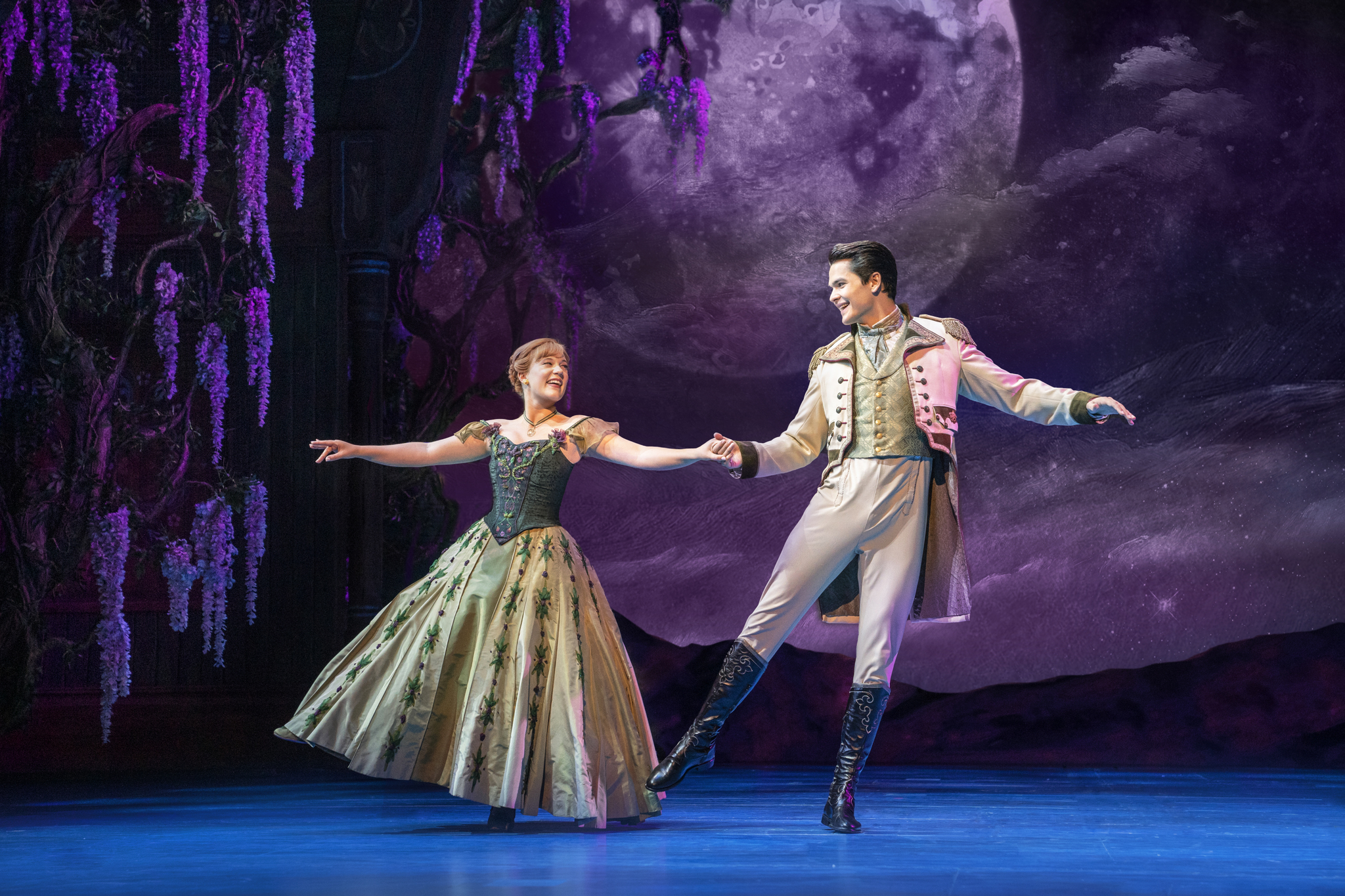
Anna (Lauren Nicole Chapman) and Hans (Will Savarese) dance the night away. (Photo by Matthew Murphy)

Like the film, the stage show revolves around the troubled relationship between royal sisters Elsa and Anna, whom we first meet as adolescents. The older Elsa is cursed with the magical ability to inadvertently freeze anyone or anything around her. After a careless act nearly kills her younger sister, Elsa’s parents force her to isolate herself from the world, and particularly from Anna.

On Thursday night, Norah Ann Nunes and Erin Choi played the rambunctious Anna and tortured Elsa, respectively, and indelibly established the personalities they would retain as young women. (Avelyn Choi and Sydney Denise Russell take over the roles at alternate performances.)

The action then fast-forwards several years to find queen-to-be Elsa (Caroline Bowman) still avoiding public contact and nervous about getting through her impending coronation without freeze-drying the guests. Meanwhile, Anna (Lauren Nicole Chapman) is stir-crazy and more than a little man-crazy and looks forward to meeting possible beaus at the coronation ball.  

As Anna, Chapman sometimes lays on the comic schtick a little heavy, but both she and Bowman have abundant acting and singing chops. They use them to flesh out the sisters’ estranged relationship, which suffers a seemingly mortal blow after Elsa accidentally plunges the kingdom into eternal winter and flees into self-imposed exile.

Anna (Lauren Nicole Chapman) and Kristoff (Dominic Dorset) struggle to cross an icy bridge. (Photo by Matthew Murphy)

Other major cast members include Will Savarese as Hans, a prince who meets Anna at the coronation and immediately wins her heart; Dominic Dorset as Kristoff, an ice merchant who comes to Anna’s aid after she wanders into a snowstorm in search of her sister; and Jeremy Davis as Olaf, a snowman brought to life by Elsa’s magic.

Olaf is one of the show’s two most ingenious creations, being a puppet that Davis supports and manipulates in full view of the audience. The other is Sven, Kristoff’s four-legged companion, whose expressive movements and postures are delivered by the limber Dan Plehal in a reindeer costume. (Collin Baja plays the role at alternate performances.)

While the relationship between Anna and Elsa provides the show’s dramatic heart, it’s Kristoff, Olaf and Sven who provide most of its humor.

Snowman Olaf (Jeremy Davis) meets Sven (alternately played by Collin Baja and Dan Plehal), who seems to be eyeing the carrot that serves as his nose. (Photo by Matthew Murphy)

As in the film, the musical highpoints are the hummable “Do You Want to Build a Snowman,” “For the First Time in Forever” and especially “Let It Go.” The latter showstopping earworm is beautifully delivered by Bowman’s Elsa and is accompanied by a feat of stage magic that defies explanation.

As for the musical low point, that would have to be “Hygge,” a goofy song-and-dance number that wasn’t in the original film. It’s one of several moments that make you wonder why Broadway’s Frozen couldn’t have skipped all the filler and been staged as a poignant one-act.

Still, a two-act Frozen is better than none at all. Onstage or on film, Disney’s tale of sisterly love is a treat.

Broadway in Columbus will present Frozen through Aug. 6 at the Ohio Theatre, 39 E. State St., Columbus. Showtimes are 7:30 p.m. Tuesday-Thursday, 8 p.m. Friday, 2 and 8 p.m. Saturday, and 1 and 6:30 p.m. Sunday. Running time: 2 hours, 15 minutes (including intermission). Tickets are available at BroadwayInColumbus.com, by calling CAPA at 614-469-0939 or at the Ohio Theatre’s CBUSArts Ticket Center. For information on future tour dates, visit frozenthemusical.com.

Character studies dominate Irish doc, U.S. road flick

Tana (Lily Gladstone) takes a cross-country trip in her late grandmother’s Cadillac in The Unknown Country. (Photo courtesy of Music Box Films)

By Richard Ades

Opening this weekend are two indie films that have more in common than you might think.

The Unknown Country, a drama by first-time director Morrisa Maltz, is about a cross-country trip taken by a grieving Native American woman. North Circular, an Irish documentary written and directed by Luke McManus, is described as “a musical trip through Dublin’s inner city.”

What unites the flicks is their willingness to digress in the presence of strong personalities. In each case, this is a mixed blessing.

The Unknown Country ostensibly focuses on Tana (Lily Gladstone), who takes time to travel to a family wedding in South Dakota even though she just lost her beloved grandmother. She then drives her granny’s Cadillac to Texas in a trek that ends at a landmark once visited by the dearly departed.

Co-written by director Maltz and cast members Gladstone and Lainey Bearkiller Shangreaux, the film is primarily about Tana’s attempt to come to terms with her loss. However, Tana herself ends up being overshadowed by a series of strong peripheral characters she meets along the road. Among others, there’s a waitress who lives for her cats, a bride and groom who feel they were destined to be together, and an elderly woman who comes to life on the dance floor.

Most of these characters are real people simply playing themselves, making the flick an adventurous blend of fiction and fact. Each of them is interesting, as are several sights Tana sees along the way, including a Native American wedding, a small-town winter festival and a brightly lit Dallas dance club.

The only problem is that we don’t get to know protagonist Tana as well as the people she meets, making the film a bit less than the sum of its very worthwhile parts.

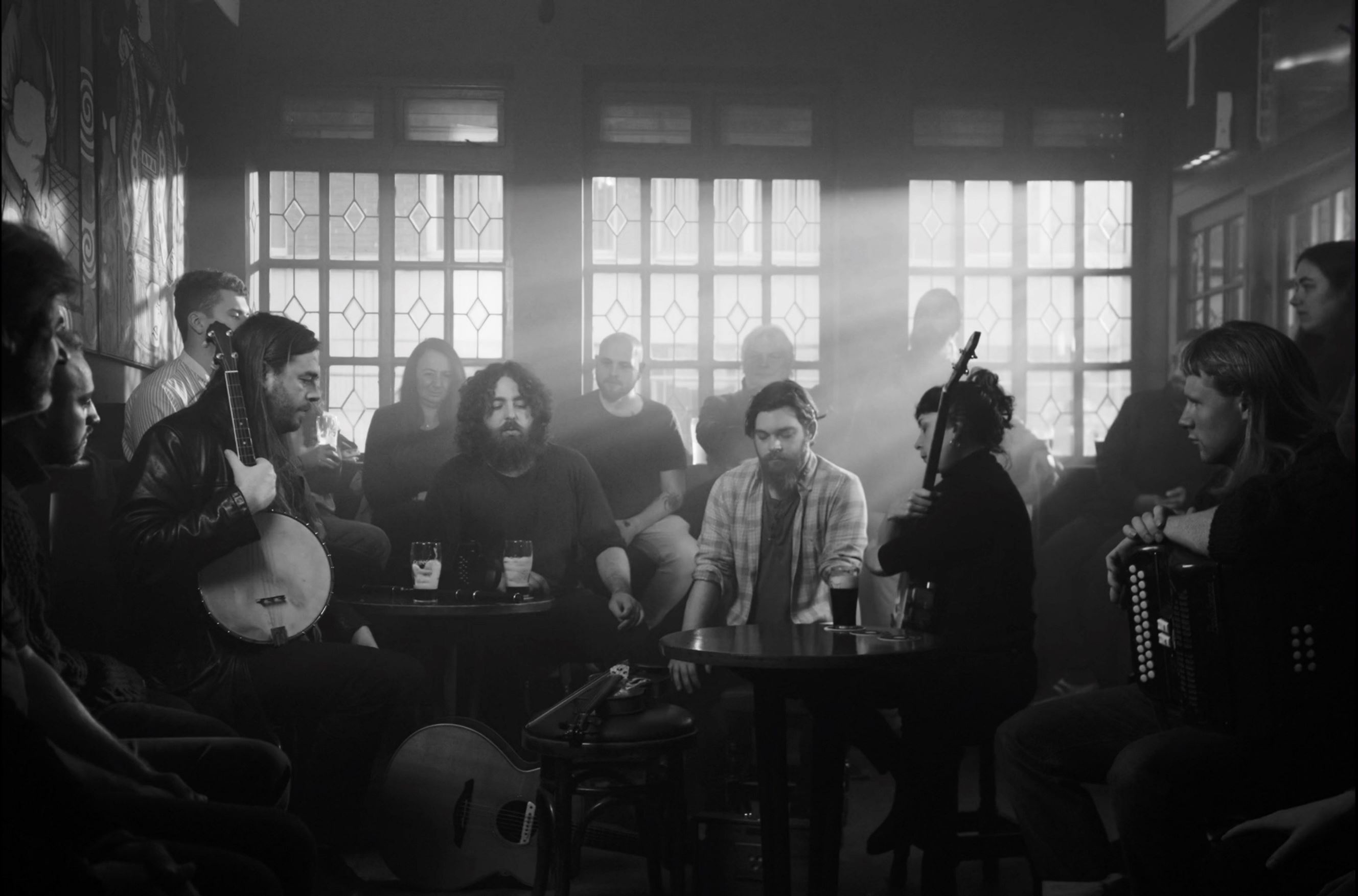
Holding forth at Dublin’s Cobblestone Pub in a scene from North Circular are (from left): folk singers John Francis Flynn, Eoghan Ó Ceannabháin, Killian O’Donnell and Lisa O’Neill. (Photo courtesy of Lightdox)

In a similar way, North Circular spends much of its time introducing us to people who live near the titular roadway, which winds around some of the poorer sections of Dublin. One of the first is an army veteran who plays the bagpipes for military ceremonies and complains that the younger generation shows little interest in learning the traditional instrument. Yes, it’s a shame, but his story comes across as unnecessary digression.

Fortunately, most of the other interviewees can speak more directly to the film’s subject, which is the neighborhood’s struggles with poverty and encroaching gentrification. And several of them do more than speak—they sing about their losses and grievances, often delivering a cappella laments to a silent audience. The sum total is a memorable trip to a side of Ireland’s capital that is never experienced by the average tourist.

Besides their plethora of minor characters, the two films have one other thing in common: striking cinematography. Andrew Jajek’s images in The Unknown Country are engrossing whether they’re showing quiet human interactions or majestic landscapes such as South Dakota’s Badlands and Texas’s Big Bend National Park. And North Circular’s black-and-white images combine with its somber folk tunes to create what at times amounts to cinematic poetry.  

Rating for each film: 3½ stars (out of 5)

The Unknown Country opens July 28 at the Quad Cinema in New York City and the Nuart in Los Angeles, and will open at additional theaters across the country in the following weeks. North Circular opens July 28 at DCTV’s Firehouse Cinema in New York City.

Reality intrudes on sheltered life in ‘Chile ’76’

Carmen (Aline Kuppenheim) is asked to put her life on the line by helping a political dissident. (Photos courtesy of Kino Lorber Team)

By Richard Ades

After being blown away by last year’s Argentina, 1985, I wondered if Chile ’76 would turn out to be an equally instructive look at its titular country’s painful history.

But it’s not, mostly because it doesn’t try to be. Manuela Martelli’s debut film is more of a psychological thriller than a historical drama.

Though it’s set three years after the military coup that brought President Augusto Pinochet to power, the right-wing dictator’s name never even comes up. Instead, the focus is on Carmen (Aline Kuppenheim), an upper-middle-class woman whose privileged life has allowed her to ignore the brutal suppression Pinochet unleashed on her country.

That begins to change, however, in an early scene. Carmen is picking out paint to renovate her family’s vacation home when the sounds of one of the country’s many political kidnappings are heard outside the store.

Quiet soon returns, but we’re left with the impression that Carmen’s life is about to be complicated by the upheaval going on around her. Director/co-scripter Martelli signals this with some rather blatant symbolism: A store employee mixes blood-red paint with a neutral shade, after which a couple of drops spill onto Carmen’s immaculate shoes.

Sure enough, once Carmen reaches her vacation home, a priest friend named Father Sanchez (Hugo Medina) involves her in a matter with political overtones. He asks her to provide medical care for Elias (Nicolas Sepulveda), a young man who he claims was shot while trying to steal food.

Elias (Nicolas Sepulveda), a wounded fugitive, is nursed back to health by Carmen (Aline Kuppenheim).

Being a doctor’s wife who once worked for the Red Cross, Carmen agrees to help, and she keeps helping after she learns Elias is in reality a political dissident hiding from the government. Eventually, she even offers to deliver messages to the fugitive’s left-wing cohorts, involving her in political intrigue for which she’s dangerously unprepared.

Remember the unseen kidnapping that first reminded us we were in Pinochet’s Chile? Most of Martelli’s film is similarly understated, concentrating on Carmen’s fears rather than on the real perils that inspire them. The only un-understated element is Maria Portugal’s musical score, composed of dissonant sounds designed to keep our nerves on edge.

Otherwise, Chile ’76 is a uniformly low-key effort thanks to Kuppenheim’s muted portrayal and Martelli’s restrained script and direction. The result is a film that may not excite viewers but is sure to leave them impressed by its subtle workmanship.  

Rating: 3 stars (out of 5)

Chile ’76 can be seen in select theaters and opens June 30 at the Gateway Film Center in Columbus.

Overheard honesty threatens marital bliss

Beth (Julia Louis-Dreyfus) tries to drown her sorrows in You Hurt My Feelings. (Photos by Jeong Park)

By Richard Ades

When a couple exchanges wedding vows, they promise to love and cherish each other, among other things. What they generally don’t promise is to be honest with each other.

Whether or not that’s a good thing is a topic writer-director Nicole Holofcener takes up in her entertaining and chuckle-worthy new film, You Hurt My Feelings.

Long-married New Yorkers Beth and Don (Julia Louis-Dreyfus and Tobias Menzies) love and support each other to a fault—the fault being that they occasionally express that support by telling little white lies.

When Don gives Beth earrings as an anniversary present, she greets them with such forced enthusiasm that it’s obvious she doesn’t like them. And when Beth reciprocates by giving Don a V-neck sweater, his disappointment is equally clear because his first comment is, “Oh, a V-neck.” (As all fans of Louis-Dreyfus’s former series, Seinfeld, know, saying the name of a gift after you open it is a sure sign you didn’t want it.)

All this is no big deal, right? When you’re in a relationship, telling the occasional little white lie can help you avoid hurt feelings or unnecessary friction.

But then Beth catches Don in a lie that doesn’t seem so little: She overhears him admitting to his brother-in-law that, even though he’s told Beth he loves the novel she’s been working on for the past two years, he actually hates it.

Beth is hurt and humiliated, telling sister and fellow eavesdropper Sarah (Michaela Watkins), “I can’t look him in the face ever again.” Sarah tries to soften the blow by admitting she tells actor-husband Mark (Arian Moayed) that he’s more talented than he actually is, but it seems the damage is done.

This unfortunate incident comes to dominate the flick, as well as supplying its title, but it’s actually just one of several examples of the fragile egos and self-doubts that afflict all the major characters.

Aspiring novelist Beth worries she won’t be able to duplicate the success of her previous work, a memoir about growing up with an abusive father. (Not that the memoir was as successful as it might have been if her father hadn’t been just verbally abusive, she muses ruefully.)

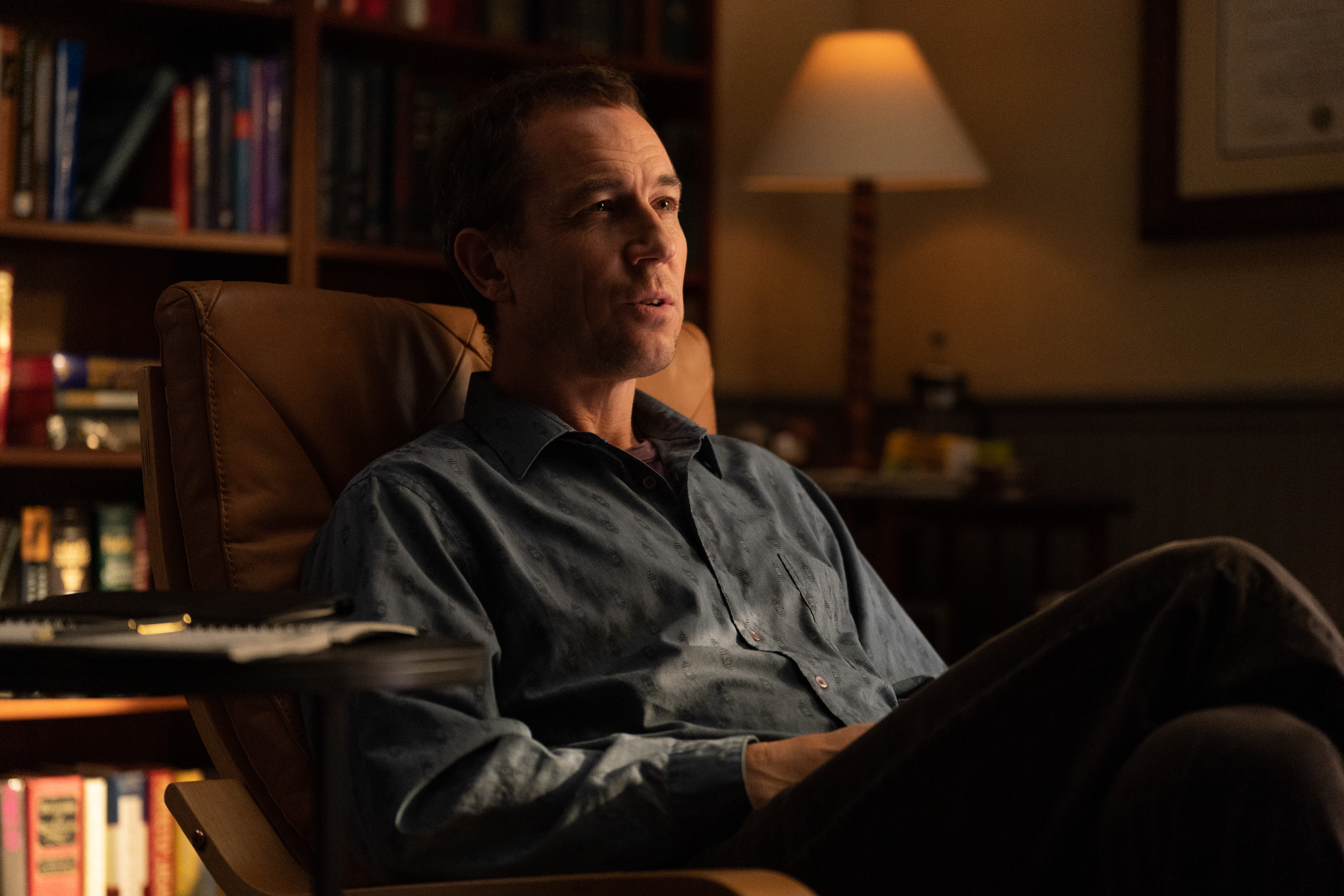
Therapist Don (Tobias Menzies) has trouble keeping his clients’ backstories straight.

Don, a therapist who seems to be chronically tired, has trouble keeping his clients straight, and he worries that he’s not helping them get any better. Sarah, an interior designer, has similar fears about pleasing her clients, while Mark suspects he’s really not such a great actor.

Finally, there’s Beth and Don’s 23-year-old son, Eliot (Owen Teague), who’s working on a play that he fears is no good, while dating a woman who he worries will break up with him.

My one quibble with the way all this trauma is acted out is that Louis-Dreyfus falls back on her old Elaine Benes mannerisms at one or two inopportune moments. Otherwise, everyone’s great, including the several supporting actors who play Mark’s eccentric and generally dissatisfied clients.

With its New York setting, sardonic wit and neurotic characters, You Hurt My Feelings may strike some as a lighter, gentler version of early Woody Allen. But Holofcener is really doing her own thing with this portrait of everyday worries and squabbles, giving viewers a breezily pleasant hour and a half in the process.

Rating; 4 stars (out of 5)

You Hurt My Feelings (rated R) opens May 26 in select theaters.

Faith community faces unwelcome intruder: sex

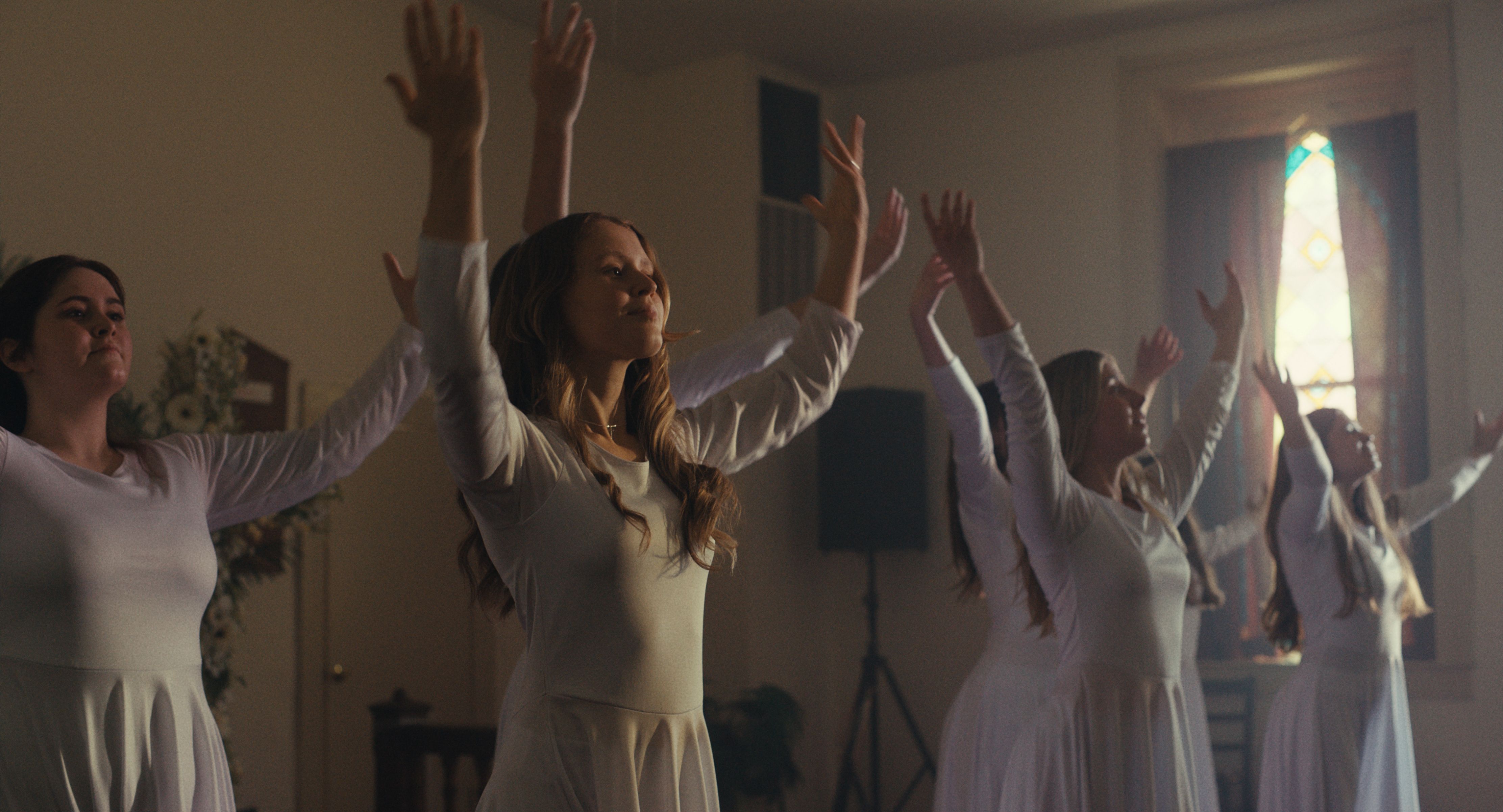
Jem (Eliza Scanlen, second from left) enjoys expressing her faith through liturgical dance. (Photo by Brian Lannin/courtesy of Bleecker Street)

By Richard Ades

Years ago, I was visiting a family of fundamentalist Christians in another state when a group of local feminists held a topless protest. A news crew went out to cover the event, and one of the protesters ended up on the evening newscast (from the neck up) explaining what they were protesting about.

Watching the interview on TV that night, the matriarch of my host family clearly was not impressed by what the woman had to say. “You can tell she just wants attention,” she said dismissively.

The comment left me with the immediate thought: “What’s wrong with that? Doesn’t everybody want attention?” But I quickly realized, “Oh, it’s a fundamentalist thing.” Apparently seeking attention was considered sinful in that culture—especially, I guessed, if you’re a woman.

The incident came rushing back to me after watching The Starling Girl, writer/director Laurel Parmet’s debut film about coming of age in a fundamentalist community. It revolves around Jem Starling (Eliza Scanlen), a 17-year-old Kentuckian who’s devoted to God and her faith. She especially loves expressing her faith through the liturgical dances she performs at services along with a handful of other girls.

After one such performance, however, her mother (Wrenn Schmidt) undermines her joy by pointing out that she’d immodestly allowed the outline of her bra to show through her dance costume. Later, adding to her daughter’s perceived sins, the mother asks whether Jem dances “for God or for vanity.”

Or, as my long-ago host would have put it, “The girl just wants attention.”

Growing up in a restrictive religious community can be tough, and it becomes even tougher when you’re a teenager whose hormones are awakening urges you’ve been taught to suppress. Jem is critical of a boy who’s been sent away to have the sin beaten out of him after he was caught looking at online porn. But she soon faces challenges of her own.

Her parents want to arrange a courtship and eventual marriage to their pastor’s younger son, Ben (Austin Abrams), an awkward boy who thinks barnyard diarrhea is an appropriate topic for a first date. Jem, though, is more interested in Ben’s older brother, Owen (Lewis Pullman), a future pastor who’s just returned from mission work in Puerto Rico. She’s so interested, in fact, that she engineers excuses to be around him, ignoring the inconvenient fact that he’s married.

As it turns out, Owen’s marriage is not a happy one, and he’s not averse to giving his young admirer the attention she so desperately wants. The result is a situation for which Jem’s upbringing has left her totally unprepared.

Competently acted, and naturalistically written and directed by Parmet, The Starling Girl offers a searing portrait of Jem’s difficult life. Though the filmmaker tries to leave her with a slim ray of hope, it’s less convincing than the film’s indictment of the intolerance and injustice that flourish when religion tries to overrule human nature.

Rating: 3½ stars (out of 5)

The Starling Girl (rated R) opens May 25 at the Gateway Film Center in Columbus, with wider distribution to follow.

Preserving film history one frame at a time

By Richard Ades

The worst job I ever had was working in a motion picture lab in the late 1970s. Not only did I spent much of my time trapped in a dark room with very pungent chemicals, but I sometimes had the difficult task of copying old, shrunken films that had to be coaxed through our machinery.  

Too bad I couldn’t have seen Film: The Living Record of Our Memory back then. It would have allowed me to feel some pride in the small role I was playing in the massive (and massively difficult) effort to preserve our cinematic history.

Spanish director Ines Toharia Teran’s documentary is about the worldwide quest to save films that otherwise would be lost due to chemical degradation, disasters and other causes.

It’s a quest that began in spite of the early film studios, we’re told, as they thought of movies as commercial products rather than works of art or historical documents that needed to be preserved. In fact, flicks that had already made the theatrical rounds were often destroyed to recover the silver in the film stock, thus helping to pay for future productions.

An additional preservation complication: Early film stock was composed of nitrate, which was dangerously inflammable. If it ever caught on fire, not even water could extinguish the flames.

The documentary tells us that the result of this danger and neglect is that 80 percent of all silent films are likely gone forever, along with half of all the “talkies” ever made.

Film is not a tragedy, however, but an account of the heroes who have devoted themselves to protecting film history. Numerous preservationists and other cinematic experts from around the world talk about the challenges they face—such as trying to reconstruct a formerly “lost” film by splicing together the least-degraded frames from various recovered prints.

Why go to all this trouble? Because otherwise we’ll lose pieces of art that help to define our cultural history. And sometimes we’ll lose pieces of actual history, as in the case of home movies and other nonfiction films that depict scenes from the Holocaust and other world tragedies.

At nearly two wide-ranging hours, Film will be of most interest to those who care about cinema’s past, present and future.

Does it bother you that Alfred Hitchcock’s 1926 film The Mountain Eagle may never be seen again? Is it important to you that people be able to watch the early works of India’s Satyajit Ray, or the many independent films that depict Africa’s anti-colonial struggles?

Do you want such influential flicks as Charles Burnett’s Killer of Sheep and Cuban director Tomas Gutierrez Alea’s Memories of Underdevelopment to be available to future cinema lovers?

If so, the documentary will be two hours well spent.

Rating: 3½ stars (out of 5)

Film: The Living Record of Our Memory opened May 5 at the Gateway Film Center in Columbus, with additional screenings planned May 8-9 in Los Angeles, May 11-14 in St. Louis, May 20 in San Francisco and May 21 in Cleveland. The film will be available through VOD outlets beginning May 16.

Motown hits supercharge Temptations history lesson

A scene from the touring production of Ain’t Too Proud: The Life and Times of the Temptations (Photos courtesy of Broadway in Columbus)

By Richard Ades

As you wait for Ain’t Too Proud to begin, the “marquees” projected onto the curtain establish the subject, place and mood. They advertise a “dance and show” featuring the Temptations at Detroit’s iconic Fox Theatre. And there are two additional words: “SOLD OUT.”

All of this is depicted in shades of gray, setting the tone for what is essentially a history lesson about the Temptations’ hard-fought quest to become the most successful R&B group of all time. But though that history is marked by struggle, conflict and loss, it’s accompanied by the some of the toe-tapping-est, spirit-lifting-est music that ever came out of Motown.

In other words, expect to have one of the best times you’ve ever had in a theater.

The musical’s book by Dominique Morisseau is based on a history of the Temptations written by founding member Otis Williams. Some have complained that this results in a one-sided look at the group, in contrast to the more even-handed Four Seasons musical Jersey Boys.

There’s some truth to this. Williams (masterfully played in the touring show by Michael Andreaus) serves as the history’s narrator and routinely depicts himself as the voice of reason who tries to keep the group on an even keel despite other members’ missteps, failings and ego trips. Even so, the general thrust of the show is not to cast blame but to explain how hard it is to achieve musical success, particularly when one starts out poor and Black.

The Temptations began making their mark during the 1960s, when civil rights struggles and an increasingly unpopular war were making front-page headlines. The musical touches on these issues and on the dilemma they raised for the group’s members, who were torn over whether they could address what was going on in their music without jeopardizing their “crossover” popularity with White audiences.

An interesting piece of trivia revealed by the show: The protest song “War (What is it good for?)” was meant to be recorded by the Temptations, but Motown execs decided it was too political. The result was that Edwin Starr got the recording deal and ended up with a hit.

Fortunately, the “Temps” got the chance to record plenty of other classic ballads and danceable anthems, and the best are peppered throughout the show. Thanks to Des McAnuff’s impeccable direction, Sergio Trujillo’s choreography and a cast that can handle both the tunes and the steps with aplomb, the result is like being in Detroit’s Fox Theatre on the aforementioned night and watching musical history come gloriously alive.

Along with Andreaus, central cast members include E. Clayton Cornelious as Paul Williams, Harrell Holmes Jr. as Melvin Franklin, Jalen Harris as Eddie Kendricks, and Elijah Ahmad Lewis as the mercurial, showboating David Ruffin. Numerous others display equal levels of talent in lesser roles.

Robert Brill’s scenic design and Howell Binkley’s lighting design are eloquently restrained, refusing to upstage the singers and dancers. A good-sized band led by Jonathan “Smitti” Smith and featuring several local musicians provides the accompaniment—and gets the chance to show what it can do on its own after the curtain call.

The moral: Don’t leave early.

Broadway in Columbus and CAPA will present Ain’t Too Proud: The Life and Times of the Temptations through April 18 at the Ohio Theatre, 39 E. State St., Columbus. Showtimes are 7:30 p.m. through Thursday, 8 p.m. Friday, 2 and 8 p.m. Saturday, and 1 and 6:30 p.m. Sunday. Running time: 2½ hours including intermission. Tickets are $40-$135+. Columbus.broadway.com. For upcoming tour dates, visit ainttooproudmusical.com.

‘Marvelous’ series’ finale lives up to its name

Rachel Brosnahan as the titular aspiring comedian in The Marvelous Mrs. Maisel

By Richard Ades

The Marvelous Mrs. Maisel is coming to an end, and it’s doing it as stylishly as ever.

The tale of a divorced Jewish housewife who seeks success as a standup comedian will be wrapped up over the course of nine episodes during the series’ fifth and final season.

Will Miriam “Midge” Maisel (Rachel Brosnahan) achieve her goal by breaking through the comedic glass ceiling of mid-20th century America? It’s not giving too much away to say she will, as that’s revealed in an early-season flash-forward. What’s not revealed right away is just how she’ll hit the big time, and how her success will affect her family and friends.

It comes out in the second episode that at some point she’ll part ways with the mannishly attired Susie Myerson (Alex Borstein), who became the fledgling comedian’s first cheerleader and, soon after, her devoted manager. How do they break up, and will they ever reconcile? Viewers will have to wait and see.

Her relationship with ex-husband Joel (Michael Zegen), whose infidelity ended their marriage in the first season, also continues to evolve. And it does so in surprising ways, as seen in another flash-forward or two.

In fact, series creator and writer Amy Sherman-Palladino does a good deal of time-traveling from the show’s principal era of the late 1950s and early ’60s. Thus, we get to peek into the futures of several characters, including Midge’s parents (Marin Hinkle and Tony Shalhoub). We even get to see grownup versions of her children, Esther and Ethan, though they played relatively minor roles during most of the series.

Through it all, Maisel continues to impress with its amazing production values, one episode opening with a dance number worthy of Broadway. The show is also frequently funny, with, as usual, much of the humor coming from its supporting characters rather than its titular comedian. And by “supporting characters,” I primarily mean Borstein’s always-hilarious Susie, followed by Shalhoub’s rendition of Midge’s curmudgeonly and neurotic dad.

(For those who want to see if Borstein is as funny in her own skin as she is in Susie’s, a new Prime comedy special allows her to tell jokes, sing and even make a few political and philosophical points. Viewers may conclude that she isn’t quite as funny in her own skin, but they’re likely to be impressed by her versatility. As indelible a character as Susie is, she’s clearly not Borstein.)

All in all, season five is one of the series’ best, maybe even as good as season one. Fans of the show’s scrappy heroine should go away happy.

Rating: 4 stars (out of 5)

Episodes 1-3 of the final season of The Marvelous Mrs. Maisel can be seen on Amazon Prime Video beginning April 14. One subsequent episode will be released each Friday through May 26. Alex Borstein: Corsets & Clown Suits will air on Prime Video beginning April 18.

Pushing Native American stereotypes from the field of play

The struggle to rid the sports arena of Native American stereotypes includes rallies such as this one in Phoenix, Ariz.

By Richard Ades

I like to think journalists are a pretty smart group overall, but then I remember the newsroom argument I got embroiled in years ago over the football team then known as the Washington Redskins.

To me, the name seemed obviously racist, but a co-worker jumped to its defense. “How do you know it doesn’t refer to potatoes?” he said, trying to make light of the issue. “Because,” I replied, “then the team’s mascot would be Mr. Potato Head.”

Sadly, my co-worker was far from alone in his reluctance to question “Redskins” or the many other team names and mascots based on Native American culture. Many sports fans just can’t understand why even seemingly innocuous monickers like “Indians” or “Braves” can be hurtful to present-day Indians trying to escape age-old stereotypes.

The fight to rid the sports world of such names is the subject of Imagining the Indian: The Fight Against Native American Mascoting. Directed by Aviva Kempner and Ben West, the documentary interviews activists from various Native tribes and nations who have devoted years and even decades to the struggle.

One of them is Marshall McKay, former tribal chairman of the Yocha Dehe Wintun Nation, who notes that Native American stereotypes galloped through the “cowboys and Indians” melodramas he watched growing up. Inevitably, the Indians were depicted as the bloodthirsty villains, but even when they were cast as “noble savages,” the portrayals were unrealistic and one-dimensional.

McKay points out that the entertainment industry was merely reflecting racist attitudes that were ingrained in the national psyche and led to countless atrocities and injustices toward Native people over the years. Near his own birthplace, he says, the California gold rush of the mid-19th century brought the army out to protect miners, while bounties were offered for Native American body parts.

Hence, the term “redskins” is offensive for reasons that have nothing to do with the color red.

At least Hollywood began cleaning up its act with 1990’s Dances With Wolves, which helped to usher in a new era of portraying Native characters more realistically. But in the sports world, the stereotypes lived on thanks to team names such as “Chiefs” or “Braves,” as well as in caricatured mascots such as the Cleveland baseball team’s Chief Wahoo.

Adding to the insult, fans were often encouraged to attend games wearing warpaint and headdresses, and to show their enthusiasm by participating in stereotypical antics such as the “tomahawk chop.”  

The problem with all this, according to one interviewee: “It’s not who we are today.” When Native men are stereotyped as fierce warriors and Native women as Pocahontas-style sex goddesses, it obscures the varied personalities and professions they represent in real life.

The documentary brings the issue up to date by reporting recent changes for the better. For instance, the Washington Redskins have been renamed the Commanders, while the Cleveland Indians are now the Guardians. And Cleveland’s Chief Wahoo, which one interviewee refers to as “Red Sambo,” has been retired.

But according to the documentary, nearly 2,000 teams, at every level of sports, retain their Native American-inspired names and mascots. Says one activist: “We’ve been in this fight for a very long time, and we’re not going to stop.”

Rating: 4 stars (out of 5)

Imagining the Indian opened March 31 in New York and will expand to other cities throughout April and May. For more information visit imaginingtheindianfilm.org.