Motown musical is like sunshine on a cloudy day

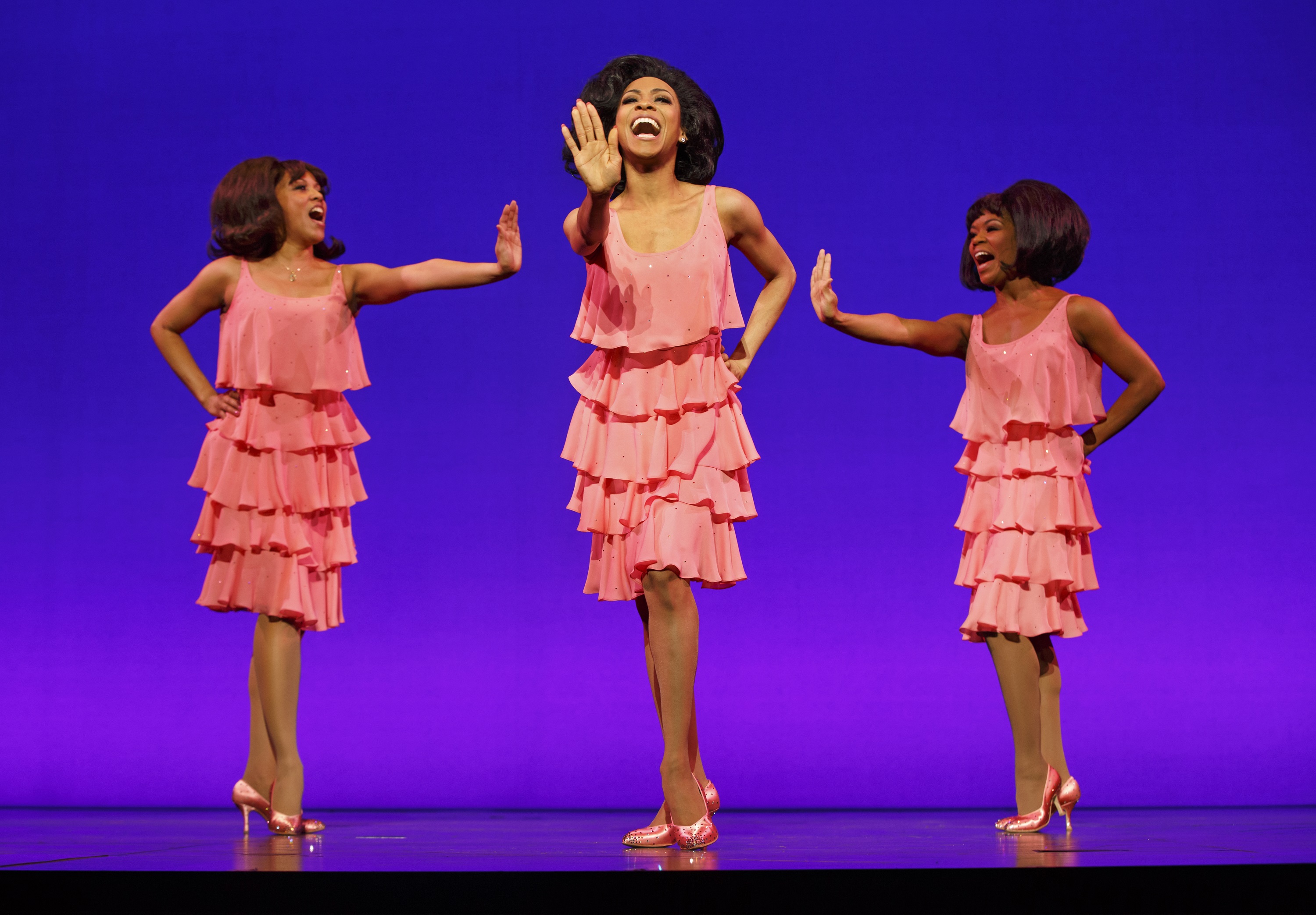
Playing the Supremes in Motown the Musical are (from left): Krisha Marcano (Florence Ballard), Allison Semmes (Diana Ross) and Trisha Jeffrey (Mary Wilson) (photo by Joan Marcus)

By Richard Ades

The curtain rises to reveal facsimiles of old Motown groups singing snippets of their hits. From the beginning, it’s clear that Motown the Musical is all about the music.

It’s only after we’ve been treated to several smartly choreographed numbers that the show introduces to the man around whom it revolves: Berry Gordy Jr. (Chester Gregory), who founded Motown and now is threatening to boycott a 1983 celebration of the record label’s 25th anniversary. Why? Because he holds a grudge against the many artists who abandoned it over the years.

Based on Gordy’s 1994 autobiography, the musical then backs up and begins recounting his long career.

First seen as a young boy growing up in Detroit, Gordy quickly develops into a brash young man who pushes his way into the music business by writing hits for singer Jackie Wilson (Rashad Naylor). But he soon becomes fed up with seeing his songs relegated to the B-sides of lesser efforts, so Gordy founds his own label.

This, however, introduces a whole new problem. Mainstream radio stations refuse to play black music—then known as “race music”—despite Gordy’s assurances that his soul/pop tunes appeal to everyone. His claim is borne out by a Southern concert that attracts a multiracial audience, which police officers struggle to keep segregated into “white” and “colored” sections of the auditorium.

Of the two acts, Act 1 is more interesting due to scenes like this that reflect the tenor of the times. It ends in the 1960s, a decade marked by hopeful activism and soul-rending violence: the Vietnam War, the assassination of a president and a King, and Detroit’s 1967 riot. On a more personal level, it also covers Gordy’s blossoming relationship with Diana Ross (Allison Semmes), lead singer of the Supremes.

Act 2 covers Motown’s move to Los Angeles and Gordy’s determination to turn Ross into a solo artist and a movie star. Inevitably, though, it becomes the story of Gordy and Motown’s gradual decline, which makes it much like every other musical biography.

Along the way, we get a few tidbits of information about Gordy’s relationships with Motown’s various stars. While these are sometimes interesting, the details are sketchy and sometimes are left out entirely—as when Gordy and an aggrieved musical group take each other to court. In such cases, it’s hard to forget that we’re hearing only Gordy’s side of the story.
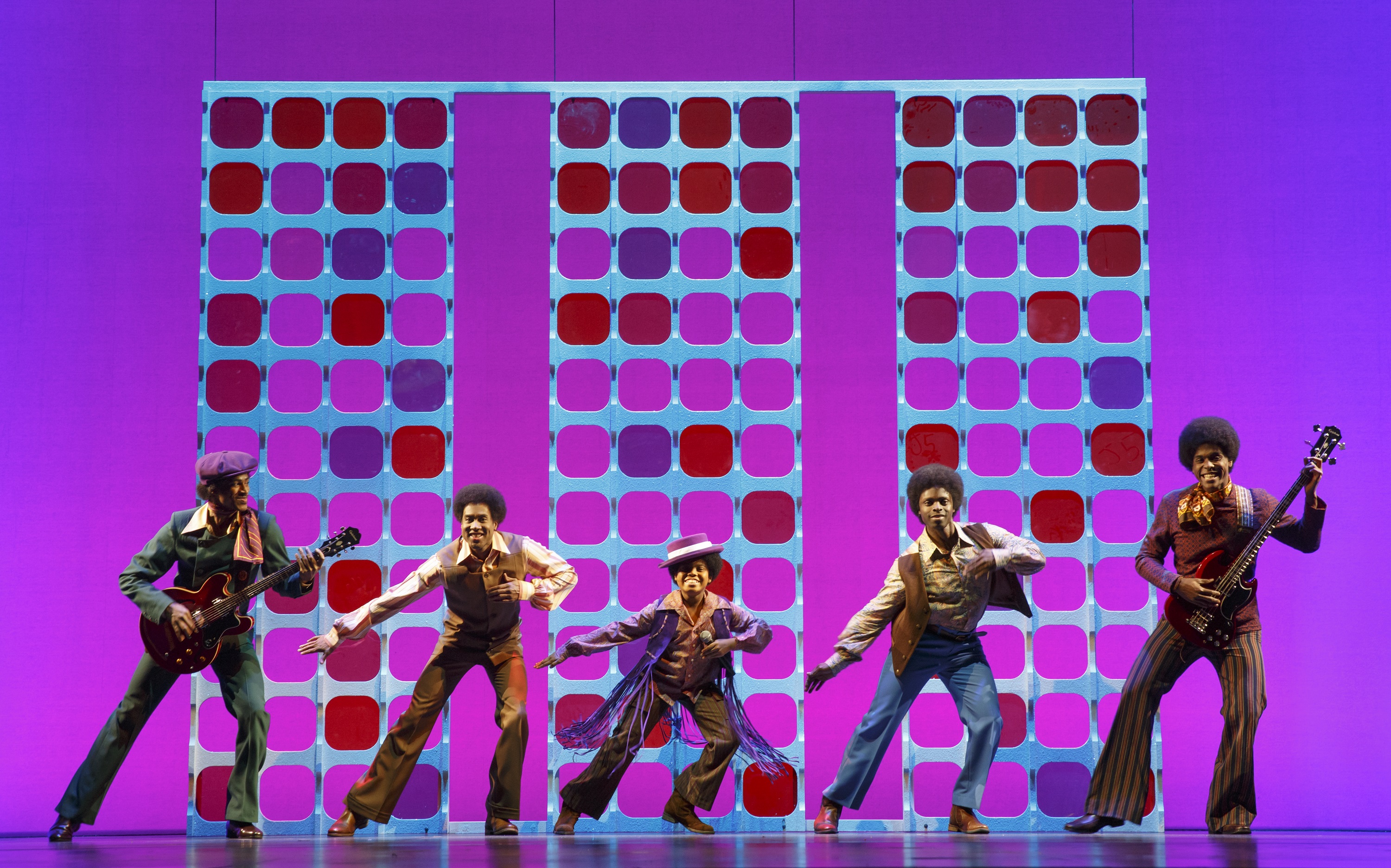
A young version of the Jackson 5 makes an appearance in Motown the Musical (photo by Joan Marcus)

But whatever the show lacks in narrative depth, it makes up for by allowing us to bask in one Motown hit after another. ABC, Ain’t No Mountain High Enough, Dancing in the Street: The nostalgic moments just keep on coming.

In the touring show, directed by Charles Randolph-Wright and accompanied by Darryl Archibald’s funky band, the songs are delivered with power and grace.

Semmes is great as Ross, seeming to gather strength as the night goes on. Though Gordy is known for promoting music rather than singing it, actor Gregory also comports himself well when he raises his voice in song. Semmes and Gregory’s duet You’re All I Need to Get By is one of the show’s sweetest numbers.

Also prominent are Jesse Nager as Smokey Robinson and the fleet-footed J.J. Batteast (alternating with Leon Outlaw Jr.) as a young Michael Jackson. On opening night, Nik Walker filled in for Jarran Muse as Marvin Gaye and displayed one of the most impressive voices of all.

David Korins’s scenery is spare, relying on Natasha Katz’s lighting to set the scene and mood. Esosa’s costume designs are period-appropriate and properly flashy.

Motown may not be a great musical, but it’s a musical with great music. Whether or not you’re old enough to remember the titular record label’s heyday, you’re sure to have fun.

Broadway in Columbus and CAPA will present Motown the Musical through Feb. 28 at the Ohio Theatre, 39 E. State St., Columbus. Show times are 7:30 p.m. through Thursday, 8 p.m. Friday, 2 and 8 p.m. Saturday, and 1 and 6:30 p.m. Sunday. Running time: 2 hours, 45 minutes (including intermission). Tickets are $33-$113. 614-469-0939, 1-800-745-3000 or ticketmaster.com.

Shoemaker sets out to save cross-dressers’ soles

The touring cast of Kinky Boots, presented by Broadway in Columbus and CAPA (photo by Matthew Murphy)

By Richard Ades

I have to admit I went into Kinky Boots with a small chip on my shoulder.

In 2013, Matilda the Musical was expected to win a slew of Tony Awards, including for best musical. Instead, despite having opened to mixed reviews, Kinky Boots danced away with the top prize.

Full disclosure: I love Matilda the Musical. Seeing it was my favorite Broadway experience since Memphis. After Kinky Boots beat out the magical lass for the top prize and others, including Cyndi Lauper’s win for best score, I decided it had better be damn good.

Anyway, that was my mindset going into the Ohio Theatre on Tuesday night, which helps to explain why it took me a while to warm up to the show. Eventually, though, I came around.

Adapted by Harvey Fierstein from a 2005 movie, Kinky Boots is the story of Charlie (Steven Booth), a young Englishman who’s preparing to move to London with his fiancée, Nicola (Charissa Hogeland). In the process, he’s leaving behind the family business, a Northampton shoe factory run by his father (Tom Souhrada).

No sooner does Charlie get to London, however, than he learns his father has died. As if that weren’t enough bad news, he then realizes the company is going broke because it can’t compete in a market flooded with cheap, foreign-made shoes.

Enter Lola (Kyle Taylor Parker), a drag performer whose chief problem seems to be her inability to find high-heeled boots strong enough to support her male frame. Thanks to a suggestion from factory worker Lauren (Lindsay Nicole Chambers), Charlie realizes the only way to save the business—along with the jobs of the people he grew up with—is to find a niche need and fill it. His solution: Start making sturdy, yet stylish, footwear for the discriminating cross-dresser.

I said I eventually came around on Kinky Boots, but that doesn’t mean I love everything about it. You don’t have to be an expert on Morse code to recognize that Fierstein is telegraphing plot points well in advance, including the fate of Charlie’s relationship with the sour-tempered Nicola. And things get even more transparent in the second act, when Fierstein manufactures conflicts by having Charlie act in totally unconvincing ways.

The show’s salvation is Lauper’s genre-hopping score, which earns its Tony. A couple of the songs strike me as derivative, but they’re generally enjoyable and catchy.

Of course, any production rises or falls on the strength of its cast, and this touring show’s cast acts, sings and dances delightfully under the guidance of director/choreographer Jerry Mitchell. At the top of the bill, Booth is relatable as Charlie, while Parker is nothing short of amazing as the sassy, yet soulful, Lola.

Some early critics complained that the show loses steam in the second act, but I actually like it better because it gives Lola a chance to grow into something beyond a flashy stereotype. Yes, Lola’s production numbers with her lascivious “Angels” are fun, but Parker’s best moment comes when Lola slows down for the Act 2 lament Hold Me in Your Heart. It’s a true show stopper.

Visually, the show is equally impressive, thanks to Gregg Barnes’s costumes, Kenneth Posner’s lighting and David Rockwell’s glorious scenery.

The one place the touring show could stand improvement is in the area of the sound. On opening night, whole lines of dialogue and lyrics were indecipherable. The English accents were partially to blame, but poor mixing seemed to be the main culprit. Hopefully, that problem will be fixed as the week goes on.

Did Kinky Books deserve to steal the top Tony away from Matilda? Not in my book. But it does give musical-loving theatergoers a colorful, toe-tapping good time.

Broadway in Columbus and CAPA will present Kinky Boots Oct. 6-11 at the Ohio Theatre, 39 E. State St., Columbus. Show times are 7:30 p.m. through Thursday, 8 p.m. Friday, 2 and 8 p.m. Saturday, 1 and 6:30 p.m. Sunday. Running time: 2 hours, 30 minutes (including intermission). Tickets are $33-$118. 614-469-0939, 1-800-745-3000 or ticketmaster.com.
Depression-era musical is far from depressing

Emma Stratton (center, lower deck) shows off her dance moves with other members of the company of Anything Goes (photo by Jeremy Daniel)

By Richard Ades

Watching Anything Goes is like taking a trans-Atlantic voyage while simultaneously time-traveling back to the 1930s.

The seagoing musical has been tweaked since it opened on Broadway in 1934, but the basic show remains intact. As a result, you feel like you’re enjoying the same kind of entertainment that helped to take our ancestors’ minds off the Great Depression.

What does the show tell us about our forebears? That they laughed at silly and sometimes naughty humor. And, mostly, that they had great taste in music.

The musical’s main claim to immortality is its collection of classic Cole Porter tunes such as You’re the Top and the title song, among many others. In the current touring show, all are wonderfully delivered by the cast and a brassy, jazz-savvy band conducted by Robbie Cowan.

Complementing the songs are some truly awesome dance numbers choreographed by director Kathleen Marshall. For tap-dancing fans, the highlight is the Act 1 capper set to the title tune. For those with a taste for something a little more provocative, Act 2’s Blow, Gabriel, Blow is equally fun.

The story centers on a young stockbroker named Billy Crocker (Brian Krinsky) and his attempt to woo engaged-to-be-married heiress Hope Harcourt (Rachelle Rose Clark). However, the show’s real star is neither Krinsky nor Clark.

Instead, it’s Emma Stratton, who plays nightclub performer Reno Sweeney. In the first scene, Reno declares her affection for Billy (I Get a Kick Out of You), only to learn that he’s fallen for Hope. A trooper if there ever was one, Reno then joins Billy’s campaign to win Hope away from her stuffy British fiancé, Lord Evelyn Oakleigh (Richard Lindenfelzer).

Reno is such an engaging character that you may root for Billy to choose her over the mousey Hope, even though you realize it’s a long shot. Meanwhile, you get to enjoy Stratton showing off her pipes and her equally impressive dance prowess in a bevy of tunes and production numbers.

Several other notable characters also figure in the plot. They include Billy’s alcoholic boss, Elisha Whitney (Michael R. Douglass); small-time gangster Moonface Martin (Dennis Setteducati); and Moonface’s free-loving girlfriend, Erma (Mychal Phillips). All have tuneful and reasonably funny moments.

Strangely, though, the funniest moment of all comes from an unlikely source. Lindenfelzer’s Lord Evelyn spends much of his time trying to master American slang, which produces chuckles at best, but the real comic gem is his attempt to locate The Gypsy in Me in an Act 2 dance duet with Reno.

The set, originally designed by Derek McLane and coordinated by James Kronzer, is clever depiction of ocean-liner interiors and exteriors.

Anything Goes is best known for its amazing collection of Porter tunes. Besides those already mentioned, the familiar solos and duets include Easy to Love (Billy), It’s De-Lovely (Billy and Hope) and Friendship (Moonface and Reno).

But thanks to the efforts of director/choreographer Marshall and her talented cast, crew and band, the show is much more than a few excerpts from the American Songbook. It’s a silly, sexy and footloose return trip to 1930s Broadway.

Broadway in Columbus and CAPA will present Anything Goes through Sunday (Feb. 8) at the Ohio Theatre, 39 E. State St. Show times are 7:30 p.m. through Thursday, 8 p.m. Friday, 2 and 8 p.m. Saturday, and 1 and 6:30 p.m. Sunday. Running time: 2 hours, 40 minutes (including intermission). Tickets are $28-$98. 614-469-0939, 1-800-745-3000 or ticketmaster.com.

‘Mormon’ musical isn’t just a raunchy satire

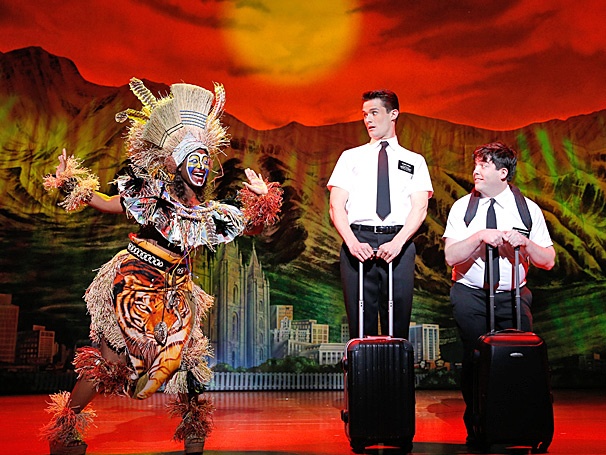
Elder Price (Mark Evans, left) and Elder Cunningham (Christopher John O’Neill) are given a rousing sendoff as they prepare to take the Mormon message to Uganda (Broadway.com photo)

By Richard Ades

The Book of Mormon has finally arrived in Columbus, and I’ve now had the chance to form a second opinion on the show I saw nearly a year ago on Broadway.

That opinion: I like it even better the second time.

Admittedly, the first act was a bit of a letdown when I attended the show Wednesday at the Ohio Theatre, partly because it had lost the element of surprise. But the second act delivered even more of a payoff, both comically and emotionally.

Emotionally? Yes. This hit musical by Avenue Q’s Robert Lopez and South Park creators Trey Parker and Matt Stone does have some inspiring and heartfelt moments in between all the F-bombs and sexual references.

You’ve probably heard that The Book of Mormon takes a satirical look at the titular faith, including its odd belief that Jesus visited what is now upper-state New York during the brief time between his crucifixion and his resurrection. Yes, it has religious zingers aplenty, and they’re both sly and hilarious. At its core, though, this is the story of a friendship between two young missionaries.

Elder Kevin Price (Mark Evans) is the fair-haired child of his missionary class, so flawless that people assume “Heavenly Father” will grant him any wish he desires. And what Kevin desires is to be assigned to spread the Mormon message in Disney-fied Orlando, which he considers the most perfect place on earth.

Elder Arnold Cunningham (Christopher John O’Neill) is Kevin’s opposite, a roly-poly ne’er-do-well with a propensity for stretching the truth. Kevin is chagrined to learn that he and Arnold have been assigned to spend their two-year mission together, and he’s even more chagrined to learn that they’ll be spending it in northern Uganda.

His chagrin turns to terror when he learns that the local people are oppressed not only by poverty, AIDS and superstition, but by a warlord who threatens to “circumcise” (i.e., genitally mutilate) all the women. After the colorfully named General Butt Fucking Naked (Corey Jones) proves his ruthlessness by shooting a detractor in the face, Kevin decides his best option is to request a transfer out of this godforsaken land.

The Book of Mormon’s success depends most heavily on Arnold, an irresponsible scamp who ultimately is forced to Man Up, as he sings in the rousing number that caps off Act 1. In the touring production at the Ohio, O’Neill hits every note just right whether he’s singing or speaking. Over the show’s 2½ hours, he builds a portrayal of a lovably needy but surprisingly resourceful man-child.

Evans also hits every note just right as Kevin, revealing a sweet voice and an innate decency hiding just beneath the character’s self-important surface. He even projects a modicum of vulnerability after a guilty conscience lands Kevin in the middle of a Spooky Mormon Hell Dream. The gaudy musical number surrounds him with threatening demons, a dismissive Jesus and even dancing Starbucks cups. (Mormons, of course, are forbidden from drinking either alcohol or caffeine.)

The show’s third important character is Nabulungi (Alexandra Ncube), a young village woman who responds to the Mormon message because it offers her hope in a hopeless world. Ncube projects charming naiveté and a beautiful singing voice, particularly in her wistful solo Sal Tlay Ka Siti.

Parker co-directs the large and energetic cast with choreographer Casey Nicholaw, who fills the production numbers with clever, spirited dance steps. Justin Mendoza conducts the orchestra, which puts forth a full and satisfying sound despite relying heavily on keyboards. Scott Pask’s scenery, augmented by Brian MacDevitt’s lighting, efficiently moves the action from continent to continent and century to century as needed.

Though The Book of Mormon delights in ridiculing the most eccentric beliefs of the Church of Jesus Christ of Latter-day Saints, it can’t really be described as anti-religious. It accepts and even celebrates religion’s ability to offer hope to people who need it.

The show may not inspire to re-evaluate your beliefs the next time men in white shirts and dark ties ring your doorbell, but you probably won’t slam your door in their faces, either.

Broadway in Columbus and CAPA will present The Book of Mormon through May 25 at the Ohio Theatre, 39 E. State St. Show times are 7:30 p.m. Tuesday-Thursday, 8 p.m. Friday, 2 and 8 p.m. Saturday, and 1 and 6:30 p.m. Sunday. Running time: 2 hours, 30 minutes (including intermission). Tickets are $43-$145. 614-469-0939, 1-800-745-3000 or ticketmaster.com.