Seeing life through the eyes of a dairy cow

An English cow named Luma is at the center of Andrea Arnold’s Cow, an IFC Films release. (Photos courtesy of Kate Kirkwood)

By Richard Ades

If you’re the kind of person who doesn’t suffer vegans gladly, join the club. After being harangued by a one at a party—and by Joaquin Phoenix at the 2020 Academy Awards—I decided to avoid them at all costs.

But my feelings have softened a bit after seeing Cow, Andrea Arnold’s documentary about the life of a British bovine. I’m still not ready to give up cheese or other milk-based products, but it’s convinced me that dairy farming is not as benign as I’d believed.

Made over a period of four years on what appears to be a good-sized English farm, the film introduces us to Luma, a black-and-white cow with soulful eyes. Luma leads a monotonous existence: Eat, sleep and get milked, all of which occur in a huge, dank barn shared with dozens of other cows. And, whenever necessary, she’s impregnated so that she can give birth and continue to produce milk.

Does Luma realize what a boring, limiting existence she leads? She often appears to, as when she pauses before joining the other cows as they trudge dutifully toward their twice-daily milking. Or are we simply seeing our own thoughts reflected in her luminous eyes? Cinematographer Magda Kowalczyk’s intimate and sensitive photography makes it so easy to identify with her plight that it’s hard to tell.

On the other hand, it’s impossible to misinterpret Luma’s feelings toward calves, particularly her own. Dairy farming requires cows to be separated from their offspring so that most of their milk can be processed and sold. But Luma doesn’t understand market forces; all she knows is that what’s happening is an attack on her maternal instincts. When her calf is taken away shortly after its birth, she responds by bellowing loudly and repeatedly.

As brilliantly photographed as Arnold’s documentary is, it may be hard for some to watch due not only to its enveloping sadness but to its slow, cow-like pace. One of the few times the somber routine of eating, sleeping and milking is interrupted occurs when good weather allows the cows to be released into the surrounding fields. There they kick up their heels in excitement before settling down to the rare pleasure of grazing on grass and sleeping under the stars.  

Spoiler alert: It must be noted that Luma’s routine also is interrupted in the final moments of the film, when her life is suddenly ended. Why, it’s not clear, though it’s obvious that her udders have become swollen and possibly infected. Is she being put down because she’s ill and in pain, or because she’s outlived her usefulness? The film doesn’t reveal the reason, leaving us to reach our own conclusions.  

Some activists will see Cow as evidence that legislation is needed to protect the welfare of farm animals. Vegans, of course, will see it as proof that they were right all along.

As for average viewers—if they can get past the film’s deliberate pace and final ambiguity—they’ll find Cow a consciousness-raising experience and a chance to see the world through the eyes of an animal that is familiar, and yet a stranger.

Rating: 4 stars (out of 5)

Cow opens April 8 in select theaters and on demand.

A kinder, funnier look at TV’s first power couple

Lucille Ball and Desi Arnaz, stars of the hit TV sitcom I Love Lucy, in a photo taken around 1953

By Richard Ades

Last year, Aaron Sorkin dramatized the lives of Lucille Ball and Desi Arnaz in Being the Ricardos. Now Amy Poehler is revisiting the television icons in the documentary Lucy and Desi.

The first thing you should know about the new flick is that it’s nothing like Being the Ricardos. While Sorkin’s tale is awash in interpersonal conflict, marital strife and political controversy, director Poehler takes a gentler approach that creates an affectionate yet clear-eyed portrait of the famous couple.

Being a comic herself, Poehler also recognizes something that apparently escaped Sorkin: If you’re doing a film about famously funny people, you really should include a few good laughs. In fact, Lucy and Desi has many laugh-out-loud moments, thanks largely to excerpts from Ball and Arnaz’s groundbreaking 1950s sitcom, I Love Lucy.

The doc begins by looking back on the pair’s early lives with the help of archival footage and interviews with people who knew them, including their daughter, Lucie Arnaz Luckinbill. We learn that both Ball and Arnaz faced financial struggles in their younger years.

Arnaz was born into wealth, but his Cuban family lost everything and was forced to flee following the island’s 1933 revolution. When he arrived in the U.S., the film points out, he was not an immigrant but a refugee.

Ball was raised by a loving grandfather who fell on hard times due to an unjust lawsuit. The family’s dire situation led her to leave home in her mid-teens and head for New York, where she struggled to break into show business until a lucky break sent her to Hollywood.

The doc covers some of the same territory as Sorkin’s drama, though it’s able to fill in more details because it doesn’t rely so much on breathless flashbacks.

This 1940 photo shows Desi Arnaz carrying his bride, Lucille Ball, over the threshold of his Roxy Theatre dressing room in New York. The couple had eloped and gotten married in Greenwich, Conn.

How did Ball and Arnaz meet? How did they become the first couple of television comedy? How did they branch out from TV stars into big-time producers? And, finally, what drove them apart at the height of their success? These questions and others are addressed, which should delight anyone who’s ever enjoyed I Love Lucy or any of the many other shows the pair helped to create.

In the process, the doc is decidedly more discreet and even-handed than Sorkin’s dramatized account, which spends much of its time trying to figure out whether Arnaz was faithful to his talented wife. Director Poehler, writer Mark Monroe and their interviewees are clearly less interested in casting blame than they are in understanding Ball and Arnaz and paying homage to the devotion they felt toward each other even after their divorce.

As Arnaz wrote in a tribute that was read when Ball was honored by the Kennedy Center only five days after his death, “I Love Lucy was never just the title.”

Rating: 4½ stars (out of 5)

Lucy and Desi (PG) is available beginning March 4 on Prime Video.

Poirot and his mustache tackle another mystery

Hercule Poirot (Kenneth Branagh, right) joins the wedding party of Simon and Linnet (Armie Hammer and Gal Gadot) in a scene from Death on the Nile. (Photos courtesy of 20th Century Studioes/Walt Disney Studios)

By Richard Ades

In the average murder mystery, viewers are challenged to answer the question: “Who is the killer?” In Kenneth Branagh’s Death on the Nile, they’re challenged to answer the question: “Who is Hercule Poirot and how will this affect him?”

Agatha Christie’s ace Belgian detective, played by director Branagh himself, becomes the center of attention long before there’s a murder (about an hour before, actually, since the killing doesn’t take place until halfway through the film). In fact, we meet him before we meet the victim or any of the suspects, thanks to a 1917-style prologue that finds him serving as a young soldier in the trenches of World War I. The point of this digression, apparently, is to allow us to get better acquainted with the future detective and to finally answer the question: “Why does he have such a big mustache?”

As in his previous Christie adaptation, 2017’s Murder on the Orient Express, Branagh’s version of Poirot is clearly the dominant figure here. Whether the actor-director is serving his own ego or simply looking for a new angle on a tale that’s all too familiar, the result is that the murder mystery itself almost seems like an afterthought.

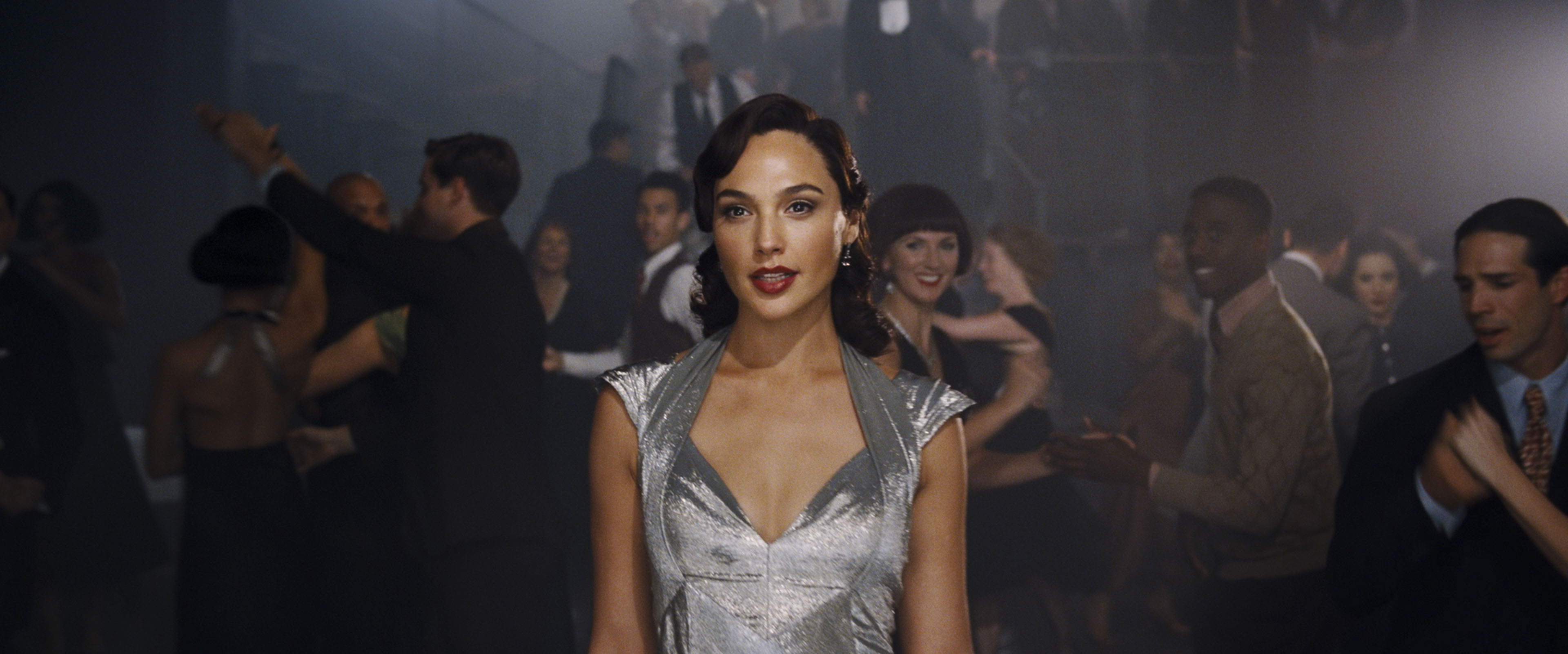
A big-name cast does succeed in creating a bit of intrigue, especially around the love triangle at the plot’s center. It features Gal Gadot as the wealthy Linnet Ridgeway; Emma Mackey as her old friend, Jacqueline; and Armie Hammer as Jacqueline’s financially struggling fiancé, Simon, who soon becomes Linnet’s employee and, shortly after, her husband. This shocking turn of events leaves Jacqueline so distraught that she crashes the new couple’s Egyptian wedding celebration and makes vague threats about what she’s going to do with the ornate pistol she’s so eager to display.

Gal Gadot as Linnet

It’s in an attempt to ditch Jacqueline that the newlyweds invite their entire wedding party—including Poirot, who’s there for reasons yet to be revealed—onto a luxurious steamboat for a trip down the Nile. Naturally, the distinguished crowd includes a plethora of possible future suspects, including a doctor who carries a torch for Linnet (Russell Brand); a leftist godmother who disapproves of the newlyweds’ lavish lifestyle (Jennifer Saunders); and an accountant for Linnet’s company who may not have her best interests at heart (Ali Fazal).

Among the others are an artist and her ne’er-do-well son (Annette Bening and Tom Bateman); an American blues singer (Sophie Okonedo) who’s there to entertain the crowd; and Rosalie (Letitia Wright), the singer’s niece and an old schoolmate of the hostess.

Once the murder occurs (finally!), Poirot leaps into action by questioning each member of the party in turn, suggesting possible motives and providing evidence to support his suspicions. This should be the most interesting part of any murder mystery, but it falls flat here because the motives sometimes seem thin and the detective often appears to pull the evidence out of his hat (or, perhaps, out of that huge mustache). More than once, viewers are left to wonder, “How did he know that?”

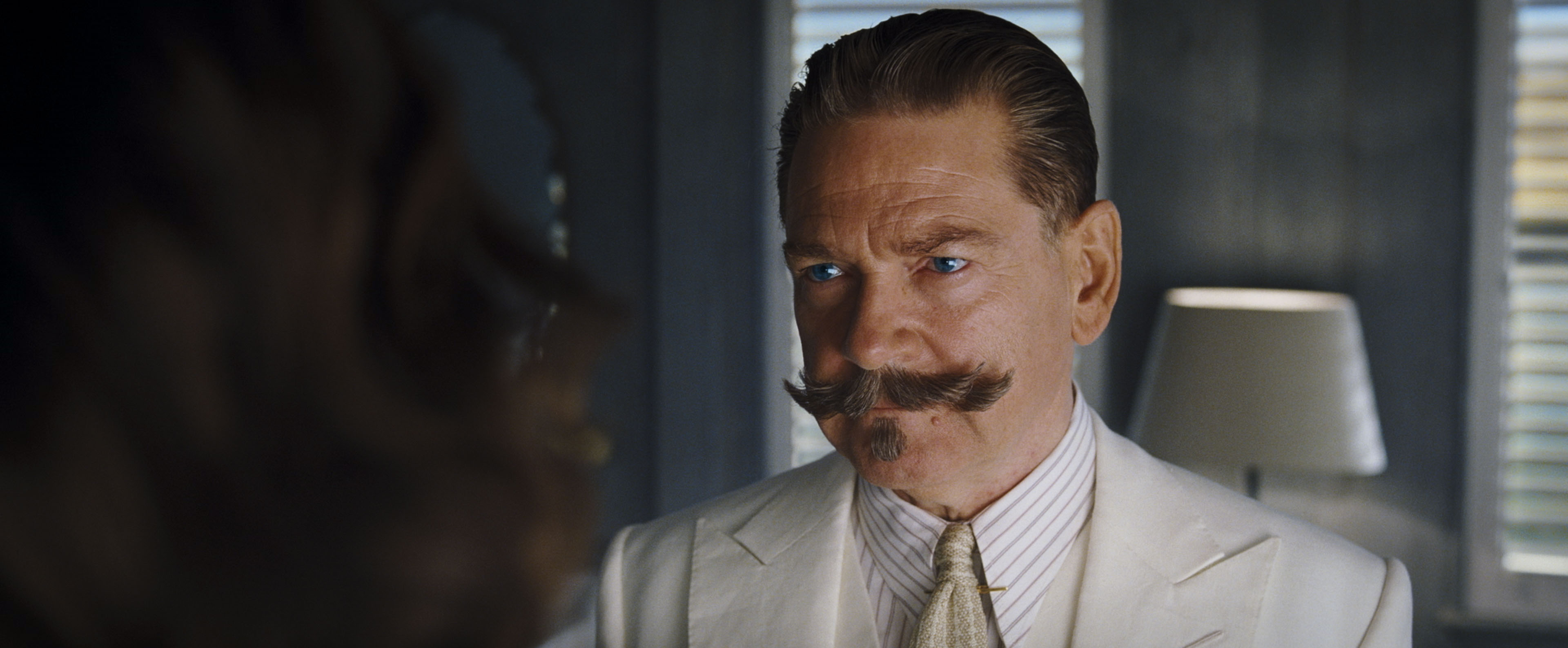
Kenneth Branagh as Hercule Poirot

But the main reason the investigation lags is that, beyond the central love triangle, we seldom get to know anyone well enough to form a clear opinion of them. This is partly because director Branagh and screenwriter Michael Green are so focused on Poirot that they fail to give most other characters a chance to distinguish themselves.

Another problem is that Branagh’s directorial style often becomes a distraction. Between composer Patrick Doyle’s bombastic score and cinematographer Haris Zambarloukos’s travelogue-style images of CGI-enhanced Egyptian landmarks, it’s all a bit much. Even in the more-intimate investigation scenes, the relentlessly circling camera quickly becomes obtrusive.

Branagh has shown he can direct a film discreetly and appropriately with 2021’s Belfast, which has deservedly garnered Oscar nominations for Best Picture and Best Director, among others. Maybe it’s time for him to admit he’s more effective on one side of the camera or the other, but not both.

Rating: 2½ stars (out of 5)

Death on the Nile (PG-13) opens Feb. 11 in theaters nationwide.

Cruz as historical investigator-turned-expectant mom

Ana (Milena Smit, left) and Janis (Penelope Cruz) meet in a maternity ward in Parallel Mothers.

By Richard Ades

I became a fan of Penelope Cruz after catching her 1992 film debut in Bigas Luna’s Jamón Jamón. On the other hand, I’ve never developed the same level of affection for the director who’s become her frequent collaborator, Pedro Almodóvar. Maybe I just haven’t seen enough of his work.

At any rate, I don’t share some critics’ swooning reaction to the latest Cruz/Almodóvar release, Parallel Mothers. Yes, it’s colorful, quirky, inventive and female-centered, as the Spanish auteur’s flicks often are. But it also has elements that don’t quite fit together, to the extent that it seems like two separate films.  

First, there’s the story of 40-ish photographer Janis (Cruz) and her quest to excavate the suspected graves of her great-grandfather and other townspeople who were executed by the fascists during the Spanish Civil War. This puts her in touch with Arturo (Israel Elejalde), a forensic anthropologist connected to a group that’s willing to pay for the work.

But then Janis becomes pregnant following a tryst with the handsome Arturo, and the historical investigation is set aside to make room for what transpires next. This mostly involves Ana (Milena Smit), an equally pregnant teenager whom Janis meets at the hospital. The two women end up giving birth at about the same time, after which their babies are simultaneously separated from them for observation.

You can probably guess what happens next, as it’s a plot device that’s been used in both comedy and melodrama. Here, it leads to problems between Janis and Arturo, who says her baby doesn’t look like him and can’t possibly be his. But the real complications develop between Janis and Ana, whose lives become entwined even though only one of them is aware that the hospital may have made a mistake.

Thanks to the always-watchable Cruz and a confident performance by Smit as the fast-maturing Ana, it’s a pleasure to watch writer-director Almodóvar send the pair through his typically convoluted twists and turns. Still, there’s not as much dramatic pay-off as one might hope. And besides, whatever happened to that planned excavation and its implied critique of Spain’s fascist past?

As it happens, the historical/political theme reappears at the end, where it comes off as a mere bookend to the main body of the film. The upshot is that it has less power than it might have had.

Almodóvar can do better, as he’s proved in flicks such as Volver, a 2006 comedy-drama that stars Cruz as a woman entrapped in Hitchcockian intrigue and family friction involving sisters, mothers and daughters. Like the new film, it’s lively and convoluted. But unlike the new film, it all comes together at the end.

If only Parallel Mothers did the same, it would seem like a unified work rather than a pleasant tale wrapped in a political dust jacket.   

Rating: 3 stars (out of 5)

Parallel Mothers (rated R) opens Jan. 28 in select theaters, including Central Ohio’s Drexel Theatre, Gateway Film Center, AMC Dine-In Easton Town Center 30 and Marcus Crosswords Cinema.

Death, infidelity and an old red Saab

Thespian Yusuke Kafuku (Hidetoshi Nishijima) reluctantly lets Misaki Watari (Toko Miura) take the wheel of his beloved Saab in Drive My Car.

By Richard Ades

Loss, anger and guilt are at the centers of two movies I caught recently: The Lost Daughter and Drive My Car. The former mainly gives Olivia Colman a chance to show off her acting chops, while the latter is pretty close to perfect.

Not to dismiss Maggie Gyllenhaal’s directing debut completely, but I just don’t share the high opinion most critics seem to have of The Lost Daughter. As strong a talent as Colman is, she can’t rise above a film that seems artificially suspenseful and gets bogged down in flashbacks that aren’t particularly interesting. Also, at two hours, it seems unnecessarily long.

On the other hand, Japan’s Drive My Car runs for three hours, and not one moment seems superfluous. Director Ryusuke Hamaguchi takes his time, to be sure, but every scene contributes to and builds toward the cathartic finale. And though its central character, like Daughter’s, is haunted by the past, the film isn’t burdened by excessive flashbacks.

That’s largely because Hamaguchi feeds us the necessary background information via an extended prologue that runs for some 40 minutes. (We know it’s a prologue because the “opening credits” don’t even appear until it’s over.) In it, we’re introduced to Yusuke Kafuku (Hidetoshi Nishijima), a theatrical actor and director, and his wife, Oto (Reika Kirishima), who writes for television. We learn that the couple share a supportive and oddly creative relationship: After sex, Oto relates imaginative stories that Yusuke parrots back to her the following day, inspiring her future scripts.

However, the two also share pain over the daughter they lost when she was only 4, leaving them childless. Another complication is the secret grief Yusuke feels after coming home unexpectedly one day and finding Oto making love with a young actor named Koji Takatsuki (Masaki Okada). Though Yusuke doesn’t confront his wife about his discovery, it seems to create tension between them that may be on the verge of coming to a head when Oto suddenly succumbs to an unexpected health crisis.

Yusuke Kafuku (Hidetoshi Nishijima) drops off his wife, Oto (Reika Kirishima), during the film’s extended prologue.

After setting the stage with this crucial background information, director/co-writer Hamaguchi finally plunges into the development that gives the story its name: Two years later, Yusuke climbs into his beloved red Saab and drives to a Hiroshima theater festival where he’s been hired to direct and possibly star in an ambitious, multilingual production of Chekhov’s Uncle Vanya.

Once there, Yusuke learns that festival rules require him to be driven to and from the rehearsal venue, a disappointment because he cherishes the solitude that driving provides, plus he uses the time to study his lines with the help of a cassette tape his wife recorded before her death. It’s only at the insistence of festival officials that he agrees to accept the services of Misaki Watari (Toko Miura), a stoic young woman who treats her driving responsibilities as a sacred duty.

Another shock arrives when a familiar but unwelcome face shows up at the auditions for Uncle Vanya: Koji, who has sought out the opportunity to work with the widower of the woman he loved and admired. The younger man’s connection to his late wife threatens to unleash the complicated feelings of anger, grief and guilt that Yusuke has struggled to contain since her demise.

Meanwhile, an even more profound relationship begins to develop between him and the dutiful driver Misaki, who has her own painful past and is, he learns, the same age his daughter would have been if she’d survived childhood. No wonder Yusuke finds it increasingly hard to deal with Chekhov’s Uncle Vanya and its pessimistic philosophizing about the disappointments of existence.

With its gentle, patient exploration of life’s challenges, buoyed by exquisitely restrained performances by stars Nishijima and Miura, Drive My Car can’t help reminding me of the film that first turned me on to Japanese cinema: Yasujiro Ozu’s Tokyo Story. That 1953 classic is considered a masterpiece, and Drive My Car may well be the same. At the very least, it should be a top contender in this year’s Academy Awards.

Rating: 4½ stars (out of 5)

Drive My Car, available only in theaters, opens Jan. 14 at Central Ohio’s Drexel Theatre and Gateway Film Center.

Columbus critics make their choices for 2021

The Columbus Film Critics Association (COFCA), consisting of critics from the Central Ohio area, recently released its picks for the best of 2021. The list is below:

Best Film

  1. The Power of the Dog
  2. Licorice Pizza
  3. West Side Story
  4. Belfast
  5. Summer of Soul (…Or, When the Revolution Could Not Be Televised)
  6. Pig
  7. C’mon C’mon
  8. The Tragedy of Macbeth
  9. tick, tick…BOOM!
  10. Dune

Best Director

  • Jane Campion, The Power of the Dog
  • Runner-up: Steven Spielberg, West Side Story
Benedict Cumberbatch in The Power of the Dog

Best Actor

  • Benedict Cumberbatch, The Power of the Dog
  • Runner-up: Nicolas Cage, Pig

Best Actress

  • Alana Haim, Licorice Pizza
  • Runner-up: Olivia Colman, The Lost Daughter

Best Supporting Actor

  • Kodi Smit-McPhee, The Power of the Dog
  • Runner-up: Troy Kotsur, CODA

Best Supporting Actress

  • Ruth Negga, Passing
  • Runner-up: Kirsten Dunst, The Power of the Dog

Best Ensemble

  • The Power of the Dog
  • Runner-up: The Harder They Fall

Actor of the Year (for an exemplary body of work)

  • Benedict Cumberbatch (The Electrical Life of Louis WainThe MauritanianThe Power of the Dog, and Spider-Man: No Way Home)
  • Runner-up: Andrew Garfield (The Eyes of Tammy FayeSpider-Man: No Way Home, and tick,
    tick…BOOM!)

Breakthrough Film Artist

  • Alana Haim, Licorice Pizza – (for acting)
  • Runner-up: Jude Hill, Belfast – (for acting)

Best Cinematography

  • Bruno Delbonnel, The Tragedy of Macbeth
  • Runner-up: Ari Wegner, The Power of the Dog

Best Film Editing

  • Sarah Broshar and Michael Kahn, West Side Story
  • Runner-up: Peter Sciberras, The Power of the Dog

Best Adapted Screenplay

  • Jane Campion, The Power of the Dog
  • Runner-up: Tony Kushner, West Side Story

Best Original Screenplay

  • Paul Thomas Anderson, Licorice Pizza
  • Runner-up: Kenneth Branagh, Belfast

Best Score

  • Jonny Greenwood, The Power of the Dog
  • Runner-up: Jonny Greenwood, Spencer

Best Documentary

  • Summer of Soul (…Or, When the Revolution Could Not Be Televised)
  • Runner-up: Flee

Best Foreign Language Film

  • Drive My Car (Doraibu mai kâ)
  • Runner-up: Flee

Best Animated Film

  • The Mitchells vs. the Machines
  • Runner-up: Flee

Best Overlooked Film

  • Riders of Justice (Retfærdighedens ryttere)
  • Runner-up: Nine Days

Texas tale asks whether there’s life after porn

Mikey (Simon Rex, right) has big plans for Strawberry (Suzanna Son) in Red Rocket. (A24 photo)

By Richard Ades

When Mikey Saber (Simon Rex) saunters into his Texas hometown at the beginning of Red Rocket, he passes a billboard advertising Donald Trump’s “Make America Great Again” campaign. This sets the time period as 2016, and it may also provide a clue that we’re about to see the tale of a master manipulator.

Here’s another clue about what’s ahead: Red Rocket is the latest film of Sean Baker (The Florida Project, Tangerine), which means it’s likely about folks scraping by in a hardscrabble and precisely detailed pocket of modern-day America.

Both clues are accurate, but they only partially prepare viewers for what’s ahead: a sex- and nudity-filled journey that will sometimes make them chuckle and other times leave them squirming in dread or discomfort.

At its center is Mikey, an ex-porn star who, when we first meet him, has $22 in his pocket and a face that shows signs of a recent beating. Upon returning to his oilfield-lined hometown for the first time in years, Mikey goes straight to the house of his estranged wife, Lexi (Bree Elrod), and mother-in-law, Lil (Brenda Deiss).

Far from being glad to see him, however, they greet Mikey with a mixture of hostility and suspicion that clearly is based on past experience. They agree to let him stay only after he agrees to contribute to the rent.

This, of course, means Mikey has to find a job, but that’s not so easy when your “resume” consists of X-rated videos. He eventually gives up on landing legit employment and wheedles a chance to sell weed for a friend of Lil named Leondria (Judy Hill). In no time, he’s raking in the big bucks.

Then, just as he seems to be getting his life in order and even reconciling with Lexi, he catches sight of a redheaded teenager named Strawberry (Suzanna Son) behind the counter of the local doughnut shop. He immediately sets out to win her over, but just what he wants to win her over to may send shivers down the average viewer’s spine.

The script, by director Baker and Chris Bergoch, never quite goes where you expect or, perhaps, want it to go, and the unsettled ending may leave some unsatisfied. The film also goes on a little longer than necessary. Still, its many quirky characters and indelible moments more than make up for such annoyances.

Rex skillfully anchors the tale as the glib and ruthless Mikey, and every member of the cast is equally effective, including Elrod as the tough yet vulnerable Lexi and Son as Strawberry, who’s not quite as innocent as she first seems. Other strong impressions are made by Ethan Darbone as Lonnie, a gullible neighbor who becomes Mikey’s biggest fan; and Brittney Rodriguez as June, Leondria’s sarcastic daughter.

Of the flick’s many indelible moments, one that particularly sticks out comes when Strawberry gives Mikey an impromptu rendition of NSYNC’s “Bye Bye Bye,” which is nicely performed by Son. Anyone else would have recognized this as a clear A Star Is Born moment, but Mikey is so limited in his outlook and experience that it fails to alter the questionable future he has in store for the teen.  

The moment is illuminating, disturbing and heartbreaking. Add “darkly funny,” and you have a pretty good description of the film as a whole.  

Rating: 4 stars (out of 5)

Red Rocket (rated R) can be seen at theaters nationwide, including (as of Dec. 24) Columbus’s Gateway Film Center.

Maria soars, Moreno returns, Spielberg triumphs

Anita (Ariana DeBose), Bernardo (David Alvarez) and a host of others take to the street in a colorful dance number from West Side Story.

By Richard Ades

After a preview screening, critics usually clear the room as soon as the end credits start to roll. But after a recent screening of Steven Spielberg’s West Side Story, several critics (including this one) remained in their seats. Either they were too mesmerized to move or they couldn’t resist the opportunity to hear a few more minutes’ worth of those iconic tunes.

First presented as a stage musical in 1957, West Side Story transposes Shakespeare’s Romeo and Juliet to a New York neighborhood divided between two rival gangs: the Puerto Rican Sharks and the non-Latino Jets. Trouble brews and inevitably leads to tragedy when a former Jet named Tony falls in love with Maria, sister of the head Shark, Bernardo.

With a book by Arthur Laurents, a glorious score by Leonard Bernstein and lyrics by Stephen Sondheim, the musical caught fire and inspired a classic, multiple-Oscar-winning 1961 movie directed by Robert Wise and Jerome Robbins.

Full disclosure: As a fan of the stage play and particularly of the original flick, I approached this new Spielberg remake with a mixture of excitement and trepidation. Would it deviate from the Wise-Robbins version, thus marring perfection? Or, conversely, would it offer a slavish clone, thus raising the question “Why did they bother?”

Maria (Rachel Zegler) catches her first sight of Tony across the dance floor.

The welcome answer is that the new movie, with a script by the great Tony Kushner (Angels in America), stays true to the spirit of the original. When it deviates, it does so in ways that are tasteful and often necessary to bring the story up to date with modern mores even though the action remains in the 1950s.

On the surface, the most obvious change is that Maria and the rest of the Puerto Rican characters are now played by Latino/Latina actors rather than Gringos in tan makeup. In a more subtle innovation, it’s announced from the beginning that the neighborhood shared by both gangs is marked for demolition to make way for ritzier dwellings. The underlying message is that the Sharks and Jets are fighting each other in a battle that ultimately will be decided by forces beyond their control. (Its relevance to modern-day America is hard to miss.)

Still, at its core, this remains the story of the dangerous romance between Maria and Tony. And it’s still told by way of the most beautiful music ever written for a stage musical, and punctuated by deliriously spirited dance steps (adapted by Justin Peck from Robbins’s original choreography).

My only serious disappointment with the new film is that one of the leading actors seems miscast. Ansel Elgort was fine the title character in 2017’s Baby Driver, but he often makes an inexpressive Tony, and he sings with a voice that’s good but not great. In compensation, Rachel Zegler’s Maria has a vulnerable face and the voice of an angel, hitting those high notes with ease. It’s largely thanks to her that their duets, such as “Tonight” and “One Hand, One Heart,” are among the film’s many highlights.

Tony (Ansel Elgort) and Maria (Rachel Zegler) share their first dance.

The supporting cast is uniformly strong, starting with Ariana DeBose as Bernardo’s mind-of-her-own girlfriend, Anita. Though DeBose doesn’t create quite as many waves as Rita Moreno did in her Oscar-winning 1961 performance, she’s a powerful presence and dances up a hurricane in colorful numbers such as “America.” In other key roles, David Alvarez is mercurial but dignified as Shark leader Bernardo, while Mike Faist projects pride mixed with desperation as Jets leader Riff.

Best of all, Moreno herself (who turns 90 on Dec. 11) plays Valentina, a Puerto Rican shopkeeper who has helped Tony get his life back together after a brief stint in prison. In a surprising twist, she’s given the honor of singing “Somewhere,” the wistful lament sung by Tony and Maria in 1961. It turns out to be one of the new film’s most touching moments.  

Though I originally worried about what Spielberg might change, one of my minor quibbles has to do with something he didn’t change: The Jets’ comic number “Gee, Officer Krupke” now seems dated, a blast from the past that’s turned into a dud amid the new film’s heightened sense of reality.

But that and other qualms fade away as the story heads into its final half-hour and the gears begin to turn toward its inescapable outcome. The feelings run as high as ever, and Bernstein’s music is as tender and majestic as always.

Thankfully, West Side Story endures.

Rating: 4½ stars (out of 5)

West Side Story (PG-13) opens Dec. 10 at theaters nationwide.

Saga of Lucy and Desi is a Baba-loser

Desi Arnaz and Lucille Ball (Javier Bardem and Nicole Kidman) in a rare happy moment from Being the Ricardos (Amazon Studios photo)

By Richard Ades

Being the Ricardos, Aaron Sorkin’s behind-the-scenes look at the 1950s sitcom I Love Lucy, provides the answers to several burning questions.

Question No. 1: Can Aaron Sorkin do comedy? Answer: No. Sorkin has excelled at high-minded dramas such as 2020’s The Trial of the Chicago 7 and TV’s The West Wing. But as the writer and director of this film about a comedy classic, he takes a relentlessly dour approach that leaves room for only a handful of chuckles. Fans of I Love Lucy will be disappointed.

Question No. 2: Can Nicole Kidman do comedy? Answer: Yes—but she gets little opportunity here. As I Love Lucy star Lucille Ball, Kidman is both unconvincing and, worst of all, unfunny except during the brief moments when she’s allowed to act out iconic scenes from the sitcom.

Question No. 3: Did they have electric lighting in the 1950s? Answer: Yes, though you’d never know it from Being the Ricardos. Cinematographer Jeff Cronenweth lights nearly every scene so dimly that you’d think it was illuminated by oil lamps and took place during a total eclipse.

For the one or two people who aren’t familiar with the iconic sitcom, I Love Lucy was about a redheaded screwball named Lucy Ricardo and her bandleader husband, Ricky, who were played by Lucille Ball and her real-life husband, Desi Arnaz. The Ricardos lived in a New York apartment building run by their friends Fred and Ethel Mertz, played by William Frawley and Vivian Vance. Premiering in 1951, the comedy quickly became a smash hit and ran for six seasons.

Set during a single week of the show’s second season, Sorkin’s movie deals with the unexpected and potentially career-ending rumor that Ball once belonged to the Communist Party. Also during the week, Ball struggles with her suspicions that husband Arnaz (Javier Bardem) is being unfaithful. In addition, she and Arnaz must inform their sponsors that she’s pregnant, after which they hope to convince them to allow her TV character to also be pregnant despite fears that viewers will be shocked and repulsed.

There also are a few side issues that come up: Co-star Vance (Nina Arianda) chafes over the unglamorous image she’s forced to maintain as frumpy neighbor Ethel Mertz; fellow co-star Frawley (J.K. Simmons) tells Ball she’s not giving Arnaz enough on-set respect; comedy writer Madelyn Pugh (Alia Shawkat) complains about jokes that “infantilize” Lucy rather than treating her as a mature woman; and Ball engages in seemingly endless skirmishes with her director and writers over what’s funny and what’s not.

Also, in a flashback to the series’ creation, Ball fights with network bigwigs over her determination to cast her Cuban-born husband as her TV spouse despite their fears that viewers aren’t ready to accept an ethnically mixed marriage.

Whew! That’s a lot of issues. But the real problem is that Sorkin treats them all so seriously, emphasizing each melodramatic moment with overwrought music supplied by composer Daniel Pemberton. A lighter touch would have helped, as well as an occasional chance to remember what made I Love Lucy such a comedic treat. The players aren’t bad—Bardem and Simmons being especially on-target as Arnaz and Frawley, respectively—but their efforts are doomed by Sorkin’s somber approach.   

If you think back, we actually had fair warning that Being the Ricardos would be a bad idea. In 2006, NBC coincidentally premiered two series that were set behind the scenes of a sketch-comedy show much like Saturday Night Live: Tina Fey’s 30 Rock and Sorkin’s Studio 60 on the Sunset Strip. Fey’s show, a comedy, ended up running for seven seasons, while Sorkin’s show, an ambitious and serious-minded drama, quickly lost viewers and was canceled after one.

The moral: If you set out to write about comedy, if helps if you do it with a sense of humor.

Rating: 2 stars (out of 5)

Being the Ricardos (rated R) opens Dec. 10 in select theaters and Dec. 21 on Amazon Prime Video.

Venus, Serena and the man with the plan

Richard Williams (Will Smith) has a talk with daughter Venus (Saniyya Sidney) in King Richard. (Photos courtesy of Warner Bros. Entertainment Inc.)

By Richard Ades

How did Venus and Serena Williams become two of the greatest tennis players of all time? According to the sports biopic King Richard, it’s because their father mapped out a long-term plan to make it happen and then saw it through.

The flick, directed by Reinaldo Marcus Green from a script by Zach Baylin, portrays Richard Williams (Will Smith) as someone who’s not easy to have as a father, a spouse or a business partner. Sometimes, in fact, he’s downright maddening. But, judging from his daughters’ eventual successes, he does gets results.

The story unfolds in the 1990s, when Venus and Serena (Saniyya Sidney and Demi Singleton) are entering their teen years while sharing a modest home with their parents and three sisters in Compton, California. Besides pushing all of his daughters to excel in their schoolwork, Richard frequently loads them into his VW bus in the evening and drives them to a scruffy public court to practice their tennis skills.

The exhausting regimen is hard on everyone, including Richard, who’s sometimes harassed and even beaten up by local thugs. But he refuses to ease up, even when wife Brandy (Aunjanue Ellis) tells him it’s too much. “We just got to stick to the plan,” he says.

The most difficult part of that plan is to find a professional coach who’s willing to work with Venus and Serena, the two most promising players, and to do it for free. Richard finally finds such a coach, whom he argues with and ends up firing, then finds an even more prestigious coach with whom he also locks horns. As the years go by, it becomes hard to tell if Richard is still aiding his daughters’ quest for success or standing in their way.

I’ve read one online commentator who makes the feminist complaint that King Richard focuses on a man rather than its rightful subjects, namely two of the world’s most prominent female athletes. That seems a little unfair since the story is set at the very beginning of Venus and Serena’s careers, before they’ve come into their own.

Brandy and Richard Williams (Aunjanue Ellis and Will Smith) are determined to turn their talented daughters into tennis superstars.

Perhaps a more valid criticism is that the script seldom acknowledges the important role played by their mother, Brandy, who knows a few things about tennis herself and sometimes has to bite her tongue when her husband makes unilateral decisions. The flick partially makes up for this in a late scene—one of the best—in which she finally lets go of years’ worth of frustration.

As one might expect, tennis matches are an intrinsic part of the sports film’s running time, including a climactic contest between one of the girls and an established competitor. These are well photographed and nicely handled by actors Sidney and Singleton and/or their on-court doubles.

Otherwise, the focus is on the members of the close-knit Williams family as Venus and Serena struggle to attain a goal never before reached by Black girls. A strong cast, beginning with Smith in the title role and including Jon Bernthal as enthusiastic coach Rick Macci, keeps things interesting.

At two hours and 26 minutes, the film does lag occasionally, and director Green (with help from composer Kris Bowers) does turn the emotional screws once or twice too often. Mostly, though, this is a fascinating origin story of tennis’s sibling superheroes.

Rating: 3½ stars (out of 5)

King Richard (PG-13) opens Nov. 19 at select theaters and online via HBO Max.